15 Fascinating Facts About Tasmanian Devils
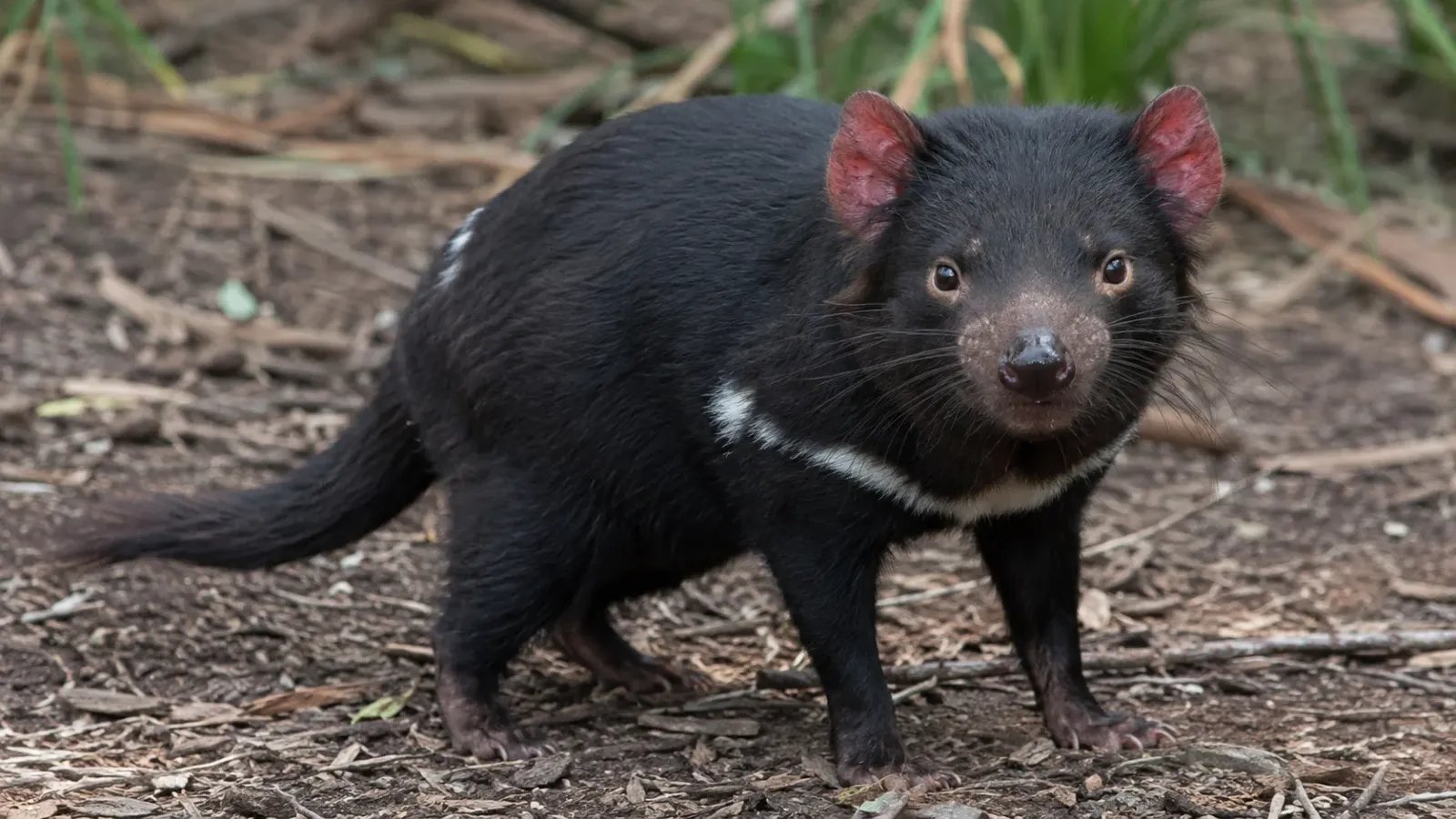
Forget the cartoon whirlwind of chaos; the real Tasmanian devil is far more complex. Though they are famously fierce scavengers, these misunderstood marsupials don't spin in tornadoes. Instead, they are shy, nocturnal survivors fighting a tragic transmissible cancer. Prepare to uncover the bizarre biology and surprising truths behind the world's largest carnivorous marsupial.
1. Tasmanian devils store fat in their tails to survive times of famine.
Much like certain geckos and other marsupials, the Tasmanian devil uses its tail as an anatomical pantry. A plump, thick tail is a prime indicator of a healthy, well-fed devil, while a thin or bony tail signals sickness or starvation. Because their food sources can be highly unpredictable, this fatty reserve is crucial for surviving harsh Tasmanian winters when carrion is scarce.
2. Their jaw strength is so immense that they can crush and consume the bones, fur, and skulls of their prey.
Pound for pound, the Tasmanian devil possesses one of the most powerful bites of any mammalian carnivore on Earth. Their muscular jaws can open to an astonishing 80 degrees, generating enough force to snap thick bones with ease. This evolutionary adaptation allows them to be highly efficient scavengers, leaving absolutely no part of a carcass behind and preventing the spread of blowflies and disease in their ecosystem.
3. Tasmanian devils suffer from one of the only known contagious cancers in the world.
Devil Facial Tumour Disease is a bizarre and tragic transmissible cancer that has decimated the wild devil population since its discovery in 1996. Unlike typical cancers, these living tumor cells are passed directly from one devil to another during the biting and scratching that accompanies mating and communal feeding. The disease is nearly 100 percent fatal, wiping out massive swathes of the population and pushing the species to the brink of extinction.
4. Mother devils give birth to up to forty young at once, but she only has four teats to feed them.
The reproductive cycle of the Tasmanian devil is a brutal evolutionary lottery. After a gestation period of just 21 days, the mother gives birth to a massive litter of underdeveloped joeys, each roughly the size of a grain of rice. These tiny newborns must undertake a frantic race from the birth canal to her rear-facing pouch. Only the first four to successfully latch onto a teat will survive; the rest simply perish and are frequently eaten by the mother to recoup lost energy.
5. Despite their ferocious reputation, they are actually timid creatures that prefer to scavenge rather than hunt.
The screaming, aggressive behavior that gave devils their name is mostly a dramatic bluff. When they encounter predators or even humans, their first instinct is to freeze or flee, not attack. The terrifying screeches and teeth-baring displays usually happen only when they are establishing dominance around a carcass or fighting for a mate. They are opportunistic feeders that rely heavily on animals that are already dead rather than taking down live prey.
6. Their ears turn a vibrant, glowing red when they are stressed or excited.
A devil's ears are nearly hairless and packed with blood vessels. When the animal becomes agitated, aggressive, or overly excited, often during a skirmish over a meal, blood rushes to these extremities to help regulate their body temperature. Against their dark fur, this sudden rush of blood makes their ears look like glowing red warning signs, giving them a demonic appearance that terrified early European settlers.
7. They sneeze at each other to avoid physical fights.
While their feeding frenzies sound like violent brawls, devils actually use a complex system of vocalizations and posturing to minimize real physical damage. One of their most unusual de-escalation tactics is a sharp, exaggerated sneeze. This sound is used as a bluffing mechanism, essentially signaling to other devils that they are willing to fight if pushed, but would prefer to establish dominance without actually trading blows.
8. Tasmanian devils were once widespread across mainland Australia but were driven out thousands of years ago.
Today, devils are found in the wild exclusively on the island state of Tasmania. However, fossil evidence proves they once roamed freely across the entire Australian continent. It is widely believed that the introduction of the dingo roughly three thousand years ago, combined with a shifting climate and human expansion, outcompeted the devils on the mainland. Tasmania's isolation protected its native devils because dingoes were never successfully introduced to the island.
9. Newborn devils lack the ability to regulate their own body temperature.
When a joey successfully makes it into the mother's pouch, it is incredibly vulnerable and completely reliant on her for warmth. Like many marsupials, the baby devil is functionally ectothermic at birth. The mother's pouch acts as a tightly controlled incubator, maintaining a precise microclimate. It is only after several months of growth and the development of their own fur coat that the joeys can generate and regulate their own body heat.
10. They secrete a pungent odor similar to a skunk when they feel threatened.
While not quite as famous or far-reaching as the spray of a North American skunk, a frightened Tasmanian devil can emit an incredibly foul-smelling musk. This stress-induced odor is produced by a specialized scent gland located at the base of their tail. In normal circumstances, a relaxed devil has a relatively mild, earthy scent, but a startled one will quickly clear the air to deter potential predators.
11. A healthy Tasmanian devil can consume up to forty percent of its own body weight in a single sitting.
Because their lifestyle involves long periods of fasting followed by sudden, unpredictable windfalls of carrion, devils are gorge feeders. When they locate a carcass, they eat ravenously and rapidly, essentially turning themselves into organic vacuum cleaners. After an exceptionally large meal, they can become so heavy and lethargic that they waddle sluggishly, needing to sleep off the immense food coma before they can resume normal activities.
12. Their distinctive black and white coat serves as nocturnal camouflage, disrupting their silhouette in the moonlight.
Almost all Tasmanian devils have primarily black fur with a white stripe or patch across their chest, and sometimes white spots on their sides. Rather than being a random genetic quirk, these white markings act as disruptive coloration. When moving through the dense Tasmanian bush at night, the moonlight reflects off the white patches in a way that breaks up the animal's physical outline, making it much harder for predators like eagles or owls to accurately gauge their shape.
13. Scientists are developing a revolutionary vaccine to protect the species from their contagious facial tumors.
To combat Devil Facial Tumour Disease, researchers and conservationists have established an intensive, multi-layered defense strategy. Beyond isolating healthy populations on remote islands, scientists have been working on a specialized vaccine to trigger the devil's immune system to recognize and attack the cancer cells. Recent field trials have shown significant promise, sparking hope that humanity can engineer a biological shield to save the species from being wiped out.
14. They sleep inside the abandoned burrows of wombats or in hollowed-out logs to avoid the daytime heat.
Despite their robust build, devils are susceptible to heat stress and avoid direct sunlight whenever possible. Because they are not particularly adept diggers themselves, they frequently appropriate the large, well-insulated burrows excavated by wombats. They line these stolen dens with bark, grass, and leaves, creating a dark, cool sanctuary where they can safely sleep through the day before emerging to scavenge under the cover of night.
15. The species is officially classified as the largest surviving carnivorous marsupial on Earth.
Prior to 1936, that title belonged to the thylacine, also known as the Tasmanian tiger. When the last known thylacine died in captivity, the Tasmanian devil inherited the mantle by default. Though they only weigh up to twenty-six pounds and stand about a foot tall at the shoulder, they are currently the undisputed heavyweights of the carnivorous marsupial world, acting as the vital apex scavengers in the Tasmanian ecosystem.
Sources & References
This AI-assisted post was rigorously curated and fact-checked for accuracy by:
 Martin Roháček
How fun was this article? 🤔
Tap a star to rate it
🧠 Quiz: How closely were you paying attention?
10 questions — all answers are in the article above!
Enjoyed these facts? There's more! 💌
Fresh fun facts in your inbox. No spam, ever.