The Evolutionary Speedster: 15 Fascinating Facts About Pronghorns
Often mistakenly referred to as the American antelope, the pronghorn is not actually related to true antelopes at all, but rather stands alone as the sole surviving member of an entirely distinct family tree whose closest living relatives are giraffes and okapis. This widespread misconception masks the true evolutionary marvel of a creature built for a ghost ecosystem, famously adapted to outrun a North American cheetah that went extinct over ten thousand years ago. Far beyond a simple prairie grazer, this evolutionary relic boasts bizarre anatomy, extreme physiological adaptations, and sensory superpowers that allow it to dominate the harsh landscapes of the American West. From bones that act like shock absorbers to hair that functions as high-tech insulation, prepare to discover the hidden truths and forgotten biology of a uniquely American survivor.
1. The Giraffe Connection
Despite being universally dubbed the American antelope, the pronghorn has zero taxonomic relationship to the true antelopes of Africa and Asia, which belong to the Bovidae family. Instead, it is the sole surviving species of the family Antilocapridae, a unique evolutionary offshoot that diverged millions of years ago. Genetic and morphological studies have revealed that their closest living relatives are actually giraffes and okapis. This surprising lineage explains some of their bizarre anatomical quirks and highlights how convergent evolution can mold entirely different genetic stocks into similar shapes when presented with similar open-grassland environments.
2. Racing a Ghost
The pronghorn is famously the second-fastest land animal on Earth, capable of sustaining speeds of nearly sixty miles per hour, which is vastly overkill for outrunning modern predators like wolves or coyotes. This extreme velocity is an evolutionary hangover from the Pleistocene epoch, shaped by a predator-prey arms race with the now-extinct American cheetah. When this formidable feline died out roughly ten thousand years ago, the pronghorn was left without a rival, maintaining its hyper-speed adaptations in a landscape devoid of its original evolutionary nemesis. Today, their incredible sprinting ability stands as a biological monument to a ghost ecosystem that vanished at the end of the last Ice Age.
3. An Engine Built for Oxygen
To achieve their legendary sustained speeds, pronghorns do not rely on sheer muscle power alone, but rather on an extensively modified cardiovascular system that operates like a high-performance engine. They possess a trachea that is remarkably wide, feeding lungs that are disproportionately massive compared to an animal of their modest body size. Furthermore, a pronghorn heart is roughly three times larger than that of a domestic sheep of similar weight, pumping a tremendous volume of highly oxygenated blood through their system. This physiological setup results in a maximal oxygen consumption rate that dwarfs that of elite human athletes, allowing them to run for miles at highway speeds without slipping into anaerobic debt.
4. The Anomaly of the Horns
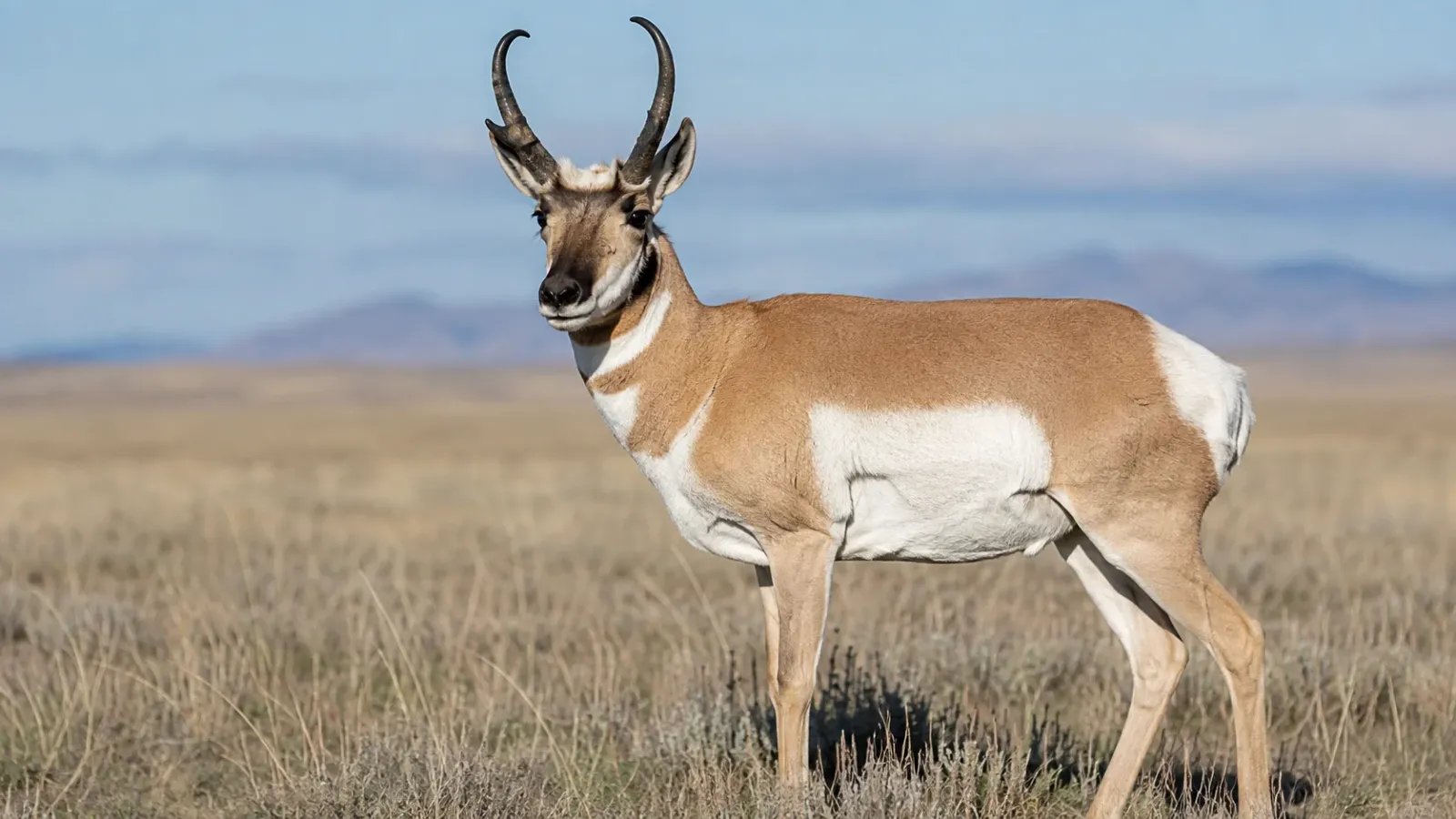
Pronghorns challenge the fundamental biological definitions of horns and antlers by exhibiting bizarre characteristics of both structural types. True horns, like those of cattle, grow continuously and are never shed, while antlers, like those of deer, are solid bone and shed annually. The pronghorn possesses a bony core permanently attached to its skull, but it grows a keratinous sheath that is distinctly branched with a forward-pointing tine. In a physiological feat totally unique in the animal kingdom, the pronghorn sheds and regrows this outer keratin sheath every single year following the autumn rut.
5. High-Tech Hollow Hair
Surviving the brutal temperature extremes of the American prairie requires specialized insulation, and the pronghorn achieves this through a coat composed of entirely hollow hairs. Each individual strand of hair contains large, air-filled cells that create a highly efficient thermal barrier, trapping body heat during sub-zero winter blizzards and shielding them from the scorching summer sun. Furthermore, muscles attached to the hair follicles allow the animal to voluntarily adjust the angle of its coat, either lying the hairs flat to trap heat or raising them to allow cooling breezes to reach the skin. As a bonus, this trapped air renders the pronghorn incredibly buoyant, making them excellent swimmers when they need to ford swollen rivers during migrations.
6. Built for Speed, Not for Springs
Despite their phenomenal athletic prowess on horizontal plains, pronghorns are remarkably poor jumpers, a vulnerability directly tied to their evolutionary history. Evolving on endless, unbroken expanses of prairie, they never developed the specialized leg structure required to vault over tall obstacles like fallen trees or boulders. Consequently, when confronted with modern barriers like agricultural fencing, their instinct is to crawl under rather than jump over, often scraping their backs on barbed wire in the process. This inability to leap has made human-made fences one of the greatest threats to their survival, fatally disrupting their ancient migration routes.
7. Shock-Absorbing Physiology
Running at sixty miles per hour on uneven, rocky terrain sends massive concussive forces up an animal leg, but the pronghorn has evolved brilliant biomechanical workarounds to prevent shattered bones. Their front feet, which bear the brunt of their galloping weight, feature exceptionally thick, cartilaginous pads that act like high-grade shock absorbers. Additionally, unlike deer and cattle, pronghorns have entirely lost their dewclaws, the small, vestigial toes found higher up on the leg, streamlining their lower limbs for maximum aerodynamic efficiency and reducing unnecessary weight. This extreme specialization of the foot and lower leg minimizes ground contact time, translating kinetic energy directly into forward momentum rather than jarring bone stress.
8. Binocular Vision Superpowers
A pronghorn eye is exceptionally large, comparable in size to that of an elephant, and is positioned far out on the side of their skull. This anatomical placement grants them a staggering 320-degree field of vision, meaning they can effectively see predators approaching from behind without ever turning their heads. Their visual acuity is so refined that scientists estimate it rivals a human looking through eight-power binoculars, allowing them to spot movement miles away across the shimmering heat of the plains. This early-warning system is deeply integrated with their flight response, ensuring they have a massive head start long before a predator can close the distance.
9. A Masterpiece of Chemical Warfare Defenses
While many herbivores would quickly succumb to the toxic chemical defenses of desert plants, the pronghorn boasts a specialized digestive system that treats poison as a staple diet. Their complex, multi-chambered stomachs are equipped with unique enzymes and resilient bacterial flora capable of breaking down highly toxic alkaloids found in plants like locoweed, rubber rabbitbrush, and sagebrush. This metabolic superpower allows them to thrive in arid, unforgiving environments where other grazing animals would starve or be poisoned. By turning lethal desert flora into a reliable fuel source, the pronghorn effectively eliminates competition for food in the harshest stretches of the American West.
10. The Visual Telegraph System
When a pronghorn spots danger on the horizon, it does not just run, it alerts every other pronghorn in the vicinity using a highly visible, silent telegraph system. The stark white hairs on their prominent rumps are connected to specialized muscles that contract when the animal is alarmed, causing the hairs to stand completely erect. This creates a brilliant, flashing white rosette that reflects the prairie sun and can be seen by other pronghorns up to three miles away. This cascading visual alarm system allows entire herds across a vast landscape to become instantly aware of a threat, triggering a coordinated flight response without a single sound being uttered.
11. An Arsenal of Scent Glands
While their vision is legendary, pronghorns also rely on an astonishingly complex chemical communication network, possessing nine distinct scent glands scattered across their bodies. Males use paired subauricular glands located below their ears to mark territory, rubbing a dark, pungent musk onto tall grasses and shrubs to warn rival bucks and attract females. They also possess median glands on their backs, glands between their hooves to leave scent trails, and twin glands on their rumps that release alarm pheromones to complement their visual warning flares. This rich olfactory vocabulary allows them to read the reproductive status, distress levels, and territorial claims of their peers across the sprawling plains.
12. The Brutal Reality of Womb Warfare
The reproductive cycle of the pronghorn contains a hidden, microscopic brutality known as embryonic reduction, a fascinating evolutionary mechanism for ensuring only the strongest offspring survive. A female pronghorn eggs are fertilized, and she initially develops a surprising number of tiny embryos, sometimes as many as seven, within her uterus. As these embryos grow, they develop long, thread-like necrotic membranes that tangle and essentially stab the competing embryos, cutting off their nutrient supply. Ultimately, this silent uterine battle royale reduces the litter to one or two dominant survivors, which are then carried to term and born highly developed and ready to run.
13. The Longest Migration in the Lower 48
While the wildebeest migrations of the Serengeti are globally renowned, the pronghorn undertakes a spectacular and arduous journey known as the Path of the Pronghorn, which is the longest terrestrial migration in the contiguous United States. Each year, herds travel up to 150 miles from their summer ranges in the Grand Teton National Park down to their crucial wintering grounds in the Green River Basin of Wyoming. This ancient, narrow corridor has been used for over six thousand years, passing through treacherous mountain passes and bottlenecking into stretches barely a few hundred yards wide. Recognizing the biological importance of this journey, the U.S. government established the first federally designated National Migration Corridor to protect this specific route from human development.
14. Extreme Muscle Specialization
When examining the muscle physiology of a pronghorn, scientists discovered that they are essentially built opposite to a sprinting cat like a cheetah. A cheetah relies heavily on fast-twitch muscle fibers for explosive, anaerobic bursts of speed that quickly generate debilitating lactic acid, forcing them to stop and rest. Pronghorn muscles, however, are packed almost exclusively with slow-twitch, highly oxidative fibers that are incredibly dense with mitochondria, the energy-producing powerhouses of the cell. This specialized cellular makeup prevents fatigue and lactic acid buildup, allowing the pronghorn to function as a supreme endurance athlete that can out-sustain any terrestrial predator on earth.
15. The Last of a Dying Dynasty
Looking at the solitary pronghorn today, it is hard to imagine that they are the sole survivors of a once wildly diverse and dominant evolutionary dynasty. During the Pleistocene epoch, the Antilocapridae family boasted dozens of different species roaming North America, including bizarre variants equipped with four, six, or uniquely twisted and spiraled horns. When the dramatic climate shifts and human pressures of the Ice Age extinction event wiped out the mastodons, dire wolves, and saber-toothed cats, every single species of this diverse family perished except one. The modern pronghorn is a lonely relic, carrying the genetic legacy of a lost era of megafauna right into the modern age.
Sources & References
This AI-assisted post was rigorously curated and fact-checked for accuracy by:
 Martin Roháček
How fun was this article? 🤔
Tap a star to rate it
🧠 Quiz: How closely were you paying attention?
10 questions — all answers are in the article above!
Enjoyed these facts? There's more! 💌
Fresh fun facts in your inbox. No spam, ever.