The Forest Giraffe: 15 Fascinating Facts About Okapis
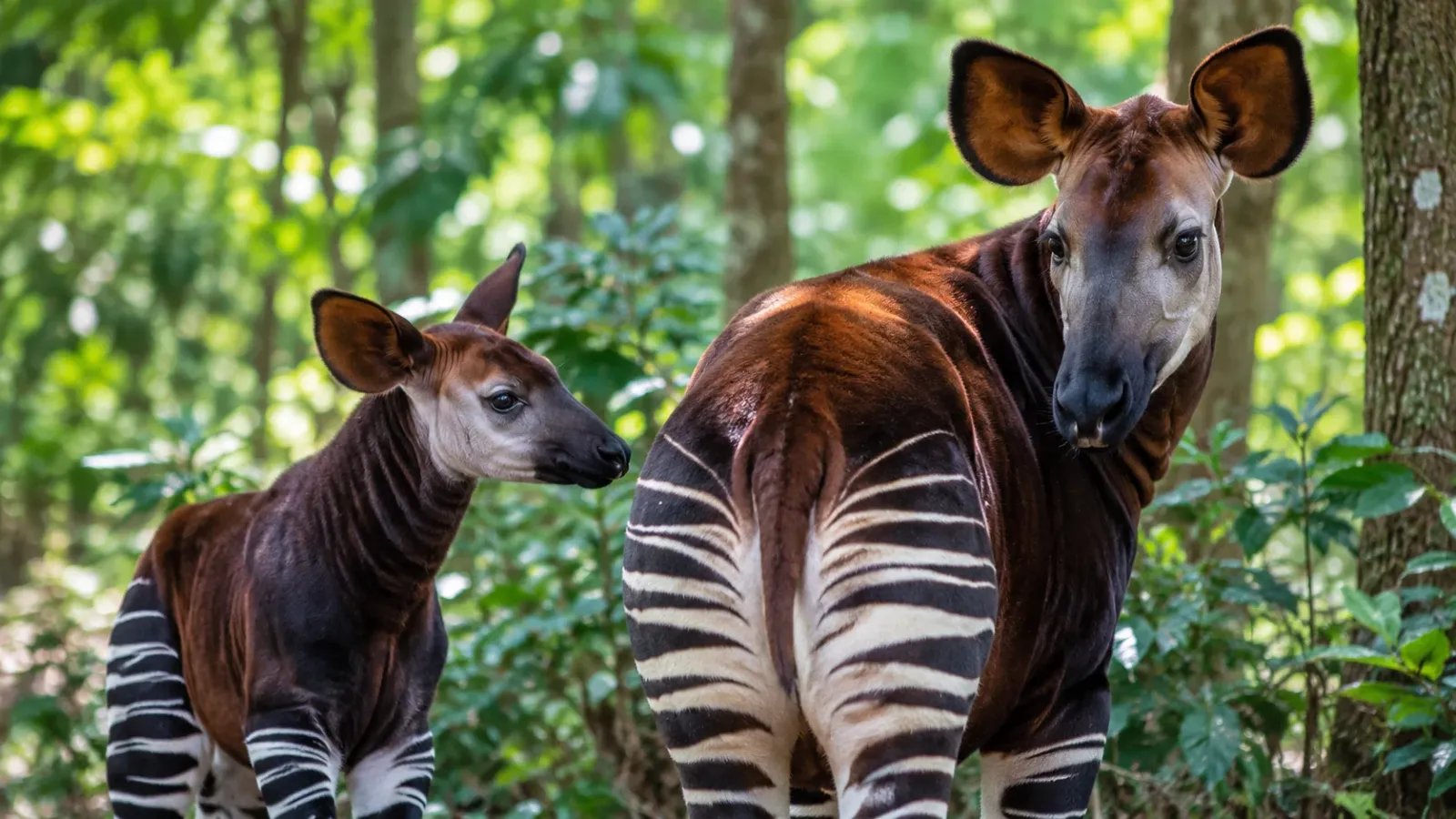
With zebra stripes on its legs and the body of a horse, the okapi looks like an animal put together from spare parts. In fact, it is the giraffe's only living relative, and it stayed hidden from Western science until 1901. Here are the surprising facts about the shy "African unicorn" of the Congo rainforest.
1. The okapi is the giraffe's only living relative.
Despite its striped legs, the okapi is not related to zebras. It belongs to the giraffe family, and the okapi and the giraffe are the only two surviving members of that family. Okapis have the same long, dark tongue, a similar skull and the same unusual way of walking as giraffes, but with a much shorter neck suited to life in a dense forest.
2. Western science only discovered it in 1901.
For years, European explorers heard rumours of a mysterious forest animal that some called the "African unicorn". The British colonial official Sir Harry Johnston gathered pieces of skin and a skull, and the okapi was formally described by scientists in 1901. Its scientific name, Okapia johnstoni, honours him. The local Mbuti people, however, had known the animal for centuries.
3. Its tongue is long enough to clean its ears.
An okapi's black tongue is about 46 centimetres (18 inches) long and highly flexible. It uses it to strip leaves and buds from branches, selecting exactly the plants it wants. The tongue is also long enough to reach its own eyes and ears, which the okapi licks clean as part of its grooming routine.
4. Its stripes help calves follow their mothers.
The okapi's body is a deep, velvety chocolate brown, but its rump and legs are marked with bold white stripes. In the dim light of the rainforest, these stripes break up the animal's outline and make it hard for predators to spot. Scientists believe they also help young okapis follow their mothers through the thick undergrowth.
5. Only males have horns.
Male okapis have two short, skin-covered horns called ossicones, similar to those of giraffes, which are usually less than 15 centimetres long. Females have only small whorls of hair where the horns would be. Males use their ossicones in sparring contests with rivals.
6. Okapi calves do not poop for weeks.
After birth, an okapi calf spends most of its time hidden in a nest in the undergrowth, and its mother visits only to nurse it. Remarkably, calves do not defecate for the first month or two of life. Scientists believe this helps them avoid attracting predators with the smell during the period when they are most vulnerable.
 African Wildlife
Venture beyond the safari stereotypes and discover the astonishing biological adaptations, fierce rivalries, and complex societies of Africa's most iconic wildlife. From venom-proof mustelids to deep-rumbling giants, explore the hidden lives of the continent's most remarkable survivors.
See All Facts
African Wildlife
Venture beyond the safari stereotypes and discover the astonishing biological adaptations, fierce rivalries, and complex societies of Africa's most iconic wildlife. From venom-proof mustelids to deep-rumbling giants, explore the hidden lives of the continent's most remarkable survivors.
See All Facts
7. Pregnancy lasts about 15 months.
Okapi pregnancies are among the longest of any hoofed animal, lasting around 440 to 450 days. The mother usually gives birth to a single calf weighing between 14 and 30 kilograms. Calves start eating solid food at about three months and are weaned at around six months.
8. They live in just one country.
In the wild, okapis are found only in the Democratic Republic of the Congo, mainly in the dense Ituri Forest in the north-east of the country. They live at altitudes of 500 to 1,500 metres and never venture into open savanna. The okapi is regarded as a national symbol of the country and is fully protected by Congolese law.
9. They are fussy eaters with a huge menu.
Okapis feed on more than 100 species of plants, including leaves, buds, ferns, fruits and fungi. Some of the plants they eat are poisonous to humans. They are the only known mammals in the Ituri Forest that feed almost entirely on understorey vegetation, the plants growing beneath the main canopy.
10. They walk like giraffes.
Okapis and giraffes share an unusual gait called pacing. Instead of moving their legs in diagonal pairs like most hoofed animals, they move the front and back legs on the same side of the body together. The result is a smooth, rolling walk that is easy to recognise once you know what to look for.
11. They are true loners.
Okapis are solitary animals that come together mainly to breed. Each one uses scent glands on its feet and urine to mark its home range. Their large ears give them excellent hearing, which is vital in a forest where it is almost impossible to see more than a few metres ahead.
12. Their coat is like a natural raincoat.
The okapi's short, dense fur has an oily texture that helps water run off it. This keeps the animal relatively dry in its humid rainforest home, where heavy rain falls for much of the year. The velvety coat has also made okapis a target for poachers.
13. Poachers once killed every okapi at a breeding centre.
In June 2012, an armed gang attacked the headquarters of the Okapi Wildlife Reserve in Epulu. They killed several guards and staff members and all 14 okapis kept at the breeding centre. The attack was carried out in retaliation for efforts to stop illegal mining and poaching in the reserve.
14. The okapi is endangered.
The IUCN lists the okapi as Endangered. Its population has declined because of logging, human settlement, illegal mining and hunting for meat and skins. Armed conflict in the region has made it extremely difficult to protect the animals or even count how many remain.
15. A UNESCO site protects their forest home.
The Okapi Wildlife Reserve covers around 14,000 square kilometres of the Ituri Forest and was declared a UNESCO World Heritage Site in 1996. It is home to a large share of the world's wild okapis, along with forest elephants, chimpanzees and many other rare species. The Okapi Conservation Project has worked there since 1987 to protect the animals and support local communities.
Sources & References
This AI-assisted post was rigorously curated and fact-checked for accuracy by:
 Martin Roháček
How fun was this article? 🤔
Tap a star to rate it
🧠 Quiz: How closely were you paying attention?
10 questions — all answers are in the article above!
Enjoyed these facts? There's more! 💌
Fresh fun facts in your inbox. No spam, ever.