The Absentee Crusader: 15 Fascinating Facts About Richard the Lionheart
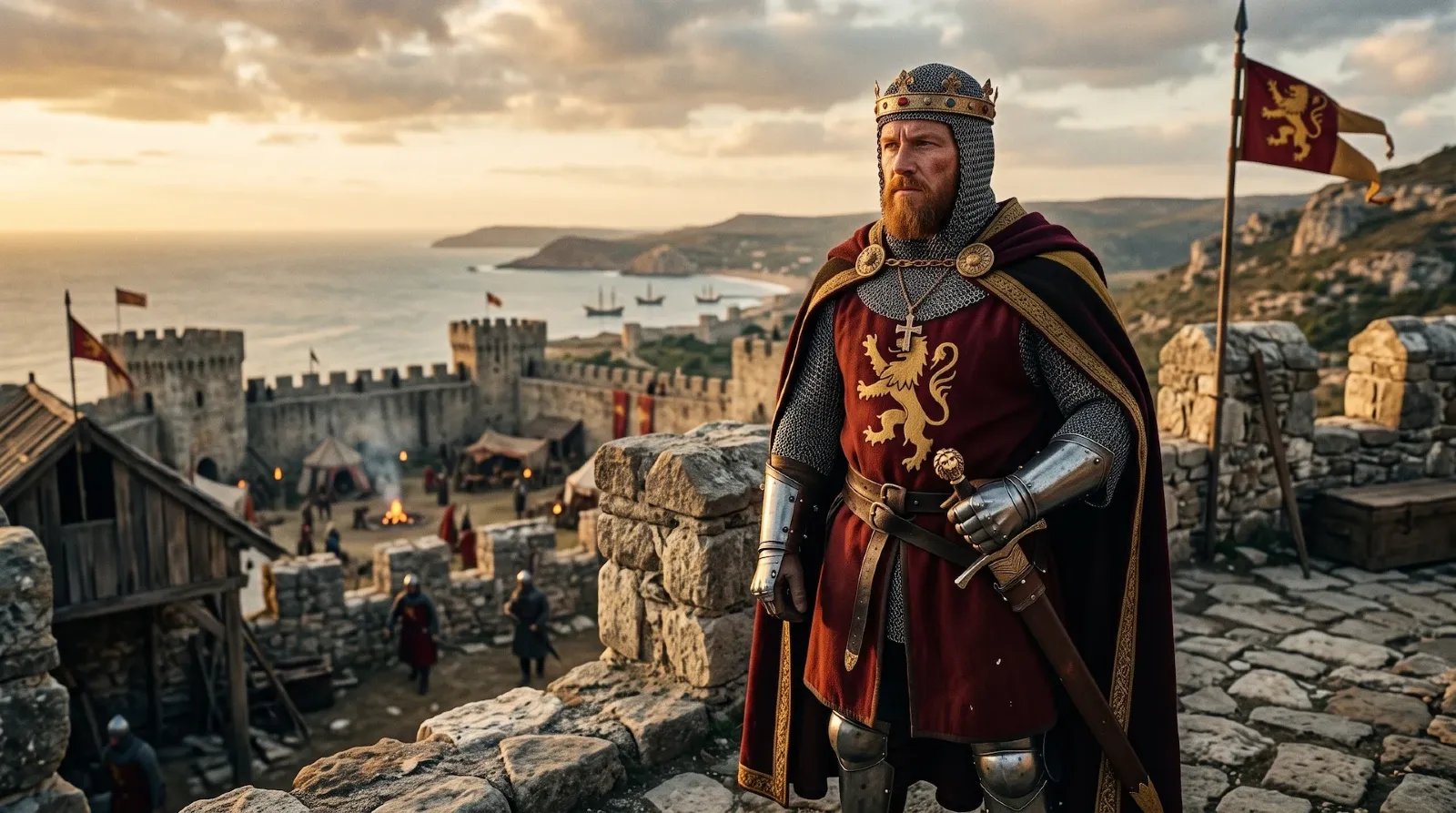
Richard the Lionheart is remembered as England's ultimate chivalric hero, but the reality is far more complex. He spent perhaps as little as six months of his reign in England, spoke French and Occitan, and used his kingdom to fund his wars. Discover the truths behind the legend of a king who fought almost everywhere but at home.
1. Richard the Lionheart spent perhaps as little as six months of his ten-year reign in England.
Although he is remembered as a great English king, Richard was born in Oxford but lived most of his adult life in the Duchy of Aquitaine in southwestern France. After becoming king in 1189, he spent very little time in England: perhaps as little as six months. Most of his reign was spent on crusade, in captivity, or defending the French lands of the Angevin Empire. England was mostly a source of money and troops for these ventures, and he reportedly said he would sell London if he could find a buyer.
2. He probably spoke French and Occitan, though he likely understood some English.
Richard's mother, Eleanor of Aquitaine, came from the French south, and the Angevin court spoke French. Richard probably spoke French and Occitan, the language of the south. Based on a remark by the chronicler Roger of Howden, he most likely also understood Middle English. The image of Richard as an English-speaking national hero is a creation of later centuries.
3. He rebelled against his own father, Henry II.
The Plantagenet family was notorious for its quarrels. In 1173, encouraged by his mother, Richard joined his brothers and the French king in a revolt against Henry II. The rebellion failed, but Richard was forgiven. Later, after the death of his elder brother, Henry the Young King, Henry II demanded that Richard hand over Aquitaine to his younger brother John, and in 1189 Richard allied with the French king Philip II against his father. Henry II died that summer, shortly after being forced to accept Richard as his heir.
4. He earned the name "Lionheart" before he became king.
The nickname did not come from the Holy Land. As Duke of Aquitaine, Richard crushed revolts by his rebellious barons, and in 1179 he took the strongly fortified castle of Taillebourg and then besieged Castillon-sur-Agen. According to Wikipedia, on this campaign he acquired the name "the Lion" for his noble, brave and fierce leadership. The Welsh churchman Gerald of Wales called him "this our lion" as early as 1187, and the form "Lionheart" is first recorded in the poet Ambroise's account of the Third Crusade.
5. Richard was captured on his way home from the crusade and held for ransom.
After a truce with Saladin in 1192, Richard left the Holy Land. His ship was driven to Corfu, and he tried to cross central Europe in disguise as a Knight Templar after a shipwreck near Aquileia. He was recognized and captured near Vienna by Duke Leopold V of Austria, whom he had offended during the siege of Acre, and was handed over to the Holy Roman Emperor, Henry VI. The emperor demanded a ransom of 150,000 marks, many times the annual income of the English crown. The sum was raised by heavy taxes, and Richard was released in 1194.
6. The tale of the minstrel Blondel finding him by singing is a legend.
A story that appeared in the middle of the thirteenth century says that Richard's minstrel Blondel traveled from castle to castle singing a song only the two of them knew, until the captive king answered from a tower. In reality, the English government knew where Richard was held, because the emperor was negotiating the ransom. The story appears decades after Richard's death and is considered folklore. It later inspired operas and films.
 Rulers, Kings and Emperors
Discover the captivating truths behind history's most iconic rulers, kings, and emperors. From eccentric geniuses and tactical masterminds to deeply flawed sovereigns, explore the hidden lives of those who shaped the modern world.
See All Facts
Rulers, Kings and Emperors
Discover the captivating truths behind history's most iconic rulers, kings, and emperors. From eccentric geniuses and tactical masterminds to deeply flawed sovereigns, explore the hidden lives of those who shaped the modern world.
See All Facts
7. He ordered the execution of around 2,700 Muslim prisoners at Acre.
After the crusaders captured Acre in July 1191, Richard and Saladin negotiated over the surrender terms, which included ransom for the garrison and the return of the True Cross. When Saladin delayed payment, Richard, according to both Christian and Muslim chroniclers, had the Muslim prisoners, numbering around 2,700, led out in front of Saladin's army and killed. Many modern historians see it as a cold political and military calculation, while his contemporaries often did not criticize it. It remains one of the best-known acts of brutality of the Third Crusade.
8. Richard never recaptured Jerusalem.
The main aim of the Third Crusade was to retake Jerusalem, but the crusaders turned back twice. In the winter of 1191 to 1192, bad weather and fears that the army might be trapped by a relief force led to a retreat to the coast. In June 1192 they came within sight of the city but retreated again because of disagreements among the leaders. Richard instead negotiated the Treaty of Jaffa with Saladin, which left Jerusalem in Muslim hands but granted Christian pilgrims access and set a three-year truce.
9. He died of an infected crossbow wound at a minor castle.
In 1199 Richard was in the Limousin, suppressing a revolt by the Viscount of Limoges, and besieged the tiny castle of Châlus-Chabrol. Some chroniclers claimed the reason was a treasure of Roman gold found by a peasant. On 26 March he was hit in the shoulder by a crossbow bolt, and the wound turned gangrenous. He died on 6 April 1199, aged 41, in the arms of his mother. For a man with such a fearsome military reputation, it was a modest end.
10. He reportedly forgave the boy who shot him.
According to the chroniclers, Richard asked to see the crossbowman before he died. The man was a boy, who said that Richard had killed his father and brothers. Richard is said to have forgiven him, saying "Live on, and by my bounty behold the light of day," and ordered him freed with 100 shillings. According to one chronicler, the mercenary captain Mercadier ignored this and had the boy flayed alive and hanged after the king's death.
11. His body was buried in three different places.
Dividing the body of a high-ranking person was a common medieval practice. Richard's heart was buried in Rouen Cathedral in Normandy, his entrails at Châlus, where he died, and the rest of his body at Fontevraud Abbey in Anjou, at the feet of his father, Henry II. Burying the heart at Rouen honored the loyalty of his Norman subjects.
12. Scientists analyzed his embalmed heart in 2012.
Richard's heart, found in a lead box in Rouen Cathedral in 1838, was analyzed by French scientists in 2012. They found that it had been embalmed with various substances, including plants such as mint, myrtle and daisy, and frankincense, a symbolically important substance because it was associated with both the birth and the embalming of Christ. It was a way of treating the heart as a holy relic as well as a physical remain.
13. The link between Richard and Robin Hood was added centuries later.
In the films, Robin Hood is a loyal supporter of King Richard fighting against the evil Prince John. In the earliest Robin Hood ballads, however, the outlaw is not connected to Richard. Around the sixteenth century, writers began to describe Robin as a contemporary of Richard, an outlaw during the misrule of Richard's brother John while Richard was away on crusade. Richard's own tax demands would hardly have made him popular with ordinary people.
14. He issued strict rules of discipline for his crusader fleet.
In 1190, as the crusaders prepared to sail to the Holy Land, Richard issued ordinances for the conduct of the pilgrims at sea, recorded by the chronicler Roger of Howden. They prescribed harsh punishments. A man who killed another on board was to be tied to the body of his victim and thrown into the sea, and one who drew a knife to strike another was to lose his hand. The rules were meant to keep order among thousands of armed men during the long voyage.
15. He is credited with introducing the three lions of England.
Richard's first Great Seal of 1189 showed one lion rampant or two lions facing each other, probably inherited from his father. His second seal, from 1198, showed a shield with three lions passant-guardant. It is the first appearance of this design, and it became established as the Royal Arms of England. The three lions are still found on the badge of the England football team and on British coins, more than eight hundred years later.
Sources & References
This AI-assisted post was rigorously curated and fact-checked for accuracy by:
 Martin Roháček
How fun was this article? 🤔
Tap a star to rate it
🧠 Quiz: How closely were you paying attention?
10 questions — all answers are in the article above!
Enjoyed these facts? There's more! 💌
Fresh fun facts in your inbox. No spam, ever.