
The Pacifist Conqueror: 15 Fascinating Facts About Ashoka
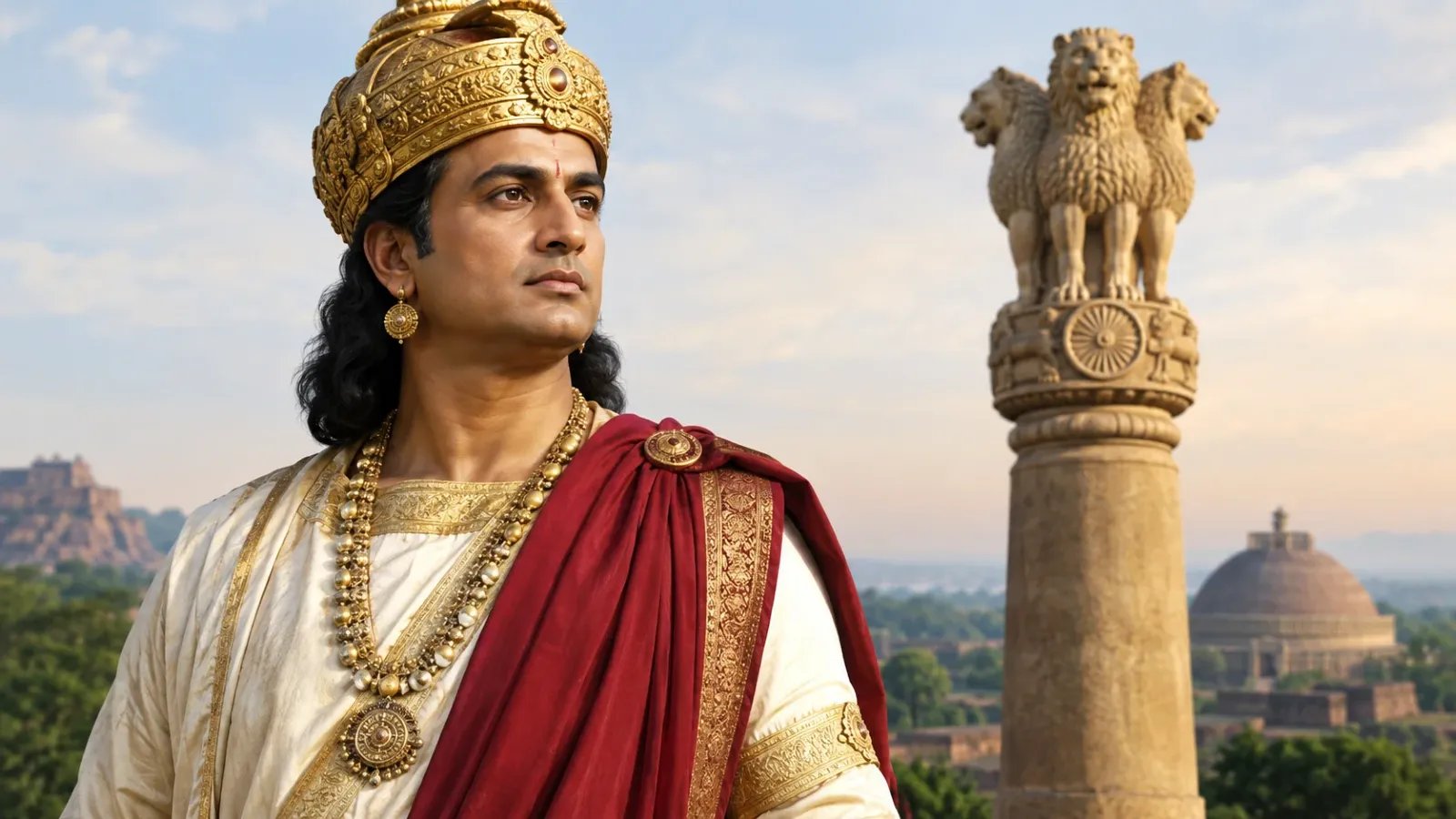
Ashoka is often remembered as a ruthless tyrant turned absolute pacifist, but reality is far more complex. Rather than disbanding his army after the Kalinga war, he kept his military strong to enforce his new moral code. Discover the pragmatic politics, architectural genius, and surprisingly modern administrative policies of India's most enigmatic ruler in these obscure historical truths.
1. Ashoka did not immediately convert to Buddhism following the bloody Kalinga War.
While popular legend claims the slaughter at Kalinga instantly transformed him into a devout Buddhist, historical timelines show he had actually associated with Buddhist monks for at least two years prior to the conflict. The war acted as a catalyst for his deeper commitment to the philosophy of Dhamma, but his conversion was a gradual philosophical evolution rather than an overnight epiphany triggered by battlefield guilt.
2. Despite his famous edicts on non-violence, Ashoka never abolished the death penalty.
Ashoka's embrace of ahimsa, or non-violence, did not extend to the complete dismantling of the Mauryan penal system. Historical edicts reveal that while he granted a three-day respite to prisoners condemned to death so they could fast, meditate, and prepare for the afterlife, the executions were still carried out to maintain law and order across his vast empire.
3. The Ashoka Chakra featured on the modern Indian flag was originally meant to represent the Buddhist concept of the wheel of cosmic law.
Found at the center of the Lion Capital of Ashoka, this twenty-four-spoke wheel is often mistaken for a standard chariot wheel or a simple solar symbol. In reality, it is a Dharmachakra representing the twelve links of dependent origination in forward and reverse order, symbolizing continuous cosmic movement, the passage of time, and the inevitable triumph of righteous law over chaos.
4. Ashoka established some of the earliest documented veterinary hospitals in human history.
Driven by his deep respect for all living creatures, the emperor decreed that medical treatment should be available to both humans and animals alike. His rock edicts mention the cultivation of medicinal herbs specifically for livestock and wildlife, and the construction of care centers along major trade routes where injured or sick animals could be treated by specialized healers.
5. Historical texts from the era describe Ashoka as having a severe skin condition and being physically unappealing.
Unlike the idealized, handsome depictions seen in modern media and statuary, Buddhist texts like the Ashokavadana describe the young prince as having skin that was rough and deeply unpleasant to the touch. This physical unattractiveness reportedly made him deeply unpopular with his father, Emperor Bindusara, who initially strongly favored Ashoka's half-brother Susima as the heir to the Mauryan throne.
6. Before his spiritual awakening, Ashoka reportedly designed a beautifully disguised torture chamber known as Ashoka's Hell.
According to Buddhist lore, Ashoka commissioned a prison that looked like a magnificent, inviting palace from the outside to lure people in. Once inside, however, victims were subjected to horrific tortures inspired by the five tortures of the Buddhist underworld. While historians debate the literal truth of this chamber, it highlights the extreme brutality of his early reign, earning him the widespread moniker Ashoka the Fierce.
7. The emperor created a specialized cadre of state officials whose sole job was to police the morality of his citizens.
Ashoka established the Dhamma Mahamatras, an entirely new class of high-ranking administrators tasked with spreading and enforcing his ethical code. These officials traveled throughout the empire to ensure that people were treating their elders with respect, practicing religious tolerance, and treating enslaved people and servants humanely, acting as ancient social workers and ethics regulators.
8. Ashoka's royal edicts were not just written in the local Brahmi script, but also in Greek and Aramaic to reach foreign subjects.
Recognizing the incredible cultural and linguistic diversity of the Mauryan Empire, which stretched into modern-day Afghanistan, Ashoka proved to be a highly pragmatic communicator. In the northwestern provinces, he had his messages of peace and morality carved into rock using Greek and Aramaic, demonstrating a sophisticated understanding of localized governance and multicultural assimilation.
9. Even though he was a devout Buddhist, Ashoka never forced Buddhism upon his subjects as a state religion.
Ashoka's concept of Dhamma was a universal ethical framework based on civic responsibility, not a rigid religious doctrine. His edicts explicitly promoted religious tolerance, urging profound respect for Brahmins, Jains, and Ajivikas alongside Buddhist monks. He believed that honoring another's religion ultimately honored one's own, making his empire a rare ancient haven of state-sponsored pluralism.
10. Under Ashoka's rule, his capital city of Pataliputra became arguably the largest and most populous city on Earth.
Situated in modern-day Patna, Pataliputra was a marvel of ancient urban planning that fascinated foreign ambassadors. Enclosed by massive wooden palisades with sixty-four gates and hundreds of watchtowers, the city housed sprawling palaces, extensive markets, and a sophisticated drainage system, rivaling or exceeding the size and grandeur of contemporary Hellenistic metropolises like Alexandria or Rome.
11. Ashoka initiated massive public works projects involving the strategic planting of banyan trees and digging of wells to stimulate economic trade.
While these roadside projects are often framed purely as acts of religious charity, they were actually brilliant economic infrastructure developments. By providing shade, mango groves, and reliable water sources at regular intervals along major trade routes, Ashoka made long-distance merchant travel vastly safer and more efficient, thereby drastically boosting the economic prosperity and tax revenues of his empire.
12. Ashoka's historical existence was completely forgotten for nearly two thousand years until British scholars deciphered his edicts in the nineteenth century.
By the Middle Ages, the ancient Brahmi script had become unreadable, and Ashoka was remembered only in mythological religious texts where he was referred to by honorifics like Beloved of the Gods. It was not until 1837, when antiquarian James Prinsep finally cracked the Brahmi script, that historians realized the legendary king of Buddhist lore and the author of the widespread stone edicts were the exact same person.
13. Ashoka utilized his own children as international ambassadors to introduce Buddhism to Sri Lanka.
Rather than sending military generals to expand his regional influence, Ashoka sent his son Mahendra and his daughter Sanghamitra on diplomatic and spiritual missions. They traveled to the court of King Devanampiya Tissa of Anuradhapura, successfully establishing a Buddhist lineage in Sri Lanka that has survived continuously to the present day, forever altering the cultural landscape of Southeast Asia.
14. The emperor radically altered the Mauryan economy by banning animal sacrifices and heavily restricting the consumption of meat in the royal kitchens.
Before his reign, hundreds of animals were slaughtered daily to feed the massive royal household and conduct traditional religious ceremonies. Ashoka's rock edicts proudly declare that he reduced this daily slaughter to just two peacocks and one deer, with the eventual goal of eliminating meat consumption entirely, a move that severely impacted the livelihoods of traditional Brahmin priests who relied on lucrative animal sacrifice rituals.
15. Rather than wiping out rebellious forest tribes on his borders, Ashoka issued chillingly pragmatic warnings mixed with pleas for peace.
Ashoka's famous pacifism had strict political limits when it came to state security. When dealing with unsubdued forest communities, his edicts stated that while he desired their peaceful assimilation and felt genuine remorse for past violence, he still possessed the military power to crush them if they did not repent. This approach proves he remained a shrewd, calculating monarch who utilized the threat of violence to maintain absolute border security.
Sources & References
This AI-assisted post was rigorously curated and fact-checked for accuracy by:
 Martin Roháček
How fun was this article? 🤔
Tap a star to rate it
🧠 Quiz: How closely were you paying attention?
10 questions — all answers are in the article above!
Enjoyed these facts? There's more! 💌
Fresh fun facts in your inbox. No spam, ever.