The Ultimate Show-Off: 15 Fascinating Facts About Peacocks
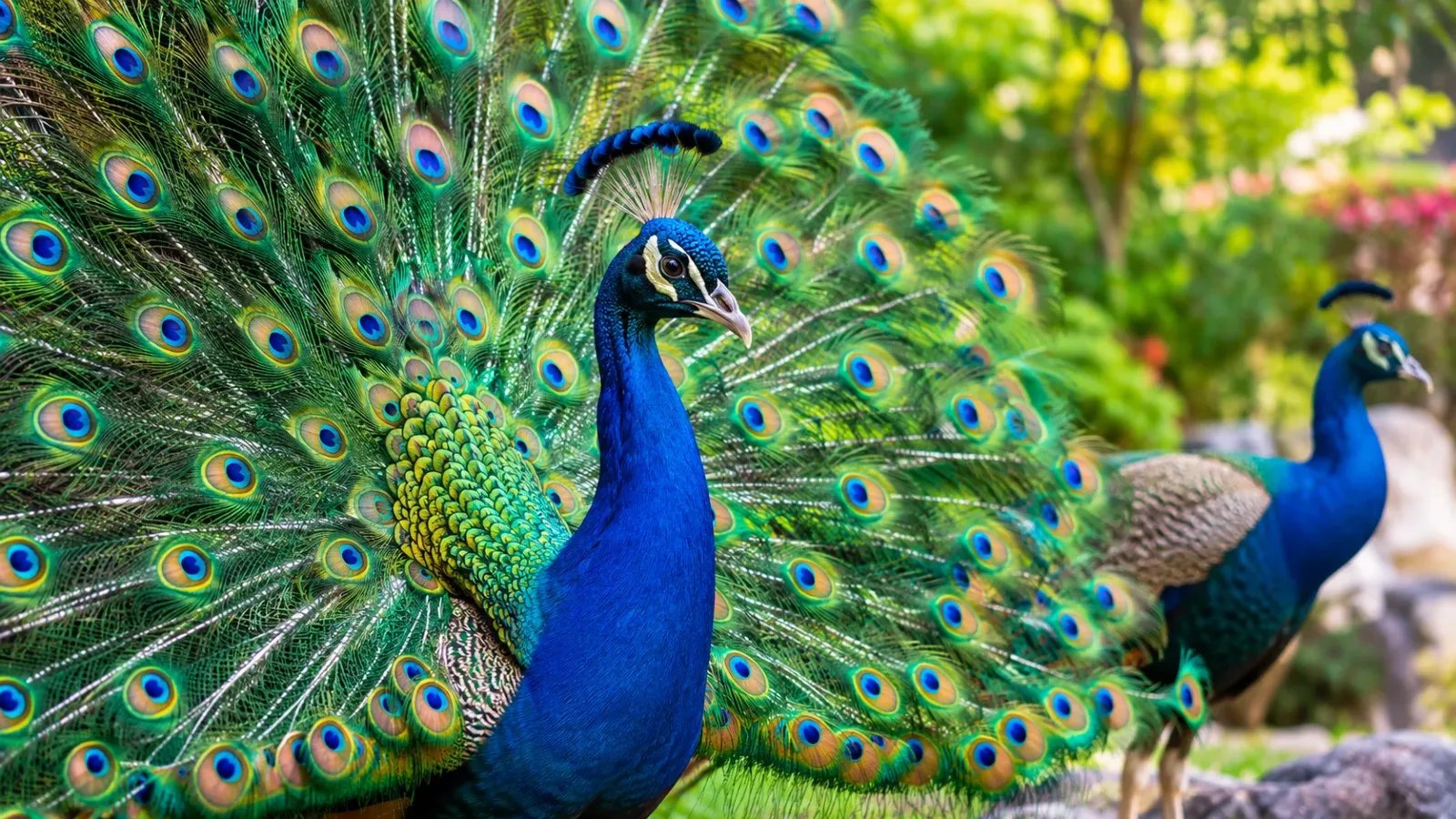
The peacock's shimmering train is one of the most famous sights in the animal kingdom, yet it is not actually a tail, and its colours are not made of pigment. These birds communicate with sounds humans cannot hear, eat snakes and once drove Charles Darwin to despair. Here are the surprising facts about peacocks.
1. Only the males are peacocks.
Strictly speaking, "peacock" refers only to the male bird. The female is a peahen, the chicks are peachicks, and the species as a whole is called peafowl. In everyday language, however, people usually call both males and females peacocks.
2. The famous train is not a tail.
The peacock's spectacular fan is made of greatly elongated feathers called upper tail coverts, which grow from the back and cover the real tail. The actual tail feathers are short and stiff, and they sit underneath the train, helping to hold it up when the bird displays. A male's train can be more than 1.5 metres long and contain around 200 feathers.
3. The colours are an optical illusion.
The shimmering blues, greens and bronzes of a peacock's feathers do not come from coloured pigment. They are structural colours, created by microscopic structures in the feathers that reflect and scatter light. That is why the colours seem to change as the bird moves and the light hits the feathers from different angles.
4. The train made Charles Darwin feel sick.
The peacock's train seemed to make no sense in Darwin's theory of natural selection, since it is heavy, conspicuous and makes the bird easier for predators to catch. In an 1860 letter, Darwin admitted that the sight of a feather in a peacock's tail made him feel sick. He later explained it through sexual selection: peahens choose the most impressive males, so extravagant trains are passed on.
5. Peacocks communicate with sounds we cannot hear.
When a male shakes his train during courtship, he produces infrasound, low-frequency sound below the range of human hearing. Studies have shown that peafowl can detect these sounds and react to them. Peacocks also make loud, piercing calls that can be heard over long distances, especially during the breeding season.
6. Their display is a shaking performance.
During courtship, a male raises his train into a fan and turns to face the female. He then makes the feathers shiver rapidly, producing a rattling sound and making the eyespots appear to shimmer. Researchers have found that the eyespots stay remarkably still while the rest of the train vibrates, which may help to keep the peahen's attention fixed on them.
 Birds of the World
From record-breaking aerial plunge-divers to massive flightless icons, the avian world is a marvel of evolutionary engineering. Discover the extraordinary intellects, specialized survival skills, and hidden superpowers of the planet's most fascinating birds.
See All Facts
7. Males shed their train every year.
A peacock's long train feathers are not permanent. After the breeding season, males moult and drop their long feathers, then grow a new train in time for the next season. This is why many of the peacock feathers sold as decorations can be collected without harming the birds.
8. Peahens sometimes grow male feathers.
In rare cases, older peahens have suddenly started growing male-style plumage and even making male calls. Research suggests that this happens when the female's ovaries become old or damaged and produce less oestrogen, the hormone that normally keeps her feathers dull and brown.
9. They eat snakes.
Peafowl are omnivores that eat seeds, insects, small reptiles and amphibians. Indian peafowl also catch and eat small snakes, including venomous ones. Their appetite for pests makes them welcome visitors in some farms and villages in India.
10. The peacock is India's national bird.
India adopted the Indian peafowl as its national bird in 1963, and the bird is protected by law. It plays a major role in Indian culture and religion. In Hindu tradition, the peacock is the mount of the war god Kartikeya, and the god Krishna is often depicted with a peacock feather in his crown.
11. The ancient Greeks thought their meat never rotted.
In Greek mythology, the peacock was the sacred bird of the goddess Hera, whose chariot was said to be pulled by peafowl. According to legend, the eyes on the peacock's train belonged to the hundred-eyed giant Argus. The Greeks also believed that peacock flesh did not decay after death, which made the bird a symbol of immortality.
12. There is an African peacock that was discovered thanks to a hat.
Besides the Indian and green peafowl of Asia, there is a third species, the Congo peafowl of central Africa. In 1913, the American zoologist James Chapin noticed an unusual feather in a headdress worn by a local man in the Congo. More than 20 years later, he matched it to museum specimens and formally described the species in 1936.
13. White peacocks are not albinos.
All-white peacocks are often mistaken for albinos, but most of them are leucistic. Leucism causes a partial loss of pigment, so the feathers are white, but the eyes stay their normal dark colour rather than turning pink or red. White peafowl have been bred in captivity for centuries and are popular in gardens and parks.
14. They sleep in trees.
Although peafowl spend the day walking and feeding on the ground, they fly up into tall trees to roost at night, safe from predators such as leopards and tigers. Despite their long trains, males are capable of short, powerful flights to reach their perches.
15. Their ancestors lived in China millions of years ago.
Fossil evidence suggests that the ancestors of peafowl lived in Asia millions of years ago. One early relative, known from fossils found in Gansu province in China, lived during the late Miocene in a high, savanna-like landscape, very different from the humid forests most peafowl prefer today.
Sources & References
This AI-assisted post was rigorously curated and fact-checked for accuracy by:
 Martin Roháček
How fun was this article? 🤔
Tap a star to rate it
🧠 Quiz: How closely were you paying attention?
10 questions — all answers are in the article above!
Enjoyed these facts? There's more! 💌
Fresh fun facts in your inbox. No spam, ever.