The Illegitimate King: 15 Fascinating Facts About William the Conqueror
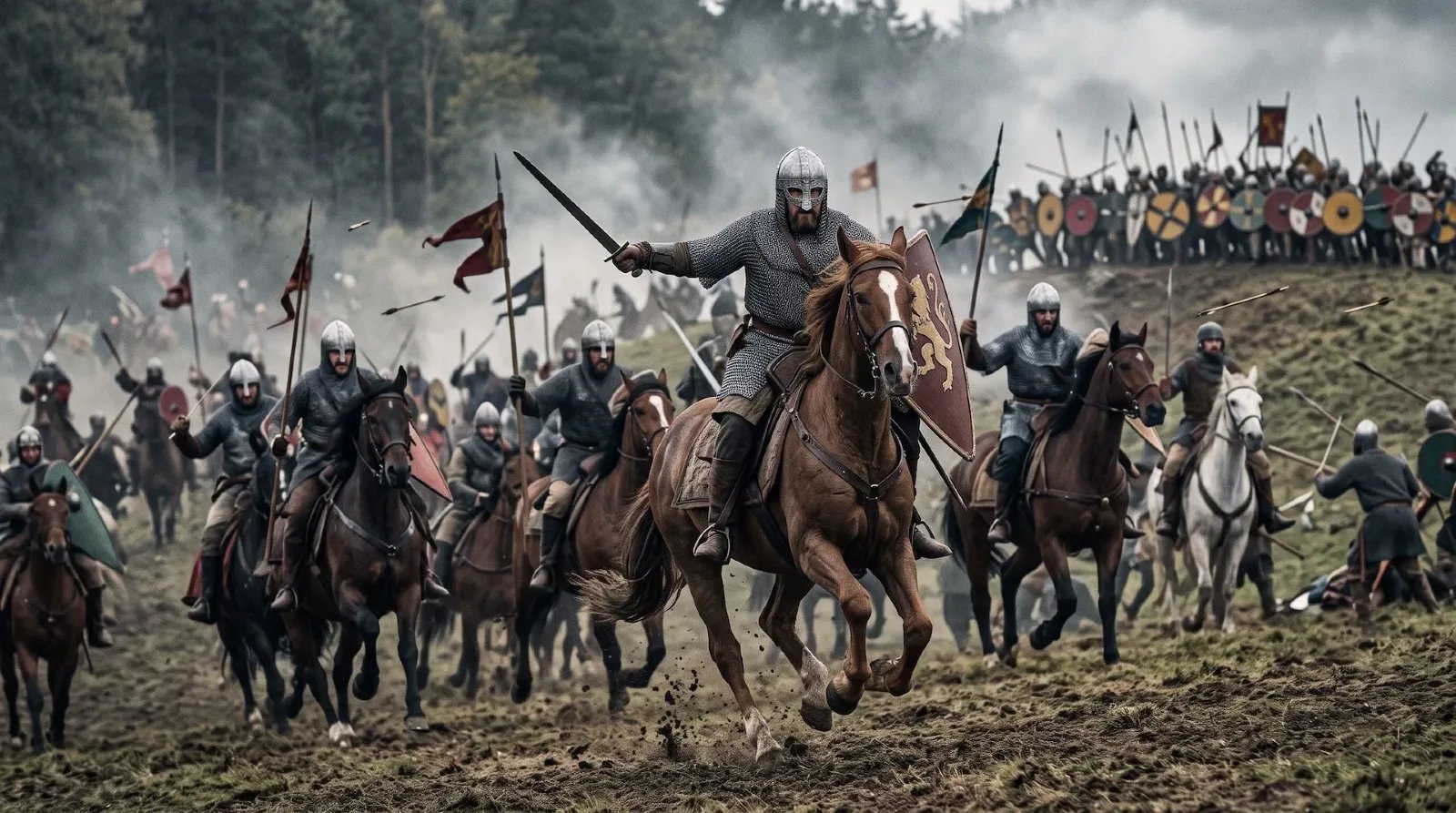
Forget the myth that William the Conqueror easily waltzed into England as a hated French tyrant. In reality, he was a complex Viking descendant who legally revolutionized Europe. Beyond the famed Battle of Hastings, his reign was defined by exploding corpses, bureaucratic obsession, and deep insecurities. Discover the bizarre truths behind the first Norman king of England.
1. William was a descendant of Vikings, even though he spoke French.
William's ancestor Rollo was a Viking leader who in 911 reached an agreement with the French king Charles the Simple, who gave him land around Rouen. This became the core of the Duchy of Normandy, the "land of the Northmen." William was Rollo's great-great-great-grandson. By William's time, however, the Normans had adopted the French language, the Christian religion, and many local customs, so he was in practice a French-speaking Frankish-Norse aristocrat who kept the martial skills of his ancestors.
2. His illegitimate birth followed him throughout his early life.
William was the son of Duke Robert I of Normandy and his mistress Herleva, who was not married to the duke. Her father, Fulbert, was possibly a tanner or an embalmer. When Robert died in 1035 on his way back from a pilgrimage to Jerusalem, the child inherited the duchy. His illegitimacy and youth made him a target, and the Norman nobles fought each other in years of anarchy. Several of his guardians were killed, and one is said to have been murdered in the very room where William slept. The experience shaped a ruler who learned to trust force and caution.
3. According to chroniclers, he punished the defenders of Alençon cruelly for mocking his birth.
Chroniclers such as William of Poitiers tell that during the siege of Alençon in about 1051, the defenders hung animal hides from the walls and beat them, a taunt about the leather-working trade of his maternal family. When the town fell, William is said to have ordered the hands and feet of thirty-odd defenders cut off. The story is told by contemporary writers sympathetic to William, so details may be exaggerated, but it illustrates the harsh warfare of the time and the sensitivity of the duke to remarks about his origins.
4. A famous but doubtful legend says he won his wife through violence.
William married Matilda of Flanders around 1050. A later legend, recorded long after the events, says that she first refused a marriage with a bastard, and that William rode to Bruges and pulled her from her horse by her braids, after which she agreed. Historians regard the story as doubtful. The marriage was probably a carefully negotiated political alliance, delayed by papal objections to the closeness of the couple's family ties. What does seem to be true is that the marriage was a close and affectionate one, and there is no sign that William was unfaithful.
5. He claimed papal backing for his invasion of England.
When Edward the Confessor died in January 1066, Harold Godwinson was crowned king, but William claimed that Edward had promised him the throne and that Harold had sworn an oath to support him. William of Poitiers wrote that Pope Alexander II approved the invasion and sent a papal banner. Historians still debate how strong the papal support really was, but William used religion to give his invasion legitimacy and to attract fighters from across northern France.
6. According to chroniclers, he stumbled when landing in England and turned it into a good omen.
William's fleet landed at Pevensey on 28 September 1066, only days after Harold had defeated the Norwegian king Harald Hardrada at Stamford Bridge. Later chroniclers report that William tripped as he stepped ashore, which his men took as an evil omen. William is said to have grasped the earth and declared he had seized England with both hands. Whether or not it happened exactly so, the story shows how important omens and morale were for an army about to fight a decisive battle.
 Rulers, Kings and Emperors
Discover the captivating truths behind history's most iconic rulers, kings, and emperors. From eccentric geniuses and tactical masterminds to deeply flawed sovereigns, explore the hidden lives of those who shaped the modern world.
See All Facts
Rulers, Kings and Emperors
Discover the captivating truths behind history's most iconic rulers, kings, and emperors. From eccentric geniuses and tactical masterminds to deeply flawed sovereigns, explore the hidden lives of those who shaped the modern world.
See All Facts
7. He ordered a huge survey of England that became the Domesday Book.
At Christmas 1085, facing the threat of a Danish invasion and needing money, William ordered a survey of the landholdings of the kingdom. The results were collected in the Domesday Book of 1086, which lists who held land in each county before and after the Conquest. The Anglo-Saxon Chronicle complained that the king's men were so thorough that not even a single ox, cow, or pig was left out. The name Domesday recalls the Day of Judgment, since there was no appeal against its verdict. The book is a unique source for eleventh-century England.
8. The Conquest is often credited with giving English separate words for animals and their meat.
After 1066, England was ruled by a French-speaking aristocracy, while most farmers continued to speak English. Many linguists see in this the origin of the pairs of words in modern English: the Germanic words cow, pig, and sheep for animals in the field, and French-derived beef, pork, and mutton for the meat on the lord's table. The explanation is popular, although scholars point out that the history of these words is more complicated. Thousands of French words entered English in the following centuries.
9. He had a wave of castles built to secure his conquest.
Large castles were almost unknown in England before 1066. Outnumbered by the English population, William and his barons built many earth-and-timber motte-and-bailey fortresses, often in the centers of towns, and sometimes after clearing houses to make room. Later the White Tower in London and other stone castles followed. These fortifications allowed small Norman garrisons to control the surrounding area and withstand rebellion.
10. His campaign in the north in 1069 to 1070 was devastating.
When the north of England rebelled in 1069, William marched north, and his army burned and destroyed villages and supplies in what is known as the Harrying of the North. The chronicler Orderic Vitalis, who wrote decades later, claimed that more than 100,000 people died of famine. Modern historians regard such numbers as exaggerated, but they agree that the campaign caused great suffering. Domesday Book, compiled some fifteen years later, still records many Yorkshire estates as "waste," that is, with greatly reduced value.
11. He tried to learn English late in life but gave up.
Orderic Vitalis records that William tried to learn to read Old English late in life, but did not have time to devote to it and soon gave up. As a result, the new king usually needed interpreters to communicate with his English subjects. Royal documents were written mostly in Latin, and French became the language of the aristocracy and courts. English remained the language of the majority and returned to official use only in the later Middle Ages.
12. His love of hunting led to harsh forest laws.
William was an enthusiastic hunter. He and his successors claimed large areas of the countryside as royal forest, where special Forest Law protected deer and their habitat. The Anglo-Saxon Chronicle complained that he loved the tall deer as if he were their father and that anyone who killed a hart or a hind would be blinded. The New Forest in Hampshire, though, was probably not depopulated as thoroughly as medieval writers claimed, since modern studies show the land was poor and sparsely settled.
13. He became very heavy, and his death followed an injury at Mantes.
In his last years William had grown very corpulent. In July 1087 he led a campaign against the French Vexin and seized the town of Mantes. According to one account, he was injured by the pommel of his saddle in the process, and another says he simply fell ill. He was taken to a priory near Rouen, where he died on 9 September 1087, around six weeks later. The sources are confused about the exact details of his final days.
14. When he died, his attendants reportedly abandoned and plundered his body.
Orderic Vitalis tells that as soon as William died, the great men who had been at his bedside hurried away to protect their own property. Servants are said to have stripped the room and left the body almost bare on the floor. According to this account, a minor knight named Herluin arranged for the corpse to be carried to Caen, at his own expense. The story, which may be embellished, expresses how little loyalty a king's death could command in a violent age.
15. His funeral ended with an embarrassing mishap.
William was buried in his foundation, the Abbey of Saint-Étienne in Caen. According to the chronicler Orderic Vitalis, the stone coffin proved too small for the king's large body, and when attendants forced it in, the corpse burst and filled the church with a dreadful smell. The priests rushed through the ceremony. His tomb was later damaged several times, and today it is marked by a slab inscribed in the early nineteenth century.
Sources & References
This AI-assisted post was rigorously curated and fact-checked for accuracy by:
 Martin Roháček
How fun was this article? 🤔
Tap a star to rate it
🧠 Quiz: How closely were you paying attention?
10 questions — all answers are in the article above!
Enjoyed these facts? There's more! 💌
Fresh fun facts in your inbox. No spam, ever.