Rolling Campaign Balls and a Medical Mystery: 15 Facts About William Henry Harrison
William Henry Harrison's one-month presidency can obscure a much longer—and stranger—story. His campaign turned an insult into a brand, put slogans on bottles and sent giant balls rolling through towns. He had studied medicine, eloped against a judge's wishes and served briefly in Colombia. Even the familiar explanation of his death is less certain than the legend suggests.
1. The future general first trained to become a doctor
Harrison's father wanted him to study medicine, and the young man went to Philadelphia to learn under Benjamin Rush, a physician who had signed the Declaration of Independence. After his father died in 1791, Harrison left his studies and entered the army. The shortest-serving president could instead have spent his life treating patients.
2. He married while the bride's disapproving father was away
Anna Symmes's father opposed her marriage to a young army officer and the difficult frontier life it promised. The couple married secretly in November 1795, while the judge was away. They went on to have ten children. Their family history began with an elopement, not the comfortable political match Harrison's prominent Virginia background might suggest.
3. Tecumseh was absent from the battle behind his famous nickname
Harrison's "Old Tippecanoe" identity came from the 1811 battle near Prophetstown. Yet Tecumseh, the best-known leader of the Indigenous resistance, was away recruiting allies. His brother Tenskwatawa was present. Harrison's troops fought the warriors who attacked their camp and subsequently burned Prophetstown; the campaign slogan later compressed this destructive conflict into a cheerful political refrain.
4. His short diplomatic career brought him into conflict with Bolivar
John Quincy Adams appointed Harrison minister to Gran Colombia in 1828. He reached the country in 1829, became entangled in its political divisions and criticized Simon Bolivar's government. Andrew Jackson recalled him after taking office. The soldier's venture into diplomacy ended within months, long before voters sent him to the White House.
5. In 1836, he was only one of several Whig presidential candidates
The Whigs did not initially unite behind Harrison in a normal two-candidate contest. Several regional Whig candidates opposed Martin Van Buren in 1836, hoping to prevent an Electoral College majority and send the decision to the House. The plan failed, but Harrison's strong showing helped make him the party's unified choice four years later.
6. He held an inauguration-age record until Ronald Reagan
Harrison was sixty-eight when he took office in March 1841, making him the oldest incoming president up to that point. No successor surpassed that inauguration age until Ronald Reagan in 1981. His opponents had made age a campaign issue; the long gap before the record changed shows how unusual his candidacy had been.
 You might also like
The First Founder: 15 Fascinating Facts About George Washington
7. An opponent handed him his most effective campaign image
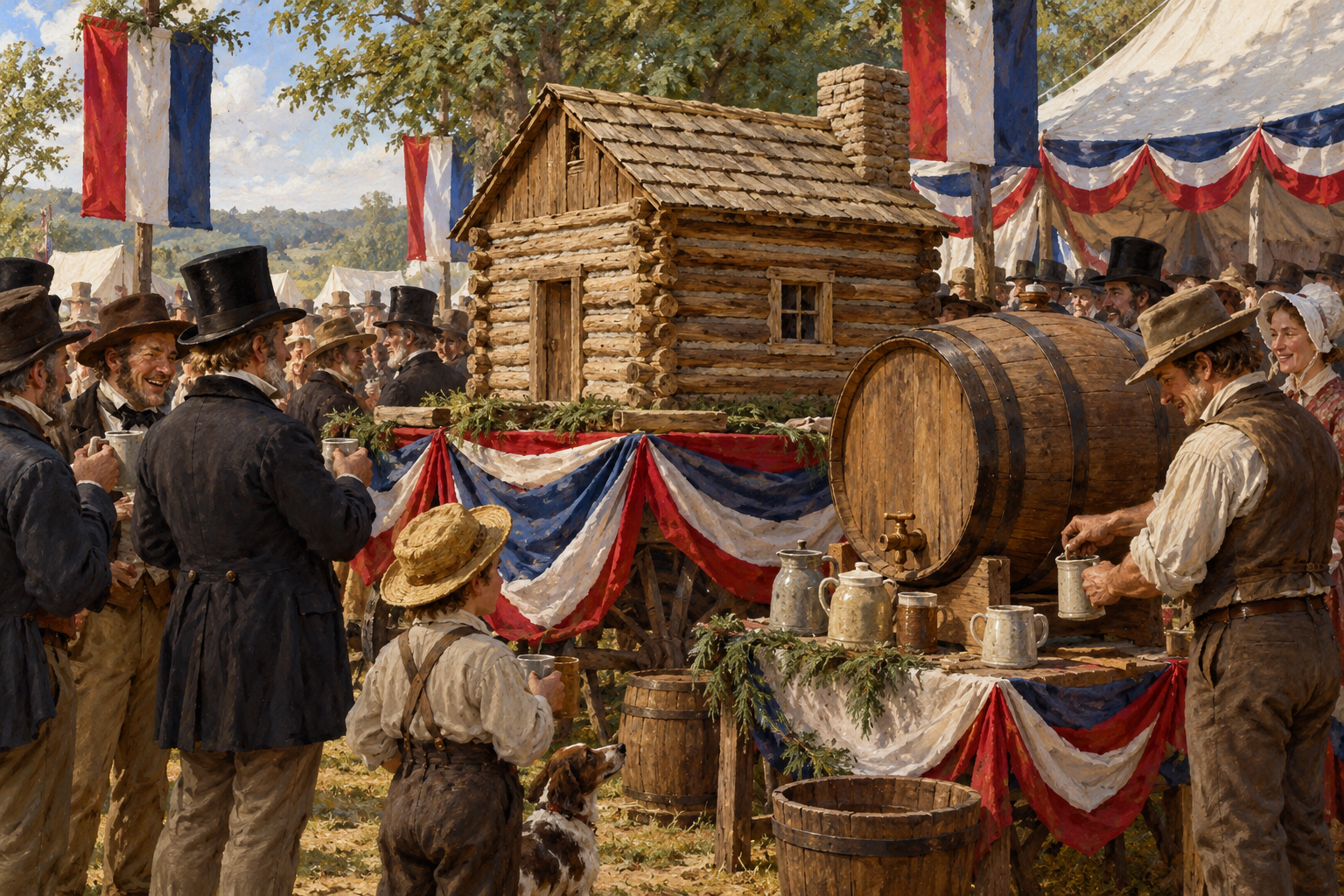
A Democratic newspaper suggested that a barrel of hard cider and a pension would satisfy Harrison in his log cabin. The Whigs embraced the sneer and made cabins and cider symbols of ordinary life. The branding obscured his background: Harrison had grown up on a wealthy Virginia plantation, and his father had signed the Declaration of Independence.
8. His campaign survives in a little green bottle
The Henry Ford museum holds an 1840 campaign bottle made by Mount Vernon Glass Works, pressed with "TIPPECANOE" on one side and "NORTH BEND" on the other. It is concrete evidence of the campaign's merchandise. The better-known E.G. Booz cabin bottles are a different story: Cornell dates its example decades after the election and explicitly rejects that campaign attribution.
9. Supporters literally kept a campaign ball rolling
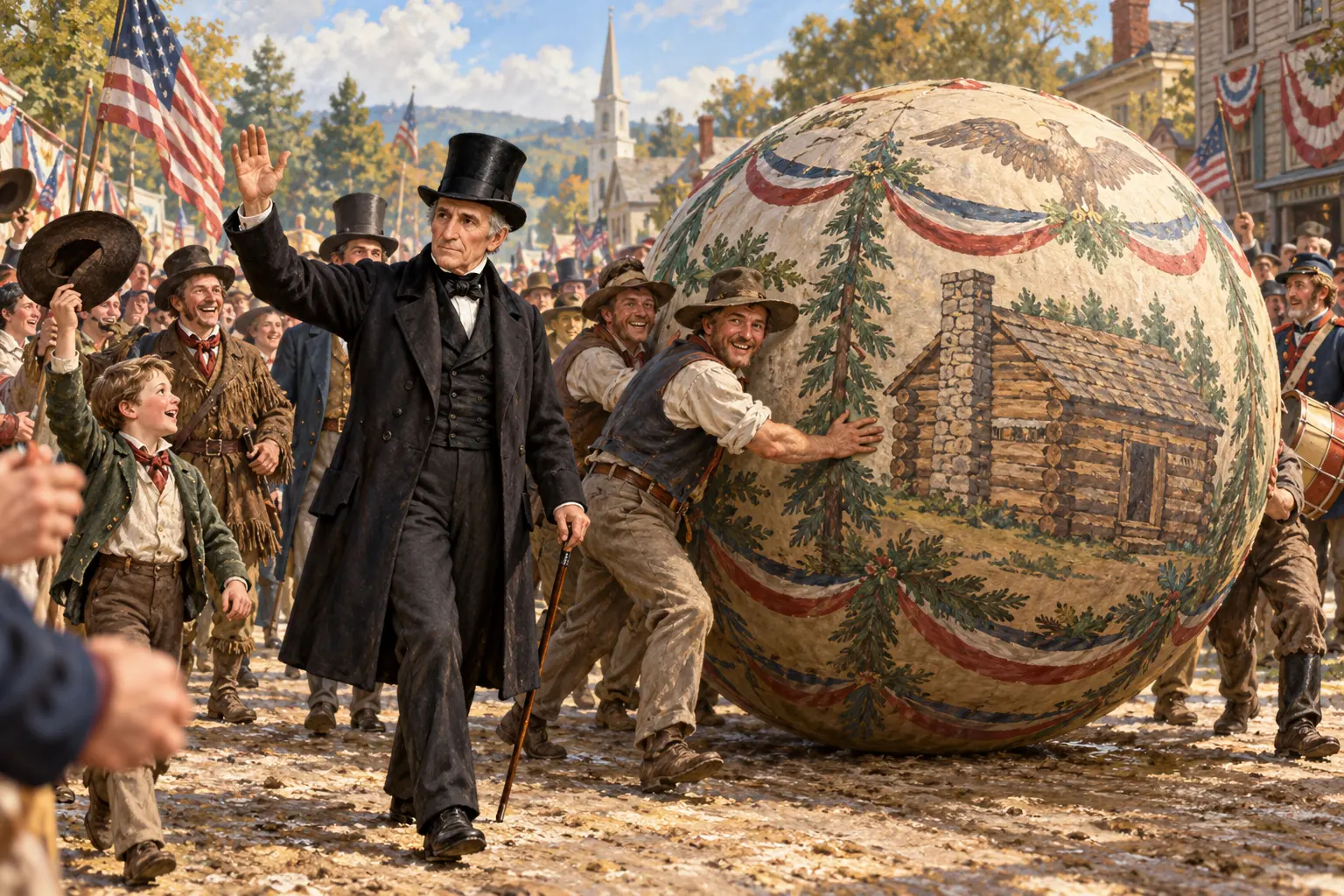
Harrison backers promoted his 1840 candidacy with enormous balls carrying political slogans and rolled through towns. His grandson Benjamin Harrison's supporters revived the spectacle in 1888, building a giant sphere of their own. A Library of Congress photograph preserves the later version, whose painted message explicitly recalls the grandfather's campaign.
 US Presidents
Discover the eccentricities, secret talents, and surprising hidden lives of America's most influential presidents, from frontier wrestlers to covert strategists.
See All Facts
10. Women campaigned for him even though they could not vote
The Whigs invited women into the spectacle of rallies and parades. Some wore sashes declaring their preference for Whig husbands, and Virginia writer Lucy Kenney produced campaign pamphlets for Harrison. Such participation mattered in a political culture that discouraged women's public partisanship. The campaign sought influence over households as well as the men casting ballots.
11. He arrived in Washington by train on his birthday
Harrison reached the capital on February 9, 1841, his sixty-eighth birthday. He was the first president-elect to arrive for his inauguration by rail. The journey combined steamboat, road travel and the railway, placing the old frontier general in a new era of presidential transport before he had even taken the oath.
12. His enormous inaugural speech included a promise to serve only once
Harrison delivered an inaugural address of more than 8,000 words, the longest in presidential history. Beneath its classical allusions was an argument for limiting executive power, including a pledge not to seek a second term. The speech is remembered for its length, but its proposed restraint on the presidency was central to what he actually said.
13. Anna Harrison never reached the White House as first lady
Anna remained in Ohio while Harrison traveled to Washington and intended to join him in May, when travel conditions would be easier. Their widowed daughter-in-law Jane acted as hostess meanwhile. Harrison died on April 4, before Anna could come. Her time as first lady ended without her ever living in the presidential residence.
14. The inauguration-to-pneumonia story is not a settled diagnosis
The familiar tale blames Harrison's death on giving a long speech in cold weather. In 2014, Jane McHugh and Philip Mackowiak reexamined his physician's case report and proposed enteric fever associated with Washington's unsanitary conditions. That is a retrospective hypothesis, not a laboratory-confirmed answer; the confident schoolbook explanation is more certain than the surviving evidence allows.
15. His papers were thought lost in a fire—until a family archive resurfaced
A fire destroyed the Harrison home at North Bend in 1858, and even grandson Benjamin believed the former president's papers had all burned. Yet documents survived. When Benjamin's widow deposited family material at the Library of Congress, a box contained William Henry Harrison's letters and letterbook. They became the core of the collection historians can consult today.
How did these facts land?
Know someone who'd love these facts? Share them 👇