The Campaign That Helped Make OK Famous: 15 Facts About Martin Van Buren
Martin Van Buren helped turn "OK" into a campaign slogan, survived a diplomatic rejection that backfired on his rival and watched a congressional speech turn his tableware into an election issue. His private world was equally unexpected: a Dutch-speaking household, a conspicuous gap in his autobiography and a retirement home equipped with an indoor flush toilet.
1. Dutch was the language of his home
Van Buren grew up in Kinderhook, a New York community whose Dutch culture outlasted colonial rule. Dutch remained part of his adult private life: historian James M. Bradley reports that Martin and his wife Hannah preferred speaking it at home. The future president's household therefore sounded rather different from the English-speaking world of Washington politics.
2. His father's tavern was also a polling place
Before he became a master political organizer, Van Buren watched travelers, voters and local figures gather at his father's tavern. It doubled as a polling place, and traffic to nearby Albany brought state politics through the door. His first political education came from a busy public meeting place rather than a college debating society.
3. His governorship lasted barely two months
Van Buren became governor of New York in January 1829, then left in March to become Andrew Jackson's secretary of state. Winning the state's highest office was thus a remarkably brief stop on his way to Washington. His election had helped Jackson's cause; Jackson's cabinet offer quickly took him away from Albany.
4. Resigning helped him become more powerful
During the Petticoat Affair, cabinet families clashed over the social acceptance of Margaret Eaton, the secretary of war's wife. Van Buren, a widower, supported Jackson and helped devise a cabinet reset by offering his own resignation. Giving up his post strengthened Jackson's trust in him instead of ending his influence.
5. A rival's decisive vote helped put him on the presidential ticket
In January 1832, Vice President John C. Calhoun cast the deciding vote against confirming Van Buren as minister to Britain. The humiliation backfired. Jackson was furious, and Van Buren became his running mate later that year. The man Calhoun had helped remove from London then took Calhoun's place as vice president.
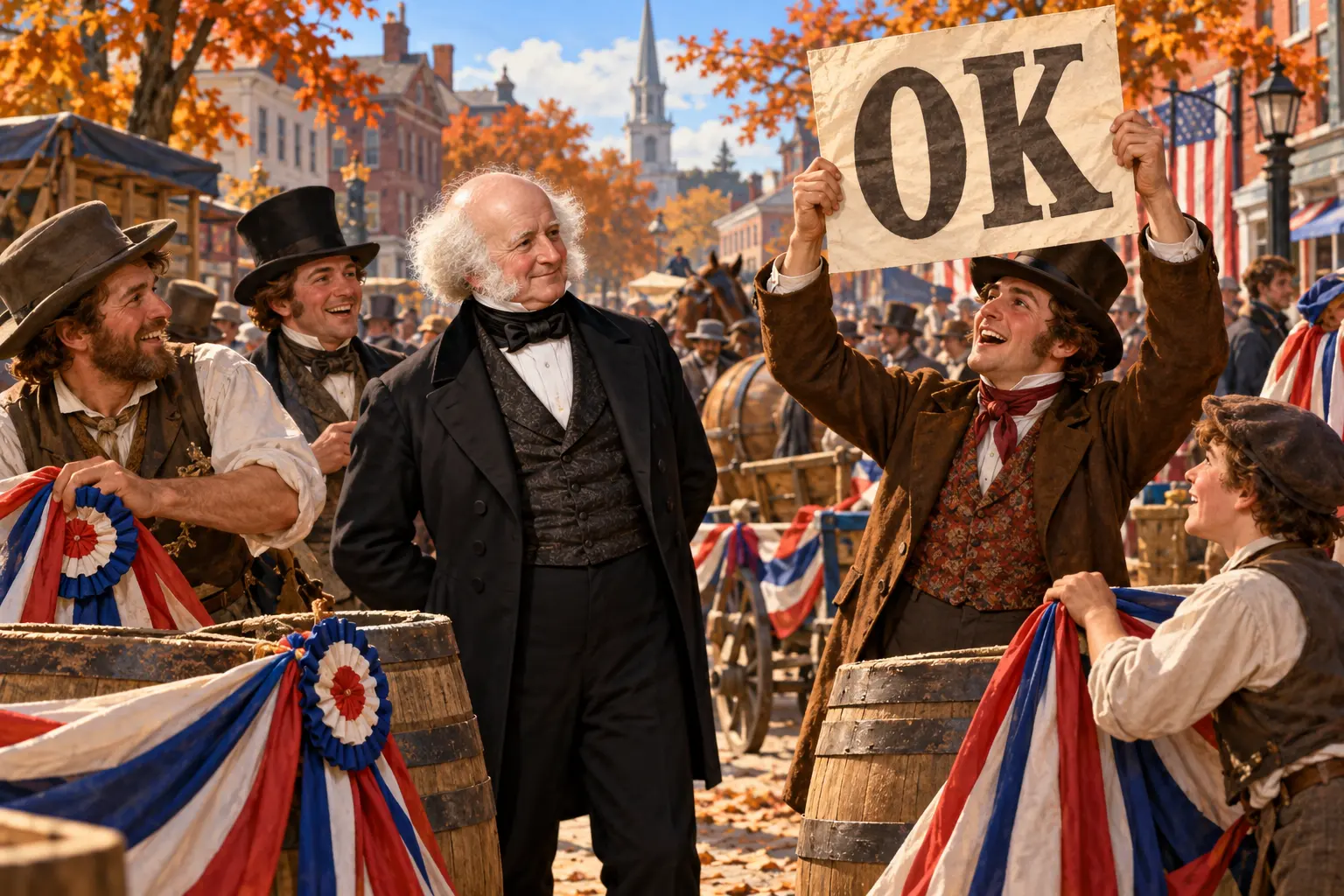
6. His campaign helped make OK a household expression
Van Buren's supporters formed O.K. Clubs in 1840, using the initials of his nickname, Old Kinderhook. They did not invent the expression: a Boston newspaper had printed it in 1839 as a joke abbreviation of a deliberately misspelled "all correct." The campaign gave the existing expression a memorable second meaning and much wider exposure.
 You might also like
15 Fascinating Facts About Ulysses S. Grant
7. His vice president needed a separate election in the Senate
Van Buren won the 1836 presidential election, but his running mate Richard Mentor Johnson did not secure an Electoral College majority for vice president. The Senate elected Johnson in February 1837 under the Twelfth Amendment. It remains the only occasion on which the Senate has chosen a vice president through this constitutional procedure.
8. A three-day speech turned his tableware into a campaign weapon
In 1840, Representative Charles Ogle attacked Van Buren's allegedly extravagant White House lifestyle over three days. The "Gold Spoon" speech became Whig campaign literature during a severe depression. The image was politically potent but selective: the supposedly aristocratic Van Buren had grown up around a tavern, while his log-cabin-branded opponent came from a wealthy Virginia family.
9. His autobiography left out his wife
Van Buren's political autobiography never mentioned Hannah, his wife of almost twelve years and the mother of his children. She had died in 1819, long before his presidency, and he never remarried. The omission is real, but it does not establish that he forgot or disliked her; it leaves historians with a conspicuous silence in an already sparse personal record.
 US Presidents
Discover the eccentricities, secret talents, and surprising hidden lives of America's most influential presidents, from frontier wrestlers to covert strategists.
See All Facts
10. A dinner guest gave his finger bowl a democratic interpretation
Van Buren entertained politicians at Lindenwald with fashionable table settings, including green glass finger bowls. In an anecdote recorded by the National Park Service, Senator Thomas Hart Benton watched his host delicately clean his fingertips, then rolled up his own cuffs for a much more vigorous wash. The contrast neatly captured the tension between refined manners and anti-aristocratic political branding.
11. His country house acquired a flush toilet and central heating
An expansion begun in 1849 doubled Lindenwald to 36 rooms and added running water, an indoor flush toilet, a bath and a coal-burning furnace. These were striking conveniences for a mid-nineteenth-century rural home. The modernization was encouraged by his son Smith, who brought his family to live there with the former president.
12. An Adams became his running mate
Van Buren had helped build the Democratic Party, yet in 1848 he ran against its nominee on the Free Soil ticket. His running mate was Charles Francis Adams, son of John Quincy Adams. A surviving campaign banner pairs their portraits above a farm scene: an unexpected political partnership preserved in a piece of election advertising.
13. His administration opposed the Amistad captives' fight for freedom
Van Buren favored returning the Africans from the Amistad to Cuba, and his administration challenged the ruling in their favor. Former president John Quincy Adams argued for their freedom before the Supreme Court. The captives ultimately prevailed after Van Buren had left office—a case in which two American presidents stood on opposing sides of a struggle for liberty.
14. A dispute over timber nearly became an international war
When lumbering intensified a boundary dispute between Maine and New Brunswick, Congress authorized Van Buren to raise 50,000 volunteers and spend $10 million. He instead sent General Winfield Scott to help calm the confrontation known as the Aroostook War. The final boundary settlement came in 1842, after Van Buren's presidency had ended.
15. A diplomatic gift of horses and pearls needed congressional instructions
In May 1840, Van Buren told Congress that the ruler of Muscat had offered horses, pearls and other valuables that he could not accept personally. The envoy then offered them to the United States government. Van Buren asked lawmakers how to dispose of the gifts without offending a foreign ruler—a practical diplomatic problem preserved in his own message.
How did these facts land?
Know someone who'd love these facts? Share them 👇