
The Harrowing Odyssey: 15 Fascinating Facts About Apollo 13
On April 11, 1970, NASA launched Apollo 13 with the goal of landing two astronauts in the Fra Mauro highlands of the Moon. Just two days into the mission, an oxygen tank exploded, turning a routine lunar voyage into one of the most intense survival missions in human history. Through remarkable ingenuity, mathematical precision, and sheer grit, the crew and Mission Control converted an impending disaster into a triumphant rescue. Here are 15 fascinating facts about the harrowing odyssey of Apollo 13.
1. The Disaster Began with a Minor Pre-Launch Drop
Long before Apollo 13 lifted off from Kennedy Space Center on April 11, 1970, a subtle ground-testing mishap set the stage for catastrophe. During routine pre-flight maintenance, Oxygen Tank 2 was accidentally dropped roughly two inches, slightly damaging an internal drain line. When technicians later attempted to empty the tank using its built-in internal heater, a faulty thermostatic switch allowed temperatures to spike past 1,000 degrees Fahrenheit. This extreme heat melted the Teflon insulation surrounding the tank's internal wiring, leaving bare wires dangerously exposed. When astronaut Jack Swigert flipped the switch to stir the cryo tanks days into the mission, an electrical spark ignited the bare wires, causing the violent explosion.
2. The Public TV Broadcast Was Completely Ignored
Just six minutes before the explosion transformed the mission into a struggle for survival, the astronauts completed a live 49-minute television broadcast. Commander Jim Lovell, Command Module Pilot Jack Swigert, and Lunar Module Pilot Fred Haise gave viewers a guided tour of their spacecraft and performed trick flips in microgravity. However, because the public had grown accustomed to lunar travel following the dramatic successes of Apollo 11 and Apollo 12, none of the major television networks aired the footage. Instead, networks chose to broadcast routine sitcoms and talk shows, leaving the crew to perform for an audience consisting almost entirely of Mission Control personnel. The world only re-engaged with the mission minutes later, when Swigert uttered his famous report that the spacecraft had encountered a fatal emergency.
3. The Lunar Module Served as an Overcrowded Lifeboat
When the explosion depleted the Command Module's oxygen and electrical supply, flight controllers instructed the crew to retreat into the Lunar Module, named Aquarius. Designed exclusively to support two astronauts for two days on the lunar surface, the lander was suddenly forced to act as a survival lifeboat for three men over nearly four days. To keep the spacecraft powered long enough to return to Earth, Mission Control devised emergency procedures that slashed electrical consumption down to a mere 12 amps. Essential systems were powered down, turning off navigation displays and ambient heating while turning the ship into an ultra-quiet, frozen shell. This clever conservation strategy preserved just enough battery power in the primary capsule to permit a successful atmospheric re-entry.
4. Engineers Fixed a Fatal CO2 Problem with Office Supplies
As the three astronauts breathed inside the sealed Lunar Module, carbon dioxide levels began to rise to dangerous, toxic levels. While Aquarius had chemical scrubbers filled with lithium hydroxide canisters to remove the gas, its round receptacles were quickly exhausted. The crew had spare canisters from the Command Module, but those were manufactured in a square shape and could not fit into the lander's circular openings. Teams of engineers on Earth spent an intense night assembling a makeshift adapter using only items available on the spacecraft. Using plastic bags, cardboard from flight manuals, suit hoses, and heavy-duty grey duct tape, the astronauts successfully built the improvised device, saving themselves from suffocation.
5. Freezing Cabin Temperatures Made Sleep Almost Impossible
Shutting down non-essential electronics reduced the ambient heat inside the spacecraft to near-freezing levels, dropping cabin temperatures to 38 degrees Fahrenheit. Without heat, heavy condensation rapidly coated every exposed metal surface, window, and instrument panel in liquid droplets. The three astronauts lacked heavy cold-weather clothing, forcing them to wear multiple layers of underwear and put on their lunar boots to stay warm. Resting became nearly impossible because cold, damp conditions caused relentless shivering throughout the long journey home. Fred Haise eventually developed a severe kidney infection caused by the intense cold combined with severe operational stress.
6. Dehydration Caused Severe Weight Loss Among the Crew
Fresh water on Apollo spacecraft was produced as a byproduct of fuel cell operation, but the loss of two fuel cells severely curtailed their water supply. Flight controllers were forced to ration drinking water strictly to ensure there was enough liquid left to cool the electronic guidance systems during re-entry. Additionally, because the crew was hesitant to dump urine overboard for fear of altering their delicate flight trajectory, they minimized liquid intake. By the time the capsule safely splashed down in the Pacific Ocean, the three men were suffering from profound dehydration. Medical evaluations revealed that the crew had lost a combined total of 31.5 pounds over the course of the harrowing four-day return trip.
 Famous Disasters, Mysteries and Crimes
Explore the gripping truths behind history's most infamous disasters, unsolved mysteries, and legendary criminals. From colossal volcanic eruptions to the birth of the modern underworld, uncover the startling facts that separate myth from reality.
See All Facts
Famous Disasters, Mysteries and Crimes
Explore the gripping truths behind history's most infamous disasters, unsolved mysteries, and legendary criminals. From colossal volcanic eruptions to the birth of the modern underworld, uncover the startling facts that separate myth from reality.
See All Facts
7. Alignment Was Performed Using the Earth's Horizon Line
Without the main guidance computer active to conserve power, Commander Jim Lovell had to manually align the spacecraft for a critical course-correction burn. Modern electronic displays and computerized gyroscopes were offline, leaving the crew without standard digital orientation tools. Lovell relied on pure visual geometry, lining up the optical reticle of his window with the Earth's terminator line—the distinct dividing arc where day meets night. Keeping the sunlit edge of the planet centered in his window required delicate, precise thruster inputs while the spacecraft rocked unpredictably. This daring manual maneuver placed Apollo 13 on the precise free-return trajectory needed to enter Earth's atmosphere safely.
8. The Emergency Loop Set a Spaceflight Distance Record
To return home safely without using the main engine, Apollo 13 executed a gravitational slingshot maneuver around the far side of the moon. Passing roughly 158 miles above the lunar surface, the trajectory swung the crew far into the deep space vacuum beyond the moon. On April 15, 1970, the crew reached a distance of 248,655 miles from Earth, setting an absolute altitude record for human spaceflight. That record for the farthest distance any human beings have ever traveled from Earth still stands today. Although the astronauts were disappointed to miss out on a moon landing, the record remains an enduring testament to their extraordinary journey.
9. The Re-Entry Radio Blackout Caused Minutes of Agony
During atmospheric re-entry, extreme friction creates a superheated layer of ionized plasma around a spacecraft that completely blocks radio communication. Standard Apollo missions typically experienced a blackout period lasting roughly three minutes before radio signals resumed. For Apollo 13, because the capsule entered the atmosphere at a shallower angle than usual, the blackout stretched to nearly six agonizing minutes. Inside Mission Control, flight director Gene Kranz and his team sat in silence as timer clocks ticked past the expected window of contact. Cheers finally erupted when Jack Swigert's voice cut through the static, confirming that the capsule's heat shield had survived intact.
10. A Nuclear Power Source Was Dumped into the Deep Ocean
The Apollo 13 Lunar Module carried a SNAP-27 radioisotope thermoelectric generator meant to power scientific experiments on the lunar surface. This unit contained roughly 8.3 pounds of highly radioactive Plutonium-238 encased in a heavy, heat-resistant graphite fuel cask. When Aquarius was jettisoned before re-entry, NASA directed its trajectory so that the module would burn up over the Pacific Ocean. The durable plutonium cask survived atmospheric entry completely intact, plunging deep into the ocean floor. Today, it rests at the bottom of the Tonga Trench under approximately six miles of water, where environmental monitoring confirms it remains safely submerged without leaking radiation.
11. A German Measles Outbreak Forced a Last-Minute Crew Switch
Just days before launch, backup Lunar Module pilot Charlie Duke inadvertently exposed the entire prime crew to the German measles. While Jim Lovell and Fred Haise were immune, Command Module Pilot Ken Mattingly lacked immunity and was grounded by flight surgeons. Mattingly was replaced on short notice by backup pilot Jack Swigert, disrupting months of closely coordinated team training. Ironically, Swigert was the astronaut who flipped the cryo-stir switch that triggered the catastrophic explosion in deep space. Mattingly remained on Earth and played a vital role in Mission Control's simulators, testing procedures to safely restart the freezing spacecraft.
12. Condensation Turned the Command Module into a Hazardous Freezer
Without electrical power generating heat, the humidity from the astronauts' breath continuously condensed on the cold aluminum walls. Water droplets soaked exposed wiring, instrument panels, and flight controls, transforming the interior into a dripping, refrigerated vault. Flight controllers were deeply concerned that powering up the electronics for re-entry would trigger massive electrical short circuits and fires. Engineers spent long hours drafting a complex, step-by-step startup sequence designed to energize circuits gradually. Remarkably, moisture-resistant insulation installed after the tragic Apollo 1 fire worked perfectly, preventing any electrical shorts during power-up.
13. Ground Controllers Worked Nonstop Powered by Slide Rules and Caffeine
Flight directors and engineering teams in Houston pulled marathon shifts, working continuously to calculate complex trajectory adjustments. Because mainframe computer access was limited and response times were critical, controllers relied heavily on manual mathematics. Engineers regularly double-checked complex orbital mechanics equations using physical slide rules and mechanical calculators. Operating on virtually no sleep and powered by coffee and adrenaline, the team invented entirely new operational checklists in real time. Their unrelenting discipline and creative problem-solving are widely recognized as one of NASA's finest operational achievements.
14. Frozen Debris Made Celestial Navigation Nearly Impossible
To verify their spatial orientation, astronauts typically used an onboard optical sextant to sight bright guide stars. Following the explosion, thousands of frozen liquid droplets and shiny insulation fragments surrounded the spacecraft like a glittering shroud. This reflective debris reflected sunlight, creating thousands of false lights that made identifying actual stars nearly impossible through the sextant eyepiece. Jim Lovell described looking into a dense, shimmering field where distinguishing a real star required immense patience and precise visual tracking. The crew ultimately adapted by using the sun and the Earth's visible outline as primary visual anchor points instead of individual stars.
15. The Final Splashdown Was One of the Most Accurate in History
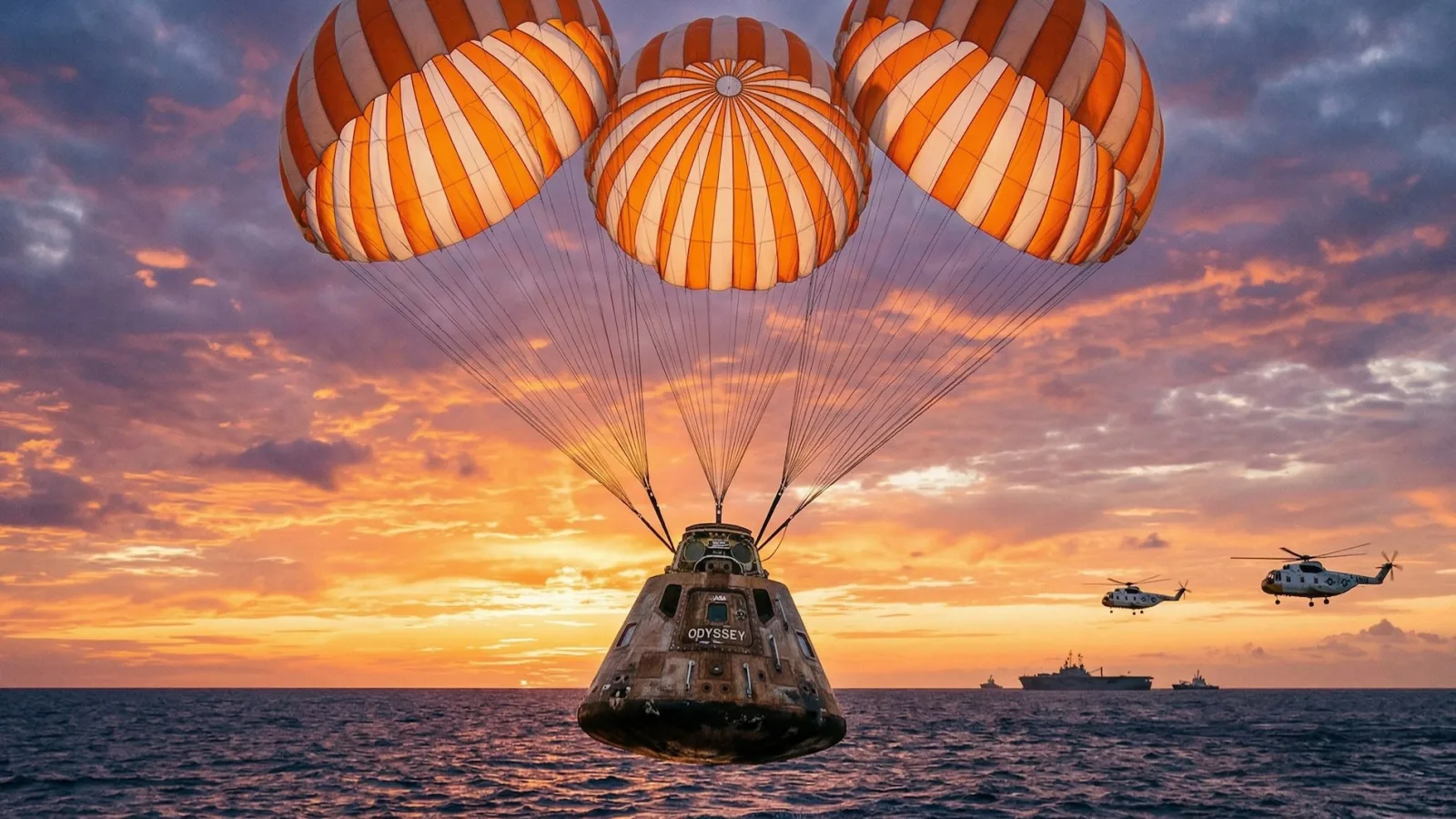
Despite navigating without power, relying on makeshift devices, and manually executing critical burns, Apollo 13 achieved an amazingly precise landing. On April 17, 1970, the Command Module Odyssey safely descended under three giant parachutes into the South Pacific Ocean. The capsule touched down within just four miles of its primary target area and the waiting recovery vessel, the USS Iwo Jima. Recovery helicopters arrived at the spacecraft within minutes to pull the three exhausted, shivering astronauts to safety. The dramatic recovery marked the successful conclusion of what NASA officially termed a "successful failure."
Sources & References
This AI-assisted post was rigorously curated and fact-checked for accuracy by:
 Martin Roháček
How fun was this article? 🤔
Tap a star to rate it
🧠 Quiz: How closely were you paying attention?
10 questions — all answers are in the article above!
Enjoyed these facts? There's more! 💌
Fresh fun facts in your inbox. No spam, ever.