The Poetic Revolutionary: 15 Fascinating Facts About Pablo Neruda
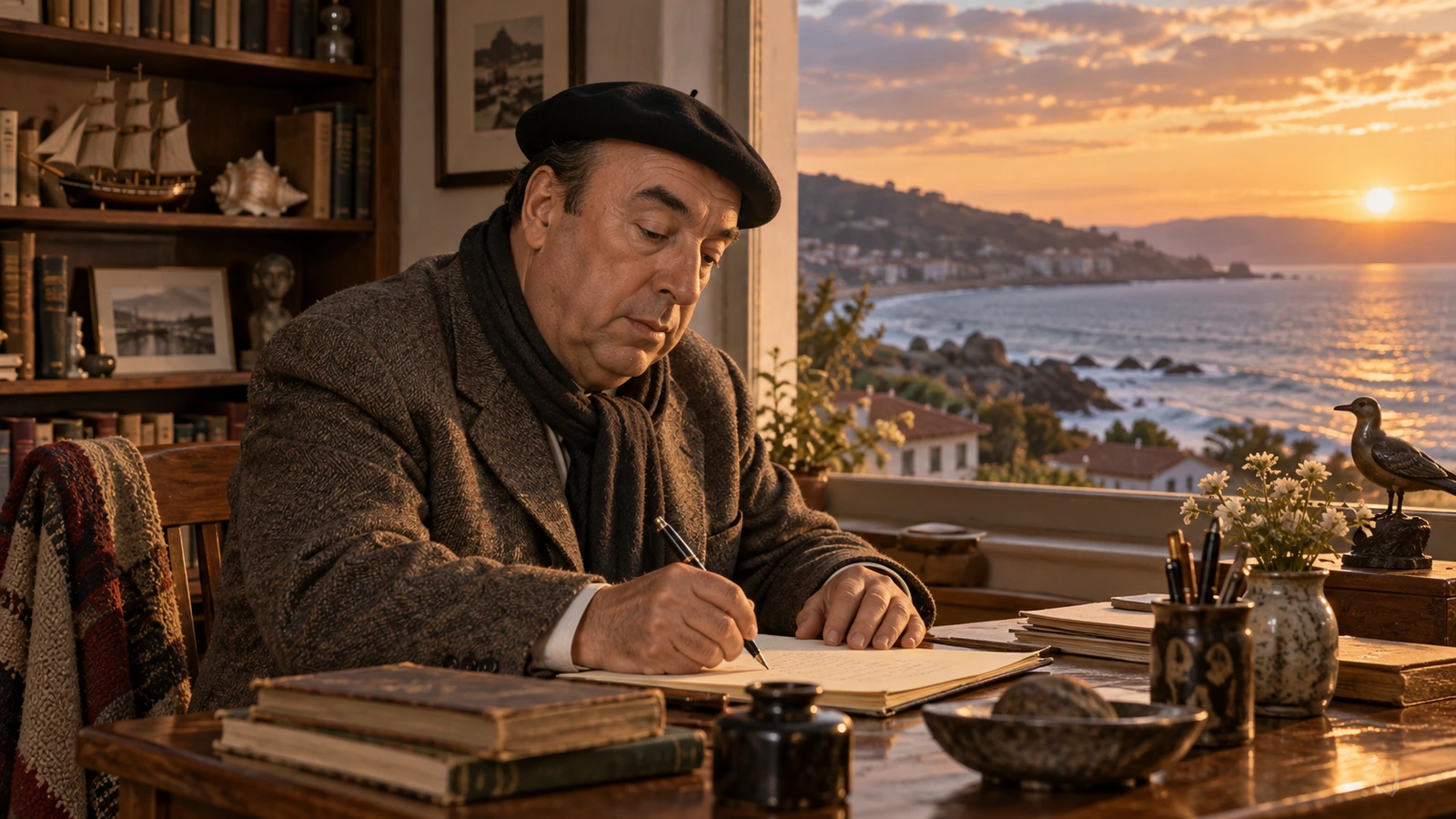
Pablo Neruda remains one of the most celebrated and polarizing literary icons of the twentieth century, blending fiery love poetry with passionate political activism. From escaping political persecution across the Andes on horseback to winning the Nobel Prize in Literature, his life was as dramatic as his verse. Beyond his romantic odes and global diplomacy, Neruda harbored unique personal quirks, including writing solely in green ink and decorating his home with ship figureheads. Today, his legacy continues to inspire millions worldwide while sparking ongoing debate over his life and mysterious death.
1. His Famous Name Was a Covert Pseudonym
Pablo Neruda was actually born Ricardo Eliécer Neftalí Reyes Basoalto in Parral, Chile, in 1904. He began writing poetry at the tender age of ten, but his father, a practical railway worker, strongly disapproved of his literary ambitions. To hide his published work from his family, the young writer adopted the pseudonym Pablo Neruda when he was just sixteen years old. He chose the surname in honor of the 19th-century Czech writer Jan Neruda, while taking "Pablo" from the French poet Paul Verlaine. Decades later, in 1946, he legally changed his name to his beloved pen name.
2. He Wrote a Global Bestseller at Age Nineteen
In 1924, while still a teenager living in Santiago, Neruda published his second book, Twenty Love Poems and a Song of Despair. The collection was scandalous for its explicit sensuality and raw emotional vulnerability, which differed sharply from traditional Latin American poetry. Despite initial resistance from conservative critics, the book became an instant phenomenon and launched him into international stardom. It remains one of the best-selling poetry collections in history, having sold tens of millions of copies worldwide. Today, its iconic opening lines are recognized by readers across the Spanish-speaking world.
3. He Spent Years as an Impoverished Diplomat in Asia
To support his writing habit, Neruda entered Chile’s foreign service in 1927 and was appointed as an honorary consul in Rangoon, Burma. Over the next several years, his diplomatic assignments took him to Ceylon, Batavia (now Jakarta), Singapore, and Barcelona. However, these early diplomatic postings paid very little, leaving him living in near-poverty while enduring intense tropical isolation. Despite the solitude, his years in Asia profoundly influenced his writing, inspiring the surrealist and somber tones of his masterpiece Residencia en la tierra. Later, he served in higher-profile posts, including consul general in Mexico and ambassador to France.
4. He Chartered a Ship to Save 2,000 War Refugees
When the Spanish Civil War broke out in 1936, Neruda was serving as a diplomat in Spain, where the tragic murder of his friend Federico García Lorca radicalized his political views. Following the defeat of the Spanish Republic in 1939, Neruda was appointed special consul in Paris for Spanish immigration. Recognizing the plight of thousands of refugees trapped in French concentration camps, he personally organized the chartering of an old cargo vessel named the SS Winnipeg. The ship transported over 2,000 Spanish Republicans and their families to safety in Chile. Neruda later considered saving those lives to be his single greatest achievement in life.
5. He Escaped Political Persecution on Horseback Across the Andes
In 1945, Neruda was elected to the Chilean Senate as a member of the Communist Party, but his political fortune turned rapidly. When President Gabriel González Videla outlawed communism in 1948, Neruda delivered a scathing speech in the Senate denouncing the administration and went underground. For over a year, supporters moved him between secret safehouses across Chile while police actively searched for him. In early 1949, he made a harrowing escape on horseback across the snow-covered Lilpela Pass in the Andes mountains into Argentina. During this arduous journey, he carried the manuscript for his monumental historical epic, Canto General.
6. He Wrote Exclusively in Green Ink
Throughout his adult life, Neruda maintained a strict artistic ritual: he wrote his original drafts almost exclusively in green ink. To the poet, green was not merely a stylistic preference; it was the color of esperanza (hope), fertility, and raw creative power. He believed that the color linked his words directly to the natural world he loved so dearly. Anyone receiving a letter or manuscript from Neruda could immediately identify his hand by the vibrant green fluid flowing across the paper. Even after gaining international fame, he refused to draft his works using standard blue or black pens.
 Writers and Literary Greats
Discover the astonishing true stories, eccentric habits, and thrilling adventures of history's greatest writers. From firing squads and pirate captivity to military hoaxes, their real lives rivaled their greatest fictions.
See All Facts
Writers and Literary Greats
Discover the astonishing true stories, eccentric habits, and thrilling adventures of history's greatest writers. From firing squads and pirate captivity to military hoaxes, their real lives rivaled their greatest fictions.
See All Facts
7. His Homes Were Filled with Nautical Artifacts and Quirky Treasures
Neruda owned three iconic homes in Chile—Isla Negra on the coast, La Sebastiana in Valparaíso, and La Chascona in Santiago—each reflecting his whimsical imagination. Though he never served as a sailor, he was obsessed with the sea and packed his residences with wooden ship figureheads, compasses, and ancient maps. He also amassed massive collections of colorful glass bottles, sea shells, antique toys, and rare insect specimens from around the world. Architectural quirks abounded in his houses, including secret passages, rounded doors resembling ship cabins, and narrow staircases. Today, all three homes operate as museums attracting thousands of visitors every year.
8. He Transformed Everyday Objects into Sacred Poetry
While many classical poets focused on grand philosophical concepts, Neruda dedicated an entire phase of his career to praising the humble objects of daily life. In his celebrated collection Odas elementales (Elementary Odes), published in 1954, he penned poetic tributes to items like onions, socks, scissors, lemons, and artichokes. He argued that beauty existed in the most ordinary domestic items and that true poetry should be accessible to everyday working people. By elevating a simple pair of woolen socks or a slice of tomato to majestic artistic heights, he revolutionized Latin American verse. His elemental odes remain among his most beloved and frequently anthologized works.
9. He Built a Secret Sanctuary for His Secret Lover
In 1951, while still married to his second wife Delia del Carril, Neruda began a secret romantic affair with Chilean singer Matilde Urrutia. To keep their relationship hidden from the public eye, he bought land at the foot of Mount San Cristóbal in Santiago and built a hidden house. He named the residence La Chascona, a Quechua-derived Chilean term meaning "wild, tangled hair," in honor of Matilde’s unmanageable red curls. A secret painting inside the house by Diego Rivera even features Matilde’s profile hiding Neruda’s side profile hidden within her hair. Matilde eventually became his third wife and remained with him until his death.
10. He Won the Stalin Peace Prize
Neruda’s commitment to communism was unwavering for much of his political career, leading him to idolize Soviet leader Joseph Stalin. In 1953, he was awarded the prestigious International Stalin Peace Prize (later renamed the Lenin Peace Prize) by the Soviet government. Following Stalin's death that same year, Neruda even published an ode praising the dictator, a move that sparked immense controversy in international literary circles. Although he later acknowledged the atrocities committed under Stalin’s regime and softened his public stances, critics often targeted his past allegiance to the Soviet Union. Nevertheless, his political convictions remained central to his public identity until his final days.
11. His Nobel Prize Victory Was Heavily Debated
In 1971, Neruda reached the pinnacle of global recognition when he was awarded the Nobel Prize in Literature "for a poetry that with the action of an elemental force brings alive a continent's destiny and dreams." However, the decision was not without fierce debate within the Swedish Academy due to his political history and previous praise of Soviet totalitarianism. Some committee members initially favored other literary giants, but Neruda’s artistic brilliance ultimately prevailed. Upon receiving the prize in Stockholm, he delivered a famous lecture emphasizing hope, solidarity, and the human condition. He became only the third Latin American writer to receive the prestigious honor.
12. Modern Critics Have Reexamined His Troubled Personal Life
In recent decades, biographers and scholars have brought renewed scrutiny to the darker, highly controversial aspects of Neruda's personal life. In his posthumously published memoirs, I Confess That I Have Lived, Neruda recounted an incident in Ceylon where he committed a sexual assault against a domestic worker, an admission that has sparked modern outrage. Additionally, he abandoned his only child, Malva Marina, who was born with hydrocephalus, leaving her and her mother in occupied Europe where the child died at age eight. These revelations have sparked intense debate in Chile regarding how to evaluate his literary genius alongside his human flaws.
13. Forensic Experts Uncovered Evidence He Was Poisoned
Neruda died on September 23, 1973, just twelve days after General Augusto Pinochet overthrew the democratically elected socialist president Salvador Allende. The official cause of death reported by the military regime was advanced prostate cancer, but long-held suspicions suggested he was assassinated. In 2013, Neruda’s body was exhumed by international forensic specialists seeking to determine the true cause of his sudden death. In 2023, a panel of forensic experts revealed they discovered high concentrations of Clostridium botulinum—a deadly neurotoxin—in one of his teeth. The findings strongly suggest that the poet may have been poisoned by the military dictatorship while hospitalized.
14. His Funeral Became the First Public Protest Against the Dictatorship
Despite the military junta imposing a strict curfew and trying to suppress public gatherings, Neruda’s funeral in Santiago transformed into an unprecedented act of resistance. Thousands of grieving Chilean citizens poured into the streets to follow his coffin to the cemetery, heavily guarded by armed soldiers. Mourners bravely began chanting socialist slogans and reciting Neruda’s radical poetry aloud in direct defiance of the regime. The funeral marked the very first major public protest against Pinochet’s brutal dictatorship. It proved that even in death, Neruda’s voice could mobilize resistance and strike fear into oppressive rulers.
15. He Remains One of the Most Translated Authors in History
Neruda’s poetry has been translated into more than 80 languages, making him one of the most widely read Latin American writers in human history. His literary influence spans continents, inspiring songwriters, filmmakers, political activists, and generations of poets. Nobel laureate Gabriel García Márquez once famously hailed Neruda as "the greatest poet of the 20th century in any language." Decades after his passing, his love poems continue to be recited at weddings, while his political verses serve as anthems for human rights movements. His unique voice permanently transformed the landscape of world literature.
Sources & References
This AI-assisted post was rigorously curated and fact-checked for accuracy by:
 Martin Roháček
How fun was this article? 🤔
Tap a star to rate it
🧠 Quiz: How closely were you paying attention?
10 questions — all answers are in the article above!
Enjoyed these facts? There's more! 💌
Fresh fun facts in your inbox. No spam, ever.