1. He Inherited a Minor City-State
When Hammurabi came to power in 1792 BCE, Babylon was not yet the legendary metropolis it would become. It was a relatively minor, unassuming city-state in central Mesopotamia, surrounded by much larger, older, and more powerful rival kingdoms like Larsa to the south and Eshnunna to the north. Through a combination of patient diplomacy and military genius, Hammurabi transformed this small territory into the capital of a massive empire.
2. He Used Water as a Weapon
Hammurabi was a brilliant and ruthless tactician who weaponized the environment against his enemies. Because Mesopotamian cities relied entirely on the Tigris and Euphrates rivers for survival, he would order his engineers to dam up the rivers leading into rival cities. He would either withhold the water to starve the city into submission, or suddenly release the dams to create devastating artificial floods that destroyed their walls and crops.
3. He Forged and Broke Alliances Strategically
During the first two decades of his reign, Hammurabi avoided large-scale wars. Instead, he made careful political alliances with stronger neighboring kings, allowing them to fight and weaken each other. Once his rivals were exhausted from their own conflicts, Hammurabi swiftly broke his alliances and marched his armies against them, easily conquering major powers like Larsa and Mari.
4. His Law Code Was Not the First
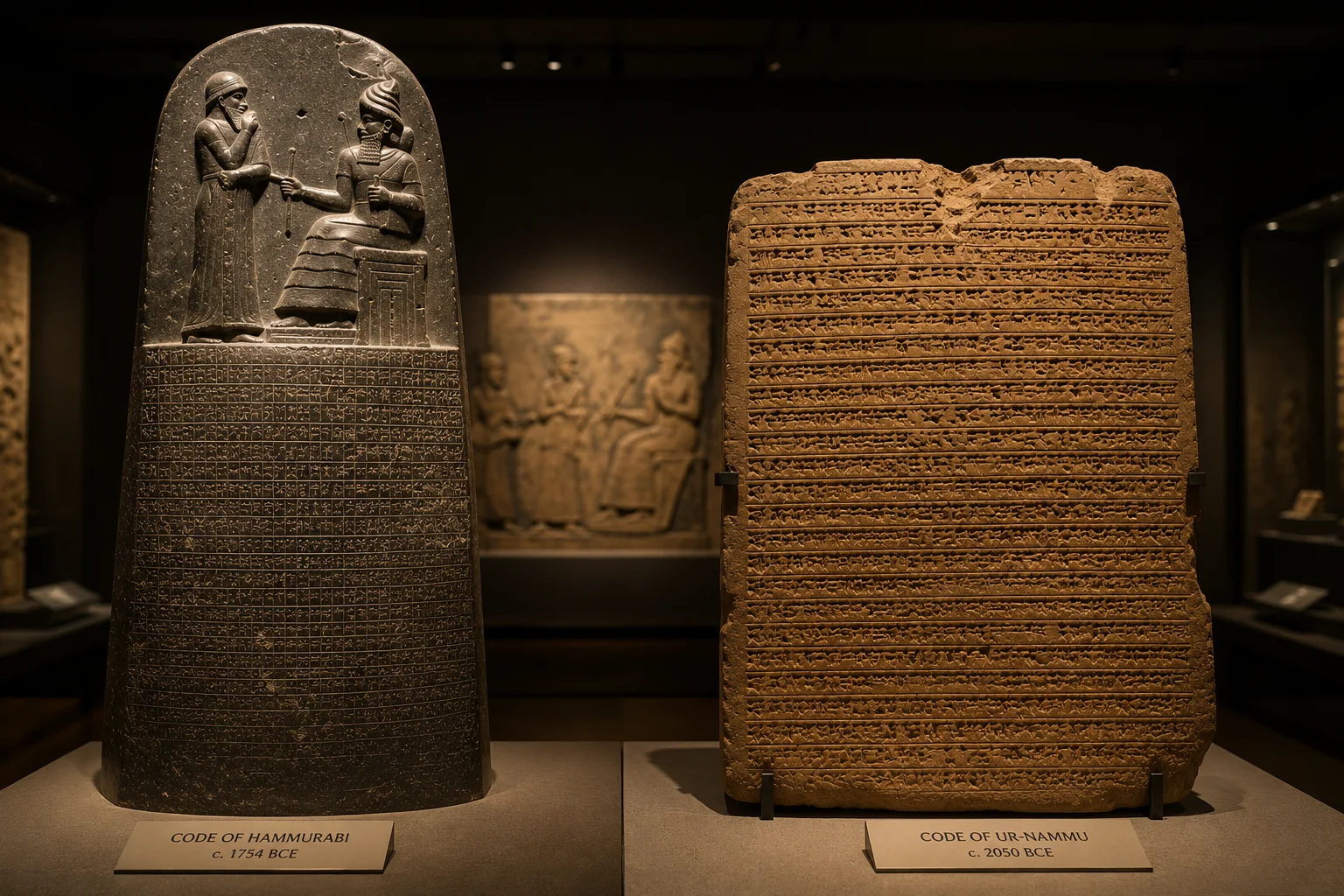
While the Code of Hammurabi is the most famous ancient legal document, it was not the first written code of laws in history. It was preceded by several older Sumerian legal texts, most notably the Code of Ur-Nammu, which was written roughly 300 years earlier. However, Hammurabi’s code was far more comprehensive, detailed, and widely distributed than any of its predecessors.
5. The Laws Were Carved into a Massive Stone Pillar
To ensure his laws were permanent and public, Hammurabi had them inscribed on a massive stele (a stone pillar) made of black diorite. Standing over seven feet tall and weighing four tons, the stele was placed in a public temple so that anyone who could read could understand the laws of the land. The top of the stele features a carving of Hammurabi receiving the laws directly from Shamash, the Mesopotamian god of justice.
6. He Popularized “An Eye for an Eye”
The Code of Hammurabi is famous for cementing the legal principle of lex talionis, the law of retribution. This is the origin of the famous phrase “an eye for an eye, and a tooth for a tooth.” The concept dictated that the punishment for a crime should exactly match the damage inflicted. If a builder built a house that collapsed and killed the owner, the builder would be put to death.
7. Justice Depended on Social Class
While the code introduced structured justice, it was far from equal. Babylonian society was divided into three distinct classes: the awilu (free property owners), the mushkenu (free commoners), and the wardu (enslaved people). Punishments varied wildly depending on the class of the victim and the perpetrator. If a wealthy man blinded another wealthy man, he lost his eye. But if a wealthy man blinded an enslaved person, he only had to pay a fine.
8. It Established the Presumption of Innocence
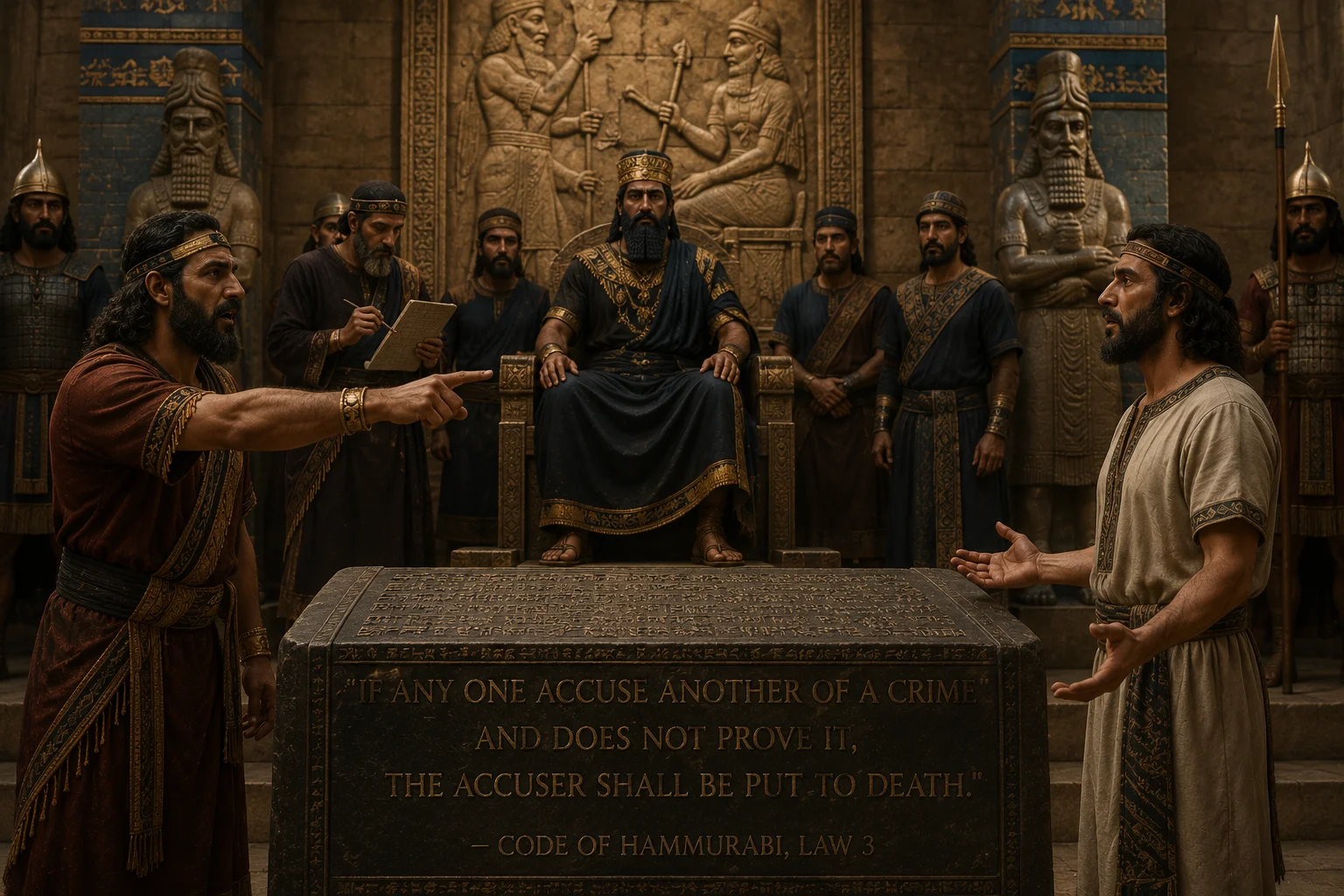
Despite its harsh physical punishments, Hammurabi’s Code introduced several incredibly advanced legal concepts, including the presumption of innocence. The code specifically required that accusers provide evidence and witnesses to prove their claims. If a person accused someone of a serious crime but could not prove it in front of a judge, the accuser themselves would face the death penalty.
9. It Included Early Minimum Wage Laws
Beyond criminal justice, a large portion of the 282 laws functioned as an early economic constitution. The code heavily regulated trade, contracts, and property rights. It also established strict price controls for basic goods and mandated specific minimum daily wages for various professions, including doctors, builders, sailors, and herdsmen.
10. He Was a Micromanager
Hammurabi did not just delegate authority; he was deeply involved in the day-to-day administration of his vast empire. Archaeologists have recovered hundreds of clay tablets containing letters written by Hammurabi to his regional governors. These letters show him micromanaging everything from clearing blocked canals and settling minor land disputes to correcting the calendar and ordering specific troops to specific border posts.
11. He Elevated the God Marduk
Before Hammurabi’s reign, Marduk was an obscure, minor deity associated solely with the city of Babylon. As Hammurabi conquered Mesopotamia, he actively promoted Marduk as the supreme leader of the Mesopotamian pantheon, claiming the god had chosen him to rule. This religious shift was so successful that Marduk remained the chief god of the region for over a thousand years.
12. He Called Himself the “Shepherd” of the People
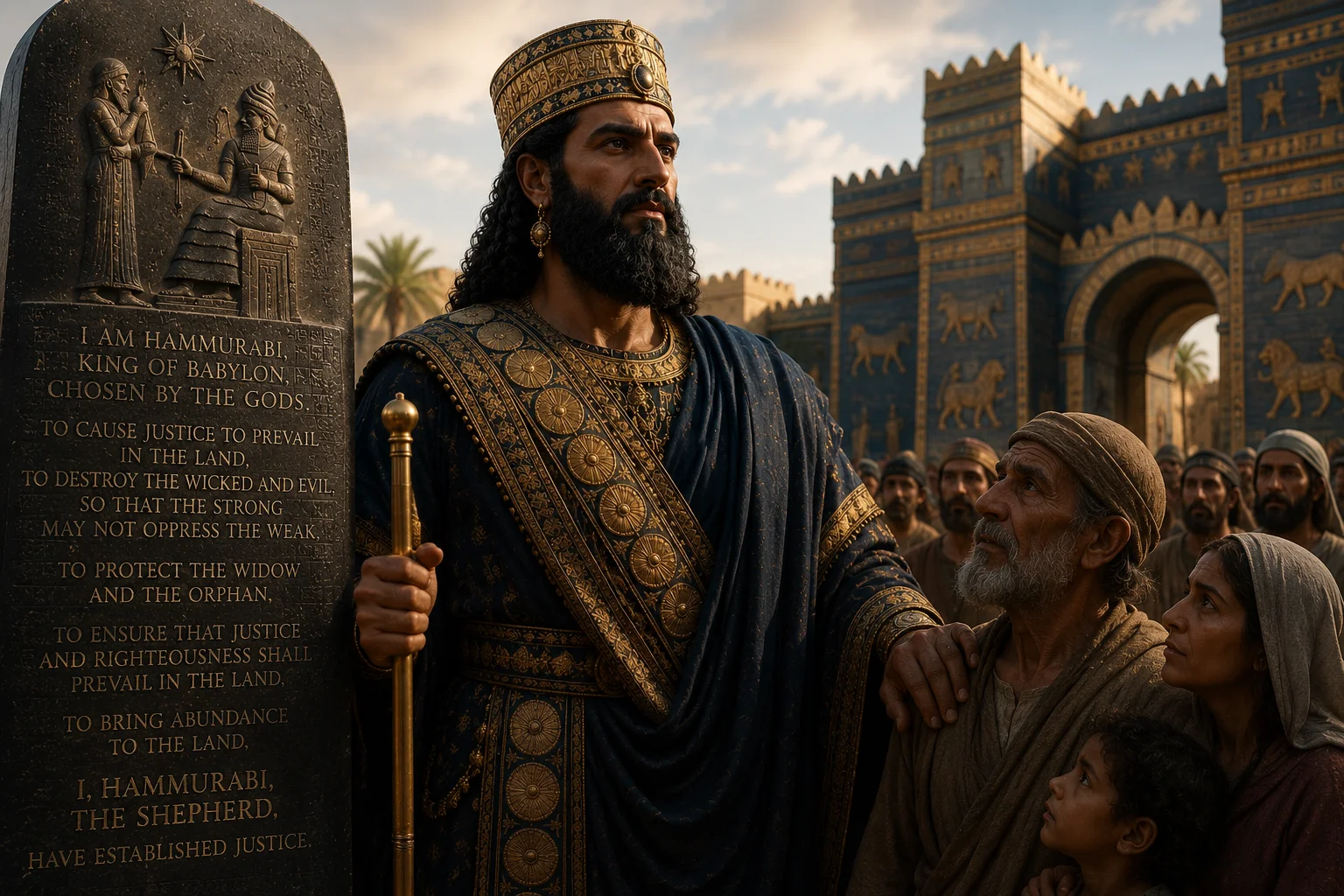
Unlike some ancient rulers who claimed to be literal gods on earth, Hammurabi framed his rule differently. In the prologue to his code, he refers to himself as a “shepherd” chosen by the gods to protect the weak from the strong, ensure widows and orphans were not mistreated, and bring abundance to the land.
13. His Empire Crumbled After His Death
Hammurabi’s empire, which stretched from the Persian Gulf across modern-day Iraq and Syria, was highly dependent on his personal brilliance and administrative energy. After his death around 1750 BCE, his son Samsu-iluna took the throne. Without Hammurabi’s military genius and constant oversight, the conquered city-states immediately began rebelling. The massive Babylonian empire shrank dramatically within a single generation.
14. The Stele Was Stolen by Ancient Invaders
The famous diorite stele containing Hammurabi’s laws did not remain in Babylon. Centuries after Hammurabi’s death, an army from the neighboring kingdom of Elam invaded Mesopotamia, looted the city, and dragged the four-ton stele back to their capital city of Susa (in modern-day Iran) as a war trophy. The Elamite king even erased some of the laws at the bottom of the pillar to write his own name.
15. The Code Was Lost for Millennia
Hammurabi and his legal code were largely forgotten by history until the turn of the 20th century. In 1901, a team of French archaeologists led by Jacques de Morgan was excavating the ancient ruins of Susa when they unearthed the massive stele, broken into three large pieces. It was translated, pieced back together, and is now prominently displayed in the Louvre Museum in Paris.