Thirteen Days on the Brink: 15 Fascinating Facts About the Cuban Missile Crisis
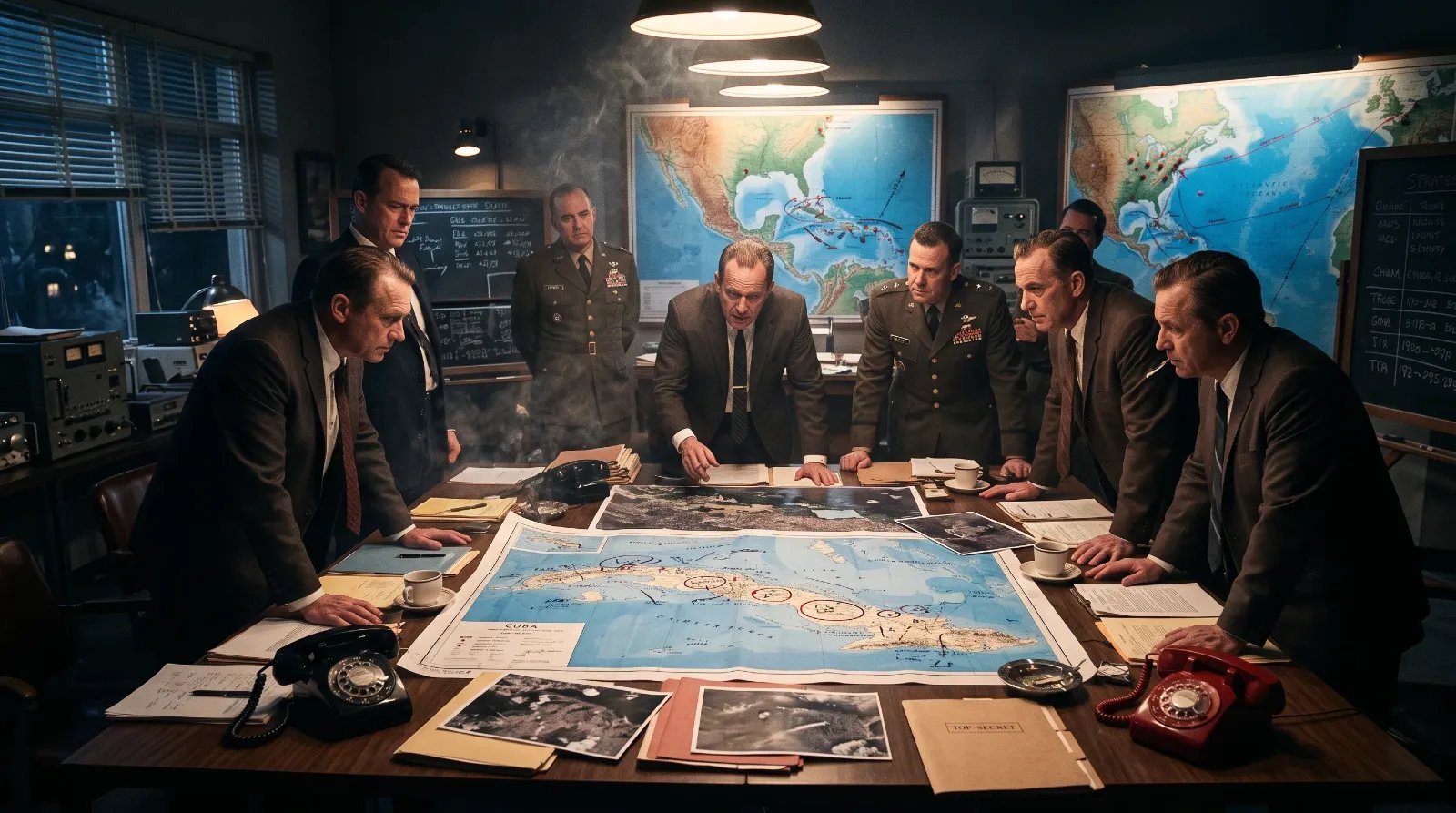
For thirteen days in October 1962, the United States and the Soviet Union stood closer to nuclear war than ever before or since. Behind the famous standoff between John F. Kennedy and Nikita Khrushchev lay secret deals, hidden warheads, a downed spy plane and a Soviet officer whose refusal may have saved the world.
1. The "thirteen days" ran from October 16 to October 28, 1962.
On October 14, 1962, an American U-2 spy plane photographed Soviet missile sites under construction in western Cuba. President John F. Kennedy was shown the photos on the morning of October 16. The crisis ended on October 28, when Soviet leader Nikita Khrushchev announced that the missiles would be removed. Robert F. Kennedy's memoir of the standoff was later published as Thirteen Days.
2. Each country remembers it by a different name.
Americans call it the Cuban Missile Crisis. In Russia, it is known as the Caribbean Crisis, and in Cuba as the October Crisis. The different names reflect how differently each country saw the confrontation and its role in it.
3. Soviet troops were told they were going to Siberia.
The secret Soviet deployment was code-named Operation Anadyr, after a river and town in the far northeast of Russia. To fool spies and even their own troops, the Soviets packed winter clothing and skis. Many soldiers learned their real destination only after their ships were at sea, heading for the tropics.
4. The US badly underestimated the Soviet force in Cuba.
During the crisis, American intelligence estimated that about 10,000 Soviet troops were stationed in Cuba. Decades later, it emerged that the true number was more than 40,000, which would have made an American invasion far bloodier than the planners expected.
5. Soviet forces had battlefield nuclear weapons the US didn't know about.
Besides the long-range missiles aimed at American cities, Soviet forces in Cuba had short-range tactical nuclear weapons meant to repel an invasion. This was publicly confirmed only in 1992 by a former Soviet general at a conference in Havana. Former Defense Secretary Robert McNamara, who attended, was visibly shocked.
6. Kennedy called the blockade a "quarantine" on purpose.
On the evening of October 22, Kennedy revealed the crisis in a televised address and announced a naval "quarantine" of Cuba. Under international law, a blockade is considered an act of war. By choosing a softer word and limiting the measure to offensive weapons, Kennedy hoped to leave Khrushchev room to back down.
 You might also like
The Vibrant Archipelago: 15 Fascinating Facts About Cuba
7. Kennedy secretly recorded his crisis meetings.
Kennedy's team of top advisers, known as the Executive Committee or ExComm, met almost continuously during the crisis. Unknown to most of them, the president had installed a hidden taping system, and many of the meetings were recorded. The tapes, released decades later, give a rare minute-by-minute view of the debates.
8. US forces reached DEFCON 2 for the only confirmed time in history.
On October 24, the Strategic Air Command raised its alert level to DEFCON 2, one step below nuclear war. Bombers carrying nuclear weapons were kept in the air around the clock, ready to strike the Soviet Union. It remains the only time US forces are known to have reached DEFCON 2.
9. One American was killed in action.
On October 27, a day later known as Black Saturday, a Soviet surface-to-air missile shot down a U-2 spy plane over Cuba. The pilot, Air Force Major Rudolf Anderson Jr., was killed. He was the only person to die from enemy fire during the crisis and was posthumously awarded the first Air Force Cross.
10. Another US spy plane strayed into Soviet airspace the same day.
Also on October 27, a U-2 on an air-sampling mission over the Arctic got lost and drifted into Soviet airspace over the Chukotka Peninsula. Soviet fighter jets scrambled to intercept it, and American fighters armed with nuclear air-to-air missiles took off to protect it. The pilot made it back safely, but the incident could have been seen as a prelude to attack.
11. A Soviet officer may have prevented nuclear war.
On October 27, US Navy ships dropped practice depth charges to force the Soviet submarine B-59 to surface. Cut off from Moscow and unaware of events above, the submarine's captain reportedly wanted to launch a nuclear torpedo. The launch required the agreement of three senior officers, and one of them, Vasili Arkhipov, refused.
12. Fidel Castro urged Khrushchev to consider a nuclear strike.
Expecting an American invasion, Castro wrote to Khrushchev on October 26 and 27, suggesting that if the US invaded Cuba, the Soviet Union should not hesitate to use nuclear weapons against America. Khrushchev was alarmed by the letter, and it pushed him further toward a deal.
🤔 Quick guess
According to Pierre Salinger, what did Kennedy have him buy before banning Cuban imports?
13. The deal included a secret part.
Publicly, Khrushchev agreed to remove the missiles in exchange for an American promise not to invade Cuba. Privately, Robert Kennedy also assured the Soviet ambassador that the US would remove its Jupiter nuclear missiles from Turkey, as long as it was never presented as part of the deal. The missiles were quietly removed in 1963, and the secret held for years.
14. Moscow announced the end of the crisis on the radio.
Diplomatic messages between Washington and Moscow could take many hours to arrive. To save time, Khrushchev broadcast his acceptance of the deal on Radio Moscow on October 28. The delays convinced both sides they needed a faster connection, and in 1963 they established the Moscow–Washington hotline, a teleprinter link rather than the famous "red phone."
15. Kennedy stocked up on Cuban cigars before the embargo.
According to his press secretary, Pierre Salinger, Kennedy asked him in early 1962 to buy as many Cuban cigars as he could. When Salinger returned the next morning with about 1,200 of them, Kennedy signed the order banning Cuban imports. The trade embargo against Cuba, tightened during the 1960s, is still in place today.
How did these facts land?
Know someone who'd love these facts? Share them 👇
🧠 Quiz: How closely were you paying attention?
Think you remember the facts? 10 questions, tap an answer.