1. It Was Discovered by Accident
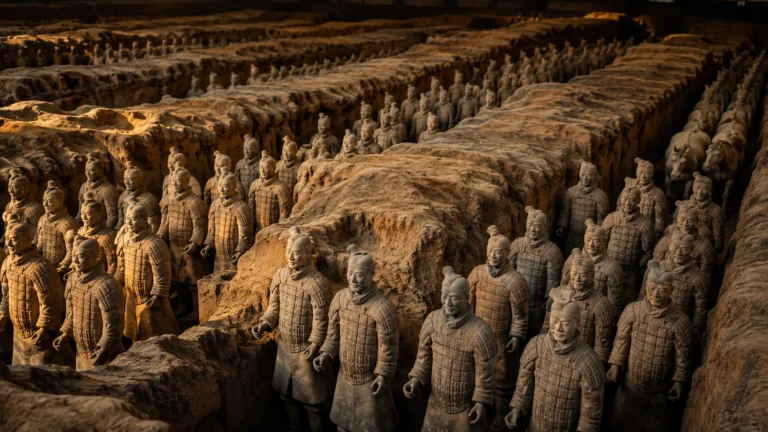
Despite its massive scale, the Terracotta Army was completely lost to history for over 2,000 years. It was only discovered by sheer luck in March 1974. A group of local farmers in Lintong County, Shaanxi Province, were digging a water well during a severe drought when their shovels struck pieces of hardened clay and bronze arrowheads. They had inadvertently uncovered the greatest archaeological find of the 20th century.
2. Every Single Face is Unique
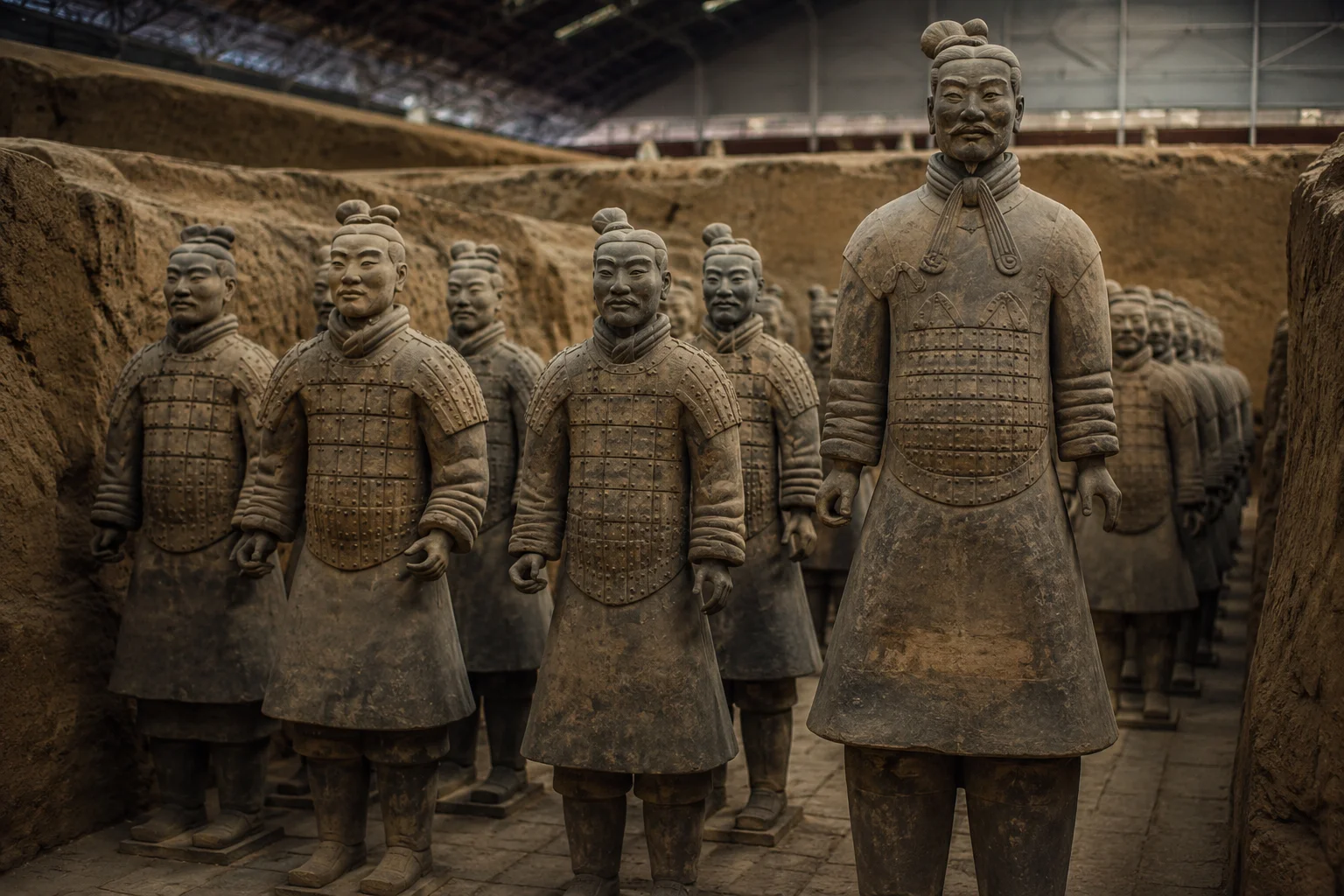
At first glance, the thousands of soldiers might look like clones, but a closer inspection reveals an astonishing fact: no two faces are exactly alike. The ancient artisans used eight basic head molds, but they hand-sculpted individual facial features, expressions, mustaches, and hairstyles onto each soldier using additional clay, reflecting the vast diversity of the emperor’s real-life army.
3. They Were Originally Painted in Bright Colors
Today, we see the soldiers as the dull brownish-gray color of baked clay. However, when they were first buried, they were brilliantly painted in vivid hues of red, green, blue, yellow, and a rare, synthetic pigment known as “Han Purple.” Tragically, when the statues were excavated and exposed to dry modern air, the ancient lacquer underneath the paint curled and flaked off within minutes, erasing their color almost instantly.
4. Height Dictated Military Rank
In the Terracotta Army, size directly correlates with status. The soldiers vary in height, but they are generally larger than the average human of that era, ranging from about 5 feet 8 inches to well over 6 feet. The tallest figures in the pits are the generals and high-ranking officers, making them easily distinguishable from the standard infantrymen.
5. They Held Real, Lethal Weapons
The soldiers were not holding clay props; they were armed with actual, battle-ready bronze weapons. Archaeologists have unearthed tens of thousands of swords, spears, halberds, and crossbow triggers. Astonishingly, many of the swords were still incredibly sharp and completely free of rust when found, thanks to the chemical composition of the bronze and a natural anti-rust layer formed by the soil over millennia.
6. The Emperor’s Tomb Has Never Been Opened
While the pits containing the army have been extensively excavated, the actual burial mound of Emperor Qin Shi Huang remains completely sealed. Archaeologists have chosen not to open the central tomb because they currently lack the advanced preservation technology required to protect whatever fragile artifacts, silks, or texts might be inside from suffering the same fate as the army’s paint.
7. It Is Surrounded by “Rivers of Mercury”
Ancient Chinese historian Sima Qian wrote that the emperor’s tomb contained a massive map of his empire, featuring rivers and oceans made of flowing liquid mercury. For centuries, this was dismissed as a myth. However, modern scientific probes of the unexcavated soil mound have revealed exceptionally high, unnatural levels of mercury, strongly suggesting the ancient legends are true.
8. It Required an “Assembly Line” to Build
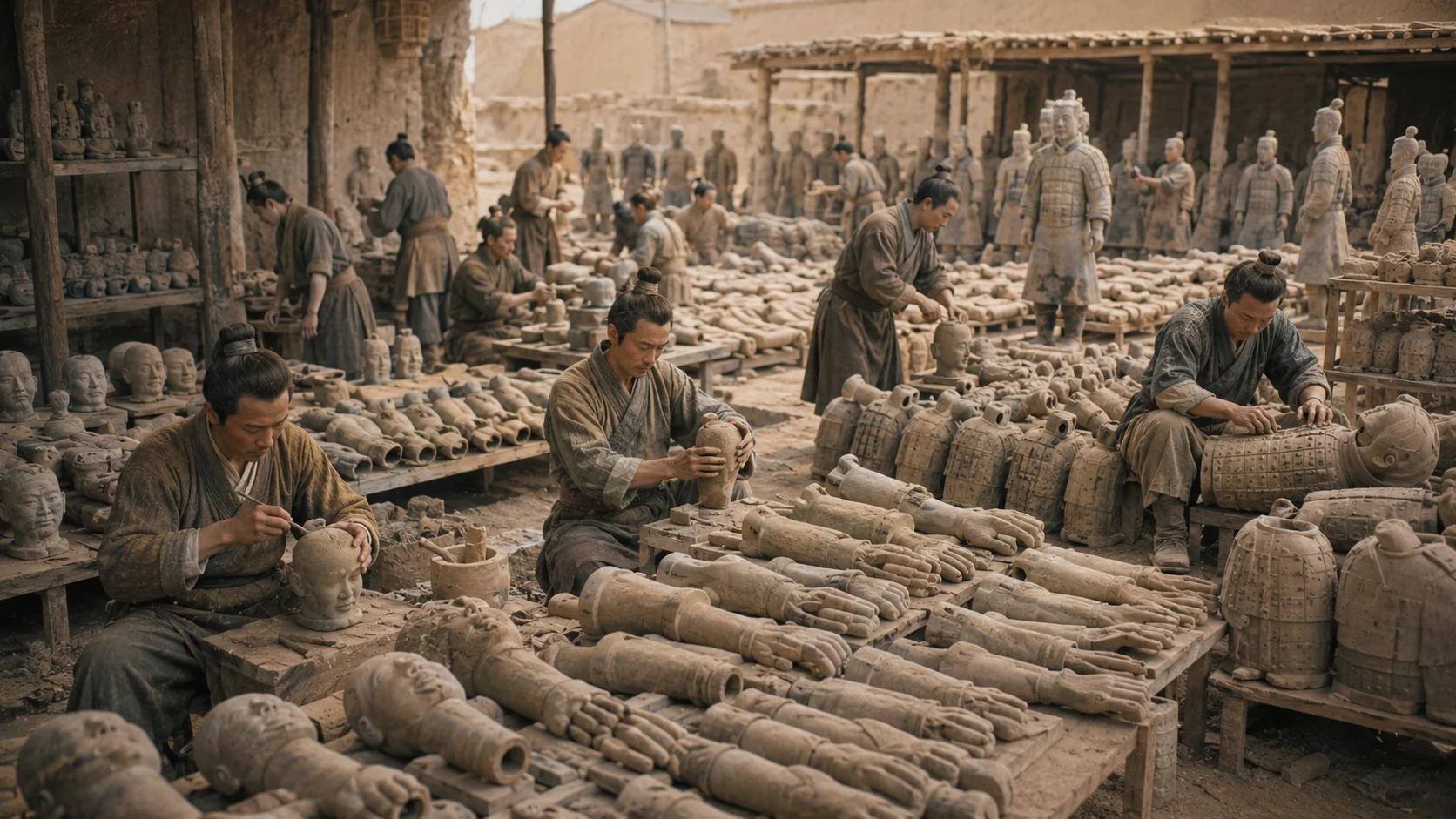
To create an estimated 8,000 soldiers, the Qin dynasty effectively invented an early form of mass-production assembly lines. Distinct workshops produced specific body parts—arms, torsos, hands, and heads—which were then fitted together. This allowed them to produce the army at an astonishingly rapid pace.
9. Quality Control Was Punishable by Death
The emperor demanded absolute perfection. To ensure accountability, every single workshop and foreman was required to stamp their names into the weapons or clay bodies they produced. If a weapon failed in battle or a statue was found to be defective, imperial inspectors could trace it directly back to the maker, who would often face execution for their failure.
10. The Project Took 38 Years and 700,000 Workers
The construction of the emperor’s necropolis was a massive state-sponsored undertaking. It began in 246 BCE, when Qin Shi Huang was just 13 years old, and continued until shortly after his death in 210 BCE. It is estimated that over 700,000 artisans, laborers, and convicts were conscripted from all corners of the newly unified Chinese empire to complete the project.
11. It Contains More Than Just Soldiers
While the military formations are the most famous, the emperor wanted to bring his entire court into the afterlife. Archaeologists have discovered other pits containing terracotta acrobats, strongmen, musicians, civil officials, and even a stream filled with beautifully crafted bronze swans, cranes, and geese to entertain the emperor for eternity.
12. The Army Was Plundered and Burned
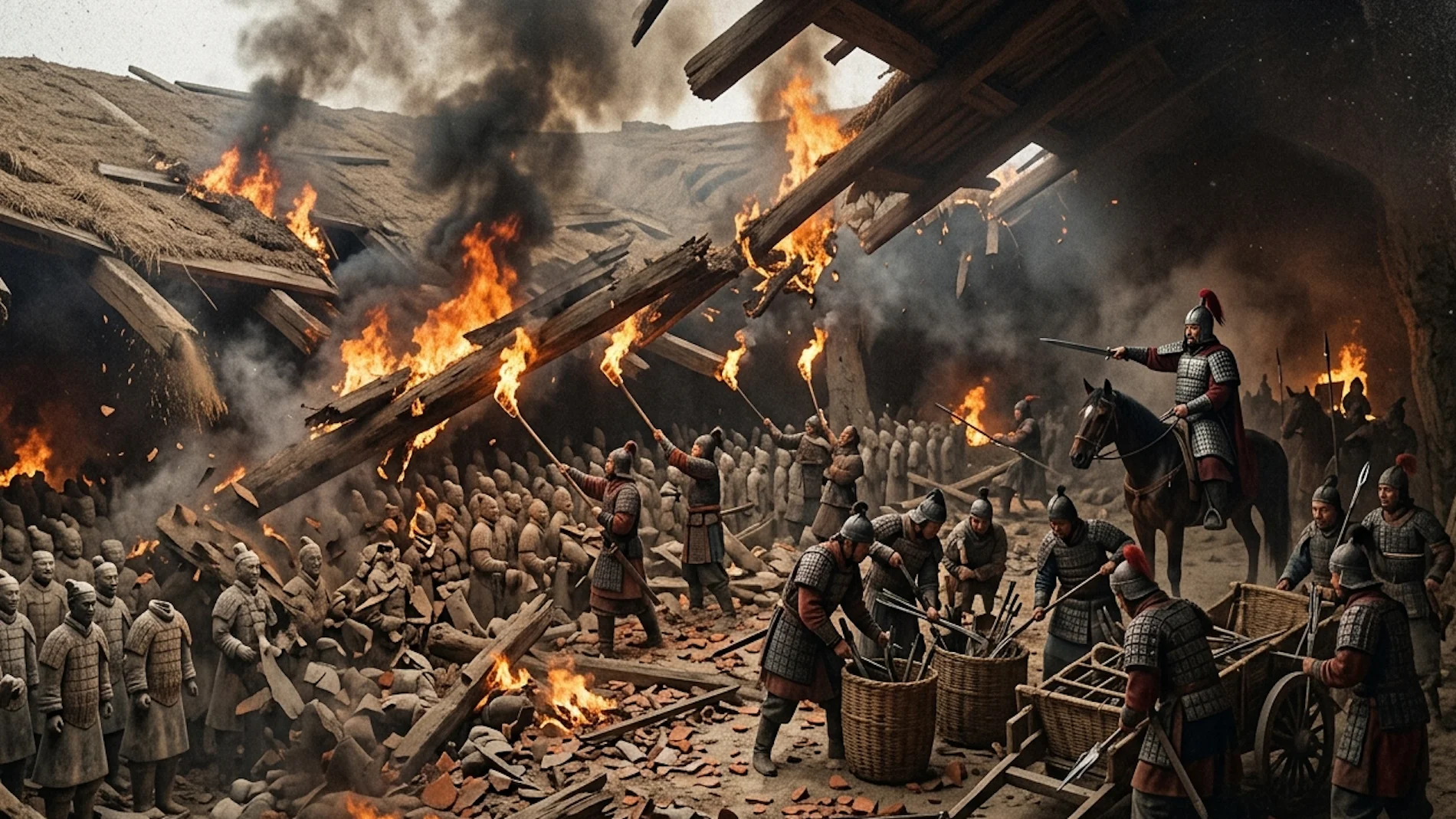
Shortly after the emperor’s death, the Qin dynasty collapsed into civil war. A rebel general named Xiang Yu reportedly raided the pits, stealing the real bronze weapons to arm his own troops. His men then set fire to the massive wooden roofs covering the pits. The roofs collapsed, crushing the terracotta figures into millions of fragments. Today, almost every soldier you see has been painstakingly glued back together.
13. The Soldiers Face East for a Specific Reason
The entire terracotta legion is strategically positioned facing east. During his reign, Emperor Qin Shi Huang conquered six rival warring states to unify China, all of which were located to the east of his home state of Qin. The army faces east to defend the emperor’s tomb from the vengeful spirits of those he conquered.
14. Lethal Booby Traps Were Reportedly Installed
According to ancient records, the central tomb is not just a resting place; it is a fortress. Sima Qian documented that the emperor ordered artisans to install spring-loaded crossbows and arrows rigged to fire upon anyone who breached the tomb’s defenses. Whether these ancient mechanical traps have survived 2,000 years underground remains an intriguing, untested mystery.
15. The Builders Were Buried Alive
The secrets of the necropolis were considered so vital that the emperor’s successor, Qin Er Shi, ordered a horrifying cover-up. According to historical texts, after the burial was complete, the gates to the tomb were permanently sealed while the artisans and laborers who knew the layout of the traps and treasures were still inside, burying them alive so they could never reveal its secrets.