The Real Dracula: 15 Fascinating Facts About Vlad the Impaler
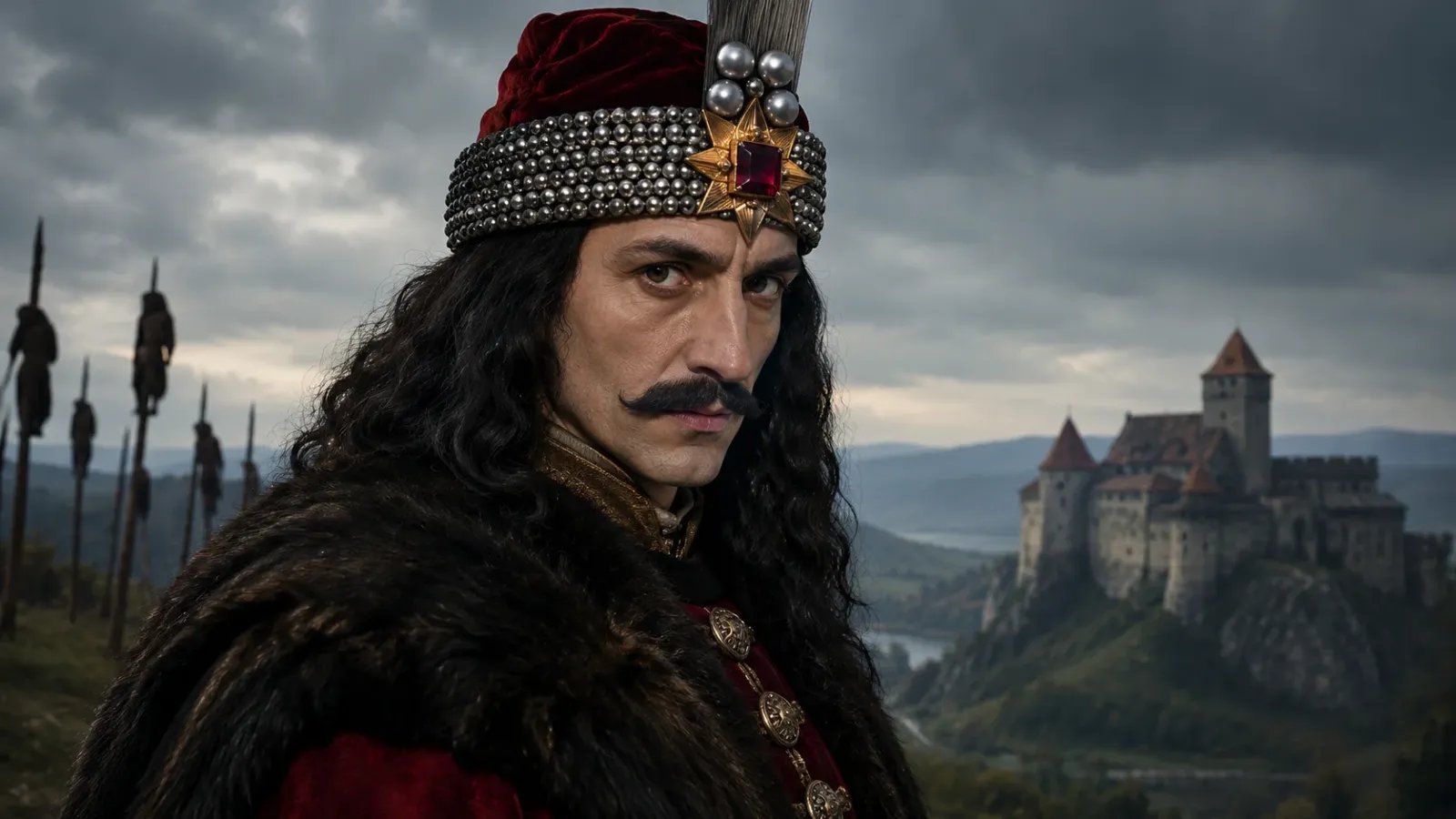
Long before Bram Stoker turned his name into a byword for vampires, Vlad III of Wallachia was a real 15th-century prince who fought the Ottoman Empire and terrified his enemies with mass impalements. Behind the legend lies a story of childhood captivity, family murder, a daring night attack on a sultan and a grave that has never been found.
1. "Dracula" simply means "son of the Dragon."
In 1431, Vlad's father, Vlad II, was admitted to the Order of the Dragon, a Christian order of knights founded by Sigismund of Luxembourg, king of Hungary, to fight the Ottoman Turks. The honor earned him the nickname Dracul, "the Dragon." His son became Dracula, "son of the Dragon." Because the Romanian word drac can also mean "devil," the name later took on a much darker ring.
2. He really was born in Transylvania.
Vlad is traditionally said to have been born around 1431 in Sighișoara, a fortified town in Transylvania, where a house claiming to be his birthplace still stands. Yet the land he actually ruled was Wallachia, the principality just south of the Carpathian Mountains, in what is now southern Romania.
3. He spent part of his youth as a hostage of the Ottoman sultan.
To guarantee his loyalty to the Ottoman Empire, Vlad II sent two of his sons, Vlad and his younger brother Radu, to live at the court of Sultan Murad II in 1442. The brothers took very different paths. Radu, nicknamed "the Handsome," became a favorite of the future sultan Mehmed II, fought on the Ottoman side and later replaced Vlad as ruler of Wallachia.
4. His father and older brother were murdered.
In 1447, Vlad II was killed on the orders of the powerful Hungarian commander John Hunyadi, working with rebellious Wallachian nobles. According to later accounts, Vlad's older brother Mircea was blinded and buried alive by nobles in the city of Târgoviște. Many historians believe these killings shaped Vlad's ruthless treatment of the Wallachian aristocracy.
5. He ruled Wallachia three separate times.
Vlad first seized the throne in 1448 with Ottoman support, but he lost it after only about two months. His main reign lasted from 1456 to 1462, and it is the period behind almost all of his legends. He briefly regained power in 1476, only to be killed a few months later.
6. He never called himself "the Impaler."
Vlad signed his letters as Vlad, voivode (prince) of Wallachia, and sometimes as Dragulya or Drakulya. The Ottomans called him Kazıklı Bey, meaning "the Impaler Lord," and the Romanian nickname Țepeș, from the word for "stake," appears in records only after his death. Impalement was a slow, agonizing execution, and he used it on such a scale that it defined his reputation.
 Rulers, Kings and Emperors
Discover the captivating truths behind history's most iconic rulers, kings, and emperors. From eccentric geniuses and tactical masterminds to deeply flawed sovereigns, explore the hidden lives of those who shaped the modern world.
See All Facts
7. Legend says he forced nobles to build his castle until their clothes fell off.
According to Romanian tradition, Vlad invited the leading nobles and their families to an Easter feast, then had the older ones executed and marched the rest to the mountains to rebuild Poenari Castle above the Argeș River. They supposedly worked until their clothes rotted away. Historians cannot confirm the details, but Poenari's ruins, reached by about 1,480 steps, are still known as Dracula's real castle.
8. He launched a night attack to kill the sultan in his own camp.
In 1462, Mehmed II, the conqueror of Constantinople, invaded Wallachia with an army far larger than Vlad's. On the night of June 17, Vlad led a surprise raid on the Ottoman camp, reportedly hoping to reach the sultan's tent and kill him. The attack caused chaos and heavy casualties, but Mehmed survived.
9. The Ottoman army reportedly found a "forest" of impaled bodies.
The Greek historian Laonikos Chalkokondyles wrote that as the sultan's army approached Târgoviște, it came upon a field of about 20,000 impaled prisoners stretching for miles. The figure is probably exaggerated, but the sight is said to have shaken even the battle-hardened Mehmed II, who soon withdrew from Wallachia.
10. He was one of the first villains of the printing age.
Within a few decades of his reign, German printers were publishing pamphlets about the cruelty of "Dracole Wayda," and the stories sold extremely well. A famous woodcut printed in Nuremberg in 1499 shows him calmly eating a meal surrounded by impaled victims. Much of his gruesome reputation in the West comes from these sensational early publications.
11. A king who should have been his ally imprisoned him for about 12 years.
After his defeat in 1462, Vlad fled to Hungary, but King Matthias Corvinus had him arrested. The king justified the move with letters, now widely considered forgeries, in which Vlad supposedly offered to help the sultan. Vlad spent roughly 12 years in Hungarian custody before he was released, reportedly married a relative of the king and returned to fight the Ottomans.
12. His head was reportedly sent to Constantinople.
Vlad was killed in battle against the Ottomans in late 1476 or early 1477, somewhere near Bucharest. The exact circumstances are unclear. According to contemporary accounts, his head was cut off and sent to Mehmed II in Constantinople as proof that the feared prince was finally dead.
13. Nobody knows where he is buried.
Tradition long held that Vlad was buried at Snagov Monastery on an island near Bucharest. When archaeologists opened the supposed grave there in the 1930s, they reportedly found no trace of his remains. Comana Monastery, which Vlad founded, is another candidate, and a 2014 claim that he was buried in Naples, Italy, was dismissed by historians.
14. In Romania, he is remembered as a hero.
Outside Romania, Vlad is a monster. At home, many people see him as a defender of the nation against the Ottoman Empire and a ruler who stamped out crime and corruption. A famous legend says he left a golden cup at a public fountain in Târgoviște so travelers could drink from it, and nobody ever dared to steal it.
15. Bram Stoker borrowed little more than his name.
Bram Stoker's working notes for Dracula, now held at the Rosenbach Museum in Philadelphia, show that his vampire was originally called Count Wampyr. In 1890, Stoker found the name Dracula in an 1820 book about Wallachia and noted that it meant "devil." He never visited Romania, and Bran Castle, marketed today as Dracula's Castle, has only a tenuous connection to the real Vlad.
Sources & References
This AI-assisted post was rigorously curated and fact-checked for accuracy by:
 Martin Roháček
How fun was this article? 🤔
Tap a star to rate it
🧠 Quiz: How closely were you paying attention?
10 questions — all answers are in the article above!
Enjoyed these facts? There's more! 💌
Fresh fun facts in your inbox. No spam, ever.