
The Red Wilderness: 15 Fascinating Facts About Wadi Rum
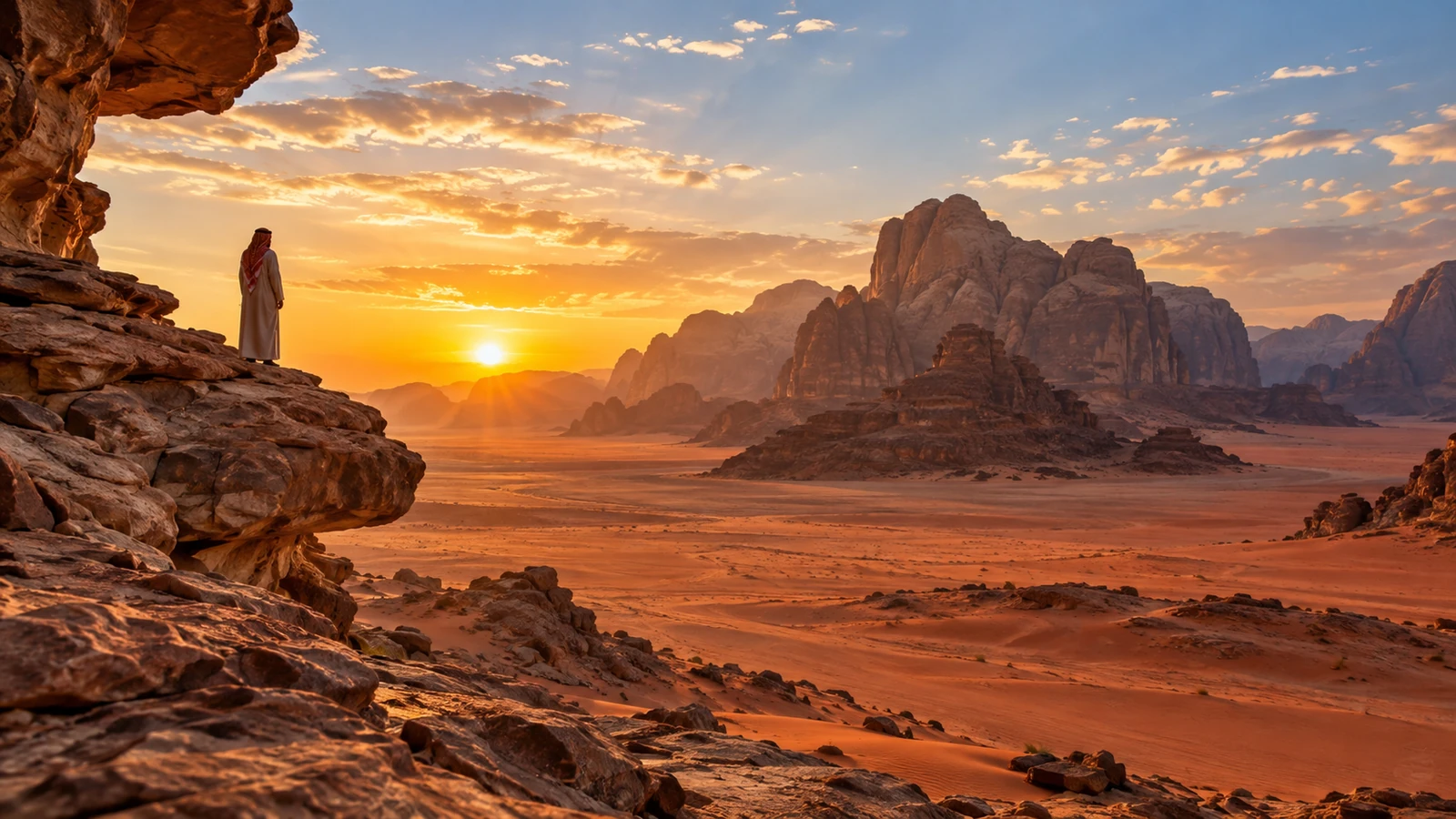
Carved by wind and time into a dramatic landscape of crimson sand and granite monoliths, Jordan's Wadi Rum is one of the world's most breathtaking natural wonders. Known as the Valley of the Moon, this protected wilderness has sheltered human civilizations for over 12,000 years, leaving behind tens of thousands of ancient rock inscriptions. From serving as T. E. Lawrence's strategic headquarters during the Arab Revolt to standing in for Mars in Hollywood blockbusters, Wadi Rum bridges deep history and surreal beauty. Discover fifteen fascinating facts about this UNESCO World Heritage site and the Bedouin communities who call it home.
1. The Name Traces Back to Ancient High Altitude and Lost Civilizations
Wadi Rum is often translated as the "Valley of the Moon," but its exact linguistic origins run much deeper into antiquity. The word "wadi" comes from the Arabic term for a valley or dry riverbed, while "Rum" most likely stems from an Aramaic root meaning "high" or "elevated," referring to the towering sandstone monoliths surrounding the area. Other scholars suggest a historical link to Iram of the Pillars, a legendary lost city mentioned in ancient Middle Eastern texts and the Quran. Semitic languages across the Arabian Peninsula often associated the root with ancient pre-Islamic tribes who grazed livestock in these high desert pastures. Today, the dual name captures both the cosmic landscape and the deep layers of human memory etched into the desert.
2. Over 45,000 Ancient Rock Writings Document Human History
Wadi Rum is effectively a massive open-air library, containing over 25,000 petroglyphs and 20,000 inscriptions carved into its sandstone cliffs. These carvings span nearly 12,000 years of continuous human occupation, ranging from prehistoric hunter-gatherers to classical empires. Visitors can spot Thamudic, Nabataean, Safaitic, and early Arabic scripts alongside detailed depictions of human figures, long-horned ibexes, and hunting scenes. Linguists consider the site crucial for understanding the evolutionary transition from early North Arabian alphabets to modern Arabic script. The inscriptions record personal names, prayers to ancient deities, camel ownership markings, and trading itineraries, offering an unparalleled glimpse into ancient desert life.
3. It Holds Rare Dual UNESCO World Heritage Status
In 2011, UNESCO designated Wadi Rum a World Heritage Site, placing it in an elite category recognized for both natural and cultural criteria. Out of over a thousand UNESCO sites worldwide, relatively few qualify under mixed status, making Wadi Rum's recognition exceptional. The designation honors its breathtaking geomorphological landscape—characterized by narrow gorges, natural arches, and towering sheer cliffs—alongside its massive collection of petroglyphs and archaeological remains. The protected area covers 720 square kilometers of wilderness, ensuring strict conservation standards to shield its fragile desert ecosystem and ancient art from unmanaged development. This status reinforces Jordan's commitment to preserving Bedouin heritage while welcoming international travelers.
4. Iron-Rich Sandstone Creates its Iconic Martian Palette
The fiery red landscape of Wadi Rum owes its striking color to the unique geological composition of its rock layers and sand dunes. The foundation of the valley consists of ancient granite, topped by thick layers of red, yellow, and white sandstone formed hundreds of millions of years ago. Over eons, wind and water eroded these cliffs, releasing iron oxide minerals that coated individual sand grains in a fine layer of rust. This natural chemical process turns the landscape into a dazzling spectrum of dark burgundy, bright red, and soft gold as sunlight shifts throughout the day. Because the terrain closely resembles the rust-colored surface of Mars, scientists and geologists frequently study Wadi Rum as a terrestrial analogue for extraterrestrial desert environments.
5. Hollywood Uses Wadi Rum as the Ultimate Alien Landscape
Wadi Rum's dramatic landscape has made it one of the most famous film locations in cinema history. Directors regularly transform the Jordanian desert into alien worlds, red planets, and fantastical landscapes. It famously starred as Mars in Ridley Scott's The Martian (2015) and served as the desert planet Arrakis in Denis Villeneuve's Dune (2021) and Dune: Part Two (2024). Film crews also utilized the terrain for Rogue One: A Star Wars Story, The Rise of Skywalker, Prometheus, and Disney's live-action Aladdin. The vast horizon, absence of modern infrastructure, and extraordinary light quality allow filmmakers to capture vast, otherworldly expanses without relying entirely on computer-generated imagery.
6. T. E. Lawrence Base Camped Here During the Arab Revolt
British officer T. E. Lawrence, popularly known as Lawrence of Arabia, based his military operations in Wadi Rum during the Arab Revolt against the Ottoman Empire from 1917 to 1918. He worked alongside Prince Faisal bin Hussein and local Bedouin tribal leaders to coordinate surprise guerrilla raids on the Hejaz Railway. Lawrence wrote extensively about the valley in his autobiographical masterpiece, Seven Pillars of Wisdom, describing its red monoliths as "vast, echoing, and God-like." Travelers today can visit Lawrence's Spring, a natural freshwater seep where his troops watered their camels, as well as the ruins of a stone building locally referred to as Lawrence's House. David Lean's epic 1962 film Lawrence of Arabia was shot on location here, forever linking the real-life historical figure to the dramatic landscape.
7. The Ancient Nabataeans Engineered Secret Water Systems Here
Long before Wadi Rum became a global tourist destination, the Nabataeans—the master builders of Petra—recognized the valley's strategic importance along incense trade routes. During the 1st century BCE, they constructed sophisticated water harvesting systems capable of capturing precious flash flood water in an arid environment. Nabataean engineers carved deep cisterns into mountain shadows, built channels along sheer rock faces, and erected masonry dams to retain runoff. At the base of Jebel Rum, archaeologists uncovered the ruins of an intricate Nabataean temple dedicated to the goddess Allat, complete with an adjacent bath complex. These hydraulic innovations allowed large caravans to rest and replenish water supplies in the heart of the desert.
8. Wadi Rum Contains Jordan's Highest Mountain Peak
While many visitors focus on the valley floor, Wadi Rum features some of the highest and most challenging mountain terrain in the Arabian Peninsula. Deep within the reserve near the border with Saudi Arabia stands Jebel Umm al Dami, the highest mountain peak in Jordan at 1,854 meters (6,083 feet) above sea level. On clear days, hikers who reach the summit are rewarded with sweeping views that extend across the Red Sea toward the Sinai Peninsula and the mountains of Saudi Arabia. Another famous peak, Jebel Rum, rises to 1,754 meters and towers directly over Wadi Rum village, making it a legendary destination for international rock climbers. These granite and sandstone summits present technical climbing routes that have challenged mountaineers for decades.
9. The Zalabia Bedouin Shifted from Nomads to Eco-Tourism Custodians
The indigenous Bedouin people of Wadi Rum, primarily from the Zalabia and Zwaydeh tribes, have inhabited these desert lands for centuries. Traditionally semi-nomadic pastoralists who herded goats and camels, their lifestyle adapted significantly over the late 20th century with the rise of global travel. Today, the Zalabia Bedouin manage the majority of eco-camps, jeep tours, and trekking expeditions within the protected area. Rather than displacing the native community, the establishment of the Wadi Rum Protected Area empowered local tribes to act as official stewards of the desert. Their deep traditional knowledge of desert navigation, plant medicine, and weather tracking remains central to visitor safety and cultural preservation.
10. Spectacular Natural Bridges Sculpted by Extreme Weather
Among the most photographically famous geological features in Wadi Rum are its spectacular natural rock arch formations. Burdah Rock Bridge, suspended over 35 meters (115 feet) above the desert canyon floor, is considered one of the highest natural arches in the world and requires a challenging scramble to reach. The lower, more accessible Um Fruth Arch offers a dramatic natural ledge that brave travelers frequently climb for classic desert photos. These arches formed through millions of years of differential erosion, where wind, frost, and rare torrents of flash flood water carved away softer sandstone layers while leaving harder rock caps intact. Other bizarre rock formations across the valley bear local names like "The Mushroom" and "Chicken Rock" due to their unusual weathered silhouettes.
11. It Features Minimal Light Pollution for World-Class Stargazing
Because Wadi Rum is protected from major urban development and surrounded by massive mountain barriers, it suffers virtually no light pollution. At night, the desert sky transforms into a dazzling cosmic display where the Milky Way is clearly visible to the naked eye. Bedouin guides have navigated by these stars for generations, using constellations to calculate time, seasonal shifts, and travel directions across featureless sands. Modern astro-tourism has flourished here, with specialized desert camps featuring clear-roofed "bubble tents" and high-powered telescopes. The dry desert air and high altitude create crystal-clear atmospheric transparency, making Wadi Rum one of the premier dark-sky destinations in the Middle East.
12. Ancient Petroglyphs Reveal a Greener Past with Exotic Wildlife
The ancient rock art of Wadi Rum provides vivid evidence that the regional climate was once far wetter and greener than the desert seen today. Thousands of years ago, during the African Humid Period, Savannah-like grasslands covered parts of the Arabian Peninsula. Petroglyphs etched onto canyon walls display animals that no longer inhabit the valley, including ostriches, lions, wild bovines, and leopards. These depictions prove that ancient hunters coexisted with large game species before desertification forced wildlife to retreat or go extinct. Today, the surviving fauna is adapted to hyper-arid conditions, including the Nubian ibex, desert hedgehogs, red foxes, and the Arabian oryx, which was successfully reintroduced to the reserve.
13. The "Seven Pillars of Wisdom" Mountain Was Named After the Book
One of the most recognizable landmarks in Wadi Rum is a massive rock formation featuring seven distinct, vertical sandstone flutes known as the "Seven Pillars of Wisdom." Popular tourist folklore often claims that T. E. Lawrence named his famous book after this striking mountain during his time in the desert. However, historical records reveal that the reverse is actually true: the mountain was named in the 1980s by local tourism authorities in honor of Lawrence's classic memoir. Lawrence had chosen his book title from the biblical Book of Proverbs ("Wisdom hath builded her house, she hath hewn out her seven pillars") before ever setting foot in Jordan. Despite the myth, the towering rock formation remains an iconic visual backdrop near the visitor center entrance.
14. Hidden Natural Springs Support Oasis Ecosystems
Despite receiving less than 50 millimeters (2 inches) of rain per year, Wadi Rum hides several permanent freshwater springs fed by underground aquifers. Water percolates down through porous sandstone until it hits impermeable granite layers, trickling out along cliff bases in steep, shady canyons. Springs such as Ain Shalla and Lawrence's Spring create microscopic oasis microclimates that support lush clusters of wild mint, maidenhair ferns, desert lavender, and fig trees. Bedouins have relied on these hidden water pockets for generations to supply their herds, while desert wildlife depends on them for survival. Ancient camel drivers carved steps into rock walls to access these high perched springs during long journeys across the desert.
15. Culinary Tradition Centered Around Underground Pit Cooking Called Zarb
Bedouin hospitality in Wadi Rum is world-renowned, and its centerpiece is a traditional subterranean cooking method known as zarb. Influenced by ancient nomadic techniques, zarb involves digging a deep hole in the desert sand, filling it with hot acacia coals, and placing a multi-tiered metal rack loaded with marinated chicken, lamb, and vegetables inside. The pit is sealed tightly with a heavy lid, blankets, and sand to trap all heat and moisture, allowing the meat to slow-roast underground for hours. When uncovered before guests, the fall-off-the-bone tender meat infuses dinner with a distinct smoky flavor, serving as both a culinary highlight and a cultural ritual of Bedouin gathering.
Sources & References
This AI-assisted post was rigorously curated and fact-checked for accuracy by:
 Martin Roháček
How fun was this article? 🤔
Tap a star to rate it
🧠 Quiz: How closely were you paying attention?
10 questions — all answers are in the article above!
Enjoyed these facts? There's more! 💌
Fresh fun facts in your inbox. No spam, ever.