1. Apprenticed as a Butcher
Before becoming one of the most celebrated composers in history, Antonín Dvořák was initially destined for a completely different life. As the eldest of fourteen children born to an innkeeper in a small Bohemian village, it was assumed he would take over the family business. At the age of thirteen, he was formally apprenticed and inducted into the local Butcher’s Guild in Zlonice. Fortunately for the musical world, his unmistakable talent on the violin and organ eventually convinced his pragmatic father to let him pursue a formal music education in Prague instead of cutting meat.
2. Discovered by Johannes Brahms
Dvořák spent the first three decades of his life in relative obscurity and crushing poverty, scraping by as a viola player in theater orchestras. His massive breakthrough occurred in 1874 when he submitted a portfolio of compositions for the Austrian State Stipend, a financial award for struggling artists. Legendary composer Johannes Brahms was serving on the jury and was absolutely astounded by the young Bohemian’s raw talent. Brahms not only awarded him the prize but personally recommended Dvořák to his own influential publisher, instantly launching his international career and sparking a lifelong friendship between the two musical giants.
3. An Obsessive Trainspotter
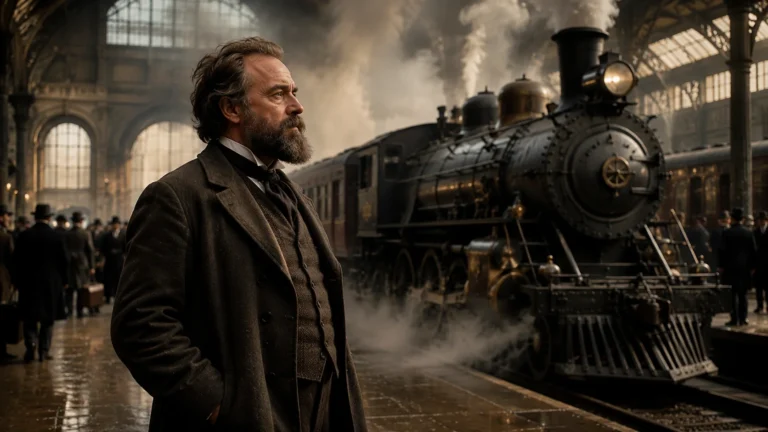
Behind his serious, bearded exterior, Dvořák harbored a lifelong, intense obsession with locomotives and the expanding railway system. He spent countless hours memorizing international train schedules, recording specific locomotive engine numbers, and conversing with railway engineers. Whenever he lived in Prague or Vienna, he maintained a strict daily ritual of taking morning walks to the local train stations just to watch the express trains arrive and depart. When he eventually moved to New York City, he transferred this mechanical fascination to the massive steamships arriving in the harbor, tracking their trans-Atlantic travel times with meticulous precision.
4. The Astronomical American Salary
In 1892, an American philanthropist named Jeannette Thurber was determined to establish a distinct national style of classical music in the United States. She lured Dvořák across the Atlantic to become the director of the National Conservatory of Music in New York City with an offer he simply could not refuse. Thurber offered him an astronomical annual salary of fifteen thousand dollars, which was roughly twenty-five times what he was earning as a professor in Prague. This incredible financial security allowed him to focus entirely on his craft, leading to the most productive and iconic period of his entire career.
5. Champion of African American Spirituals
Upon arriving in the United States, Dvořák shocked the traditional classical music establishment with a highly progressive and radical declaration. He told American journalists that the future of their nation’s classical music must be built upon the foundation of African American spirituals and Native American melodies. He worked closely with a talented Black student named Harry T. Burleigh, who spent hours singing traditional plantation spirituals to the captivated composer. Dvořák deeply respected these rich, emotional melodies, asserting they contained everything needed for a great and noble school of American music.
6. Escaping to Spillville, Iowa
Despite his massive success in New York City, Dvořák suffered from severe homesickness and detested the chaotic noise of urban American life. For his summer vacation in 1893, he brought his entire family to Spillville, Iowa, a remote and quiet farming community settled primarily by Czech immigrants. Surrounded by familiar food, language, and culture, the composer felt completely rejuvenated and spent his days playing the organ at the local St. Wenceslas Church. This peaceful rural retreat in the American Midwest inspired some of his most joyous and famous chamber music works.

7. An Annoying Bird Inspired a Masterpiece
While enjoying his peaceful summer walks along the Turkey River in Iowa, Dvořák encountered a local songbird that persistently interrupted his thoughts. The bright red bird, widely believed by ornithologists to be a Scarlet Tanager or a Red-eyed Vireo, sang a catchy, repetitive melody that the composer found highly distracting. Rather than ignoring it, Dvořák rapidly transcribed the bird’s song and integrated it directly into the third movement of his famous String Quartet in F major. He composed the entire masterpiece, now known as the American Quartet, in just sixteen days during his stay in Spillville.
8. The Goin Home Spiritual Myth
The second movement of his Symphony From the New World features a sweeping, melancholic melody played by the English horn that is famous around the globe. Because it sounds so authentically rooted in American folk music, a massive misconception persists that Dvořák simply copied an existing African American spiritual called Goin Home. In reality, the exact opposite is true, as Dvořák composed the haunting melody entirely from scratch. Decades later, his former student William Arms Fisher added the nostalgic lyrics to the composer’s original melody, creating a piece of sheet music that mistakenly became known as a traditional folk song.
9. He Married His Crush’s Younger Sister
Dvořák’s personal life featured a highly unusual romantic trajectory during his early years as a struggling musician in Prague. He was hired as a piano tutor for a wealthy family and fell deeply in love with his teenage pupil, Josefina Cermakova, but she ultimately rejected his affections and married an aristocrat. Years later, Dvořák began courting Josefina’s younger sister, Anna, who was an excellent singer and deeply appreciated his musical genius. The two were married in 1873, and despite the awkward origins of their relationship, they enjoyed a remarkably happy and supportive marriage that produced nine children.
10. A Deep Affection for Pigeons
When he was not composing symphonies or chasing steam locomotives, Dvořák found immense peace in the quiet hobby of raising birds. At his beloved summer estate in the Bohemian countryside of Vysoka, he built large aviaries and became an enthusiastic pigeon fancier. He lovingly bred various specialized types of pigeons, often spending hours sitting in his garden simply watching them fly and listening to their cooing. He considered the birds to be perfect, beautiful creations of nature, and this quiet rural hobby provided a necessary mental escape from the intense pressures of his international fame.
11. Crippling Bouts of Agoraphobia
Despite his global fame and required public appearances, Dvořák silently battled severe anxiety and agoraphobia during the later decades of his life. The composer experienced an intense, irrational fear of open spaces, crowded streets, and public interactions, which sometimes left him terrified to leave his own home without a companion. His nervous condition became so overwhelmingly debilitating that he actually missed the highly anticipated premiere of his own New World Symphony in certain cities. His family and close friends had to carefully manage his travel schedules and provide constant reassurance to help him navigate his professional obligations.
12. His Music Went to the Moon
The cultural impact of Dvořák’s time in America was so profound that his music eventually left the Earth entirely. When American astronauts Neil Armstrong and Buzz Aldrin embarked on the historic Apollo 11 mission in 1969, they were allowed to bring custom cassette tapes of their favorite music for the journey. Armstrong specifically selected a recording of Dvořák’s Symphony From the New World to play in the command module as they soared through space. It was a fitting, poetic tribute that a symphony inspired by the discovery of a new continent was played during humanity’s first voyage to another world.

13. A Lifelong Devotion to Nature
Dvořák possessed a profound, almost spiritual connection to the natural world that heavily influenced his compositional style. He was an avid, tireless hiker who regularly took long, solitary walks through the dense Bohemian forests, finding musical inspiration in the rustling leaves and flowing rivers. He frequently stated that he studied the songs of birds and the sounds of the wind just as closely as he studied the works of Beethoven and Mozart. This deep immersion in nature is exactly what gives his symphonic works their incredibly organic, pastoral, and vibrant energy.
14. His Final Years Were Dedicated to Opera
While audiences worldwide celebrated him primarily for his towering symphonies and chamber music, Dvořák’s greatest personal ambition was to be recognized as a master opera composer. Upon returning permanently to Europe from the United States, he essentially abandoned writing symphonies and dedicated the final years of his life almost entirely to dramatic vocal works. His ultimate masterpiece, Rusalka, beautifully combined his mastery of orchestration with a tragic, fairy-tale narrative heavily inspired by Slavic mythology. It remains one of the most beloved and frequently performed Czech operas in the global repertoire today.
15. A Sudden and Mysterious Passing
In the spring of 1904, the composer was still actively searching for new opera librettos and experiencing a massive surge of creative energy. However, he fell ill with what initially appeared to be a severe case of influenza, which subsequently developed into complications involving his kidneys. On the first day of May, while eating a meal with his family, he suddenly collapsed and died at the age of sixty-two. While medical historians debate whether the exact cause was a stroke or sudden heart failure, his unexpected passing sent shockwaves through the musical world and prompted massive national mourning in Prague.
Sources and References