The Impregnable Fortress: 15 Fascinating Facts About Alcatraz
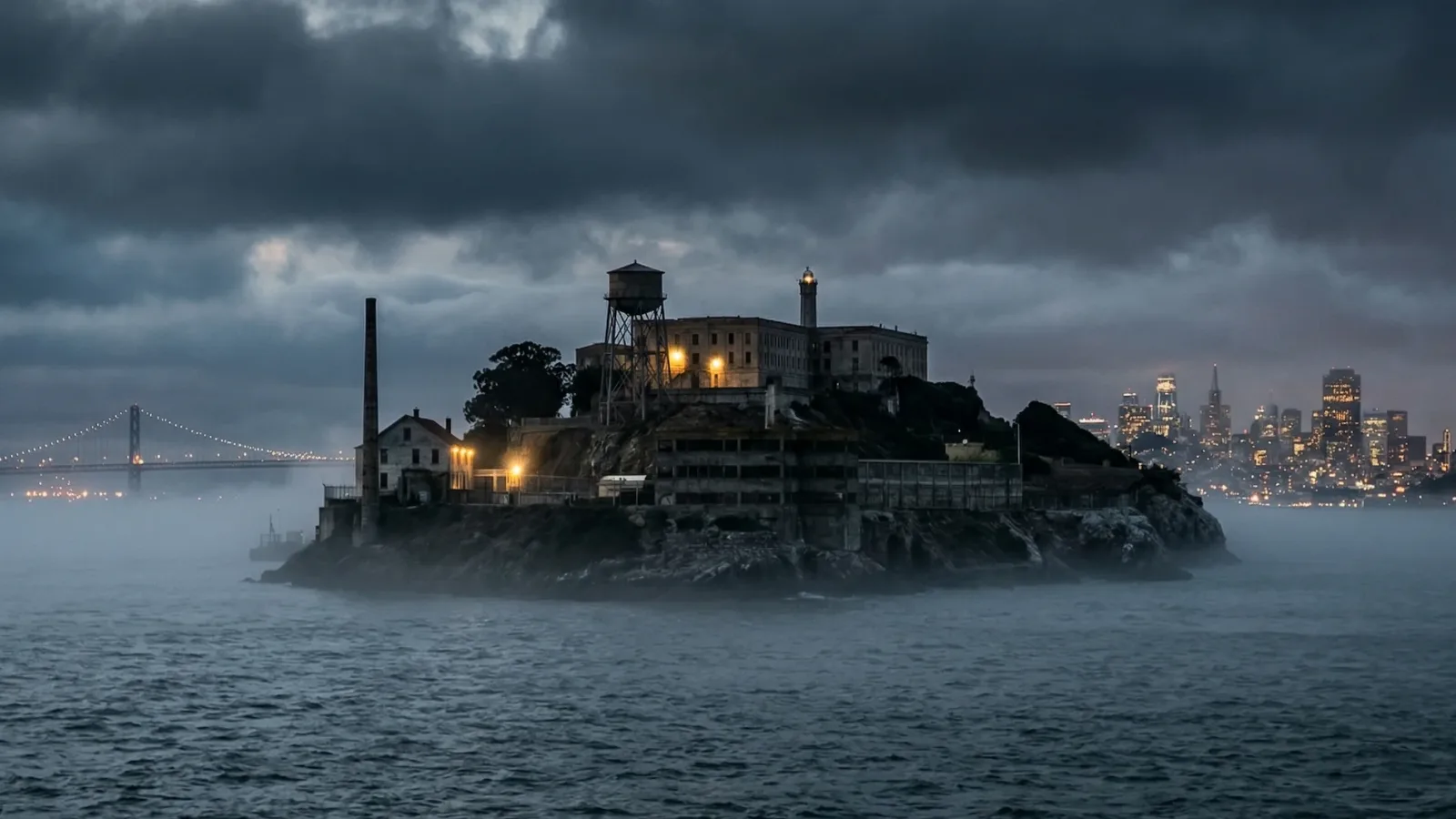
Perched in the icy, treacherous waters of San Francisco Bay, Alcatraz Island is universally remembered as America's ultimate high-security prison. Yet beneath its terrifying reputation lies a complex history filled with surprising administrative quirks, civil rights milestones, and bizarre daily realities. From mobsters performing in inmate bands to guards' children riding bicycles outside the cell blocks, the true story of 'The Rock' extends far beyond Hollywood legend. Here are 15 fascinating facts that reveal the hidden, extraordinary history of America's most famous island fortress.
1. It Was Actually a Desired Assignment for Prisoners
Despite its terrifying reputation as an inescapable hellhole, Alcatraz was surprisingly coveted by many federal prisoners across the United States. The federal penitentiary operated on a strict one-man-per-cell policy, meaning inmates never had to worry about being robbed or assaulted by dangerous cellmates. This offered incarcerated men an unprecedented degree of personal safety and privacy that was practically unheard of in other overcrowded, violent federal facilities. Furthermore, inmates who followed the rules enjoyed privileges like library access, radio listening hours, and musical instrument practice. For hardened criminals trapped in chaotic federal penitentiaries, a transfer to "The Rock" often represented a welcome refuge of predictable order and security.
2. The Guards Served Premium Gourmet Food to Prevent Riots
Prison administrators understood that poor meal quality was the single primary catalyst behind almost every major prison riot in American history. To completely eliminate this volatile threat, Alcatraz intentionally served the highest quality food in the entire federal prison system. The daily menu featured fresh fruits, roasted meats, hot baked goods, and elaborate desserts prepared by trained inmate chefs under strict supervision. Guard towers were equipped with tear-gas canisters directly above the dining hall as a precaution, but the strategy worked remarkably well. By keeping prisoners thoroughly well-fed and satisfied, the facility effectively neutralized dining hall unrest before it could ever start.
3. Hot Showers Were Used as an Anti-Escape Tactic
While warm running water might sound like a luxurious amenity for federal prisoners, the prison's mandatory hot shower policy was actually a calculated physical tactic. The administration deliberately restricted inmates to hot water so their bodies would never acclimatize to frigid temperatures. Guards reasoned that if prisoners were kept accustomed to heat, their systems would suffer severe thermal shock if they ever entered San Francisco Bay. The water surrounding the island averages a bone-chilling 50 to 55 degrees Fahrenheit year-round. This clever physiological strategy ensured that any escapee attempting a long swim would quickly be paralyzed by cold water shock and severe hypothermia.
4. Prison Officials Intentionally Spread Shark Rumors
To further demoralize potential escapees, guards actively cultivated and amplified rumors that San Francisco Bay was infested with aggressive, man-eating sharks. In truth, the marine ecosystem surrounding the island is primarily home to small, harmless species like leopard sharks and bottom-feeding dogfish. Great white sharks do occasionally enter the bay, but attacks near Alcatraz are virtually non-existent due to water salinity and swimming patterns. However, the psychological campaign was extraordinarily successful at planting deep psychological dread in the minds of inmates. Many prisoners genuinely believed that entering the water meant immediate dismemberment by hungry ocean predators.
5. Al Capone Played Banjo in the Prison Band
When notorious Chicago mob boss Al Capone arrived at Alcatraz in 1934, he quickly learned that his vast wealth and political connections held zero power inside the walls. Stripped of his gangland influence, Capone eventually chose to adapt and become a compliant, model inmate to earn basic privileges. He secured permission to order a banjo and joined the inmate band known as the Rock Islanders. Every Sunday afternoon, Capone peacefully practiced and performed jazz and traditional songs alongside fellow prisoners in the recreation yard. The former crime lord who once ruled Chicago's underworld spent his final incarcerated years strumming folk music on an isolated island fortress.
6. No Prisoner Was Ever Officially Executed on the Island
Although Alcatraz housed some of the most dangerous, violent criminals in American history, the facility completely lacked an execution chamber. During its entire 29-year operation as a federal penitentiary, not a single inmate was officially put to death on the island. If an inmate committed a capital offense or arrived with a death sentence, they were quietly transferred across the bay to San Quentin State Prison. San Quentin possessed California's official gas chamber and handled all state and federal executions in the region. Consequently, while 15 inmates died of natural causes and eight were killed by fellow prisoners, zero official executions occurred at Alcatraz.
7. The Famous 1962 Escape Remains an Unsolved Mystery
Alcatraz officially maintained that no prisoner ever successfully escaped from the island fortress. Out of 36 men who attempted to flee across 14 separate incidents, nearly all were killed, recaptured, or drowned in the treacherous bay. However, the famous June 1962 escape of Frank Morris and brothers John and Clarence Anglin remains an agonizing open case. The trio meticulously crafted dummy heads out of soap, toilet paper, and real human hair to fool guards while they dug through air vents. Using a homemade raft made from over 50 stolen raincoats, they vanished into the foggy night and were never seen again. While authorities believe they drowned, no bodies were ever recovered, leaving their ultimate fate an unsolved legend.
8. Guards and Their Families Lived on the Island
Behind the imposing concrete walls and barbed wire, Alcatraz was home to a tight-knit residential community of prison officers and their families. Dozens of children grew up on the island, playing games in courtyards, flying kites, and roller-skating right beneath guard towers. Family members enjoyed amenities like a bowling alley, a soda fountain shop, and social halls for community gatherings. Every weekday morning, the children boarded an official military ferry boat to commute across the bay to attend public school in San Francisco. Many former residents recall their childhood on "The Rock" as an incredibly safe, nostalgic, and idyllic upbringing.
9. The "Birdman of Alcatraz" Kept No Birds on the Island
One of the prison's most famous historical inmates was Robert Stroud, widely known across pop culture as the "Birdman of Alcatraz." His legendary moniker was immortalized by a Hollywood feature film starring actor Burt Lancaster. However, the famous title is a massive historical misnomer because Stroud was completely forbidden from keeping birds at Alcatraz. His famous ornithological research and bird-breeding experiments actually took place decades earlier while he was incarcerated at Leavenworth Penitentiary in Kansas. By the time Stroud was transferred to Alcatraz in 1942, prison officials confiscated his avian equipment and forbade him from keeping any animals in his cell.
10. It Was Originally a Civil War Military Citadel
Long before it was established as a high-security federal civilian prison, Alcatraz served as a massive military fortress. Following the California Gold Rush of 1849, the United States Army recognized the strategic need to protect San Francisco Bay's incredible wealth. By the 1850s, the military transformed the barren rock into a formidable citadel equipped with over 100 heavy cannons, making it the most heavily fortified post on the Pacific Coast. During the American Civil War, the island citadel served as an arsenal and housed Confederate sympathizers and military prisoners. This military foundation eventually paved the way for its conversion into a long-term army prison and later a federal penitentiary.
11. It Featured the West Coast's First Operational Lighthouse
Dense maritime fog and treacherous rocky shoals made navigating San Francisco Bay notoriously dangerous for 19th-century sailing vessels. To assist incoming ships during the Gold Rush, the United States government constructed the West Coast's very first operational lighthouse on Alcatraz Island in 1854. The original 84-foot brick tower predated the federal penitentiary by eight decades and illuminated the bay entrance for crucial trade vessels. The structure was eventually damaged during the catastrophic 1906 San Francisco earthquake and replaced with a taller, concrete tower in 1909. Today, this historic lighthouse remains the oldest continually operating light station on the American Pacific Coast.
12. An Early "Rule of Silence" Driven Inmates Insane
In the early years of the federal penitentiary during the 1930s, Warden James A. Johnston instituted a strict, unforgiving "Rule of Silence." Inmates were completely forbidden from talking to one another during meals, work shifts, or lining up in corridors, with talking restricted strictly to weekend recreation hours. Violating this rule resulted in immediate solitary confinement in dark dungeon cells on a bread-and-water diet. The prolonged sensory deprivation and total isolation proved to be psychologically devastating, leading to severe mental breakdowns and inmate self-harm. Recognizing the catastrophic psychological damage caused by the policy, prison officials finally abolished the rule of silence in 1937.
13. Inmates Maintained Stunning Outdoor Gardens
To promote psychological stability and foster productive daily routines, prison administrators allowed well-behaved inmates to participate in outdoor gardening programs. Inmates painstakingly restored, expanded, and maintained elaborate terraced gardens originally planted by military officers' wives in the 19th century. Working high on the island's rocky slopes, prisoners cultivated vibrant succulents, heirloom roses, fig trees, and flowering shrubs. These delicate, colorful gardens provided a striking visual contrast against the harsh concrete guard towers and rusted barbed wire. Today, conservationists actively preserve these historic gardens, which continue to bloom across the island as a living legacy of inmate craftsmanship.
14. Astronomical Operating Costs Forced its Closure
Contrary to popular belief, Alcatraz was not shut down because of the famous 1962 escape attempt or public outcry over inmate treatment. The facility was closed in March 1963 primarily because it was a ruinous financial disaster for the federal government. Operating an isolated island fortress required shipping every essential commodity across the bay, including over one million gallons of fresh drinking water every week. Additionally, exposure to harsh saltwater air severely eroded the island's concrete buildings and iron infrastructure, requiring millions in repairs. Running Alcatraz cost nearly three times more per inmate than any other federal penitentiary in the nation, making closure inevitable.
15. Native American Activists Occupied the Island for 19 Months
Six years after the federal prison shuttered, Alcatraz became the focal point of a historic civil rights milestone. From November 1969 to June 1971, a collective of Native American activists known as the Indians of All Tribes occupied the island for 19 months. Citing the 1868 Treaty of Fort Laramie, which stated retired federal land should return to Native peoples, they demanded the island be transformed into a Native American cultural and educational center. Though the federal government eventually forcibly removed the final protesters, the high-profile occupation fundamentally altered American Indian federal policy, ushering in an era of tribal self-determination.
Sources & References
This AI-assisted post was rigorously curated and fact-checked for accuracy by:
 Martin Roháček
How fun was this article? 🤔
Tap a star to rate it
🧠 Quiz: How closely were you paying attention?
10 questions — all answers are in the article above!
Enjoyed these facts? There's more! 💌
Fresh fun facts in your inbox. No spam, ever.