The Run for the Roses: 15 Fascinating Facts About the Kentucky Derby
The Kentucky Derby lasts about two minutes, yet it has more than 150 years of drama behind it. Its first champions were Black jockeys, its speed record has stood for over half a century, and one of its biggest winners only got into the race because another horse dropped out the day before. Here is the story behind America's most famous horse race.
1. The first Kentucky Derby was won by a Black jockey.
On 17 May 1875, around 10,000 spectators watched 15 three-year-old horses contest the first Kentucky Derby. The winner was a colt named Aristides, ridden by the Black jockey Oliver Lewis and trained by Ansel Williamson, a formerly enslaved man who later entered the Hall of Fame. Thirteen of the 15 jockeys in that first race were African American.
2. Black jockeys dominated the early decades of the race.
Before the 1900s, Black horsemen were among the most skilled riders and trainers in American racing. Black jockeys won 15 of the first 28 Kentucky Derbies. Isaac Burns Murphy won three of them, in 1884, 1890 and 1891, and in 1955 he became the first jockey inducted into the National Museum of Racing's Hall of Fame. Segregation and discrimination later pushed Black jockeys out of the sport almost entirely.
3. The race was modelled on an English original.
In 1872, Colonel Meriwether Lewis Clark Jr., a grandson of the explorer William Clark of the Lewis and Clark Expedition, travelled to England to see the Derby at Epsom. Inspired, he returned home and founded a racetrack in Louisville, which later became known as Churchill Downs. The Kentucky Derby was originally run over 1.5 miles, the same distance as the Epsom Derby, before it was shortened to 1.25 miles in 1896.
4. It has been held every year since 1875.
The Kentucky Derby is one of the longest continuously held sporting events in the United States and has never been cancelled. It has only been moved within the same year twice. In 1945, wartime restrictions pushed it back to June. In 2020, the COVID-19 pandemic moved it from May to 5 September, and it was run without spectators for the first time.
5. Secretariat's 1973 record has never been broken.
In 1973, Secretariat won the Derby in a time of 1 minute 59.4 seconds, breaking the record set by Northern Dancer in 1964. Remarkably, he ran each quarter-mile faster than the one before, accelerating all the way to the finish. More than 50 years later, no horse has run the race faster. Secretariat went on to win the Triple Crown that year.
6. The winner is draped in more than 400 roses.
The Derby is nicknamed "The Run for the Roses" because the winning horse receives a garland of more than 400 red roses sewn onto a green satin backing. The garland is assembled by hand the day before the race. The tradition of presenting roses dates back to the late 19th century, and the rose became the official flower of the race in 1904.
7. The race has its own official cocktail.
The mint julep, a drink made of bourbon, fresh mint and sugar syrup, is the traditional beverage of the Kentucky Derby. Around 120,000 juleps are typically served at Churchill Downs over Derby weekend. Since 1939, fans have been able to take home souvenir julep glasses printed with the names of every previous winner, and the design changes every year.
8. Every horse gets just one chance.
The Kentucky Derby is open only to three-year-old thoroughbreds, so no horse can ever run in it twice. Colts and geldings carry 126 pounds (57 kilograms), while fillies carry slightly less. Only three fillies have ever won the race: Regret in 1915, Genuine Risk in 1980 and Winning Colors in 1988.
9. "My Old Kentucky Home" has been sung before the race for a century.
As the horses step onto the track for the post parade, the University of Louisville marching band plays Stephen Foster's "My Old Kentucky Home", and many of the spectators sing along. The tradition began in 1921. In 2020, when there were no fans in the stands, the song was played on a solitary bugle instead.
10. The first winner to be disqualified on the track came in 2019.
In 2019, Maximum Security crossed the finish line first but was disqualified for drifting out of his lane and interfering with other horses. It was the first time in the race's history that the winner had been disqualified for an incident during the race. Victory was awarded to Country House, a long shot at odds of 65 to 1.
11. An 80-1 outsider won after getting in at the last minute.
In 2022, Rich Strike was not even in the field until another horse was scratched the day before the race. Starting from the outermost gate at odds of 80 to 1, he weaved through the pack to win in one of the biggest upsets in the race's history. Only Donerail, who won at odds of 91 to 1 in 1913, was a bigger long shot.
12. A Hall of Fame jockey lost the Derby by misjudging the finish line.
In 1957, legendary jockey Bill Shoemaker was making a powerful closing drive aboard Gallant Man, battling Iron Liege for the lead. Just as they pulled even, Shoemaker stood up in the stirrups too early, misjudging the finish line. The brief hesitation stalled Gallant Man's momentum, allowing Iron Liege to hold on and win by a nose. Despite the famous blunder, Shoemaker amassed a total of four Derby victories throughout his illustrious career.
13. The first woman to ride in the Derby did so in 1970.
Diane Crump made history in 1970 as the first female jockey to ride in the Kentucky Derby, finishing 15th aboard Fathom. A year earlier, she had become the first woman to ride in a professional pari-mutuel race in the United States. Since then, only a handful of women have ridden in the Derby.
14. The extravagant hats are part of the plan.
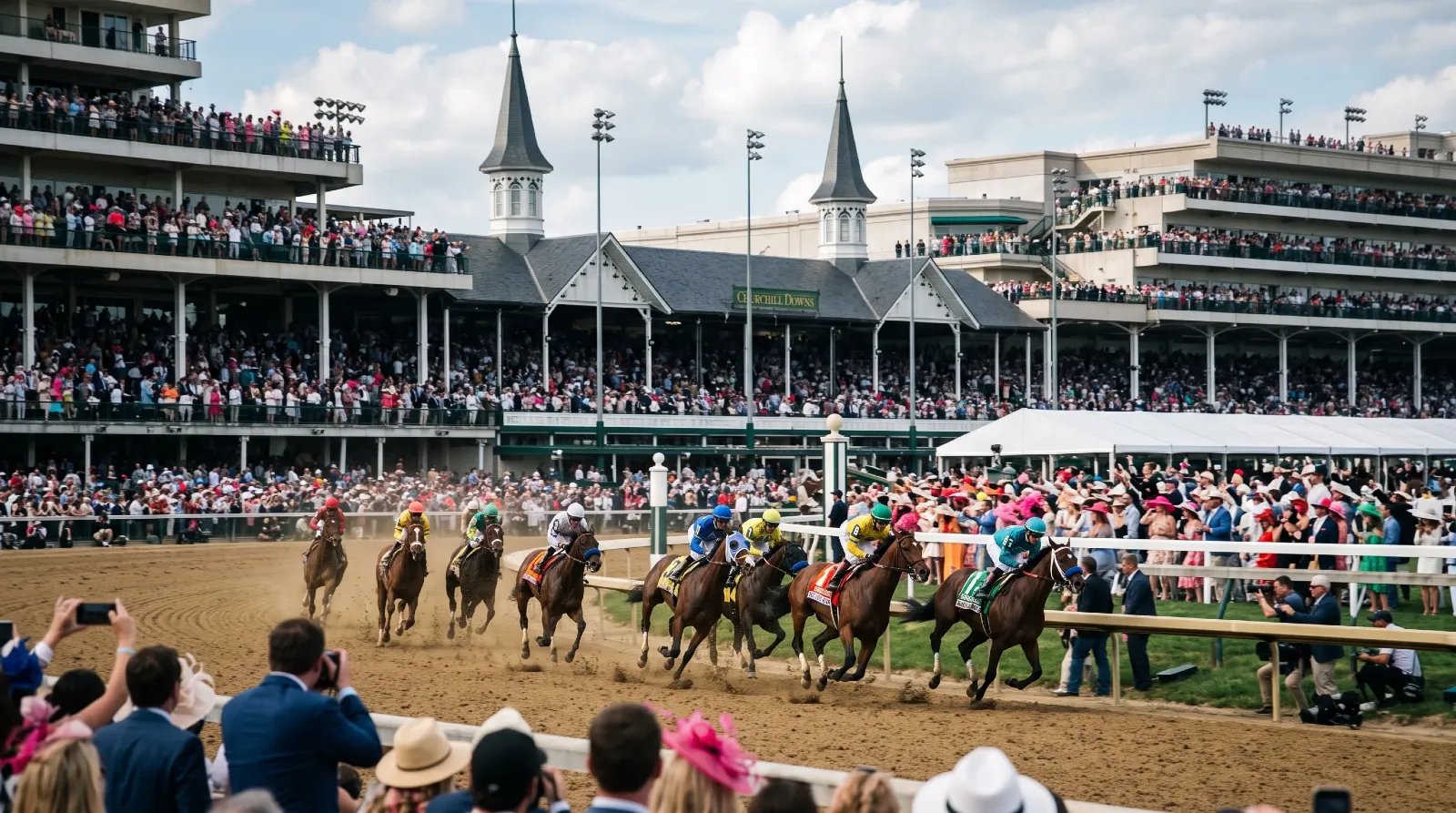
Colonel Clark wanted the Derby to have the elegant atmosphere of English racing, which made it attractive to fashionable women. Over time, wearing large and elaborate hats became one of the race's best-known traditions. Today, many spectators spend months planning their headwear, which can feature anything from fresh flowers to tiny model racehorses.
15. Its iconic twin spires are older than the 20th century.
The famous Twin Spires on top of the grandstand at Churchill Downs were built in 1895. Designed by architect Joseph Dominic Baldez, they have since become the symbol of the racetrack and of the Kentucky Derby itself. The Derby regularly attracts crowds of more than 150,000 people, making it one of the best-attended sporting events in the United States.
Sources & References
This AI-assisted post was rigorously curated and fact-checked for accuracy by:
 Martin Roháček
How fun was this article? 🤔
Tap a star to rate it
🧠 Quiz: How closely were you paying attention?
10 questions — all answers are in the article above!
Enjoyed these facts? There's more! 💌
Fresh fun facts in your inbox. No spam, ever.