The Absurd Outback Conflict: 15 Fascinating Facts About Australia's Great Emu War
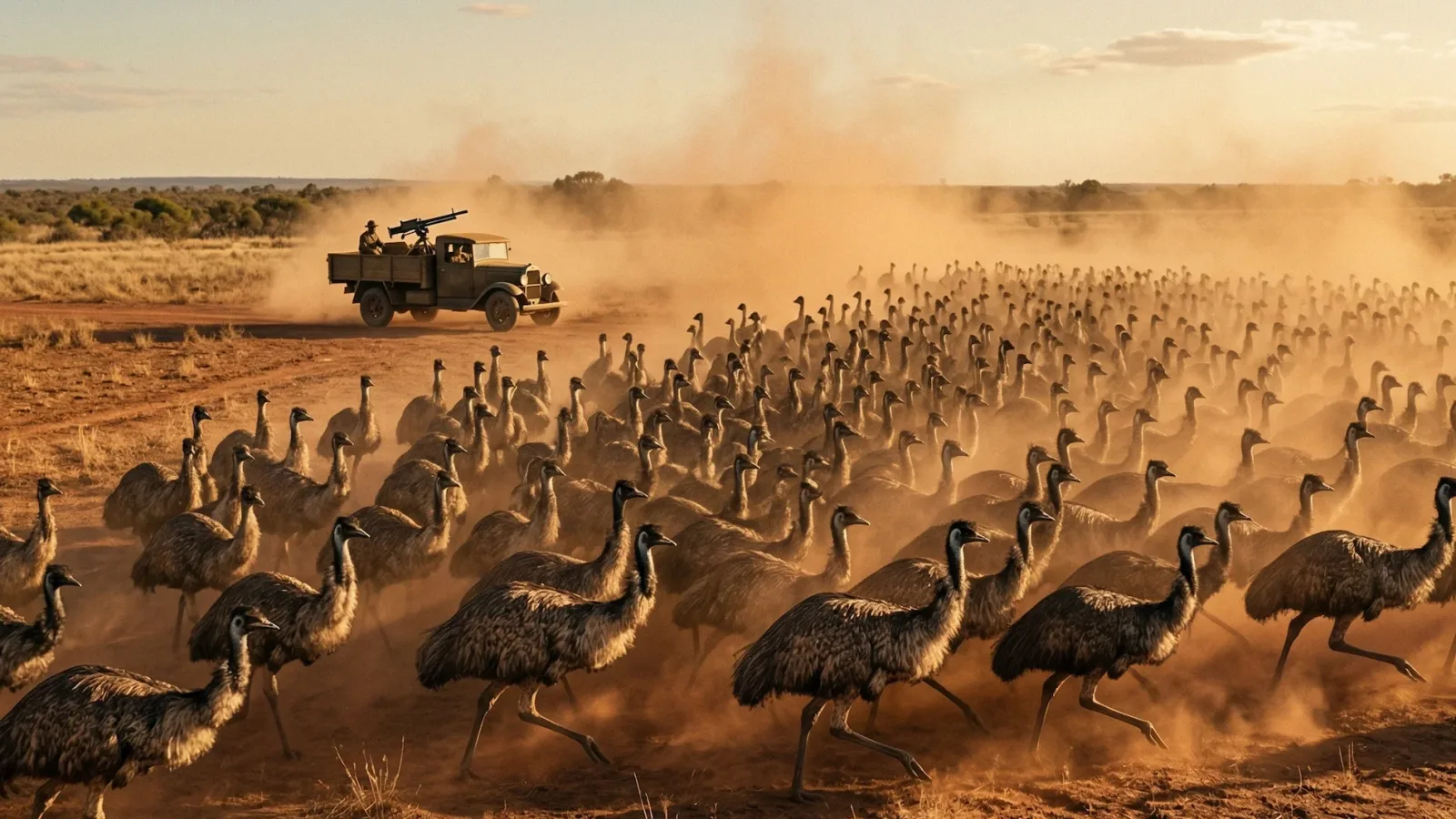
In 1932, the Australian government declared actual war on twenty thousand giant emus threatening agricultural crops in Western Australia. Deploying WWI veterans equipped with heavy Lewis machine guns, the military anticipated a swift and decisive victory over the native birds. Instead, the army was completely outmaneuvered by the emus' natural camouflage, speed, and surprisingly clever guerrilla tactics. Discover the absurd, true history behind one of the most bizarre military campaigns in human history.
1. The Veteran Farmers Who Demanded Machine Guns
Following the Great Depression, the Australian government encouraged World War I veterans to take up farming in Western Australia’s wheat belt. When the 1932 drought forced twenty thousand emus to migrate inland looking for food, these giant birds laid waste to the veterans' crops. Having survived the brutal trench warfare of Europe, the ex-soldier farmers understood the terrifying effectiveness of automatic weapons. Instead of petitioning the Department of Agriculture, they went straight to the Minister of Defence to request military assistance. They believed that machine guns were the only logical solution to defeat the massive avian invasion.
2. The Ecological Double-Whammy of Emus and Rabbits
The emus did not merely consume vast amounts of wheat; they created a compounding ecological disaster for Western Australian agriculture. As the massive birds pushed through heavy wire enclosures designed to protect crops, they tore gaping holes in the state's barrier fences. These structural breaches allowed millions of ravenous rabbits to flood directly into the wheat fields behind the birds. Whatever wheat the emus spared was promptly devoured by the surging rabbit population. Farmers found themselves fighting a two-front war against both giant birds and exploding rodent numbers.
3. A Military Force of Just Three Men and Two Guns
Despite the dramatic framing of a government war, the actual military task force deployed to the outback was shockingly small. The operation was led by Major G.P.W. Meredith of the Royal Australian Artillery, who commanded just two gunners. Their heavy firepower consisted of two Lewis light machine guns and ten thousand rounds of military-grade ammunition. The government expected this modest strike team to swiftly eradicate thousands of wild birds across hundreds of square miles. Instead, the small team found themselves hopelessly outnumbered by an extremely agile and unpredictable opponent.
4. The Satirical Title of the Minister for the Emu War
Australia's Minister of Defence, Sir George Pearce, enthusiastically authorized the military deployment in late 1932. Pearce viewed the operation as a fantastic opportunity for live target practice and positive propaganda to support struggling soldier-settlers. However, his decision backfired spectacularly when politicians and journalists began mocking the entire campaign. During heated parliamentary debates, opposition members relentlessly ridiculed Pearce, officially dubbing him the Minister for the Emu War. The embarrassing moniker stuck with him throughout the rest of his political career.
5. The Disastrous First Engagement at Campion
The first major clash between troops and emus occurred on November 4, 1932, near the town of Campion. Soldiers spotted a flock of roughly one thousand emus heading directly toward a local fence line and attempted to draw them into an ambush. The troops waited until the birds were within range before opening fire with their heavy Lewis machine guns. However, the machine guns jammed after firing only a few bursts, allowing the terrified flock to scatter in all directions. Only a small fraction of the giant flock was brought down before the rest vanished into the dense bush.
6. The Surprising Sentry System of Emu Squads
Military officers were stunned to observe that emus did not act like mindless livestock, but rather displayed advanced tactical behavior. Instead of clustering into large targets, the flocks broke up into small, highly mobile squads that maneuvered independently across the terrain. Each squad assigned a tall, dominant male to act as a designated sentry while the rest of the birds fed on the crops. This lookout scanned the horizon constantly and signaled the flock to scatter the moment military vehicles approached. Major Meredith noted with frustration that the birds seemed to possess an innate understanding of maneuver warfare.
7. The Disastrous Truck-Mounted Machine Gun Experiment
Realizing that the emus could easily outrun soldiers on foot, Major Meredith attempted to adapt his tactics to match the birds' impressive speed. He ordered one of the heavy Lewis machine guns mounted directly onto the bed of a military truck. The plan was to chase down running flocks across the open outback while firing continuous bursts. However, the rough, unpaved terrain bounced the truck so violently that the gunner could not aim or fire a single safe shot. To make matters worse, a fleeing emu became entangled in the steering wheel, sending the vehicle crashing into a fence.
8. The Shocking Armor-Like Resiliency of Emu Feathers
The military underestimated not only the speed of emus, but also their extraordinary physical durability. The soldiers quickly discovered that the birds' dense, double-vane feathers and thick muscular tissue acted like natural body armor against bullets. Many emus sustained direct hits from military rounds only to keep running at full speed without breaking stride. Major Meredith reported that unless a bullet struck a vital organ directly, the bird would simply carry on as if unharmed. The troops grew increasingly bewildered by the near-invincibility of their feathered opponents.
9. Major Meredith’s Unlikely Praise Comparing Emus to Zulu Warriors
Following the embarrassing tactical setbacks, Major Meredith expressed profound admiration for the fighting qualities of his avian adversaries. In an official report, he famously compared the resilient emus to the legendary Zulu warriors who had fought the British Empire in South Africa. Meredith remarked that if his army possessed a division with the bullet-stopping capacity of these birds, it could face any army in the world. He openly conceded that the emus could face machine guns with the invulnerability of tanks. This unexpected praise highlighted just how thoroughly defeated the military forces felt.
10. The Embarrassing Official Ammo-to-Kill Ratio
The initial phase of the campaign proved to be an absolute logistical nightmare regarding ammunition efficiency. After several weeks of strenuous operation, troops had expended thousands of rounds of heavy ammunition with remarkably little to show for it. Early official reports indicated that over two thousand five hundred rounds had yielded only a couple hundred confirmed emu casualties. This ridiculous ratio meant the government was spending an exorbitant amount of money for every single bird destroyed. The absurd financial cost per kill provided endless ammunition for political critics back in the capital.
11. The Temporary Withdrawal and Second Wave Campaign
Due to fierce public outcry and political pressure, the government officially ordered Major Meredith to withdraw his troops on November 8, 1932. However, as soon as the army left, emu attacks on wheat crops resumed with relentless intensity, prompting local farmers to plead for help once more. The Premier of Western Australia supported their request, forcing the Minister of Defence to order a second military campaign on November 13. During this second phase, Meredith's team achieved far better tactical results, claiming nearly one thousand emu kills. Even so, the overall impact on the total emu population remained negligible.
12. The Press Field Day and Political Satire
Media outlets across Australia and around the globe seized upon the Emu War as an irresistible story of absurd military incompetence. Major newspapers in Sydney, Melbourne, and London ran hilarious articles depicting the Australian military losing a war to native wildlife. Satirists published cartoon strips showing decorated generals surrendering their swords to proud, stoic emus. The media relentlessly pointed out that the birds had used guerilla warfare tactics to completely outmaneuver modern military doctrine. The campaign became an enduring symbol of bureaucratic folly and public embarrassment.
13. The Government Wise Refusal of Future Military Requests
Despite their humiliating defeat in 1932, desperate Western Australian wheat farmers repeatedly asked the federal government for military assistance in later years. Persistent emu invasions prompted formal requests for army deployments in 1934, 1943, and 1948. Remembering the political circus of the original campaign, successive prime ministers and defence ministers firmly rejected every single request. The government realized that sending heavy artillery and machine guns against birds was an incurable public relations nightmare. Instead, officials insisted that agricultural problems required agricultural solutions rather than military intervention.
14. The Bounty System’s Devastating Efficiency
When the military proved ineffective, the Australian government turned to a traditional economic solution by reinstating the bounty system. Local farmers and professional bounty hunters were offered cash rewards for every emu beak or pair of legs brought to government stations. Armed with familiar hunting rifles and intimate knowledge of the local terrain, private citizens accomplished what the military could not. Within just six months of the bounty's introduction in 1934, over fifty-seven thousand emu bounties were successfully claimed. The simple monetary incentive decimated the invading flocks far more efficiently than machine guns ever had.
15. The Final Victory Came from Thousands of Miles of Fences
The long-term resolution to the emu conflict was ultimately achieved through massive civil engineering rather than gunpowder. Australia expanded and reinforced its extensive State Barrier Fence system, constructing thousands of miles of heavy, impenetrable fencing across Western Australia. These massive structures diverted natural emu migration routes safely away from prime agricultural regions toward uninhabited desert areas. Today, these vermin-proof barrier fences continue to protect the valuable wheat belt without requiring violent skirmishes. History ultimately proved that simple physical barriers were far more powerful than machine guns.
Sources & References
This AI-assisted post was rigorously curated and fact-checked for accuracy by:
 Martin Roháček
How fun was this article? 🤔
Tap a star to rate it
🧠 Quiz: How closely were you paying attention?
10 questions — all answers are in the article above!
Enjoyed these facts? There's more! 💌
Fresh fun facts in your inbox. No spam, ever.