The Red Fortress: 15 Fascinating Facts About the Alhambra
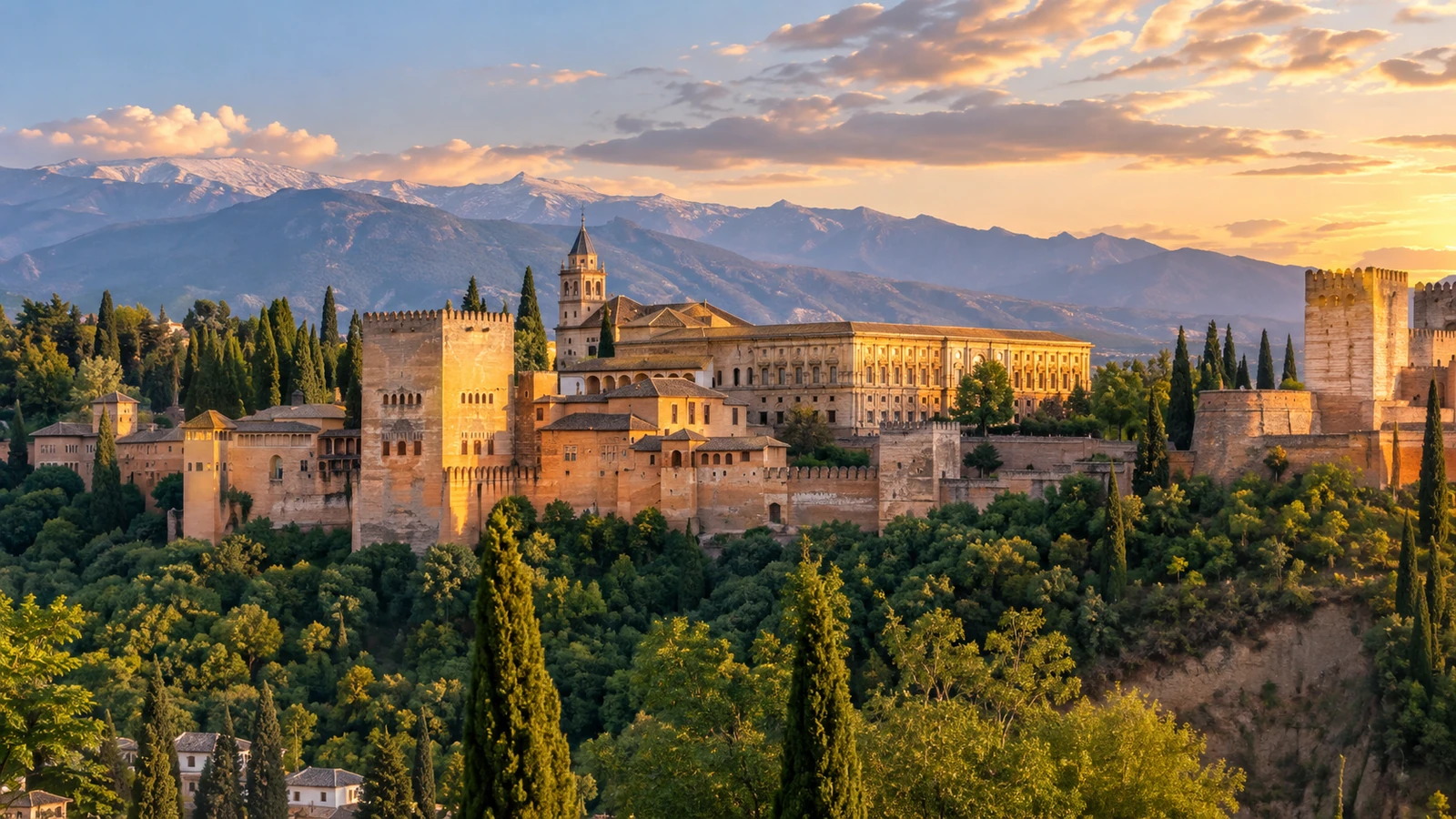
Perched high on Sabika Hill overlooking Granada, Spain, the Alhambra stands as the ultimate crown jewel of Moorish architecture in Europe. Built primarily during the 13th and 14th centuries by the Nasrid Dynasty, this breathtaking citadel seamlessly blends fortress defense with ethereal palaces, tranquil water gardens, and intricate geometric art. From secret subterranean dungeons and complex hydraulic engineering to heroic acts that saved it from destruction, the Alhambra holds centuries of history within its crimson clay walls. Here are 15 fascinating facts about one of Spain's most legendary monuments.
1. The Name "Alhambra" Means "The Red Fortress"
The name "Alhambra" derives from the Arabic phrase al-Qal'at al-Ḥamrā', which translates directly to "The Red Fortress." This title refers to the distinct reddish color of the sun-dried tapia clay bricks used to construct its outer fortification walls. Perched atop Sabika Hill overlooking Granada, the massive citadel glows with a striking crimson hue during sunset. While the exterior was built to look intimidating and rugged, the interior was designed as a luxurious earthly paradise. Today, visitors can still see how the original reddish earth mixed with stone gives the hilltop complex its iconic color palette.
2. It Was Built by the Last Muslim Dynasty in Spain
The Alhambra in its current form was established in 1238 by Muhammad I, also known as Ibn al-Ahmar, the founder of the Nasrid Dynasty. The Nasrids ruled the Kingdom of Granada, which was the final Muslim realm on the Iberian Peninsula during the period known as the Reconquista. Subsequent rulers, particularly Yusuf I and Muhammad V in the 14th century, transformed the hilltop fortress into a sprawling, opulent palace complex. Their additions created some of the most exquisite examples of Islamic architecture anywhere in the world. The dynasty held power until 1492, when the Catholic Monarchs accepted Granada's surrender.
3. It Powered Gardens on a Hill via an Ingenious Aqueduct
Constructing a sprawling oasis on top of a dry, rocky hill required groundbreaking hydraulic engineering. Nasrid engineers constructed the Acequia Real (Royal Canal), a six-mile-long aqueduct that diverted water from the Darro River directly to the Sabika Hill. The water was brought uphill using clever gravity-fed channels, water wheels, and pressure systems that filled cisterns beneath the citadel. This constant water flow supplied the complex's famous fountains, reflecting pools, and lush agricultural terraces without modern pumps. The soothing sound of running water was intentionally integrated into every courtyard to cool the air and create a peaceful atmosphere.
4. The Famous Court of the Lions Features 12 White Marble Felines
At the heart of the Nasrid Palaces lies the Court of the Lions, constructed under Sultan Muhammad V in the late 14th century. The central courtyard features an alabaster basin supported by twelve stylized white marble lions, each spouting water from its mouth. A complex subterranean piping system feeds the fountain while directing water into four surrounding channels representing the four rivers of Islamic Paradise. Surrounding the courtyard is an arcade supported by 124 slender marble columns arranged in intricate rhythm. Architectural historians believe the central fountain may have been influenced by Jewish symbolic art or gifted by a Jewish minister.
5. Walls and Ceilings Are Covered in Carved Arabic Poetry
Unlike Christian palaces filled with portraits and figurative statues, the walls of the Alhambra are covered in stunning Arabic calligraphy and geometric arabesques. Thousands of inscriptions adorn the stucco and wood, featuring verses from the Quran, royal praises, and poems written by court poets like Ibn Zamrak. One phrase appears hundreds of times throughout the entire palace complex: "Wa lā ghāliba illā-Llāh", meaning "There is no conqueror but God." The intricate carving was created using carved plaster molds and hand-chiseled stuccowork that was originally painted in vibrant lapis lazuli, gold, and red. This integration of poetry into stone effectively turns the complex into a giant, readable book.
6. Islamic Mathematicians Designed the Complex Using Complex Geometry
The intricate tilework and stucco patterns throughout the Alhambra display an incredible understanding of geometry centuries ahead of European mathematics. Artisans utilized every single one of the seventeen possible geometric wallpaper symmetry groups in their tile designs, a mathematical feat not fully categorized by Western science until the 20th century. The proportions of rooms and courtyards were meticulously calculated using ratios derived from the square root of two. Ceilings feature muqarnas, intricate three-dimensional vaulting made of thousands of tiny stalactite-like stucco pieces. These mathematical patterns were meant to reflect the infinite nature of the cosmos and divine order.
7. The Generalife Served as an Exclusive Royal Summer Retreat
Located adjacent to the main fortress on the slopes of the Cerro del Sol is the Generalife, the summer residence of the Nasrid sultans. Its name derives from the Arabic Jannat al-Arif, which translates to "Architect's Garden" or "Garden of the Sublime Paradise." Built in the early 14th century, the retreat provided the royal family with an escape from political affairs amidst terraced orchards and running water. The highlight of the Generalife is the Water Garden Courtyard, where long pools are framed by continuous arches of jetting water. It remains one of the oldest surviving Moorish gardens in existence today.
8. A Brave Hero Saved the Complex From Napoleon's Army
During the Peninsular War in 1812, Napoleon's occupying French forces turned the Alhambra into a military barracks and ammunition depot. Upon retreating from Granada, the French commander ordered his troops to blow up the entire citadel using explosive charges placed in the towers. Eight of the outer towers were completely destroyed before a brave Spanish corporal named José García risked his life to extinguish the lit fuses. His swift actions stopped the chain reaction of explosions and saved the core Nasrid Palaces from total destruction. Today, a commemorative plaque honors García's heroism in preventing one of history's greatest cultural losses.
9. Emperor Charles V Placed a Renaissance Palace in the Center
Following the fall of Granada in 1492, Holy Roman Emperor Charles V decided to construct his own imperial residence directly inside the Alhambra grounds in 1526. Designed by Spanish architect Pedro Machuca, the Palace of Charles V features a starkly Mannerist exterior and a magnificent circular two-story courtyard. The imposing, heavy stone structure contrasts dramatically with the light, airy Moorish architecture surrounding it. Construction on the Renaissance palace was funded by a special tax levied on the converted Muslim population, known as Moriscos. The building remained roofless and unfinished for centuries until it was finally completed in the 20th century.
10. Washington Irving Helped Save the Alhambra From Neglect
By the early 19th century, the Alhambra had fallen into disrepair, inhabited mainly by squatters, thieves, and wandering travelers. In 1829, American author Washington Irving traveled to Granada and was permitted to live inside the vacant rooms of the palace. Inspired by his stay, he published Tales of the Alhambra in 1832, a collection of local legends, historical accounts, and romantic sketches. The book became an international bestseller and ignited a wave of romantic fascination with Moorish Spain across Europe and America. This sudden global popularity pressured the Spanish government to declare the complex a national monument and fund its restoration.
11. The Hall of the Abencerrajes Has a Chilling Blood Legend
One of the most dramatic halls in the Nasrid Palace is the Hall of the Abencerrajes, renowned for its magnificent star-shaped muqarnas ceiling. According to popular legend, Sultan Abu al-Hasan ordered the execution of thirty-six noblemen of the Abencerrajes family inside this room. The story claims the sultan believed one of the family members was having an affair with his queen. The noblemen were allegedly beheaded one by one over the marble fountain basin at the center of the hall. Rust stains remaining on the marble basin are historically pointed out as indelible bloodstains from the tragic night.
12. Moorish Architects Used Light as a Primary Building Material
The architects of the Alhambra designed the structures to manipulate natural sunlight and shadow in order to create illusions of weightlessness. Windows and wooden screens, known as mashrabiya, were strategically angled to filter intense Iberian sunlight into soft, dappled rays across detailed plaster walls. Smooth reflecting pools, such as the famous basin in the Court of the Myrtles, mirror the elaborate porticos and open sky. This visual trickery caused heavy stone arches to appear to float on water, reinforcing the impression that the palace was a terrestrial paradise. As the sun moves throughout the day, the changing lighting conditions dramatically alter the appearance of every room.
13. Subterranean Dungeons Once Held Thousands of Captives
Beneath the romantic gardens and tiled courtyards of the Alhambra lies a sprawling network of underground tunnels, storerooms, and dungeons. Known as mazmorras, these deep subterranean silos were carved into the bedrock of the hill to store grain and hold Christian prisoners of war. Captives were lowered into the dark chambers through narrow vertical openings that were capped with heavy stones. During peacetime, many of these captives were forced to labor on the citadel's continuous construction projects. The underground system also included secret escape tunnels designed to allow royal family members to flee the fortress during a siege.
14. The Partal Palace Features the Oldest Remaining Structure
While many visitors focus on the Court of the Lions, the oldest surviving palace structure within the complex is the Partal Palace, built by Sultan Muhammad III in the early 14th century. The centerpiece of this area is the Torre de las Damas (Tower of the Ladies), which sits behind a large rectangular reflecting pool. The interior of the tower features incredible carved wooden ceilings and plasterwork that predates the grander royal chambers built decades later. Surrounding the Partal are landscaped terraced gardens that incorporate the ruins of earlier residential quarters. It provides a rare glimpse into the early architectural development of the Nasrid royal court.
15. Daily Visitors Are Capped to Protect fragile Historic Stucco
In 1984, the Alhambra, along with the Generalife and the historic Albaicín quarter, was designated a UNESCO World Heritage Site. Today, it stands as one of Spain's most popular cultural destinations, drawing millions of visitors every year. To protect delicate plasterwork, painted ceilings, and marble tiles from humidity and wear caused by human breath and foot traffic, authorities enforce strict daily visitor quotas. Access to the Nasrid Palaces requires timed-entry tickets that sell out months in advance. Despite these restrictions, conservationists continuously work using laser scanners and specialized micro-tools to preserve the delicate medieval masterpiece for future generations.
Sources & References
This AI-assisted post was rigorously curated and fact-checked for accuracy by:
 Martin Roháček
How fun was this article? 🤔
Tap a star to rate it
🧠 Quiz: How closely were you paying attention?
10 questions — all answers are in the article above!
Enjoyed these facts? There's more! 💌
Fresh fun facts in your inbox. No spam, ever.