The Fearless Aviator: 15 Fascinating Facts About Amelia Earhart
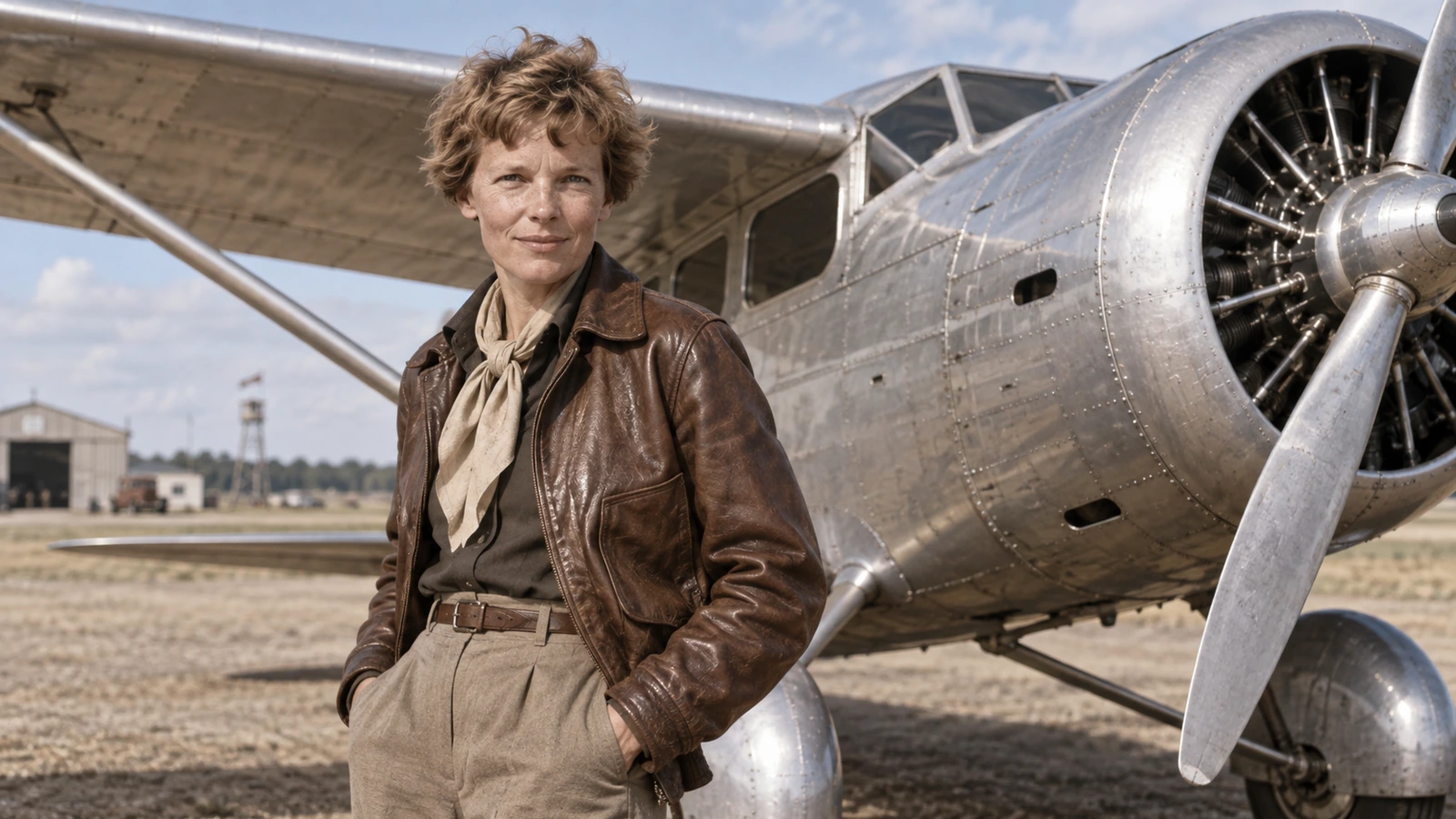
Amelia Earhart stands as one of the most enduring icons of aviation history, celebrated for her daring records and trailblazing spirit. While millions know her as the first woman to fly solo across the Atlantic Ocean, her story is packed with lesser-known triumphs, unconventional choices, and groundbreaking career achievements. From designing her own practical fashion line to co-founding an enduring network for female pilots, she constantly broke boundaries both on the ground and in the skies. Here are 15 fascinating facts about the life, career, and legacy of Amelia Earhart.
1. She Built Her Own Backyard Roller Coaster as a Child
Long before taking off in airplanes, a young Amelia Earhart was already an avid thrill-seeker in her own backyard. With the assistance of her sister Muriel and an uncle, ten-year-old Amelia constructed a makeshift roller coaster attached to the roof of the family home tool shed. She fashioned a cart out of a wooden box and ran it down a pair of wooden rails greased with lard to maximize speed. Her maiden voyage ended in a dramatic crash that tore her dress and bruised her collarbone, but she was entirely unfazed by the impact. She emerged from the wreckage exclaiming that the ride felt just like flying, foreshadowing her lifelong obsession with high-speed adventure.
2. Her First Encounter with an Airplane Was a Disappointment
Given her legendary aviation career, one might expect that Earhart fell in love with flight the instant she saw an aircraft. However, when her father took ten-year-old Amelia to the Iowa State Fair in 1907, her initial impression of an airplane was downright dismissive. She described the rusted biplane made of wire and wood as thoroughly uninteresting, preferring instead to ride the fairground merry-go-round. It was not until more than a decade later at an air show in Toronto that her interest was genuinely piqued. A stunt pilot swooped dangerously close to her and a friend, and rather than running away, Earhart stood her ground, captivated by the raw energy of the machine.
3. World War I Sparked Her Passion for Flying
During World War I, Earhart moved to Toronto, Canada, to serve as a nurse's aide with the Voluntary Aid Detachment at Spadina Military Hospital. She spent long shifts preparing meals, dispensing medication, and caring for wounded soldiers returning from the front lines in Europe. Many of the recovering veterans were pilots from the Royal Flying Corps, and Earhart spent hours listening to their vivid aerial combat stories. Inspired by their bravery, she began spending her free time watching military pilots train at a nearby airfield in Toronto. This experience transformed aviation from an abstract curiosity into a profound personal calling that defined the rest of her life.
4. She Worked Over a Dozen Odd Jobs to Pay for Flight School
Learning to fly in the early 1920s was an extraordinarily expensive ambition, especially for a young woman without wealthy patrons. Earhart was determined to fund her own aviation training, taking lessons from pioneer female aviator Neta Snook. To pay the hourly rate for lessons and plane rentals, Earhart worked a dizzying variety of jobs, including photographer, truck driver, stenographer, and gravel truck operator. She even took a position as a social worker at Denison House, a settlement center in Boston, while saving every spare penny for her aerial passion. Her unrelenting work ethic proved that she was willing to make whatever sacrifices were necessary to stay in the sky.
5. Her First Airplane Was a Bright Yellow Biplane Named "The Canary"
In 1921, shortly after logging enough flight hours to fly independently, Earhart purchased her very first aircraft. It was a secondhand, brightly painted yellow Kinner Airster biplane that she affectionately named "The Canary." The small two-seater plane was notoriously difficult to maneuver, but Earhart quickly mastered its quirks through sheer persistence. In October 1922, she flew "The Canary" to an altitude of 14,000 feet, setting an unofficial world altitude record for female pilots. Owning her own aircraft solidified her reputation as a rising star in aviation, proving her technical skill to a skeptical public.
6. The Press Nicknamed Her "Lady Lindy" Due to Her Appearance
Following Charles Lindbergh's historical solo flight across the Atlantic Ocean in 1927, the world went searching for a female counterpart to the aviation hero. Earhart fit the bill perfectly, possessing a lean build, tousled hair, and a shy, charming smile that mirrored Lindbergh's famous visage. Media outlets quickly dubbed her "Lady Lindy," a moniker that boosted her public profile while occasionally frustrating her desire for independent recognition. While the comparison initially helped generate funding and publicity, Earhart was determined to forge her own legacy rather than remain in anyone's shadow. She soon proved through her own heroic solo flights that she was far more than just a famous lookalike.
7. She Handed Her Husband an Unconventional Pre-Nuptial Letter
Earhart was fiercely independent and held deep skepticism toward the traditional social expectations of marriage in the early 20th century. When publisher George P. Putnam proposed to her, she turned him down five separate times before finally accepting his sixth offer in 1931. On the morning of their wedding, she handed him a candid hand-written letter detailing her terms for their partnership. In the letter, she wrote that she would not hold him to any medieval code of faithfulness, nor did she expect to be bound herself. She demanded that both partners retain their professional freedom, setting a remarkably progressive standard for modern marital independence.
8. She Touched Down in an Irish Cow Pasture After Flying the Atlantic
In May 1932, five years after her initial flight across the Atlantic as a passenger, Earhart became the first woman to make the journey completely solo. Flying a red Lockheed Vega 5B from Newfoundland, she braved thick fog, mechanical troubles, and ice buildup on the wings during a harrowing 15-hour flight. She originally aimed for Paris, but severe weather and fuel concerns forced her to land in a quiet cow pasture near Culmore, Northern Ireland. When a surprised local farmhand asked where she had come from, she famously replied, "From America." The stunning accomplishment earned her international acclaim and sealed her status as a global aviation icon.
9. She Designed Her Own Successful Line of Practical Women's Clothing
Beyond her achievements in the cockpit, Earhart was an innovative entrepreneur who launched her own line of women's apparel in 1933. Frustrated by the restrictive and impractical women's fashions of the era, she designed separates that prioritized comfort, mobility, and utility for active lifestyles. Her clothing line utilized durable materials such as suitings, cottons, and even surplus parachute silk, featuring functional elements like deep pockets and washable fabrics. Sold in major department stores like Macy's and Marshall Field's, her designs proved immensely popular with modern, working women. Earhart personally modeled many of the outfits in promotional materials, demonstrating that high fashion could coexist with practical everyday living.
10. She Was the First Person to Fly Solo from Hawaii to California
In January 1935, Earhart tackled one of the most perilous oceanic routes in aviation history by flying solo from Honolulu, Hawaii, to Oakland, California. Previous attempts by other aviators had ended in tragedy, leading many experts to claim the 2,408-mile open-ocean journey was essentially a suicide mission. Armed with a modern radio apparatus and custom fuel tanks in her Lockheed Vega, she completed the flight in 18 hours and 15 minutes without a single mechanical hitch. As she landed smoothly in Oakland, thousands of cheering onlookers greeted her, celebrating another unprecedented world record. The successful flight proved that long-distance transoceanic navigation could be executed safely with proper planning and skill.
11. She Co-Founded an International Female Pilots' Organization
Recognizing the immense discrimination faced by female aviators, Earhart helped establish an organization dedicated to supporting women in aviation in 1929. She hosted an inaugural meeting at Curtiss Field in Long Island, inviting all 117 licensed female pilots in the United States. Ninety-nine of those women stepped forward to become charter members, giving the nascent organization its historic name, "The Ninety-Nines." Earhart was elected as the group's first president, leading campaigns to open air races to female entrants and secure professional pilot jobs for women. Today, The Ninety-Nines remains an active international organization providing scholarships and mentorship to female pilots worldwide.
12. Purdue University Financed Her Advanced "Flying Laboratory"
In 1935, Purdue University hired Earhart as a visiting career counselor to guide female students toward non-traditional careers in science and engineering. Impressed by her vision, the university's leadership established a dedicated research fund to support her aviation ambitions. Through donations from benefactors like industrialist J.K. Lilly, Purdue purchased a state-of-the-art twin-engine Lockheed Electra 10E for Earhart. Dubbed her "Flying Laboratory," the aircraft was custom-fitted with giant auxiliary fuel tanks to extend its range for a historic circumnavigation flight. This academic partnership allowed Earhart to pursue her grandest aerial undertaking with cutting-edge technology.
13. She Rejected Coffee and Tea in Favor of Hot Chocolate
Long endurance flights required extreme mental sharpness, yet Earhart famously avoided the traditional caffeine sources of her day. Unlike most pilots who relied heavily on coffee or black tea to stay awake during overnight flights, she thoroughly disliked the taste of both beverages. Instead, her pre-flight ritual involved sipping a warm thermos of hot chocolate to sustain her energy levels. During long oceanic crossings, she kept tomato juice and hot chocolate nearby in vacuum flasks, taking small sips to maintain concentration without suffering a caffeine crash. This unique habit surprised many contemporary journalists, who expected a rugged pilot to prefer strong coffee.
14. She Was the First Woman Awarded the Distinguished Flying Cross
Earhart's heroic solo transatlantic flight in 1932 earned her formal recognition from the highest levels of the United States government. Vice President Charles Curtis presented her with the Distinguished Flying Cross, making her the very first woman in history to receive the prestigious military decoration. Congress passed special legislation authorizing the award, which was typically reserved for members of the armed forces demonstrating heroism in flight. She also received the Gold Medal of the National Geographic Society, presented directly by President Herbert Hoover. These honors cemented her position as one of the most celebrated figures in American history.
15. Her Plane Vanished Near Howland Island After Traveling 22,000 Miles
In mid-1937, Earhart set out to achieve her ultimate goal: becoming the first woman to circumnavigate the globe following an arduous equatorial route. Accompanied by navigator Fred Noonan, she departed Oakland, California, and successfully completed over 22,000 miles of the 29,000-mile journey across South America, Africa, and Asia. On July 2, 1937, her Lockheed Electra departed Lae, Papua New Guinea, heading toward a microscopic landing strip on Howland Island in the central Pacific Ocean. Cloud cover, radio communication breakdowns, and difficult navigation led to the aircraft running low on fuel, and the pair vanished somewhere in the Pacific Ocean. Despite the largest search and rescue effort in U.S. naval history at the time, no trace of the plane or crew was ever officially found, sparking decades of mystery.
Sources & References
This AI-assisted post was rigorously curated and fact-checked for accuracy by:
 Martin Roháček
How fun was this article? 🤔
Tap a star to rate it
🧠 Quiz: How closely were you paying attention?
10 questions — all answers are in the article above!
Enjoyed these facts? There's more! 💌
Fresh fun facts in your inbox. No spam, ever.