The Eternal Kingdom: 15 Fascinating Facts About Ancient Egypt
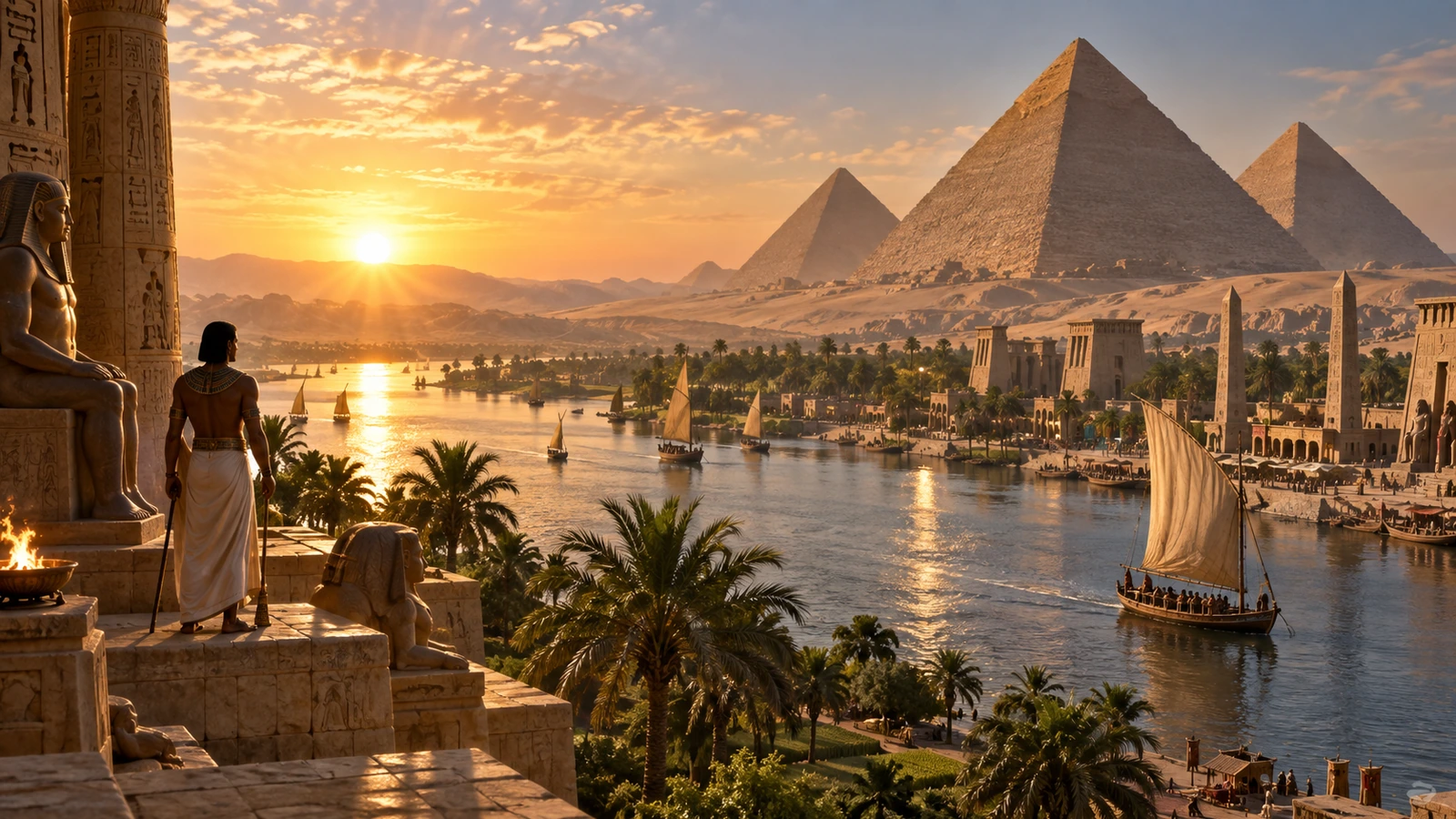
Ancient Egypt stands as one of the most mesmerizing and enduring civilizations in human history, spanning over three millennia of cultural, technological, and architectural achievements. Beyond the legendary monuments and golden burial masks lies a world filled with surprising medical innovations, sophisticated legal systems, and remarkable daily customs. From police baboons patrolling crowded marketplaces to elite weapons forged from falling meteorites, pharaonic society was far more complex than modern pop culture suggests. Step back in time to explore fifteen astounding facts that reveal the true genius and eccentricity of life along the Nile.
1. Cleopatra's Mind-Bending Timeline
Cleopatra VII was the last active ruler of the Ptolemaic Kingdom of Egypt, but her era was much closer to modern events than to the dawn of Egyptian civilization. The Great Pyramid of Giza was constructed around 2560 BCE, roughly 2,500 years before Cleopatra was even born. In contrast, the Apollo 11 moon landing occurred in 1969 CE, less than 2,000 years after her death in 30 BCE. This means the famous queen lived chronologically closer to the lunar landing than to the iconic monuments associated with her empire. Her reign represented the twilight of a civilization whose early history was already ancient to her.
2. King Tutankhamun’s Space-Forged Dagger
When archaeologists unsealed the tomb of King Tutankhamun in 1922, they discovered a beautifully crafted iron dagger tucked alongside the young pharaoh's mummy. Because iron smelting was virtually non-existent in Egypt during the Bronze Age, the origin of the blade remained a mystery for nearly a century. In 2016, researchers using non-destructive X-ray fluorescence analysis confirmed that the iron blade contained high concentrations of nickel and cobalt. This distinct chemical signature matched the composition of meteorites found along the Red Sea coast, proving the metal fell from space. Long before iron ore could be mined on Earth, Egyptian artisans were forging elite weapons out of fallen stars.
3. Trained Police Baboons Maintained Law and Order
Law enforcement in ancient Egyptian market towns relied on a rather unorthodox unit: trained olive baboons. Surviving tomb murals and painted reliefs depict police officers leading leashed primates through bustling crowded plazas to deter pickpockets and apprehend fleeing thieves. These aggressive primates possessed powerful jaws, keen vision, and formidable agility, making them terrifying pursuers for any criminal trying to escape. In addition to baboons, ancient officers also utilized trained dogs, but primates offered a unique advantage due to their ability to grasp suspects. Criminals in pharaonic cities had to outrun sharp-toothed primates to evade justice.
4. Eye Kohl Was Both Fashionable and Anti-Bacterial
The dramatic dark eyeliner visible in ancient Egyptian portraiture was far more than a cosmetic choice. Known as kohl, this thick black paste was made from crushed galena, a mineral rich in lead sulfide, and applied by men, women, and children across all social classes. While it served to reduce the blinding glare of the harsh desert sun, modern chemical analysis reveals an even more impressive benefit. The lead salts in the mixture actually stimulated the production of nitric oxide in skin cells, boosting the immune response to combat common eye infections like conjunctivitis. Thus, this ancient cosmetic doubled as an effective medical defense against desert eye disease.
5. The World's First Toothpaste Formula Was Scorchingly Gritty
Ancient Egyptians were deeply concerned with dental hygiene, which led them to invent one of the world's earliest recorded toothpastes. A preserved fourth-century CE papyrus recipe instructs users to mix rock salt, dried iris flowers, mint leaves, and crushed grains of black pepper into a fine powder. When combined with saliva, this abrasive mixture was brushed onto the teeth using frayed wooden sticks to scrub away plaque and freshen breath. Modern dentists who tested the formula found it remarkably effective at cleaning teeth, though it caused severe bleeding of the gums due to its harsh grit. Despite the discomfort, the recipe was centuries ahead of medieval European oral care standards.
6. The Pyramids Were Built by Paid Laborers, Not Slaves
Contrary to popular Hollywood myths and biblical cinematic depictions, the great pyramids were not constructed by enslaved populations working under cruel whips. Archeological digs at Giza have unearthed vast settlements dedicated to the skilled laborers, stonemasons, and engineers who built the royal tombs. These workers were hired laborers who worked in seasonal shifts, often during the annual Nile floods when agricultural fields were submerged. They received honorable burials in tombs near the royal pyramids, complete with grave goods for the afterlife. Furthermore, royal records show that the workers were paid in high-quality food, medical care, and generous rations of meat and beer.
7. Physicians Prescribed Fungal Bread for Infected Wounds
Thousands of years before Sir Alexander Fleming discovered penicillin in 1928, Egyptian doctors were already utilizing the germ-fighting power of fungi. Medical texts such as the Edwin Smith Papyrus and the Ebers Papyrus document the practice of placing moldy bread directly onto open wounds and surgical cuts. While ancient healers did not understand the biochemical concept of microscopic bacteria, they empirically observed that moldy dough prevented infections and promoted healing. The organic mold growing on the bread produced natural antibiotic compounds similar to penicillin, killing dangerous pathogens before they could take root. This ancient practice represents one of humanity's earliest recorded uses of antibiotic therapy.
8. Devoted Pet Owners Shaved Their Eyebrows When Cats Died
Cats held an unparalleled sacred status in ancient Egyptian culture, where they were revered as representations of the goddess Bastet and protected as essential pest hunters. When a beloved domestic feline passed away from natural causes, the entire household entered a deep state of ritual mourning. To publicly express their grief, family members would shave off their own eyebrows and refrain from wearing fine clothes until the hair grew back. The deceased cat was then meticulously embalmed, wrapped in fine linen, and buried in dedicated animal cemeteries with bowls of milk. Harming or killing a cat, even by accident, was treated as a severe crime that frequently carried the death penalty.
9. Ramses II Signed the World's Oldest Surviving Peace Treaty
Following the grueling and inconclusive Battle of Kadesh around 1274 BCE, Pharaoh Ramses II and King Hattusili III of the Hittite Empire recognized the futility of continued conflict. Rather than continuing an exhausting war, the two great powers negotiated and signed the Treaty of Kadesh, the world's earliest known international peace treaty. Recorded in both Egyptian hieroglyphs and Akkadian cuneiform, the agreement established a formal non-aggression pact, a mutual defense alliance, and mutual extradition guarantees for political refugees. The treaty successfully secured peace along their borders for decades and demonstrated sophisticated diplomatic protocols. A replica of this historical agreement is prominently displayed today at the United Nations headquarters in New York City.
10. Senet Was a National Board Game Obsession
Long before modern board games existed, ancient Egyptians of all social standings were obsessed with a strategy game called Senet. Originating around 3100 BCE, Senet was played on a grid of thirty squares where players moved pieces based on the roll of counting sticks or knucklebones. Over time, the game evolved from a casual pastime into a deeply spiritual metaphor for the soul's perilous journey through the underworld to reach eternal life. Tomb paintings frequently depict royalty, including Queen Nefertari, playing against invisible divine opponents. King Tutankhamun was so fond of the game that four complete Senet sets were packed into his tomb to entertain him in the afterlife.
11. Thick Beer Served as Daily Calories and Official Currency
Beer in ancient Egypt was vastly different from the light, carbonated beverages served in modern taverns. It was a thick, sweet, porridge-like liquid crafted from fermented barley bread and dates, packed with essential nutrients, proteins, and minerals. Because untreated Nile water was often contaminated with parasites and dangerous bacteria, this low-alcohol brewed beverage was much safer to drink daily for men, women, and children. Beyond its crucial role in nutrition, beer served as a foundational unit of currency throughout the empire. Laborers who built state monuments and royal tombs were paid their daily wages in standardized wooden jugs of beer alongside grain rations.
12. Embalmers Liquefied and Discarded the Human Brain
During the complex process of mummification, ancient Egyptian embalmers carefully preserved most major organs, but they treated the human brain as entirely worthless. Believing that thought, intelligence, and emotion resided exclusively in the heart, practitioners used a long iron hook inserted through the nostrils to break up the brain tissue. They then flushed out the liquefied brain matter and threw it away, leaving the cranial cavity empty or filling it with resin. In stark contrast, the heart was meticulously preserved and left inside the chest cavity or placed near it. They believed the heart was the vital organ that would be weighed against the feather of Ma'at during the final judgment in the afterlife.
13. Egyptian Women Possessed Extraordinary Legal and Financial Rights
Compared to their contemporaries in ancient Greece or Rome, women in pharaonic Egypt enjoyed a remarkable degree of legal and financial autonomy. Egyptian legal code dictated that women could independently own, inherit, buy, sell, and lease property without needing permission from a male relative. They had the right to run independent businesses, execute legal contracts, serve as witnesses in court, and initiate divorce proceedings if their marriages failed. In cases of divorce, women were legally entitled to retain their personal pre-marital property and receive a portion of the marital assets. While political power remained predominantly male-dominated, Egyptian women held legal equality under the law that would not be seen again in Europe for millennia.
14. Napoleon Did Not Blast the Nose Off the Sphinx
A widespread historical myth claims that Napoleon Bonaparte's French troops destroyed the nose of the Great Sphinx of Giza with cannonball fire during their 1798 Egyptian campaign. However, historical documentation and detailed artistic records completely debunk this enduring story. Sketches of the Great Sphinx created by Danish explorer Frederic Louis Norden in 1737 show the monument already missing its nose more than half a century before Napoleon set foot in Egypt. Historical writings from the 15th-century Arab historian al-Maqrizi attribute the damage to Sa'im al-Dahr, a Sufi Muslim fanatic who pried the nose off in 1378 CE in anger over local peasants offering sacrifices to the statue.
15. The Egyptian Nile Calendar Shaped Our Modern 365-Day Year
The entire ancient Egyptian society functioned around the predictable annual flooding of the Nile River, which deposited rich silt onto agricultural fields. To track this crucial agricultural cycle, ancient astronomers developed one of the world's first solar calendars featuring 365 days. Their calendar divided the year into three main four-month seasons based on agriculture: Akhet (inundation), Peret (growing), and Shemu (harvest). To round out the astronomical solar year, they added five extra intercalary days at the end of the twelve 30-day months to celebrate the birthdays of key deities. Centuries later, Julius Caesar adopted this 365-day Egyptian solar framework to create the Julian calendar, which directly evolved into the Gregorian calendar used globally today.
Sources & References
This AI-assisted post was rigorously curated and fact-checked for accuracy by:
 Martin Roháček
How fun was this article? 🤔
Tap a star to rate it
🧠 Quiz: How closely were you paying attention?
10 questions — all answers are in the article above!
Enjoyed these facts? There's more! 💌
Fresh fun facts in your inbox. No spam, ever.