The Alpine Wonder: 15 Fascinating Facts About Banff National Park
Established in 1885 following a heated dispute over thermal hot springs, Banff National Park stands as Canada's oldest national park and a crown jewel of the Canadian Rockies. Spanning 6,641 square kilometers of rugged alpine terrain, glacier-fed turquoise lakes, and ancient limestone peaks, this UNESCO World Heritage site hosts an incredible diversity of wildlife and geological marvels. Beyond its postcard-perfect views of Lake Louise and Moraine Lake lies a complex wilderness shaped by tropical sea reefs, ancient Indigenous heritage, and pioneering conservation efforts. Discover the captivating history, engineering triumphs, and natural phenomena that make Banff one of North America's most celebrated natural treasures.
1. Canada's First National Park Was Born From a Hot Spring Dispute
In 1883, three Canadian Pacific Railway workers stumbled upon natural thermal hot springs on the slopes of Sulphur Mountain. The discovery sparked a fierce legal battle over private ownership rights, prompting the Canadian government to step in and preserve the land. In 1885, Prime Minister John A. Macdonald established a 26-square-kilometer reserve around the hot springs to protect them for public benefit. This modest sanctuary grew into Rocky Mountains Park in 1887 and was later renamed Banff National Park, serving as the cornerstone of Canada's vast national park system.
2. The Majestic Rocky Mountains Were Once an Ancient Tropical Sea Reef
The towering limestone peaks that define Banff's dramatic landscape were formed hundreds of millions of years ago beneath a warm, shallow tropical ocean. During the Devonian period, roughly 350 million years ago, vast coral reefs and marine organisms thrived where alpine meadows now sit. Over geological eras, colossal tectonic forces collided, thrusting ancient marine sediments upward and folding them into towering mountain ranges. Today, hikers across Banff routinely discover fossilized corals, brachiopods, and ancient sea creatures embedded directly in high-altitude rock faces.
3. Glacial Rock Flour Gives Lake Louise Its World-Famous Turquoise Glow
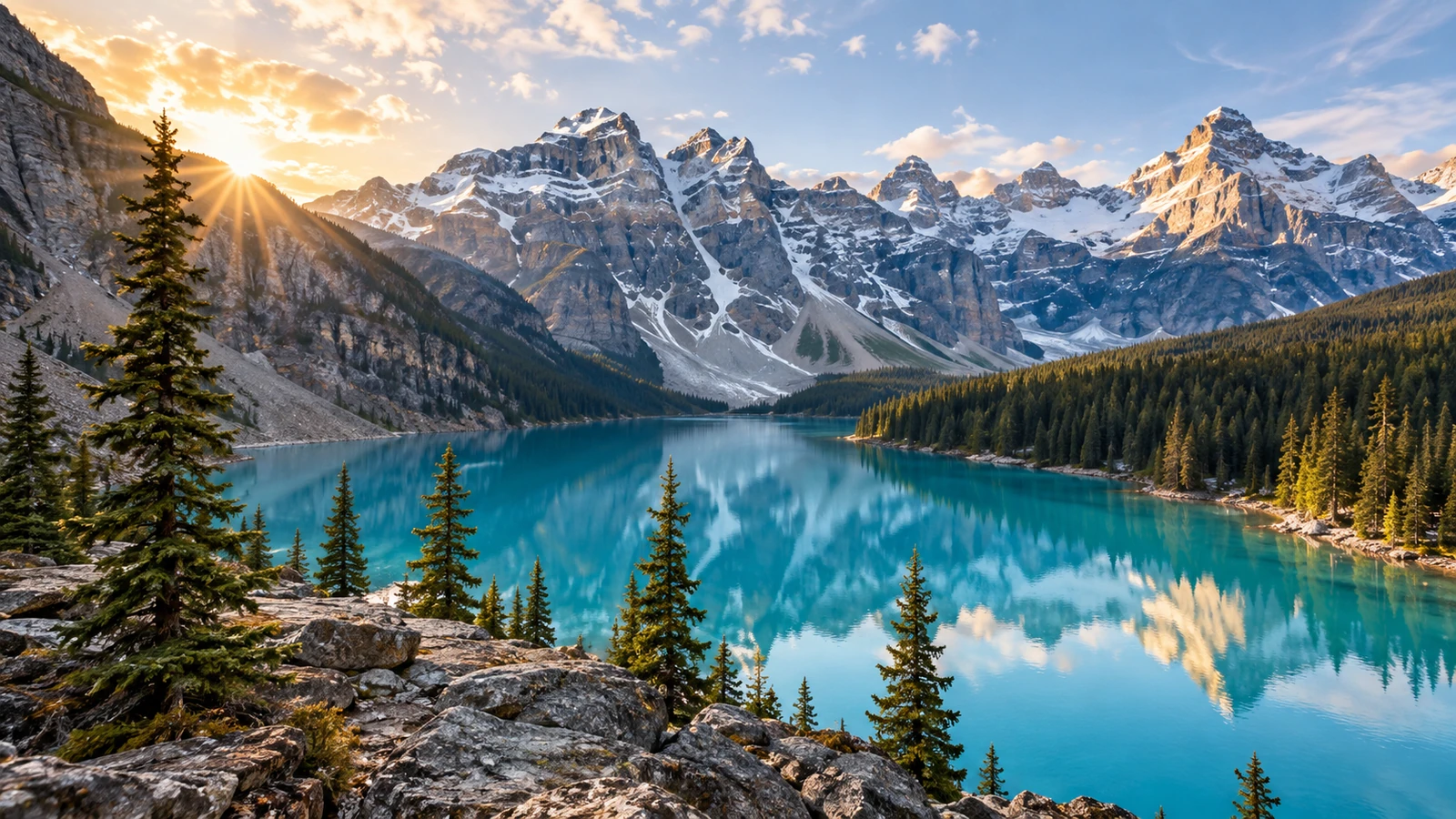
The breathtaking, milky-turquoise color of Lake Louise and Moraine Lake is the result of continuous geological grinding. As heavy mountain glaciers grind slowly against underlying bedrock, they reduce stone to an extremely fine powder known as glacial rock flour or silt. During the summer melt season, streams transport this microscopic silt into alpine lakes, where it remains suspended in the water column. When sunlight hits the water surface, the rock flour absorbs most light wavelengths while scattering brilliant shades of turquoise and emerald back to the human eye.
4. Banff Pioneered World-Leading Wildlife Overpasses and Underpasses
Bisecting a pristine national park with the high-speed Trans-Canada Highway created severe collision hazards for native wildlife and motorists alike. To solve this ecological crisis, Banff constructed 44 specialized wildlife crossing structures, including six massive vegetation-covered overpasses and 38 underpasses. Fenced highway corridors direct animals toward these safe passages, drastically reducing wildlife-vehicle collisions by over 80 percent. Apex predators like grizzly bears, wolves, and cougars routinely utilize these corridors, making Banff an international benchmark for ecological highway engineering.
5. Extirpated Elk Were Successfully Reintroduced to the Bow Valley
By the early 20th century, uncontrolled hunting and severe winter conditions had completely eliminated the native elk population from the Bow Valley. In 1917, wildlife officials imported 250 elk from Yellowstone National Park to rebuild the lost species within Banff. The reintroduction effort proved extraordinarily successful, allowing the elk population to rebound and thrive along forest edges and river valleys. Today, elk are among Banff's most recognizable wild residents, though visitors are advised to keep a safe distance, especially during the autumn rutting season.
6. The Water at Banff Upper Hot Springs Takes Decades to Reach the Surface
The soothing geothermal water flowing into Banff Upper Hot Springs begins its journey high above on Mount Rundle as falling rain and snow. Meltwater seeps deep into the subterranean crust through rock fractures, descending to depths of approximately three kilometers beneath the surface. At these extreme depths, Earth's internal geothermal heat warms the water while dissolving natural minerals like calcium, magnesium, and sulfate. Subterranean pressure then forces the heated water rapidly back upward along the Sulphur Mountain Thrust Fault, emerging naturally at temperatures around 38°C to 40°C.
7. Mount Rundle Sheds Layers Daily Due to Extreme Freeze-Thaw Cycles
Mount Rundle features an iconic wedge-shaped silhouette that looms over the town of Banff, constantly reshaped by intense thermal weathering. During spring and autumn, moisture seeps deep into microscopic fractures along the mountain's tilted limestone and shale layers. When temperatures plunge below freezing at night, the water expands as ice, slowly prying massive rock slabs apart in a process called frost wedging. As daytime sun warms the slopes, the ice melts, releasing rocks that cascade down the cliffs and altering the mountain's shape day by day.
8. Indigenous Peoples Inhabited the Land for Over 10,000 Years
Long before railway surveyors and European travelers arrived, First Nations communities inhabited the Bow Valley for thousands of years. Archaeological excavations near Vermilion Lakes have uncovered hearths, stone tools, and butchered animal bones dating back more than 10,000 years to the end of the last ice age. Nearby cliff faces feature ancient red ochre pictographs painted by ancestors of the Stoney Nakoda, Blackfoot, and Tsuut'ina Nations. These sacred cultural sites demonstrate deep historical connections to the alpine landscape that predate modern exploration.
9. Johnston Canyon Waterfalls Glow Electric Blue Under Sub-Zero Moonlight
When winter temperatures drop below minus 25°C, Johnston Canyon undergoes a surreal seasonal transformation into a frozen realm. Cascading waterfalls freeze solid into dramatic ice towers and shimmering blue icefalls suspended along sheer limestone walls. The dense structural composition of the ice absorbs longer red wavelengths of light while reflecting short-wave blue light, creating an intense azure glow. Under clear winter skies and bright moonlight, guided night walks reveal a spectacular, luminous frozen canyon landscape.
10. Less Than Three Percent of the Park Is Developed
Despite receiving over four million visitors annually from around the globe, less than three percent of Banff National Park's total land area is developed. Strict environmental protection regulations enforced by Parks Canada limit commercial infrastructure, urban boundaries, and resort expansions within the park. The remaining 97 percent of the park's 6,641 square kilometers remains strictly managed wilderness where natural ecological cycles proceed without major human interference. This balance ensures that critical habitats remain preserved for sensitive species while accommodating eco-tourism.
11. Alpine Goats Descend to Roadsides to Lick Essential Minerals
Mountain goats residing in Banff's high alpine zones display an unusual behavioral habit driven by nutritional necessity. High-altitude vegetation lacks sufficient concentrations of essential minerals like sodium, leaving goats search for alternative mineral licks to maintain health. During spring and early summer, goats travel down steep mountain slopes to highway shoulders to lick road salt residues left behind from winter snow clearing. Parks Canada monitors these salt licks closely and builds dedicated underpasses to ensure goats cross busy roads safely.
12. Banff's Glaciers Supply Freshwater Across Prairie Provinces
The vast glaciers and icefields resting atop Banff's continental divide serve as giant freshwater reservoirs for Western Canada. Glacial meltwater feeds major river networks, including the Bow and North Saskatchewan rivers, carrying water thousands of kilometers east across Alberta, Saskatchewan, and Manitoba. Millions of prairie residents, agricultural crop networks, and municipal water systems rely heavily on this seasonal runoff. However, long-term climate monitoring indicates that famous ice formations like the Columbia Icefield are receding rapidly, posing future water security challenges.
13. Hidden Marble Caves Form Fleeting Spring Ice Crystals
Deep within Banff's backcountry karst topography lie extensive subterranean cave systems carved out of limestone and marble over millennia. Within remote caverns like the Castleguard Cave network—Canada's longest cave system—winter conditions freeze atmospheric moisture into delicate underground ice formations. Every spring, subterranean meltwater forms extraordinary crystal ice stalagmites, frost flowers, and icy columns that persist for only a few brief days before melting away. Due to extreme hazards and delicate cave ecosystems, access to these hidden chambers is strictly regulated for scientific research.
14. The Nearby Spiral Tunnels Revolutionized Mountain Rail Travel
Conquering the steep, treacherous mountain terrain near Banff presented a massive danger to early 20th-century transcontinental rail transport. The original railway descent down the Kicking Horse Pass featured an extraordinary four-and-a-half percent grade that frequently caused dangerous train runaway accidents. To eliminate this hazard, Canadian Pacific Railway engineers built two ingenious Spiral Tunnels inside Cathedral Mountain and Mount Ogden in 1909. By routing trains in loops through interior mountain bedrock, engineers doubled the track distance and halved the steep grade to a manageable level.
15. Dark Sky Conditions Offer World-Class Views of the Northern Lights
Banff National Park maintains strict outdoor lighting policies that preserve exceptionally dark night skies across its mountain valleys. Combined with dry alpine air and high northern latitudes, the park offers outstanding conditions for viewing deep-space stars and atmospheric phenomena. On clear winter nights, energetic solar particles colliding with Earth's magnetic field generate luminous displays of the Aurora Borealis. Vibrant green and violet curtains of light regularly dance over iconic peaks like Mount Castle and Mount Rundle, attracting night-sky photographers from around the world.
Sources & References
This AI-assisted post was rigorously curated and fact-checked for accuracy by:
 Martin Roháček
How fun was this article? 🤔
Tap a star to rate it
🧠 Quiz: How closely were you paying attention?
10 questions — all answers are in the article above!
Enjoyed these facts? There's more! 💌
Fresh fun facts in your inbox. No spam, ever.