1. The Navy Wanted It Painted Like a Bumblebee
When the bridge was being proposed, the United States Navy heavily opposed the design because they feared ships would crash into it during heavy San Francisco fogs. To maximize visibility, the Navy strongly petitioned for the entire bridge to be painted in alternating, high-contrast stripes of black and bright yellow, completely disregarding aesthetics in favor of a massive, bumblebee-like warning sign.
2. The Iconic Orange Was Just a Primer
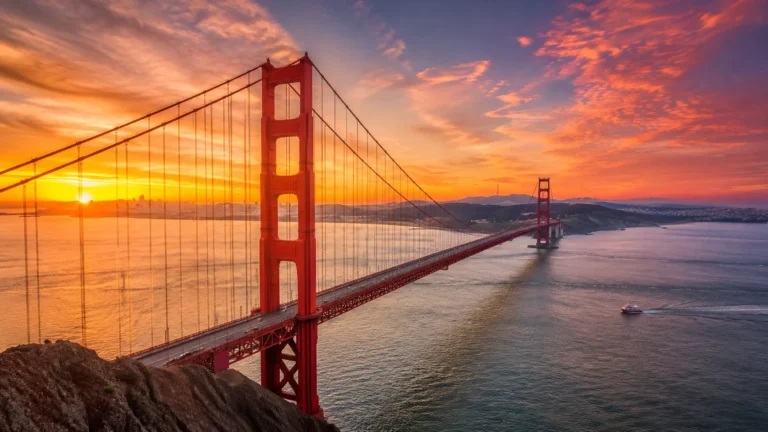
The famous “International Orange” color was never supposed to be the final paint job. When the steel beams arrived by train from the East Coast, they were coated in a red-orange lead primer to protect them from rusting during transit. Consulting architect Irving Morrow loved how the vibrant primer contrasted with the cool blue water and gray fog, so he fought to keep the bridge that specific color instead of the standard gray or black requested by the authorities.
3. The Halfway to Hell Club
During construction in the 1930s, working on suspension bridges was incredibly deadly, with an industry average of one worker dying for every million dollars spent. Chief Engineer Joseph Strauss mandated the installation of a massive safety net suspended under the bridge deck. This net ended up saving the lives of 19 men who slipped from the steel beams. These survivors formed an exclusive, elite fraternity that they proudly dubbed the “Halfway to Hell Club.”
4. The Strait Was Named Before the Gold Rush
Many people assume the “Golden Gate” refers to the bridge serving as the gateway to the California Gold Rush. In reality, the strait was named two years before gold was discovered at Sutter’s Mill. In 1846, U.S. Army Captain John C. Fremont looked at the narrow opening of the bay and named it “Chrysopylae” (Golden Gate), comparing it to the Golden Horn harbor of ancient Byzantium due to its massive potential for maritime trade.
5. The Cables Were Spun in Thin Air
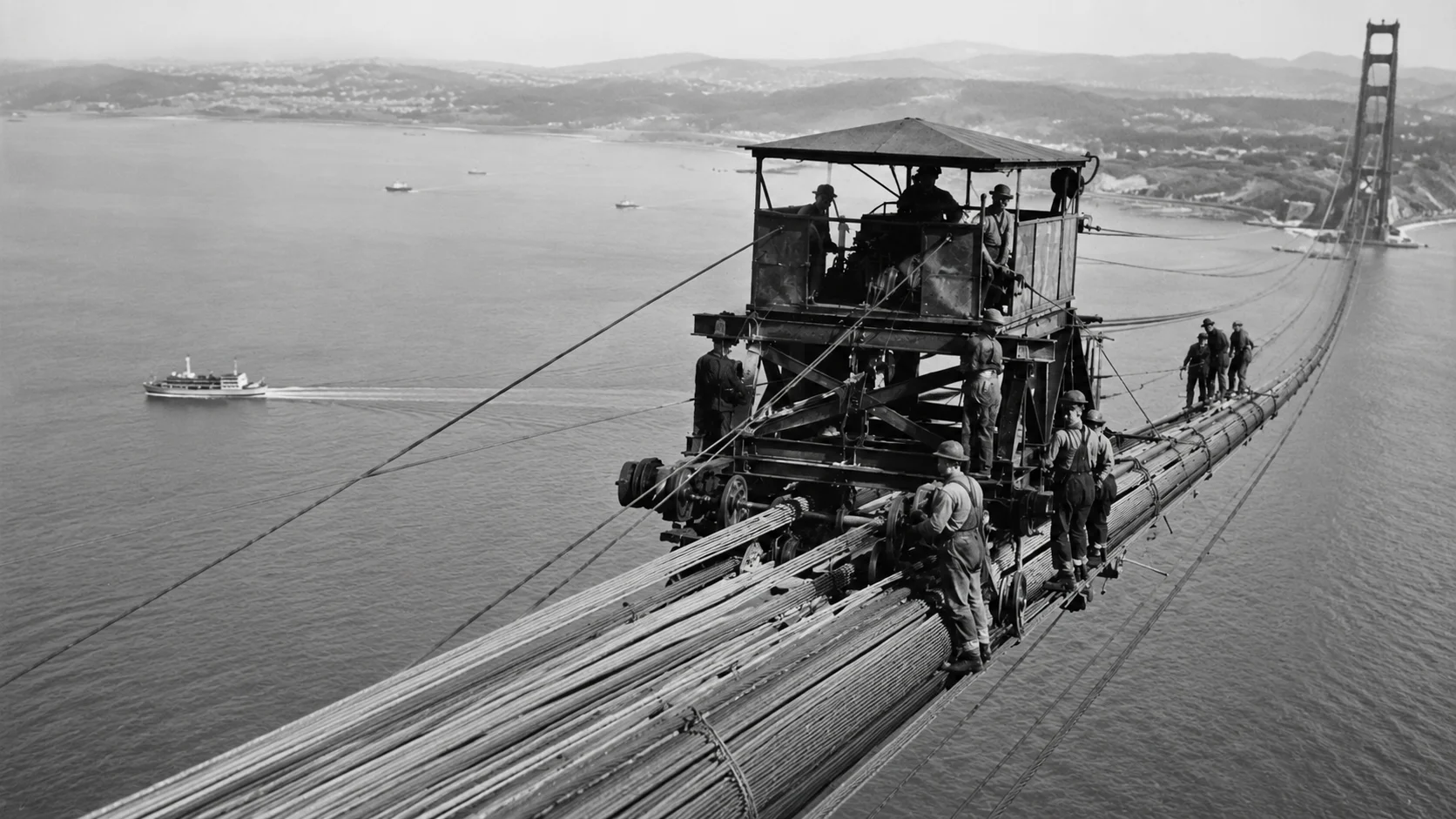
The two massive main cables holding up the bridge were not shipped to San Francisco in one piece; they were constructed entirely on-site. Using a specialized spinning shuttle that traveled back and forth across the strait, workers spun 27,572 individual strands of galvanized steel wire together for each cable. If you unraveled all the wire used in the bridge, it would stretch for 80,000 miles—long enough to circle the Earth’s equator three times.
6. A Poet Built the Bridge
The driving force behind the Golden Gate Bridge was Joseph Strauss, a brilliant but notoriously difficult engineer. However, Strauss was not just a man of math and steel; he was also an avid, published poet. Upon the completion of his life’s greatest work, he wrote a triumphant poem titled “The Mighty Task is Done,” celebrating the human will to conquer the impossible.
7. The Bridge Sang a Creepy Song
In 2020, the bridge underwent a major aerodynamic retrofit, which included the installation of new, thinner slats on the western handrails to help the structure withstand high winds. However, when the coastal winds hit a specific angle and speed, the new slats acted like a massive musical reed. The bridge began emitting a loud, eerie, low-frequency hum that could be heard for miles across San Francisco, prompting the installation of acoustic clips to silence the noise.
8. It Flattened During Its 50th Anniversary
In 1987, city officials closed the bridge to vehicle traffic to allow pedestrians to walk across in celebration of its 50th anniversary. They expected around 50,000 people, but a staggering 300,000 people showed up and crowded onto the deck. The immense, concentrated weight of the crowd actually caused the bridge’s signature arch to completely flatten out. Engineers quickly assured the panicked public that the bridge was designed to flex and handle far more weight than the crowd provided.
9. The Myth of the Seven-Year Paint Job
A highly persistent urban legend claims that painting the Golden Gate Bridge is a cycle taking exactly seven years, and the moment the painters finish one end, they immediately start over at the other. In reality, the bridge is continuously maintained by a dedicated crew of painters who constantly monitor the structure, treating and touching up specific areas that are degrading due to the harsh, salty maritime environment.
10. The Military Feared It Would Trap Their Fleet
Before construction was approved, the Department of War strongly opposed building any bridge across the strait. They argued that if the United States went to war and an enemy successfully bombed the bridge, the massive steel wreckage would collapse into the water and permanently trap the Pacific Fleet inside the San Francisco Bay, leaving the West Coast completely undefended.
11. Finished Under Budget and Ahead of Schedule
Megaprojects are notoriously plagued by massive delays and ballooning costs. The Golden Gate Bridge stands as a rare historical exception. Despite battling brutal ocean currents, blinding fog, and the intense financial struggles of the Great Depression, the construction was completed ahead of its scheduled deadline and came in at $1.3 million under its original budget.
12. A Roller Skater Was the First to Cross
On May 27, 1937, the bridge opened to pedestrian traffic the day before vehicles were allowed to cross. While local politicians and dignitaries were lining up to cut the ribbon, an energetic 11-year-old girl named Carmelita Mitchell beat them all to the punch. She strapped on her roller skates and zoomed across the span, becoming the very first civilian to make the journey across the newly minted bridge.
13. The Terrifying Sway of 1951
On December 1, 1951, a massive windstorm battered San Francisco, striking the bridge from an unusual, highly dangerous angle. The structure began to ripple and sway violently, twisting nearly 24 feet side-to-side and dipping up and down by over 10 feet. It was the worst motion the bridge had ever experienced, leading to its first-ever weather-related closure and prompting engineers to add millions of pounds of steel bracing under the deck to stiffen the structure.
14. The Traffic Zipper Truck
To accommodate heavy rush hour traffic, the bridge does not have a permanent center divider. Instead, it utilizes a highly specialized piece of heavy machinery known as the “Zipper Truck.” Every day, this machine drives over the bridge, picking up 1,500-pound concrete and steel barriers and shifting them over by one lane, allowing more lanes to open for inbound city traffic in the morning and outbound traffic in the evening.
15. The “Rivet” That Wasn’t
In 1937, a massive ceremony was held to celebrate the driving of the “last rivet” into the bridge. It was a custom-made, solid gold rivet. However, when the construction worker hit it with his pneumatic riveting gun, the gold proved to be far too soft to withstand the intense pressure. The golden rivet instantly disintegrated, forcing the crew to quietly swap it out and finish the bridge with a standard steel rivet.