The Impregnable Citadel: 15 Fascinating Facts About Carcassonne
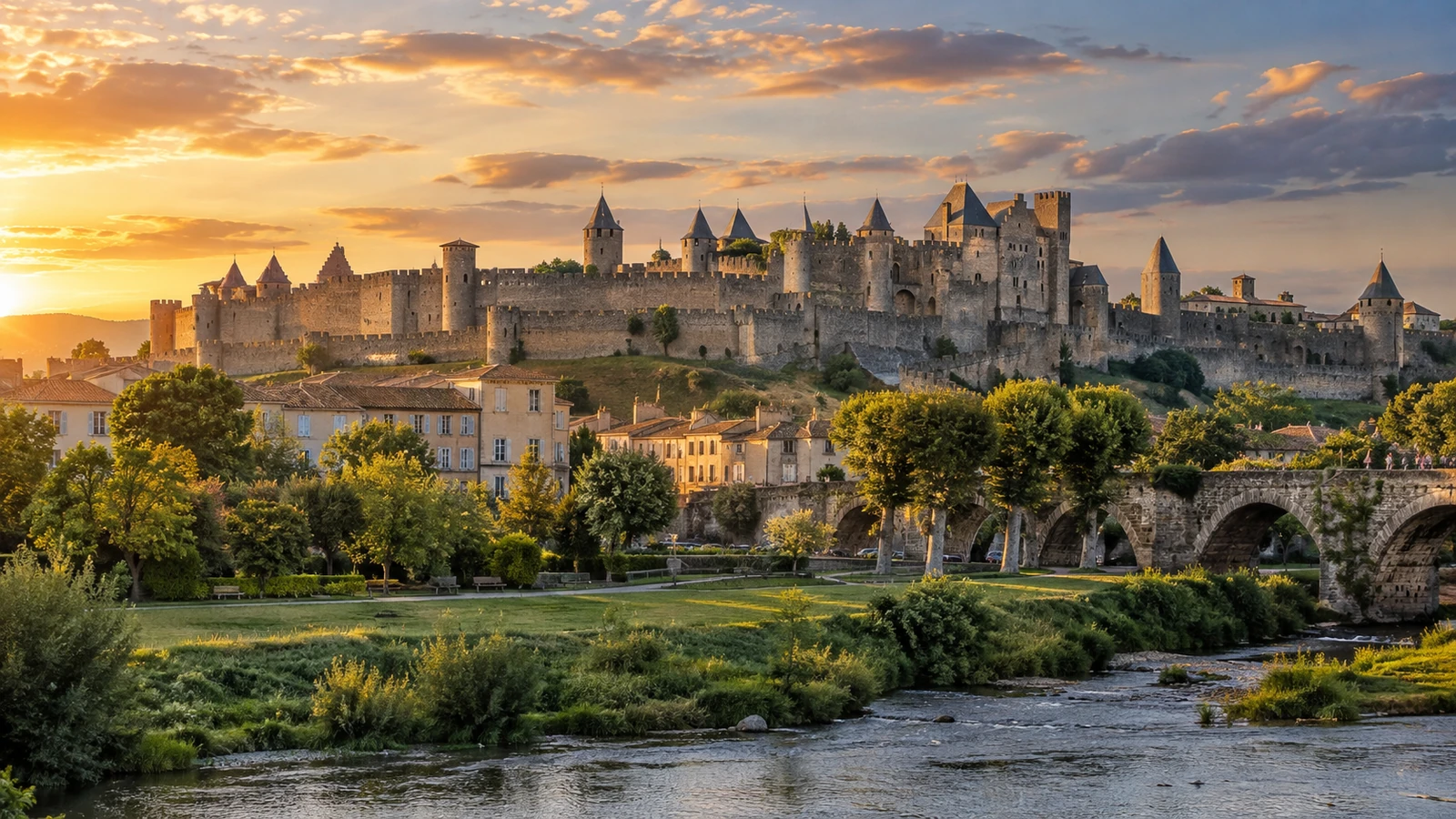
Perched dramatically above the Aude River in southern France, Carcassonne is Europe's largest and best-preserved fortified medieval city. With its double ring of ramparts, 52 towering turrets, and cobblestone lanes, this breathtaking fortress looks like a fairytale come to life. Yet behind its picture-perfect stone towers lies a turbulent history of Cathar crusades, narrow escapes from government demolition decrees, and controversial 19th-century architectural restorations. From pig legends to Hollywood blockbusters and iconic board games, discover the surprising history of this French marvel.
1. The Legendary Pig That Tricked an Emperor
According to local folklore, a clever noblewoman saved Carcassonne from a grueling five-year siege led by Charlemagne. Lady Carcas, the ruler of the fortress, found her citizens starving with only one sack of wheat and a single pig remaining. In a stroke of psychological warfare, she fed the remaining grain to the pig and tossed the fattened animal over the battlements toward the besieging army. Charlemagne's troops concluded that the city possessed such endless provisions that they could afford to waste livestock, prompting them to abandon the siege. As the army retreated, Lady Carcas joyfully rang the city bells, leading a soldier to exclaim "Carcas sonne!" ("Carcas rings!"), giving the city its legendary name.
2. A Citadel Divided into Two Distinct Cities
Many visitors assume Carcassonne is a single medieval complex, but it is actually divided into two separate urban centers separated by the Aude River. The famous hilltop fortress is known as the Cité Médiévale, while the sprawling lower town is called the Bastide Saint-Louis. King Louis IX founded the lower city in 1247 to house citizens who had been expelled from the upper citadel following a failed rebellion led by Raimond Trencavel. Today, visitors can cross the 14th-century Old Bridge (Pont Vieux) to travel between the quiet residential grid of the lower town and the high-walled fortress above.
3. The Lethal Double Wall and "The Lices"
Carcassonne owes its historical military invincibility to a sophisticated system of concentric defenses. The fortress features two huge outer walls stretching nearly three kilometers, punctuated by 52 distinct towers. Between these inner and outer fortifications lies a wide, grassy trench known as The Lices. If invading forces managed to breach the outer ramparts, they found themselves trapped inside this narrow open space, exposed to lethal crossfire from archers positioned along the higher inner wall. Today, this former killing zone serves as a peaceful walking path for tourists surrounding the citadel.
4. Ancient Roman Foundations Beneath Medieval Stone
While Carcassonne is celebrated as a high-medieval masterpiece, its military origins extend back nearly two millennia. The Romans first fortified the strategic hilltop in the 3rd century AD to protect trade routes between the Mediterranean and the Atlantic. Keen-eyed observers can spot the original Gallo-Roman masonry near the base of several towers, characterized by layers of distinctive thin red bricks alternating with small stone blocks. Visigoths, Saracens, and French crusaders later built directly on top of these Roman foundations, creating a physical timeline of European defensive architecture.
5. The Tragic Siege of the Albigensian Crusade
The dark history of Carcassonne is deeply intertwined with the brutal Albigensian Crusade of the early 13th century. The city was a major stronghold for the Cathars, a Christian sect labeled as heretics by the Catholic Church. In August 1209, papal crusaders led by Simon de Montfort besieged the fortress, cutting off its vital water supplies during the sweltering summer heat. The young ruler Raymond-Roger de Trencavel was forced to surrender to save his starving citizens, after which he was imprisoned in his own dungeon where he died shortly after at age 24.
6. The Dark History of the Inquisition Tower
Following the crusade, Carcassonne became a primary operational base for the Papal Inquisition established to eradicate lingering Cathar sympathizers. Within the castle complex, the Tour de l'Inquisition served as a notorious prison and interrogation center. Accused heretics were confined within its damp stone walls, known locally as la Murée ("the walled-in area"), and subjected to harsh imprisonment to force confessions. Many prisoners kept within this tower were subsequently handed over to secular authorities to be burned at the stake outside the city walls.
7. The Hidden Water Sources of the Ramparts
Surviving a long siege required more than just thick walls; access to clean drinking water was critical for defense. Builders constructed hidden subterranean wells deep within the citadel's defenses, most notably the Grand Puits (Great Well). Local tradition held that the well was so vital to the city's survival during medieval sieges that its exact structural access points were guarded as top-secret military intelligence. Legend even claimed that fleeing Cathars dumped their immense religious treasures into the well's depths, though modern archeological excavations have found no gold.
8. The Mysterious "Siege Stone" of the Basilica
Nestled inside the fortress sits the Basilica of Saints Nazarius and Celsus, a stunning church combining Romanesque and Gothic architecture. Inside the south aisle, visitors can view the famous Pierre du Siège (Siege Stone), a rare 13th-century stone relief carving. This artifact provides historians with a contemporary visual depiction of medieval siege tactics, showing knights, mangonels, cross-bowmen, and battering rams attacking fortified walls during the Cathar Crusades. It remains one of the few surviving period carvings illustrating actual medieval siege warfare in action.
9. Saved from Demolition by a 19th-Century Author
By the early 19th century, military advancements had made castle defenses obsolete, and Carcassonne fell into tragic neglect. The ramparts decayed into ruins, and local residents began dismantling the towers to steal stone for building houses. In 1849, the French government officially issued a decree to demolish the fortifications entirely. However, a passionate protest campaign spearheaded by local historian Jean-Pierre Poux and famous author Prosper Mérimée—then serving as Inspector of Historical Monuments—successfully forced the government to reverse its decision and preserve the site.
10. The "Witch's Hat" Restoration Controversy
After saving the city from demolition, the French government hired legendary architect Eugène Viollet-le-Duc in 1853 to restore the ramparts. While Viollet-le-Duc saved the structure, his stylistic choices sparked fierce architectural controversy. Coming from northern France, he topped the towers with steep, conical slate roofs resembling northern castles rather than the flat, terracotta-tiled roofs historically native to sunny southern Occitanie. Purists mocked these distinct conical caps as looking like "witch's hats," yet those high-pitched silhouettes are now famous around the world.
11. Hollywood's Stand-in for Nottingham Castle
Carcassonne's dramatic medieval skyline has made it a favorite location for filmmakers seeking authentic period atmospheres. Its most famous screen appearance came in the 1991 blockbuster Robin Hood: Prince of Thieves, starring Kevin Costner and Morgan Freeman. Film producers utilized the imposing ramparts and gates of the citadel to represent Nottingham Castle. The movie immortalized the fortress for a global audience, driving a new wave of international tourism to southern France.
12. The Board Game Empire Inspired by Its Walls
In 2000, German game designer Klaus-Jürgen Wrede released a tile-laying board game simply titled Carcassonne after visiting the French fortress. Players draw and place tiles depicting roads, cities, monasteries, and fields to construct a medieval landscape around the city. The game became a monumental global success, winning the prestigious Spiel des Jahres award in 2001 and selling over twelve million copies worldwide. Today, millions of gamers recognize the city's iconographic fortress walls through its popular tabletop adaptation.
13. The Annual "Burning Citadel" Pyrotechnic Spectacle
Every year on July 14th for Bastille Day, Carcassonne hosts one of the world's most dramatic fireworks displays, known as the Embrasement de la Cité. Over 700 kilograms of pyrotechnics are set off along the three-kilometer stretch of medieval walls. The carefully choreographed show creates an astonishing optical illusion making the entire ancient fortress appear as though it is engulfed in roaring flames. Hundreds of thousands of spectators line the banks of the Aude River and surrounding hills to watch the illuminated castle glow against the night sky.
14. A Car-Free Haven for Pedestrians
To preserve the delicate stonework and maintain an immersive historic ambiance, city officials strictly limit motor vehicles inside the ancient Cité during daytime hours. Modern cars are barred from navigating the narrow, winding cobblestone streets, forcing residents and delivery vehicles to adhere to tight schedules. This strict traffic regulation allows pedestrians to wander through medieval alleyways without dodging modern vehicles, creating an unhurried atmosphere that feels remarkably unchanged from centuries past.
15. A Rare Intersection of Two UNESCO Sites
In 1997, UNESCO designated the Historic Fortified City of Carcassonne as a World Heritage Site, recognizing it as an outstanding example of a medieval fortified town. Uniquely, Carcassonne sits right at the intersection of two separate UNESCO World Heritage Sites. Passing right through the lower town is the historic Canal du Midi, a 240-kilometer 17th-century waterway constructed under King Louis XIV that was designated by UNESCO in 1996. This rare convergence makes Carcassonne an essential destination for heritage travelers seeking world-class historical engineering.
Sources & References
This AI-assisted post was rigorously curated and fact-checked for accuracy by:
 Martin Roháček
How fun was this article? 🤔
Tap a star to rate it
🧠 Quiz: How closely were you paying attention?
10 questions — all answers are in the article above!
Enjoyed these facts? There's more! 💌
Fresh fun facts in your inbox. No spam, ever.