The Chromatic Marvels: 15 Fascinating Facts About Chameleons
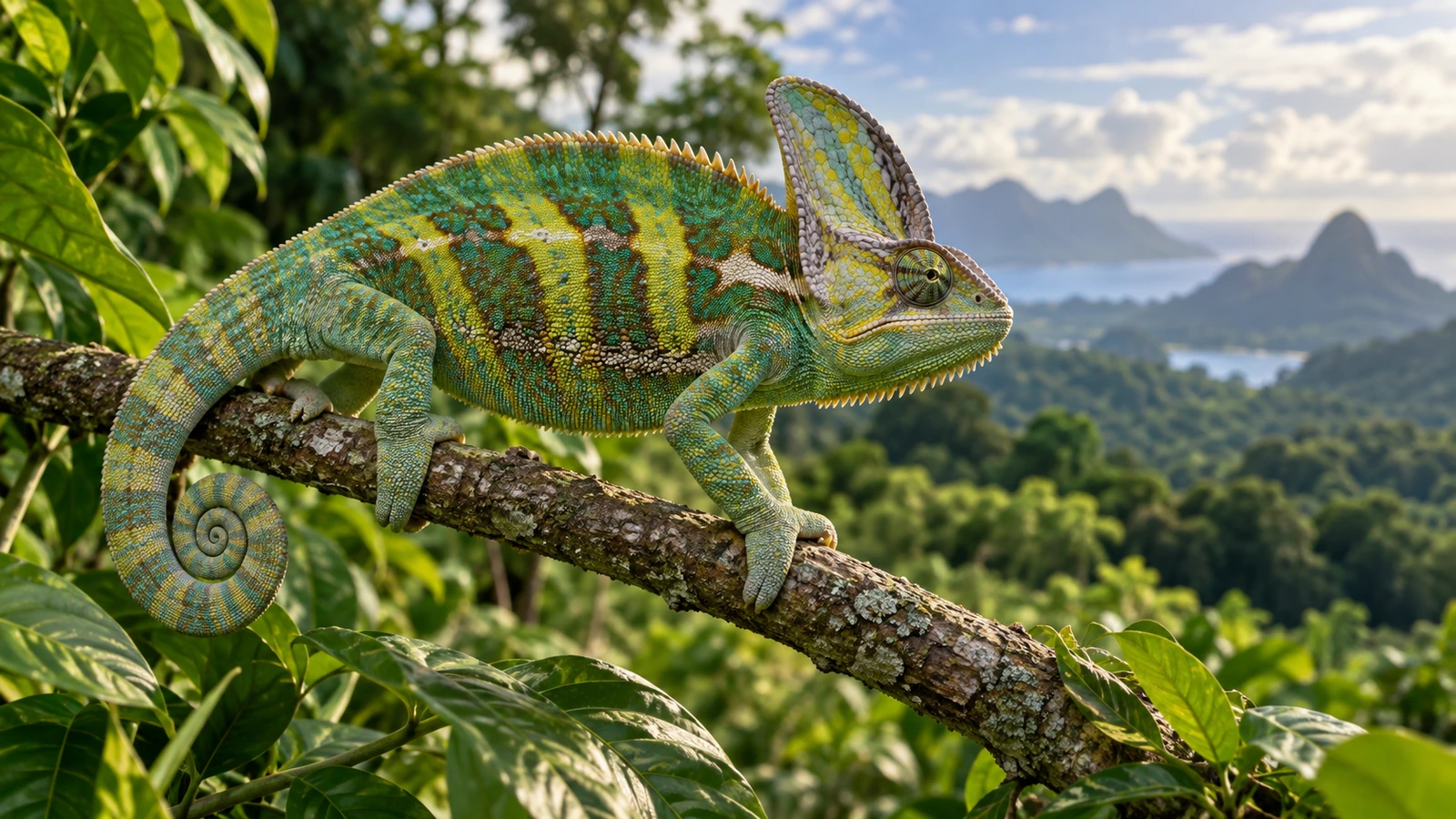
Chameleons are among the most peculiar and highly adapted reptiles on Earth, famed for their rotating eyes, lightning-fast tongues, and striking skin patterns. Contrary to popular belief, these arboreal creatures change color to signal emotions and control body temperature rather than to blend in with their surroundings. From bones that glow under ultraviolet light to sticky saliva that overwhelms heavy prey, their evolutionary traits are truly astounding. Here are 15 fascinating facts about chameleons that reveal the surprising science behind these captivating creatures.
1. Color Change Is About Communication and Temperature, Not Camouflage
Popular culture portrays chameleons as master shapeshifters who alter their skin tones to blend seamlessly into any background. In reality, their color changes are primarily driven by emotional states, social signals, and temperature regulation. A threatened or aggressive male will display bold, vibrant hues like bright red or yellow to intimidate rivals or attract mates. Conversely, a cold chameleon turns dark brown or black to absorb more heat from sunlight. While their baseline coloration naturally matches their native habitat, active color shifting is essentially an intricate form of visual language.
2. They Shift Colors Using Microscopic Nanocrystals
For decades, scientists believed chameleons changed colors by moving pigments around inside specialized skin cells called melanophores. However, researchers discovered that they actually rely on microscopic guanine nanocrystals located in a distinct layer of skin cells known as iridophores. By contracting or relaxing their skin, chameleons alter the spacing between these microscopic crystals. This structural adjustment changes the specific wavelengths of light reflected off the skin, instantly creating vivid greens, blues, and reds. They even possess a deeper layer of iridophores that reflects near-infrared light, helping them stay cool in tropical environments.
3. A Chameleon's Tongue Accelerates Faster Than a Fighter Jet
When striking prey, a chameleon's tongue is one of the fastest moving appendages in the entire animal kingdom. The tongue launch achieves accelerations exceeding 41 g's, far surpassing the peak acceleration experienced by a fighter jet taking off from an aircraft carrier. A specialized elastic muscle stores mechanical energy like a loaded bow before releasing the tongue in under one-hundredth of a second. This explosive speed ensures that unsuspecting flies and grasshoppers have zero time to react before being snagged. Even tiny species boast remarkable tongue speeds relative to their body size that outstrip those of their larger relatives.
4. Their Saliva Is 400 Times Stickier Than Human Spit
Snagging heavy or struggle-prone prey requires more than just speed; it requires an exceptionally strong adhesive. Researchers analyzing chameleon saliva found that it is roughly 400 times more viscous than human saliva. This ultra-sticky coating creates an immense surface tension upon contact, ensuring that heavy beetles or large crickets cannot break free during recoil. Once the tip of the tongue strikes the insect, the suction combined with this biological glue holds the victim fast. The chameleon then reels its prey back into its mouth in less than half a second.
5. Their Eyes Move Independently for a 360-Degree Field of View
Chameleons possess some of the most specialized visual hardware among terrestrial vertebrates. Their upper and lower eyelids are fused together, leaving only a tiny pinhole pupil visible for each eye. Crucially, each eye can move and focus completely independently of the other, granting them a full 360-degree field of vision. One eye can scan the canopy ahead for incoming predators while the other tracks a moving insect behind them. Once prey is spotted, both eyes lock forward simultaneously to provide precise binocular vision and depth perception before the strike.
6. Their Feet Act Like Biological Salad Tongs
Navigating slender tree branches requires a grip unlike that of most other reptiles. Chameleon feet are structurally adapted through a condition known as zygodactyly, where toes are fused into two opposing bundles on each foot. On the front feet, the inner group contains three toes and the outer group contains two, whereas on the hind feet, this arrangement is reversed. This specialized arrangement acts like a pair of biological salad tongs, allowing them to clamp tightly onto arboreal perches. Thanks to this powerful anatomical vise, they can easily maintain their footing even in high winds.
 Reptiles, Amphibians and Snakes
From venomous serpents and heavily armored crocodilians to shape-shifting amphibians, explore the fascinating biology and hidden secrets of Earth's most incredible cold-blooded marvels.
See All Facts
Reptiles, Amphibians and Snakes
From venomous serpents and heavily armored crocodilians to shape-shifting amphibians, explore the fascinating biology and hidden secrets of Earth's most incredible cold-blooded marvels.
See All Facts
7. The Smallest Known Reptile on Earth Is a Tiny Chameleon
In 2021, scientists in northern Madagascar announced the discovery of Brookesia nana, or the nano-chameleon. Adult males of this minuscule species measure just 13.5 millimeters in body length, making them small enough to perch comfortably on the tip of a matchstick. Despite their miniature size, they possess fully functional eyes and hunting capabilities identical to their massive cousins. Unfortunately, because their entire known habitat consists of a tiny patch of degraded rainforest, the species faces an immediate threat from ongoing deforestation. Researchers are actively pushing for habitat protection to preserve this microscopic reptile.
8. Unlike Other Lizards, Chameleons Cannot Regrow Their Tails
Many common lizards feature caudal autotomy, the ability to shed their tail when seized by a predator and later regrow it. Chameleons, however, lack this defensive adaptation and cannot regenerate a lost tail. Instead, their prehensile tail functions as a critical fifth limb that provides stability while moving through the canopy. While navigating delicate twigs, the tail wraps securely around branches to anchor the animal in place. At night, they tightly curl their tail while sleeping to prevent accidental falls from the trees.
9. They Rock Back and Forth to Mimic Leaves Swaying in the Wind
Watching a chameleon walk across an open branch reveals a strange, jerky movement that looks almost like a deliberate dance step. The chameleon steps forward, pauses, rocks back and forth, and then takes another hesitant step. This behavioral adaptation is known as motion camouflage, designed to mimic the natural sway of leaves blowing in a breeze. By blending their movement with the ambient rhythmic motion of the surrounding foliage, they trick prospective predators and prey into overlooking them. This clever trick allows them to stalk skittish insects without sounding alarm bells.
10. Some Chameleon Species Give Birth to Live Young
While the vast majority of reptiles lay hard-shelled or leathery eggs, several chameleon species are ovoviviparous. Female Jackson's chameleons, which are native to the high-altitude regions of East Africa, carry their developing embryos internally for five to six months. When giving birth, the female deposits sticky, transparent sacs containing fully formed baby chameleons directly onto tree branches. The newborn babies immediately break free from their membranes and grab onto the bark to avoid falling to the forest floor. This live-birth strategy protects vulnerable offspring from extreme temperature fluctuations and ground predators.
11. They Can See Ultraviolet Light Invisible to Humans
Chameleons possess advanced visual perception that extends into the ultraviolet spectrum, a range of light invisible to the human eye. Exposure to natural UV light directly influences their behavior, boosting their appetite, activity levels, and reproductive drive. Furthermore, UV vision plays a critical role in their social interactions, allowing them to detect subtle skin cues displayed by potential mates or territorial rivals. Female chameleons exposed to optimal UV light are significantly more likely to engage in successful mating displays. This unique sensory ability makes UV light essential for their survival in dense rainforest canopies.
12. Their Bones Glow Bright Blue Under Blacklight
A surprising discovery revealed that many chameleon species display biofluorescence on their heads and bodies. Under ultraviolet blacklight, bony crests called tubercles on their skulls absorb light and re-emit it as a neon-blue glow through thin layers of skin. Because these glowing patterns match the UV-sensing capabilities of their eyes, scientists believe the displays serve as secret signaling channels. The fluorescence allows chameleons to communicate dominance or species identity to one another without alerting predators that lack UV vision. This hidden visual network was overlooked by researchers for centuries.
13. They Are Virtually Deaf to Airborne Sounds
Chameleons lack both an outer ear structure and an external tympanic opening, making them almost completely deaf to typical airborne noises. They cannot hear high-pitched sounds or soft vocalizations traveling through the air around them. However, they can sense low-frequency sound waves ranging from 200 to 600 Hertz that travel through physical substrates. When vibrations pass through tree branches, specialized mechanoreceptors in their inner ears pick up these subtle tactile signals. This substrate-borne hearing allows them to detect approaching predators or movement along neighboring stems.
14. The Giant Parson's Chameleon Can Eat Small Birds
While most chameleons feast on insects like crickets, flies, and beetles, the largest species possess terrifying hunting capabilities. The Parson's chameleon of Madagascar can reach lengths of nearly 27 inches and weigh up to two pounds. Armed with massive jaws and an exceptionally powerful tongue strike, these giant reptiles target much larger prey. Their diet includes small birds, rodents, and even smaller lizards that happen to cross their path. Standing at the top of the arboreal reptile food chain, they are formidable apex predators in their local forest canopy.
15. Their Tongues Are Stored Like Accordions Inside Their Jaws
To launch a tongue that is often up to twice the length of its entire body, a chameleon requires a unique muscular storage system. When resting inside the mouth, the massive tongue is compressed over a central bone called the hyoid process like a folded accordion. Specialized accelerator muscles surrounding the hyoid bone contract tightly, building up immense tension against lubricated sheath tissues. When the chameleon triggers a strike, this stored energy releases instantly, shooting the tongue forward like a coiled spring. After impact, retractor muscles swiftly draw the massive organ back into its neatly folded resting position.
Sources & References
This AI-assisted post was rigorously curated and fact-checked for accuracy by:
 Martin Roháček
How fun was this article? 🤔
Tap a star to rate it
🧠 Quiz: How closely were you paying attention?
10 questions — all answers are in the article above!
Enjoyed these facts? There's more! 💌
Fresh fun facts in your inbox. No spam, ever.