The Light-Chasing Master: 15 Fascinating Facts About Claude Monet
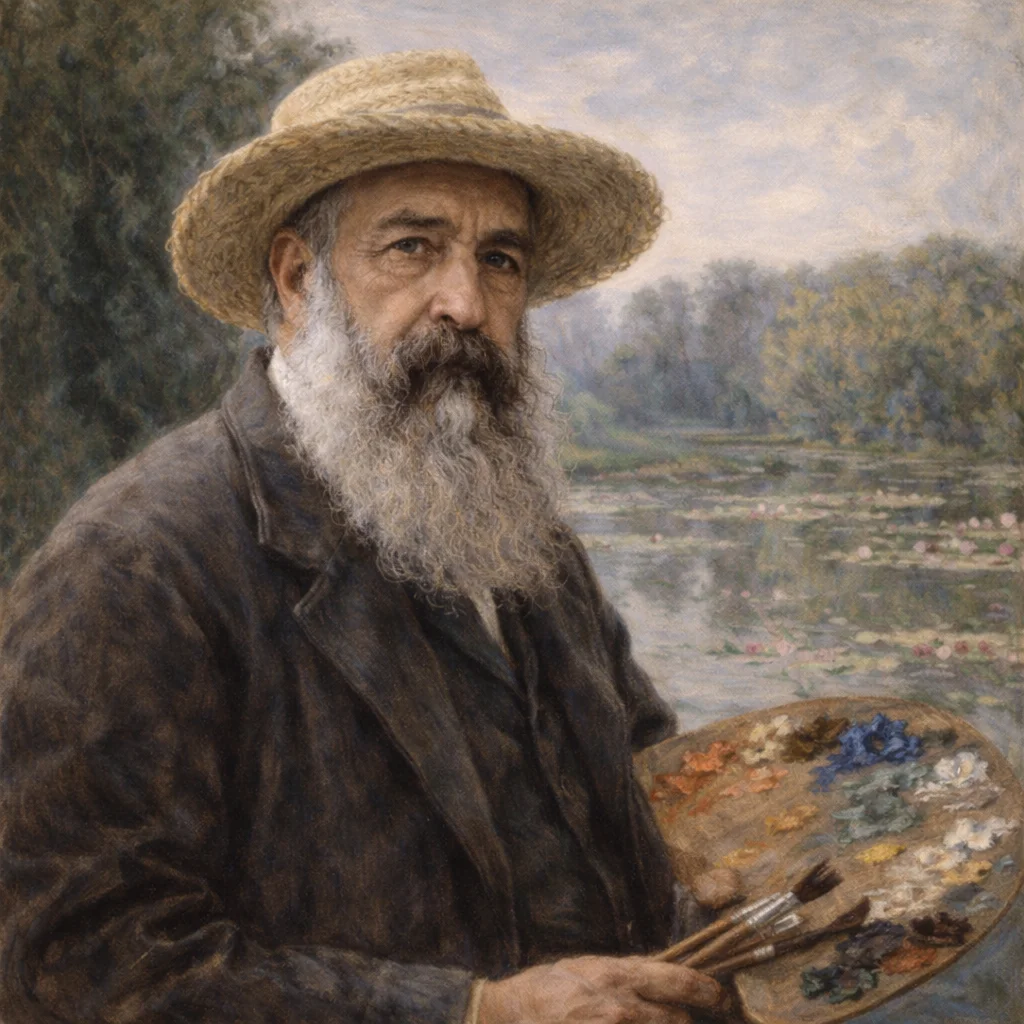
Claude Monet is celebrated worldwide as the founding father of Impressionism, renowned for his serene water lilies and luminous plays of natural light. Yet behind his tranquil masterpieces lies a tumultuous life filled with desperate poverty, sharp perfectionism, and fierce determination. From drawing teenage caricatures to surviving an attempt on his own life, Monet fought both critics and local bureaucracy to revolutionize modern art. Here are 15 fascinating facts about the painter who forever changed how we see the natural world.
1. Monet Started His Career as a Profitable Caricaturist
As a teenager growing up in the Normandy port city of Le Havre, Claude Monet demonstrated an early talent for drawing charcoal caricatures of local figures and schoolteachers. By age fifteen, he was already displaying these humorous, exaggerated portraits in the window of a local frame shop and selling them for up to twenty francs each. This precocious commercial success earned him a modest nest egg before he ever painted a single landscape. His artistic direction shifted dramatically when painter Eugène Boudin befriended him on the docks and coaxed the young satirist outdoors to paint en plein air. That initial push away from studio satire sparked Monet's lifelong obsession with capturing natural light and atmosphere.
2. "Impressionism" Was Coined as an Insult by a Mocking Art Critic
In April 1874, Monet and a group of independent artists organized an alternative exhibition in Paris to bypass the conservative official Salon. Among the displayed works was Monet’s Impression, Sunrise, depicting the misty harbor of Le Havre at dawn with loose, sketchy brushstrokes. Satirical journalist and critic Louis Leroy wrote a scathing review, sneering that wallpaper in its embryonic state was more finished than Monet's canvas and mockingly labeling the group "Impressionists." Far from being offended, Monet and his circle triumphantly embraced the derisive moniker as a badge of honor. What began as a critic's jab soon defined one of the most revolutionary movements in art history.
3. Financial Despair Drove Him to an Attempted Suicide in the Seine
Long before Monet achieved wealth and global renown, his early career was plagued by crushing poverty, mounting debts, and professional rejection. In the spring of 1868, evicted from his lodgings and unable to provide for his young family, the twenty-seven-year-old artist hit rock bottom. Overwhelmed by despair, Monet threw himself into the icy waters of the Seine River near Gloton in hopes of drowning. However, his powerful natural swimming instincts kicked in, and he managed to haul himself back to the riverbank. This dark episode marked the lowest point of his life, after which he grimly rededicated himself to his art despite lingering financial precarity.
4. Local Farmers Feared His Water Lilies Would Poison Their Livestock
When Monet bought his estate in Giverny in 1890, he envisioned a grand water garden inspired by traditional Japanese prints. However, his ambitious plans met fierce resistance from the village's conservative agricultural community. Neighboring farmers filed official complaints with the local council, terrified that the exotic imported water lilies would contaminate the local water supply and poison their drinking cattle. Monet was forced to engage in a protracted bureaucratic battle before finally securing permission to divert water from the nearby river. Today, those controversial aquatic plants form the centerpieces of some of the most celebrated masterworks in Western art.
5. He Employed a Full-Time Gardener Just to Dust His Water Lilies
Monet's passion for his Giverny gardens bordered on obsession, requiring a dedicated team of up to six gardeners to maintain every leaf and stem. One assistant had the unusual daily assignment of rowing out onto the lily pond in a small wooden boat early each morning. Because soot from nearby coal-burning trains and dust from rural roads routinely settled on the water, the gardener had to carefully wash and dust every individual lily pad before Monet began his painting sessions. Monet insisted on pristine surfaces so that the morning light would reflect perfectly off the calm water. This meticulous maintenance allowed him to capture the subtle, fleeting shifts of light that defined his later career.
6. He Repeatedly Destroyed Hundreds of His Own Canvases in Fits of Rage
Monet was a ruthless perfectionist who often fell into deep bouts of self-doubt regarding his ability to capture nature's fleeting beauty. When a composition failed to meet his exacting standards, he frequently slashed the canvas with a palette knife, kicked it to pieces, or threw it onto a fire. In 1908, shortly before a major exhibition of his water lily series in Paris, Monet destroyed over thirty completed canvases in a fit of frustration, forcing the show to be postponed for a year. His family and close friends often had to physically intervene or secretly rescue paintings from his studio burn pile before he could incinerate them.
7. Cataracts Altered His Perception of Color in His Later Years
In his sixties, Monet began suffering from nuclear cataracts, a degenerative eye condition that blurred his vision and heavily altered his perception of color. As his eye lenses turned yellow and brown, he lost the ability to perceive subtle blues and violets, seeing the world through a mud-red hue instead. Determined to keep working, Monet relied on the labeled positions of paint tubes on his palette and his sharp visual memory to construct scenes. After undergoing cataract surgery in 1923, he suddenly saw intense ultraviolet light, causing him to re-paint several works with vivid indigo and cyan tones. Art historians view this late period as a crucial bridge between Impressionism and mid-century Abstract Expressionism.
8. His First Wife Posed as Multiple Figures in a Single Painting
Monet's first wife and muse, Camille Doncieux, appeared in dozens of his early compositions, serving as his primary model throughout the 1860s and 1870s. In his famous 1866 masterpiece Women in the Garden, Monet painted four distinct, fashionably dressed women gathering flowers in a sunlit landscape, but all four were actually modeled by Camille. Tragically, Camille suffered from chronic illness and passed away in 1879 at the young age of thirty-two. Deeply grieved, Monet painted a haunting, melancholic portrait of her on her deathbed, capturing the fading tones of light across her face during her final moments.
9. He Successfully Engineered a River Diversion to Build His Famous Pond
Creating the world-famous water garden at Giverny required significant civil engineering rather than mere gardening skills. To maintain a constant flow of fresh water for his lily pond, Monet applied for permission to divert a small branch of the Epte River, a tributary of the Seine. Despite opposition from local authorities and suspicion from neighbors, he successfully secured approval to alter the natural waterway and construct a series of sluice gates. By controlling the water flow, Monet kept the pond clear and managed the microclimate of his water garden. This engineered paradise provided him with an endless stream of artistic inspiration for the final three decades of his life.
10. He Traveled to London Specifically to Paint the Industrial Smog
While many artists complained about London's thick, polluted industrial fog, Monet found the city's murky atmosphere utterly intoxicating. Between 1899 and 1901, he made three extended trips to the British capital, booking rooms at the Savoy Hotel overlooking the River Thames. He was fascinated by how coal smoke and heavy fog combined to refract sunlight into unusual hues of orange, purple, and crimson. Monet produced nearly a hundred canvases depicting the Houses of Parliament, Waterloo Bridge, and Charing Cross Bridge obscured by haze. He famously remarked that without its fog, London would not be a beautiful city at all.
11. He Was a Pallbearer at Édouard Manet's Funeral Despite His Fear of Death
Although Monet possessed a lifelong aversion to mortality and rarely spoke of death, he paid profound respect to his close friend and fellow artistic pioneer Édouard Manet. When Manet died in April 1883 at age fifty-one, Monet served as one of six official pallbearers alongside novelist Émile Zola and painter Edgar Degas. Monet had long considered Manet a guiding light who had paved the way for the Impressionist movement. Their friendship was rooted in mutual admiration, financial solidarity during lean years, and a shared desire to break away from traditional academic painting standards.
12. A Massive French Lottery Win Finally Granted Him Financial Independence
For decades, Monet struggled to pay for basic art supplies, rent, and food, frequently begging wealthy patrons for small loans. His financial trajectory changed dramatically in 1890 when he and his second wife, Alice Hoschedé, won 100,000 francs in the French National Lottery. This astonishing windfall gave Monet complete financial security almost overnight. He immediately used the funds to purchase the rented house and grounds at Giverny, which he had been leasing since 1883. Free from financial anxiety, Monet expanded the gardens, built specialized studios, and dedicated himself entirely to his late artistic visions.
13. He Painted the Same Haystacks Twenty-Five Times to Capture Changing Light
Monet believed that the true subject of any landscape was not the object itself, but the atmosphere and light enveloping it. To demonstrate this concept, he spent months in 1890 and 1891 painting a series of wheat stacks in a field near Giverny. Monet set up multiple easels side by side outdoors, switching rapidly from one canvas to another as the sun moved across the sky or weather conditions changed. He completed twenty-five distinct views of the same haystacks under different conditions, ranging from frosty winter mornings to glowing summer sunsets. The resulting series was a critical and commercial triumph that revolutionized how artists approached light.
14. His Famous Japanese Footbridge Was Actually Painted Green, Not Red
In many of Monet's vibrant water lily paintings, the arched wooden bridge spanning his pond appears wrapped in rich hues of turquoise, violet, and green. Contrary to popular belief that the bridge was modeled after bright red traditional Japanese structures, Monet actually had the real bridge painted a subdued shade of apple green. He chose this specific color deliberately so that the structure would harmonize seamlessly with the surrounding weeping willows and bamboo thickets rather than visually dominating the garden. The painter wanted the bridge to serve as a quiet structural accent within the organic landscape.
15. He Forbidden Cut Flowers and Black Drapery at His Funeral
When Monet passed away from lung cancer on December 5, 1926, at the age of eighty-six, he left strict instructions regarding his funeral service. The man who had spent his adult life cultivating and painting flowers adamantly banned cut floral arrangements from his casket, viewing killed blossoms as an unnatural waste. He also requested a modest, simple ceremony free of formal black funeral drapery. At the service, his close friend, French Prime Minister Georges Clemenceau, dramatically pulled off the traditional black pall covering Monet's coffin and replaced it with a colorful floral cloth, declaring that Monet deserved a farewell as vibrant and full of light as his life's work.
Sources & References
This AI-assisted post was rigorously curated and fact-checked for accuracy by:
 Martin Roháček
How fun was this article? 🤔
Tap a star to rate it
🧠 Quiz: How closely were you paying attention?
10 questions — all answers are in the article above!
Enjoyed these facts? There's more! 💌
Fresh fun facts in your inbox. No spam, ever.