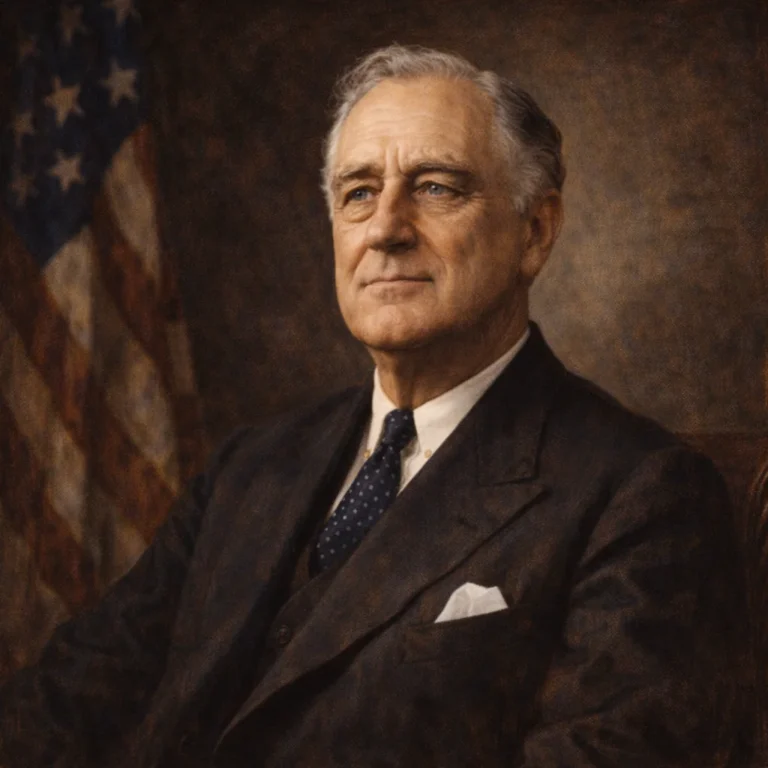
Franklin Delano Roosevelt guided the United States through its two greatest crises of the 20th century: the Great Depression and World War II. As the only president to serve more than two terms, he fundamentally reshaped the role of the American government in the daily lives of its citizens. Despite facing a debilitating physical disability, he projected an image of strength and optimism that rallied the nation. Furthermore, his "Fireside Chats" revolutionized how politicians communicate with the public. Prepare to explore the life of the man who said we have nothing to fear but fear itself.
Franklin Roosevelt
Voters elected him to the presidency four distinct times. Roosevelt won the elections of 1932, 1936, 1940, and 1944. Consequently, he served as president for twelve years, a record that led Congress to pass the 22nd Amendment to limit future presidents to two terms.
He went to great lengths to hide his wheelchair from the public. After contracting polio at age 39, he lost the use of his legs. To maintain an image of strength, he used heavy steel braces to stand during speeches and forbade photographers from taking pictures of him in his wheelchair.
He married his own distant cousin, Eleanor Roosevelt. The two were fifth cousins once removed and had known each other since childhood. At their wedding, Theodore Roosevelt, who was Eleanor’s uncle and Franklin’s fifth cousin, walked the bride down the aisle.
An assassin tried to shoot Franklin Roosevelt but killed the Mayor of Chicago instead. In 1933, Giuseppe Zangara fired five shots at Roosevelt in Miami. Although the president escaped unharmed, the bullets mortally wounded Mayor Anton Cermak, who was standing nearby.
He served hot dogs to the King and Queen of England. When King George VI and Queen Elizabeth visited the United States in 1939, Roosevelt hosted a picnic for them at his Hyde Park estate. This casual menu choice shocked the press but charmed the royals, strengthening the bond between the two nations.
He stood as the first president to appear on television. In 1939, he spoke at the opening session of the New York World’s Fair. Although only a few hundred people owned television sets at the time, the broadcast marked the beginning of the televised presidency.
Roosevelt became the first president to fly in an airplane while in office. In 1943, he flew to Morocco for the Casablanca Conference to meet with Winston Churchill. This secret trip required him to fly on a commercial seaplane called the Dixie Clipper.
Franklin Roosevelt appointed the first woman to a presidential cabinet. Frances Perkins served as his Secretary of Labor for his entire presidency. She played a crucial role in writing the Social Security Act and establishing the minimum wage.
His dog, Fala, became a national celebrity. The Scottish Terrier traveled everywhere with the president and even had a secretary to answer his fan mail. Roosevelt famously defended the dog in a campaign speech after Republicans accused him of sending a destroyer ship to pick up the forgotten pet.
He was an avid stamp collector. FDR found great relaxation in organizing his massive collection of postage stamps. During his presidency, he even helped the Postmaster General design several new American stamps.
A letter from Albert Einstein convinced him to build the atomic bomb. The physicist warned Roosevelt that Nazi Germany might be developing a nuclear weapon. This warning led the president to authorize the Manhattan Project, which eventually produced the bombs that ended the war in the Pacific.
He died while an artist was painting his portrait. On April 12, 1945, he suffered a massive stroke while sitting for a watercolor painting at his retreat in Warm Springs, Georgia. The artist, Elizabeth Shoumatoff, never finished the work, and the “Unfinished Portrait” remains famous today.
Franklin Roosevelt tried to expand the Supreme Court to save his programs. When the Court struck down several New Deal laws, Roosevelt proposed a plan to add more judges who would support him. Critics called this “court-packing,” and Congress rejected the plan, dealing him a rare political defeat.
He established the March of Dimes to fight polio. Before it became a general charity for children’s health, the organization focused specifically on finding a cure for the disease that paralyzed him. He encouraged Americans to send dimes to the White House to fund research.
Finally, he almost pursued a career in the navy instead of politics. He loved the sea and had a vast collection of naval prints and model ships. He eventually satisfied this passion by serving as the Assistant Secretary of the Navy under Woodrow Wilson.
How useful was this post?
Click on a star to rate it!
This AI-assisted post was rigorously curated and fact-checked for accuracy by: