The Enigmatic Queen: 15 Fascinating Facts About Cleopatra
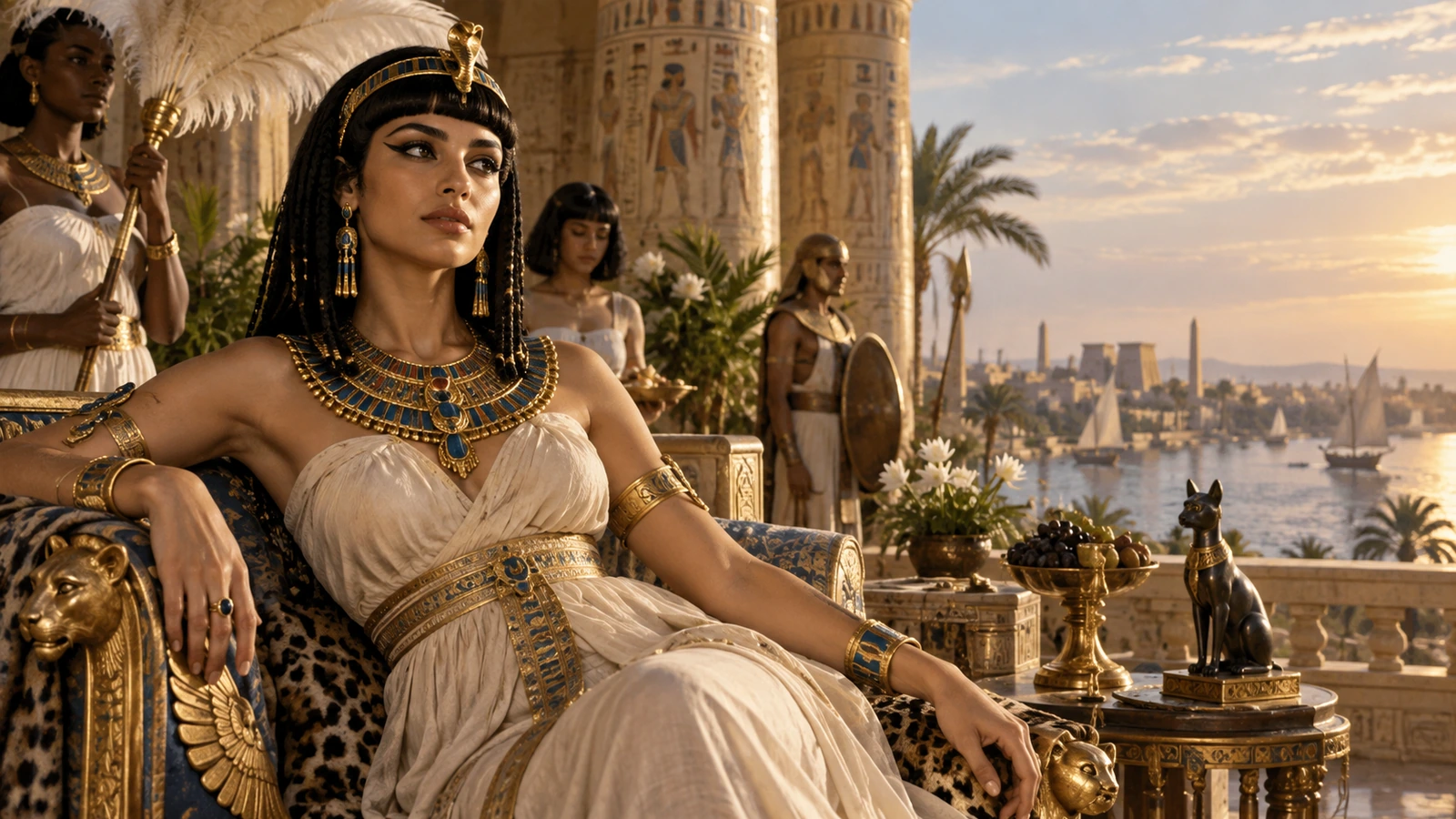
Cleopatra VII Philopator remains one of the most romanticized and misunderstood figures of the ancient world. Far from being a simple seductress of Roman generals, she was a brilliant polyglot diplomat, a keen scientific author, and a cunning military commander. From her genuine European lineage to the real science behind her iconic makeup, here are 15 fascinating facts that reveal the true story of Egypt's last active pharaoh.
1. She Lived Closer to the Moon Landing Than to the Great Pyramids
Cleopatra VII Philopator lived in the 1st century BCE, putting her chronologically closer to the Apollo 11 Moon landing in 1969 than to the construction of the Great Pyramid of Giza. The Great Pyramid was completed around 2560 BCE, roughly 2,500 years before Cleopatra took the throne. For Cleopatra, monuments like the Sphinx were already ancient history that she viewed with the same historical distance we feel today. She walked among the stone structures of ancient Egyptian civilization as a latecomer to a millenia-old empire. This remarkable timeline highlights just how impossibly long the Egyptian empire endured.
2. She Was Ethnically Macedonian Greek, Not Egyptian
Despite being the most iconic ruler of ancient Egypt, Cleopatra had no native Egyptian blood. She was a direct descendant of Ptolemy I Soter, a Macedonian Greek general who served under Alexander the Great. Following Alexander's death in 323 BCE, Ptolemy seized control of Egypt and established a Greek-speaking ruling dynasty that lasted three centuries. Cleopatra was the product of generations of royal intermarriage designed to preserve European royal bloodlines. Consequently, her native language was Koine Greek, and her cultural roots were thoroughly Hellenistic.
3. She Was the First Ptolemaic Monarch to Learn Egyptian
Cleopatra was a formidable intellectual who fluently spoke at least nine languages, including Greek, Parthian, Aramaic, and Hebrew. Unlike her Ptolemaic ancestors, who spent nearly 300 years ruling Egypt without ever learning the local language, she was the very first ruler of her dynasty to master written and spoken Egyptian. This linguistic skill allowed her to negotiate directly with foreign delegates from Ethiopia, Arabia, and the Near East without relying on court interpreters. Her mastery of Egyptian also endeared her to the native population, who saw her as a leader who truly respected their culture. By communicating directly with her subjects, she bolstered her political authority across a diverse empire.
4. She Smuggled Herself to Caesar in a Bed Sack, Not a Carpet
Popular culture often depicts Cleopatra being dramatically unrolled from a luxurious Persian carpet before Julius Caesar, but ancient texts tell a different story. According to the Greek historian Plutarch, she smuggled herself into the royal palace inside a coarse linen bed sack or laundry bag. Her loyal servant Apollodorus tied the sack shut and carried it past the guards of her hostile brother and co-ruler, Ptolemy XIII. When released inside Caesar’s private quarters, the bold and resourcefully packaged young queen immediately captivated the Roman general. This daring stunt showcased her willingness to gamble everything for political survival.
5. She Dissolved a Multi-Million-Dollar Pearl to Win a Bet
To win a legendary wager against Mark Antony, Cleopatra demonstrated her unfathomable wealth by consuming one of the world's most valuable pearls. She bet Antony that she could host a single dinner costing ten million sestertii, an astronomical sum in the ancient Roman economy. When the main feast appeared ordinary, Antony scoffed, only for Cleopatra to remove a priceless pearl earring and drop it into a vessel of strong vinegar. The acidic liquid dissolved the calcium carbonate jewel, creating a chemical cocktail that she drank to win the bet. Modern chemical experiments have confirmed that concentrated vinegar can indeed dissolve a real pearl within hours.
6. She Formed a Wild Drinking Club Called the Inimitable Livers
Cleopatra and Mark Antony founded an exclusive social club in Alexandria known as the "Inimitable Livers" or Amimetobioi. Members of this elite society gathered nightly for lavish banquets, excessive drinking, and elaborate theatrical pranks. The pair famously disguised themselves as common servants to wander the streets of Alexandria late at night, teasing locals and listening to urban gossip. Later in their lives, as defeat by Rome loomed, they dissolved the club and formed a new society named "Companions to the Death." This decadent lifestyle served as both royal bonding and clever political theatre for the power couple.
 Rulers, Kings and Emperors
Discover the captivating truths behind history's most iconic rulers, kings, and emperors. From eccentric geniuses and tactical masterminds to deeply flawed sovereigns, explore the hidden lives of those who shaped the modern world.
See All Facts
Rulers, Kings and Emperors
Discover the captivating truths behind history's most iconic rulers, kings, and emperors. From eccentric geniuses and tactical masterminds to deeply flawed sovereigns, explore the hidden lives of those who shaped the modern world.
See All Facts
7. Roman Propaganda Exaggerated Her Beauty over Her Intellect
Roman propaganda depicted Cleopatra as a hyper-sexualized seductress who bewitched Rome's greatest generals with irresistible physical beauty. However, contemporary coins minted during her reign show her with a prominent hooked nose, a sharp chin, and strong features. The historian Plutarch noted that her physical appearance was not inherently captivating, but her presence, intellect, and magnetic conversation were enchanting. Roman writers emphasized her overwhelming charm, sharp wit, and melodious voice rather than flawless facial features. Discrediting her as a dangerous temptress allowed Octavian to frame his civil war as a defense against foreign sorcery.
8. She Married Two of Her Own Younger Brothers
To maintain the purity of the royal lineage, Ptolemaic tradition dictated that monarchs marry their siblings. Cleopatra was forced to marry two of her younger teenage brothers, Ptolemy XIII and Ptolemy XIV, both of whom served as nominal co-rulers. However, these forced alliances quickly devolved into bloody civil conflict as Cleopatra sought absolute power. Her first husband-brother, Ptolemy XIII, drowned in the Nile after waging war against her and Julius Caesar. Her second brother-husband, Ptolemy XIV, died under suspicious circumstances shortly after, likely poisoned on Cleopatra's orders to clear the way for her son.
9. She Was an Accomplished Author of Scientific Texts
Beyond her political maneuvering, Cleopatra was a respected scholar who authored medical and scientific works. She wrote an extensive treatise titled Kosmetikon, which focused on pharmaceuticals, dermatology, and cosmetics. The text included practical recipes for treating hair loss, dandruff, and skin ailments, showing a sophisticated understanding of early chemistry. Medical writers like Galen cited her formulas for centuries after her death, demonstrating that her scientific contributions were taken seriously across the Mediterranean. Her knowledge of botany and chemistry also extended into the deadly realm of lethal poisons.
10. She Styled Herself as the Living Incarnation of Isis
Cleopatra strategically aligned herself with Egyptian religion by proclaiming that she was the living incarnation of Isis, the supreme mother goddess. She regularly wore the sacred robes of Isis during public ceremonies and conducted rituals designed to reinforce her divinity. This clever self-fashioning presented Mark Antony as Dionysus-Osiris, creating a powerful divine power couple in the eyes of Eastern populations. By integrating her political persona with ancient Egyptian cosmology, she gained absolute devotion from her native subjects. To the Egyptian priesthood, obeying Cleopatra was equivalent to serving the gods themselves.
11. She Personally Commanded a Naval Fleet in Battle
Cleopatra was not merely a royal bystander during military operations; she actively commanded her own naval fleet in battle. At the Battle of Actium in 31 BCE, she personally led sixty Egyptian warships alongside Mark Antony's heavy Roman vessels against Octavian's forces. Dressed in full royal attire, she directed tactical movements from her flagship, the Antonias. When the naval battle took a disastrous turn, she managed to break through the enemy lines with her squadron to secure her treasure and retreat toward Alexandria. Antony abandoned his own flagship to follow her, effectively sealing the destruction of their combined military power.
12. She Likely Died from Poison, Not a Snake Bite
The popular legend of Cleopatra dying from the bite of an asp smuggled in a fig basket is likely a romanticized myth. A cobra bite causes a prolonged, agonizing death accompanied by severe swelling and paralysis, which contradicts historical accounts of her peaceful passing. Ancient accounts indicate that she died quickly and cleanly alongside two of her handmaidens, leaving no physical marks on her body. Most modern historians and toxicologists believe she ingested a carefully formulated fatal cocktail of hemlock, wolfsbane, and opium. She likely carried this lethal poison in a hollow hair comb or small vial for immediate use in case of capture.
13. Her Son Was the Only Biological Child of Julius Caesar
Cleopatra bore a son with Julius Caesar named Ptolemy XV, affectionately nicknamed Caesarion, or "Little Caesar." He was Caesar's only known biological son, a fact that posed a direct threat to Octavian, Caesar's adopted heir. Cleopatra co-ruled Egypt with Caesarion and envisioned him eventually inheriting both the Roman and Egyptian worlds. However, after Cleopatra's suicide in 30 BCE, Octavian tracked down the teenager as he attempted to flee to India. Infamously declaring that "two Caesars is one too many," Octavian ordered Caesarion's execution, officially ending the 3,000-year-old tradition of Egyptian pharaohs.
14. Her Eyeliner Was Actually Ancient Antibacterial Medicine
The iconic dark kohl eyeliner worn by Cleopatra and ancient Egyptian royalty was much more than a dramatic cosmetic statement. Modern chemical analysis reveals that the lead-based kohl contained specialized lead salts that actually boosted skin health. When applied around the eyes, low doses of these lead compounds stimulated the production of nitric oxide in blood vessels. Nitric oxide enhances immune response and helped protect the eyes against bacterial infections caused by stagnant Nile floodwaters. Cleopatra’s striking makeup routine double-headed as an ancient bio-chemical defense against blinding eye diseases.
15. Her Final Resting Place Remains Completely Undiscovered
Despite centuries of intense archaeological excavation, the final resting place of Cleopatra and Mark Antony remains one of history's greatest unsolved mysteries. Ancient sources record that Octavian allowed the lovers to be buried together with full royal honors inside a grandiose tomb near Alexandria. Over the millennia, tsunamis, earthquakes, and coastal erosion submerged large portions of ancient Alexandria beneath the Mediterranean Sea. Recent excavations at Taposiris Magna, a temple complex west of Alexandria, have uncovered intriguing artifacts, but the actual royal burial chamber remains lost. The desert sands and sea floor continue to guard the queen's final secret.
Sources & References
This AI-assisted post was rigorously curated and fact-checked for accuracy by:
 Martin Roháček
How fun was this article? 🤔
Tap a star to rate it
🧠 Quiz: How closely were you paying attention?
10 questions — all answers are in the article above!
Enjoyed these facts? There's more! 💌
Fresh fun facts in your inbox. No spam, ever.