
The Enduring Sage: 15 Fascinating Facts About Confucius
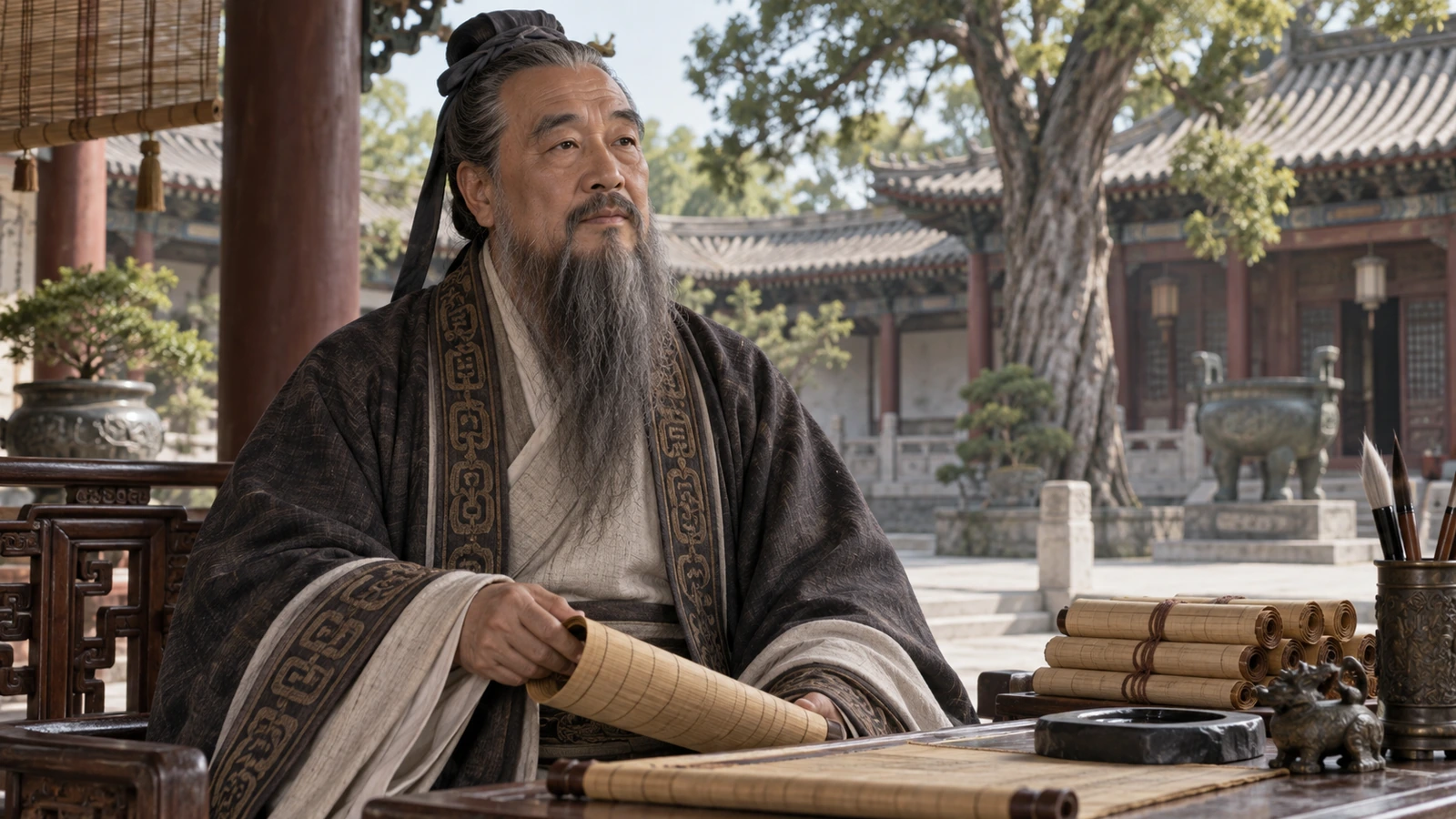
Long before he was revered as East Asia's ultimate moral philosopher, Confucius was a homeless political exile, an unheeded advisor, and a former granary keeper who loved music and ginger. Known in China as Master Kong, his ideas fundamentally transformed Asian civilization, government, and ethics despite his earthly career being viewed by contemporaries as a failure. From his record-breaking family tree to his surprisingly tall stature and fastidious eating habits, the real man behind the icon is far more human and intriguing than legend suggests. Here are 15 fascinating facts about the philosopher whose wisdom shaped billions of lives.
1. Jesuit Missionaries Invented the Name "Confucius"
While known globally as Confucius, the ancient philosopher never heard that name during his lifetime. His personal name was Kong Qiu, and his students and contemporaries addressed him respectfully as Kong Fuzi, which translates directly to "Master Kong." When Catholic Jesuit missionaries arrived in China during the sixteenth and seventeenth centuries, they encountered his massive philosophical legacy. To make his revered title sound more formal and academic to European scholars, they Latinized "Kong Fuzi" into "Confucius." This Latin translation quickly spread across Western literature and remains the primary name by which the ancient thinker is known in the Western world today.
2. He Was an Impressive Physical Giant of His Era
Modern artistic depictions often portray Confucius as an elderly, frail sage with a flowing beard, but historical accounts paint a very different physical picture. Ancient Chinese chronicles, including Sima Qian's Records of the Grand Historian, describe him as a man of extraordinary height, measuring nine chi and six cun in Zhou dynasty units. Converted into modern metric standards, this places his height at approximately six feet two inches (1.88 meters). At a time when the average height of men in northern China was significantly lower, Confucius would have towered over almost everyone in a crowd. His formidable stature earned him widespread recognition as the "tall man" in surrounding kingdoms long before his teachings gained fame.
3. His Personal Name Came from an Unusual Cranial Trait
The personal name given to Confucius at birth, Qiu, literally means "mound" or "hill." According to early biographies and oral traditions, he was given this name because the top of his skull possessed an unusual physical concavity that resembled a valley surrounded by a ridge, or the crown of Mount Ni where his parents prayed for a son. Rather than hiding this cranial irregularity, his family chose to commemorate it directly in his naming. Later commentators noted that his distinctive forehead set him apart visually from early childhood. This striking anatomical feature became a hallmark of early traditional portraits, which often depicted the philosopher with a prominent, raised forehead.
4. He Began His Career as a Lowly Accountant and Stablekeeper
Although Confucius was born into the minor nobility of the state of Lu, his family fell into deep poverty following the early death of his father. Forced to support his mother and family from a young age, the future master took on several humble bureaucratic jobs. He worked as a granary clerk responsible for accurate bookkeeping of grain reserves and later served as a supervisor of livestock and public pastures. Far from disdaining these low-level tasks, Confucius approached them with meticulous diligence, arguing that any honest job executed properly demonstrated moral character. These early practical experiences managing real-world economic affairs heavily influenced his mature political philosophies.
5. He Never Wrote the Analects Himself
The Analects, or Lunyu, stands as the most famous collection of Confucian sayings and philosophical dialogues in history, yet the master himself never penned a single line of it. The text was compiled posthumously by multiple generations of his devoted disciples long after his death in 479 BCE. His followers painstakingly gathered their memories of his daily lectures, casual conversations, and answers to student queries, recording them on thin bamboo strips tied together with silk threads. Because it was assembled by different groups of students over several decades, the text possesses a direct, conversational quality rather than a systematic treatise structure. Despite its fragmented nature, it became the foundation of Chinese civil service examinations for nearly two millennia.
6. He Holds the World Record for the Longest Family Tree
According to Guinness World Records, the family lineage of Confucius is the longest documented genealogy in human history. Detailed records maintained by the Kong Family Genealogy Compilation Committee track more than eighty generations of direct male descendants spanning over 2,500 years. The vast family tree includes more than two million verified living descendants spread across mainland China, Taiwan, Korea, and around the global diaspora. The head of the family line traditionally held a high hereditary noble rank in Imperial China, preserving meticulous birth and marriage records. Even today, individuals bearing the surname Kong can trace their exact ancestral line straight back to the philosopher.
 Philosophers Through the Ages
From wrestling rings and pirate kidnappings to sword duels and secret brotherhoods, the greatest thinkers in history led lives as dramatic as their ideas. Explore the surprising human stories behind the brilliant minds who shaped Western and Eastern philosophy.
See All Facts
Philosophers Through the Ages
From wrestling rings and pirate kidnappings to sword duels and secret brotherhoods, the greatest thinkers in history led lives as dramatic as their ideas. Explore the surprising human stories behind the brilliant minds who shaped Western and Eastern philosophy.
See All Facts
7. He Formulated the "Silver Rule" Centuries Before the Golden Rule
While Western moral philosophy often highlights the "Golden Rule" taught by Jesus, Confucius popularized a negative formulation of ethics known to scholars as the "Silver Rule." When a student asked him if a single word could guide a person's entire life, Confucius suggested shu, often translated as reciprocity or empathy. He explained this principle with the famous maxim: "Do not impose on others what you yourself do not desire." By framing morality around refraining from harm rather than enforcing specific actions, Confucius focused on self-restraint and social harmony. This subtle distinction placed personal humility and consideration for others at the center of ancient Chinese governance.
8. His Devotion to Music Was So Intense He Forgot to Eat Meat
Confucius viewed music not merely as entertainment, but as an essential tool for moral refinement and civic order. According to the Analects, while visiting the state of Qi, he heard a performance of the ancient ceremonial music known as Shao and was so profoundly moved that he lost his appetite for three months. He remarked to his companions that he had never imagined music could reach such divine perfection, famously claiming he did not even notice the taste of meat during that entire period. He believed that proper music harmonized the human mind and refined emotions, including musical proficiency among the essential skills required for an educated gentleman.
9. He Was an Extraordinarily Fastidious and Picky Eater
Historical passages in the Analects reveal that Confucius maintained incredibly strict, precise dining habits that bordered on obsessive fastidiousness. He refused to eat meat that was not cut into perfect straight lines, food that had turned slightly discolored or sour, or dishes prepared without the exact appropriate sauce. Additionally, he insisted on eating seasonal produce only and refused meals served without correct etiquette or proper table arrangements. However, there was one item he could never get enough of: fresh ginger. He insisted on having ginger served with every single meal, believing it cleansed the palate and aided digestion.
10. He Spent Over a Decade as a Homeless Political Exile
Despite his posthumous status as China's greatest sage, Confucius considered his own life a political failure. After rising to the position of Minister of Crime in his home state of Lu, political intrigue and court corruption forced him to resign his office around the age of 55. He spent the next fourteen years wandering across rival warring states, moving from court to court with a small circle of loyal disciples. He sought an enlightened ruler willing to implement his ethical reforms, but prince after prince rejected his political vision as impractical for wartime. This prolonged period of exile transformed him into a full-time itinerant educator rather than a practical statesman.
11. He Amusedly Embraced Being Called a "Stray Dog"
During his long years of wandering, Confucius encountered numerous insults and rejections from cynical hermits and suspicious locals. On one occasion, while separated from his disciples at the gates of the city of Zheng, a bystander observed his disheveled appearance and described him to his searching students as looking like a "homeless stray dog." When his disciples located him and repeated the stranger's mocking description, Confucius laughed aloud with delight. He completely agreed with the assessment, noting that while comparing his appearance to ancient kings was absurd, calling him a stray dog perfectly captured his wandering, rootless life.
12. He Played the Lute Calmly While Facing Starvation Under Siege
While traveling between the hostile states of Chen and Cai, Confucius and his entourage were trapped by local troops in a remote region, cutting off all their food supplies for seven straight days. As starvation set in, many of his disciples grew sick, physically exhausted, and deeply bitter about their plight, questioning why good men were suffering so terribly. Unmoved by panic, Confucius remained composed, continuing to tune his stringed instrument, sing classical poetry, and lecture on virtue. When his star pupil Yan Hui assured him that their hardship only proved their moral purity in an unready world, Confucius smiled and commended his wisdom.
13. He Revolutionized Education by Teaching Commoners for Bundles of Meat
Prior to Confucius, formal education in China was an exclusive privilege reserved strictly for aristocratic elites preparing for hereditary leadership. Confucius broke this ancient class barrier by establishing the first private academy open to anyone willing to learn, regardless of social background or wealth. He famously declared that he would never refuse instruction to anyone who brought even a modest symbolic gift, such as a simple bundle of dried meat. By prioritizing character, intellect, and moral dedication over noble birth, he created the foundational principle of meritocracy in East Asian society.
14. His Tomb Was Desecrated During the Cultural Revolution
During the Chinese Cultural Revolution in November 1966, Red Guards targeted the legacy of Confucius as part of the campaign to destroy traditional culture and ideas. A group of over two hundred radical students and activists stormed the ancient Confucian Temple and Cemetery in Qufu, Shandong province. They destroyed thousands of historic stone steles, smashed statues, tore down antique texts, and used explosives to excavate the tomb of Confucius himself. However, when they breached the burial mound, they found no intact human remains or rich treasures, as the grave had naturally decomposed or been emptied centuries earlier.
15. His Birthday Is Celebrated as Teachers' Day in East Asia
In recognition of his role as East Asia's "First Teacher," the traditional birthday of Confucius on September 28th is officially celebrated as Teachers' Day in Taiwan and commemorated widely across East Asia. On this day, elaborate ceremonies take place at Confucian temples, featuring ancient music, traditional dances, and ceremonial offerings of incense. Schoolchildren pay special respect to their teachers, presenting them with cards and expressions of gratitude. The enduring holiday highlights how Confucius shifted societal veneration away from military conquerors and toward educators and moral scholars.
Sources & References
This AI-assisted post was rigorously curated and fact-checked for accuracy by:
 Martin Roháček
How fun was this article? 🤔
Tap a star to rate it
🧠 Quiz: How closely were you paying attention?
10 questions — all answers are in the article above!
Enjoyed these facts? There's more! 💌
Fresh fun facts in your inbox. No spam, ever.