The Radical Philosopher: 15 Fascinating Facts About Denis Diderot
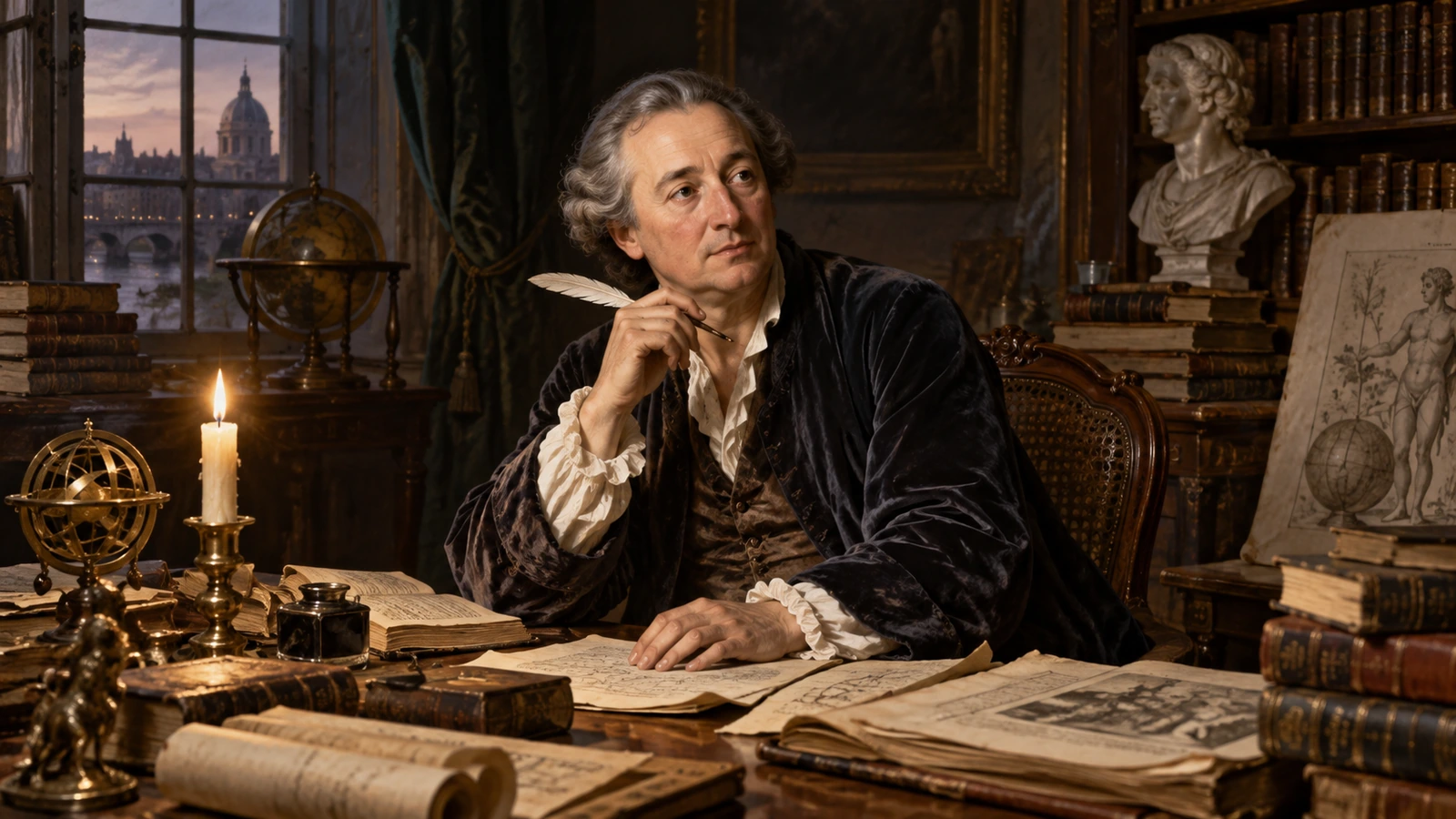
Denis Diderot was one of the most daring, versatile, and subversive minds of the French Enlightenment. As the chief editor of the monumental Encyclopédie, he attempted to organize all human knowledge while dodging royal censors and religious authorities. From inventing theatrical conventions to inspiring modern psychological terms about consumer behavior, Diderot constantly challenged the status quo. Explore fifteen surprising facts about the life, works, and eccentricities of this foundational philosopher.
1. Catherine the Great Purchased His Library to Pay His Daughter's Dowry
In 1765, Denis Diderot faced severe financial distress because he needed money to provide a respectable dowry for his only surviving child, Angélique. Hearing of his plight, Empress Catherine the Great of Russia made an exceptionally generous offer to purchase his entire personal book collection. Rather than shipping the massive library immediately to Saint Petersburg, she requested that Diderot keep the volumes in his Paris home and act as her personal librarian on a generous annual salary. This clever arrangement allowed the philosopher to maintain his research while receiving decades of financial security in advance. Catherine's patronage not only saved Diderot from penury but also forged a powerful intellectual bond between Enlightenment Paris and the Russian imperial court.
2. A Scarlet Dressing Gown Inspired the Concept of the Diderot Effect
In a famous 1769 essay titled Regrets on Parting with My Old Dressing Gown, Diderot recounted how receiving an elegant scarlet robe as a gift ruined his domestic life. The sudden addition of such a luxurious item made his modest pine desk, worn straw chairs, and familiar wall tapestries look utterly shabby by comparison. Driven by a desire for aesthetic harmony, he compulsively replaced all his old furnishings with expensive luxury items until he found himself deeply in debt. Modern consumer psychologists coined the term "Diderot Effect" to describe this common phenomenon where purchasing one new product triggers a spiral of continuous, unwanted consumption. Ultimately, the philosopher lamented that while he was once the absolute master of his old rustic robe, he had become a helpless slave to his fancy new one.
3. He Spent Three Months Imprisoned in a Dungeon for Writing About the Blind
In 1749, Diderot published his groundbreaking psychological work titled Letter on the Blind for the Use of Those Who Can See. In the text, he argued that human morality and perceptions of God are not innate divine gifts, but are instead shaped entirely by sensory experience. Royal censors and church authorities viewed his radical materialist stance as an overt attack on Christian theology and traditional religious dogma. Consequently, royal officers arrested the philosopher and detained him for over three months in the gloomy dungeon of the Château de Vincennes near Paris. He was only released after writing an apology and promising to focus his energies on editing the massive Encyclopédie.
4. His Publisher Secretly Censored the Encyclopédie Behind His Back
For over two decades, Diderot poured his heart and soul into editing the monumental Encyclopédie, which aimed to categorize all human knowledge. However, his main publisher, André le Breton, grew deeply terrified that the bold political and anti-clerical entries would lead to royal prosecution or imprisonment. Without consulting Diderot, Le Breton secretly altered the printed proofs of the final volumes, deleting controversial passages and softening radical entries. Diderot only discovered the systematic betrayal after the multi-volume work had already been bound and distributed to subscribers across Europe. Devastated and furious, the philosopher wept tears of anger in Le Breton's office, though the damaged text could never be fully restored.
5. He Pioneered the Concept of the "Fourth Wall" in Theater
Long before modern cinema and television adopted the term, Diderot formulated the concept of the theoretical "fourth wall" in dramatic art. In his 1758 treatise On Dramatic Poetry, he argued that actors on stage should perform as if an invisible wall completely separated them from the audience. He believed that cast members should entirely ignore the spectators and interact solely with their stage environment to create authentic emotional realism. By treating the edge of the stage as an impenetrable barrier, performers could avoid theatrical melodrama and deliver more naturalistic portrayals. Today, breaking or maintaining this imaginary fourth wall remains one of the most essential storytelling tools in global performing arts.
6. His Father Disowned Him for Rejecting Law and the Clergy
Born into a respectable family of master cutlers in Langres, Diderot was expected to pursue a stable career in law or join the Catholic priesthood. He received a rigorous classical education from the Jesuits, but upon graduating, he flatly refused to enter either establishment profession. Driven by a passion for literature, mathematics, and philosophy, he opted to lead an impoverished bohemian lifestyle in the Latin Quarter of Paris. Outraged by his son's refusal to secure a respectable livelihood, his conservative father completely cut off his financial allowance. For nearly a decade, Diderot survived by taking on sporadic tutoring gigs, translating foreign texts, and writing sermons for lazy parish priests.
7. He Married a Linen Draper's Daughter in Secret Against His Family's Wishes
In 1743, Diderot fell deeply in love with Anne-Antoinette Champion, a devoutly Catholic and poorly educated daughter of a local linen draper. Knowing his traditional father would never approve of a match with a woman lacking a fortune or high social standing, Diderot married her in total secrecy. When his father discovered the clandestine union, he was so furious that he briefly obtained a royal warrant to lock Denis in a monastery to prevent the wedding, though Diderot escaped. Unfortunately, the hasty marriage quickly soured as the couple suffered from vast intellectual differences and frequent financial strain. Despite long periods of domestic unhappiness and high-profile extramarital affairs, the pair remained legally married for the rest of Diderot's life.
8. His Masterpiece Novel Was Discovered in a Used Book Bin Over a Century Later
Diderot wrote his brilliant satirical dialogue, Rameau's Nephew, during the 1760s and 1770s, but he deliberately chose not to publish it during his lifetime to avoid persecution. The masterpiece survived only in manuscript form, circulating among select friends and eventually reaching Johann Wolfgang von Goethe, who translated it into German. The original French manuscript vanished for decades until an eagle-eyed librarian unexpectedly stumbled across it in 1891 inside a second-hand book bin in Paris. Purchased for a mere few francs, the authentic manuscript confirmed Diderot's genius as a novelist long after his death. Today, this dark critique of Enlightenment morals and artistic genius is recognized as one of the greatest French literary works of the eighteenth century.
9. He Slapped Catherine the Great's Thigh in Excitement During Philosophical Debates
At the age of sixty, Diderot undertook an arduous, multi-month journey across frozen Europe to express his gratitude to Empress Catherine the Great in Saint Petersburg. During his five-month stay in Russia, the philosopher met privately with the monarch almost every single afternoon for animated debates on politics and society. Diderot was an extraordinarily expressive speaker who frequently gestured wildly, grabbed the Empress by the hands, and vigorously slapped her thighs to emphasize his radical points. Catherine found his lack of courtly etiquette thoroughly entertaining, though she famously joked that she had to put a table between them to protect her knees from bruises. Despite their fond friendship, she ultimately dismissed most of his radical democratic advice as idealistic and impractical for ruling Russia.
10. He Authored Over 7,000 Articles by Visiting Manual Labor Workshops
While many Enlightenment thinkers focused strictly on abstract theology and political theory, Diderot harbored a profound respect for practical trades and mechanical arts. To write accurately for the Encyclopédie, he spent countless weeks exploring dusty Parisian workshops to observe weavers, blacksmiths, glassblowers, and cutlery makers at work. He painstakingly interviewed tradesmen, learned to operate their machinery himself, and sketched precise technical diagrams of their tools and methods. As a result, he personally authored more than 7,000 detailed entries that elevated manual craftsmanship to the same level of intellectual importance as philosophy and science. His comprehensive documentation preserved invaluable industrial techniques that would have otherwise been lost to history.
11. His Deep Friendship with Jean-Jacques Rousseau Ended in Bitter Public Feuds
During their early years in Paris, Diderot and Jean-Jacques Rousseau were virtually inseparable companions who shared meals, meager funds, and radical ideas. Diderot even walked miles to visit Rousseau when the latter was briefly imprisoned, encouraging him to enter the essay competition that launched his literary fame. However, as the years passed, Rousseau's growing paranoia and retreat into hermit-like isolation clashed directly with Diderot's vibrant social life and commitment to urban reform. Their philosophical views also diverged sharply, as Diderot championed social progress while Rousseau romanticized solitary nature. By the late 1750s, their intense bond had utterly shattered into venomous personal insults, public accusations, and lifelong mutual hatred.
12. He Authored Postmodern Meta-Fiction Two Centuries Before the Movement Existed
Diderot's innovative approach to storytelling was remarkably far ahead of its time, as demonstrated in his comic novel Jacques the Fatalist and His Master. Throughout the narrative, the fictional narrator frequently breaks into the story to argue directly with the reader, mocking classic literary tropes and refusing to provide predictable plot developments. The book continually questions whether human actions are governed by absolute free will or preordained destiny, creating a playful, self-referential web of storytelling. By constantly pulling back the curtain on the art of fiction itself, Diderot anticipated modern narrative techniques used by writers centuries later. His bold subversion of traditional novelistic structure remains a high point of eighteenth-century experimental prose.
13. He Used the "Riddle of the Egg" to Argue for Biological Evolution
In his revolutionary philosophical dialogue D'Alembert's Dream, Diderot introduced a thought experiment known as the "Riddle of the Egg" to critique divine creationism. He challenged theologians to explain how an inert, senseless liquid inside an eggshell transforms through heat alone into a living, feeling chick capable of independent thought. Diderot argued that this simple biological process proved that matter possesses the inherent ability to organize itself into complex life without divine intervention. This materialist concept was an astonishing precursor to modern evolutionary biology and cellular development, decades before Charles Darwin was born. By framing complex biological transformation around an everyday farm egg, Diderot effectively undermined traditional religious claims of miraculous creation.
14. His Body Was Displaced and Lost During the Violence of the French Revolution
When Diderot died in 1784, his surviving family and wealthy supporters arranged for his interment inside the Church of Saint-Roch in Paris. However, during the height of the French Revolution in the 1790s, radical anti-clerical mobs stormed churches across the capital and desecrated religious crypts. The burial vaults of Saint-Roch were ransacked, and many of the lead coffins were melted down to manufacture musket balls for revolutionary armies. During the chaotic destruction, Diderot's remains were disinterred and dumped into anonymous mass graves or lost beneath urban soil. Today, despite his monumental contributions to French intellectual heritage, no verified physical tomb or grave site exists for the famous philosopher.
15. He Died Suddenly at the Dinner Table While Reaching for Fruit
On July 31, 1784, the seventy-year-old philosopher sat down for lunch with his family at his apartment on the Rue de Richelieu in Paris. Despite his failing health and recurring heart troubles, Diderot maintained his hearty appetite and reached across the table for a sweet preserve or fresh cherry. When his daughter, Madame de Vandeul, gently warned him that eating rich fruit might upset his fragile stomach, he playfully brushed off her concern. He famously retorted, "What the devil do you think this will do to me?" before reaching for another bite. Moments later, he leaned forward against the dining table, lowered his head, and quietly passed away from a sudden stroke or heart attack.
Sources & References
This AI-assisted post was rigorously curated and fact-checked for accuracy by:
 Martin Roháček
How fun was this article? 🤔
Tap a star to rate it
🧠 Quiz: How closely were you paying attention?
10 questions — all answers are in the article above!
Enjoyed these facts? There's more! 💌
Fresh fun facts in your inbox. No spam, ever.