The Elusive Abyssal Titan: 15 Fascinating Facts About Giant Squids
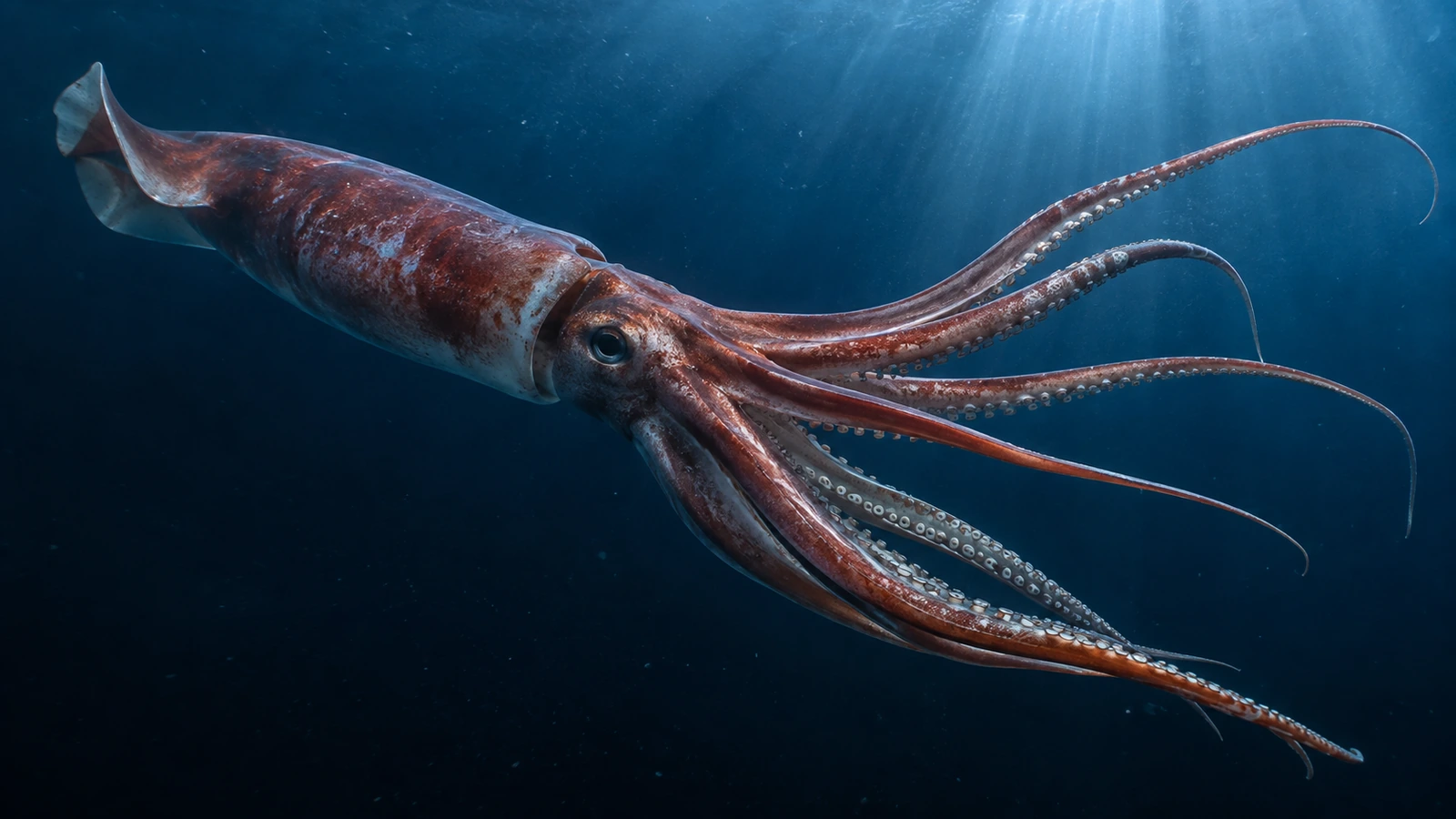
For centuries, tales of sea monsters dragging whole ships into the ocean depths were dismissed as mariners' tall tales, yet the giant squid is very real. Living hundreds of meters beneath the waves, Architeuthis dux remains one of the ocean's most mysterious and formidable predators. From dinner-plate-sized eyes to donut-shaped brains, this deep-sea creature possesses incredible biological adaptations designed for life in total darkness. Here are 15 fascinating facts about the legend that became reality.
1. Their Eyes Are as Big as Dinner Plates
The giant squid holds the record for possessing the largest eyes in the entire animal kingdom. Measuring up to 27 centimeters (11 inches) across, their eyes are roughly the size of a standard dinner plate or a basketball. These immense organs allow the creature to capture the faintest traces of light in the oceanic twilight zone, hundreds of meters below the surface. Biologists believe these massive visual detectors evolved specifically to spot the dim bioluminescent disruptions caused by moving predators. This extreme visual sensitivity gives the squid early warning when deep-sea creatures or large whales approach in the dark.
2. Their Brain Is Shaped Like a Donut
One of the stranger quirks of giant squid anatomy is that their brain forms a hollow ring shaped like a donut. The squid's esophagus passes directly through the center of this neural torus on its way from the mouth to the stomach. Because of this bizarre layout, swallowing large or unbroken chunks of food poses a genuine life threat to the animal. If a giant squid attempts to ingest a piece of prey that is too large, it can cause physical trauma or fatal brain damage. To prevent this, the squid uses a sharp, rasping tongue called a radula to shred its meal into tiny fragments before swallowing.
3. They Have Deep Blue Blood
Unlike human blood, which relies on iron-based hemoglobin to transport oxygen and appears red, giant squid blood is a rich shade of deep blue. This vivid coloration comes from hemocyanin, a copper-based protein suspended in their blood plasma. Hemocyanin is far more efficient than hemoglobin at transporting oxygen in near-freezing water under intense atmospheric pressure. However, it functions poorly in warmer or oxygen-deprived waters, which is why stranded giant squids quickly suffocate when brought to shallow ocean surfaces. This copper-rich circulatory fluid is essential for their high-speed hunting bursts in the abyss.
4. Ammonia Keeps Them Floating—and Unpalatable
Most bony fish rely on a gas-filled swim bladder to adjust their buoyancy in the water column, but giant squids use a very different chemical trick. Their muscular tissue is saturated with a dense solution of ammonium chloride, which is lighter than surrounding seawater. This liquid provides neutral buoyancy, allowing the squid to hover effortlessly in the water column without wasting precious energy on constant swimming. The side effect of this adaptation is that giant squid flesh smells strongly of cleaning fluid and tastes utterly repulsive. Consequently, humans cannot eat giant squid calamari, as the ammonium concentrations make it completely unpalatable.
5. They Rely on Three Separate Hearts
To propel blue blood through their massive bodies, giant squids depend on a complex circulatory system powered by three distinct hearts. Two of these hearts, known as branchial hearts, are located near the base of the gills and pump deoxygenated blood through the respiratory organs. Once oxygenated by seawater, the blood flows to a third, larger systemic heart that pumps it throughout the remainder of the body. This three-heart configuration compensates for the lower oxygen-binding capacity of hemocyanin compared to iron-based blood systems. It ensures that oxygen reaches muscles rapidly during intense underwater movements.
6. Their Suckers Feature Sharp, Serrated Teeth
The suction cups lining a giant squid's arms are not soft, pliable pads like those found on domestic aquarium creatures. Instead, each individual sucker is reinforced around its inner perimeter by a ring of hard, sharp teeth made of chitin. These serrated rings act like tiny saws, digging into the slick flesh or scales of struggling prey to ensure a non-slip grip. When a target is seized, hundreds of these tooth-ringed suckers latch on simultaneously, making escape nearly impossible. These chitinous rings also leave distinct circular scars on the skin of predators that attempt to attack them.
7. Sperm Whales Are Their Chief Arch-Rivals
The primary natural predator of full-grown giant squids is the sperm whale, leading to titanic battles thousands of feet below the ocean surface. Mature sperm whales frequently dive into the twilight zone to hunt these massive cephalopods as a primary food source. Hard chitinous squid beaks, which cannot be digested, are routinely found by the thousands inside sperm whale stomachs. In turn, captured sperm whales almost always bear permanent circular scars across their heads and flanks from the squid's tooth-lined suction cups. These battle marks demonstrate that giant squids fight fiercely using every arm and tentacle to defend themselves.
8. They Live Remarkably Short Lives
Given that giant squids can reach total lengths exceeding 40 feet, one might assume they require decades to achieve such massive proportions. In reality, marine scientists estimate that giant squids live remarkably short lives, lasting only about three to five years. They exhibit some of the fastest recorded growth rates in the animal kingdom, expanding from microscopic hatchlings to oceanic titans in a few short years. To sustain this extraordinary growth spurt, squids must feed voraciously every single day on deep-sea fish and smaller squid species. They essentially live fast, reproduce once, and die shortly thereafter.
9. They Move Using High-Pressure Jet Propulsion
Giant squids are agile, rapid swimmers that propel themselves using a highly efficient natural hydro-jet system. They expand their mantle cavity to draw large volumes of seawater inside, then forcefully contract their powerful mantle muscles. This action blasts the pressurized water out through a flexible, directional nozzle called a siphon or funnel. By angling the siphon forward or backward, the squid can dart rapidly in any direction to catch prey or flee from predators. This jet propulsion mechanism allows them to accelerate with surprising speed despite their immense physical size.
10. Their Beak Is Capable of Slicing Steel
The only hard, rigid structure in a giant squid's entire body is its powerful beak, located at the center where all eight arms meet. Composed of interlocking proteins and dense chitin, the beak resembles the bill of a giant parrot but possesses incredible mechanical strength. It is driven by massive surrounding muscular tissue, enabling the squid to snap through tough bone, thick cartilage, and heavy fish scales effortlessly. Marine researchers have even observed squid beaks severing heavy steel cables attached to underwater scientific equipment. This beak serves as the squid's ultimate tool for butchering prey into manageable morsels.
11. They Have Eight Arms and Two Feeding Tentacles
A frequent point of confusion is the distinction between a squid's arms and its tentacles, which serve very different functions. Unlike octopuses, which possess eight identical arms, giant squids have eight heavy arms plus two significantly longer feeding tentacles. The eight arms are lined with suction cups along their entire length and are used to manipulate food and wrestle threats. The two elongated tentacles feature club-like ends equipped with suckers, designed to shoot outward like lightning to snag distant prey. Once the prey is grabbed by the clubbed ends, the tentacles retract to pull the victim toward the waiting arms and beak.
12. A Living Adult Was Filmed in the Wild for the First Time in 2012
For centuries, human knowledge of the giant squid relied exclusively on dead specimens that washed ashore or were dragged up in commercial fishing nets. That changed in July 2012 when zoologist Tsunemi Kubodera and an international team captured the first video footage of a live adult giant squid in its natural habitat. Using a deep-sea submersible off Japan's Ogasawara Islands, the team descended to a depth of nearly 2,000 feet (630 meters). They lured a 10-foot-long specimen into camera range using a specialized bioluminescent decoy that mimicked a distressed jellyfish. The stunning footage provided humanity with its first glimpse of the ocean titan hunting in the deep abyss.
13. They Are Extremely Long, But Not the Heaviest Invertebrate
While the giant squid (*Architeuthis dux*) is famous for its immense length, it is actually not the heaviest invertebrate on Earth. That record belongs to its cold-water relative, the colossal squid (*Mesonychoteuthis hamiltoni*), which inhabits the frozen ocean surrounding Antarctica. While giant squids can grow longer due to their elongated feeding tentacles, colossal squids possess a much bulkier, wider mantle and heavier limbs. A full-grown colossal squid can weigh up to 1,000 pounds (450 kilograms), outweighing the giant squid by several hundred pounds. Both species represent the outer physical limits of invertebrate evolution in deep marine ecosystems.
14. Squid Nerve Cells Revolutionized Human Neuroscience
Although giant squids themselves are elusive, squid nervous systems played a monumental role in modern medical science. Cephalopods possess giant axons—single nerve fibers that can measure up to 1 millimeter in diameter, making them roughly 1,000 times thicker than human axons. In the mid-20th century, neurophysiologists Alan Hodgkin and Andrew Huxley used these massive squid nerve fibers to insert microelectrodes and study nerve signals. Their pioneering experiments revealed how sodium and potassium ions cross cell membranes to transmit electrical impulses, work that earned them a Nobel Prize in 1963. Understanding giant squid biology directly unlocked the secrets of how human brain and nerve cells communicate.
15. They Can Expel Dark Ink Even in Total Darkness
Even though giant squids dwell in the deep twilight zone where sunlight barely penetrates, they retain a fully functional ink sac. When threatened by a predator, the squid can discharge a dark cloud of ink made from melanin and mucus directly into the water. In the dim ocean depths, this cloud does not just create a visual blinding screen; it forms a physical decoy shape that distracts attackers. Furthermore, the ink contains chemical compounds that temporarily deaden the sense of smell in predators like sperm whales. This dual visual and chemical defense gives the giant squid precious seconds to jet away to safety.
Sources & References
This AI-assisted post was rigorously curated and fact-checked for accuracy by:
 Martin Roháček
How fun was this article? 🤔
Tap a star to rate it
🧠 Quiz: How closely were you paying attention?
10 questions — all answers are in the article above!
Enjoyed these facts? There's more! 💌
Fresh fun facts in your inbox. No spam, ever.