The Cradle of the West: 15 Fascinating Facts About Greece
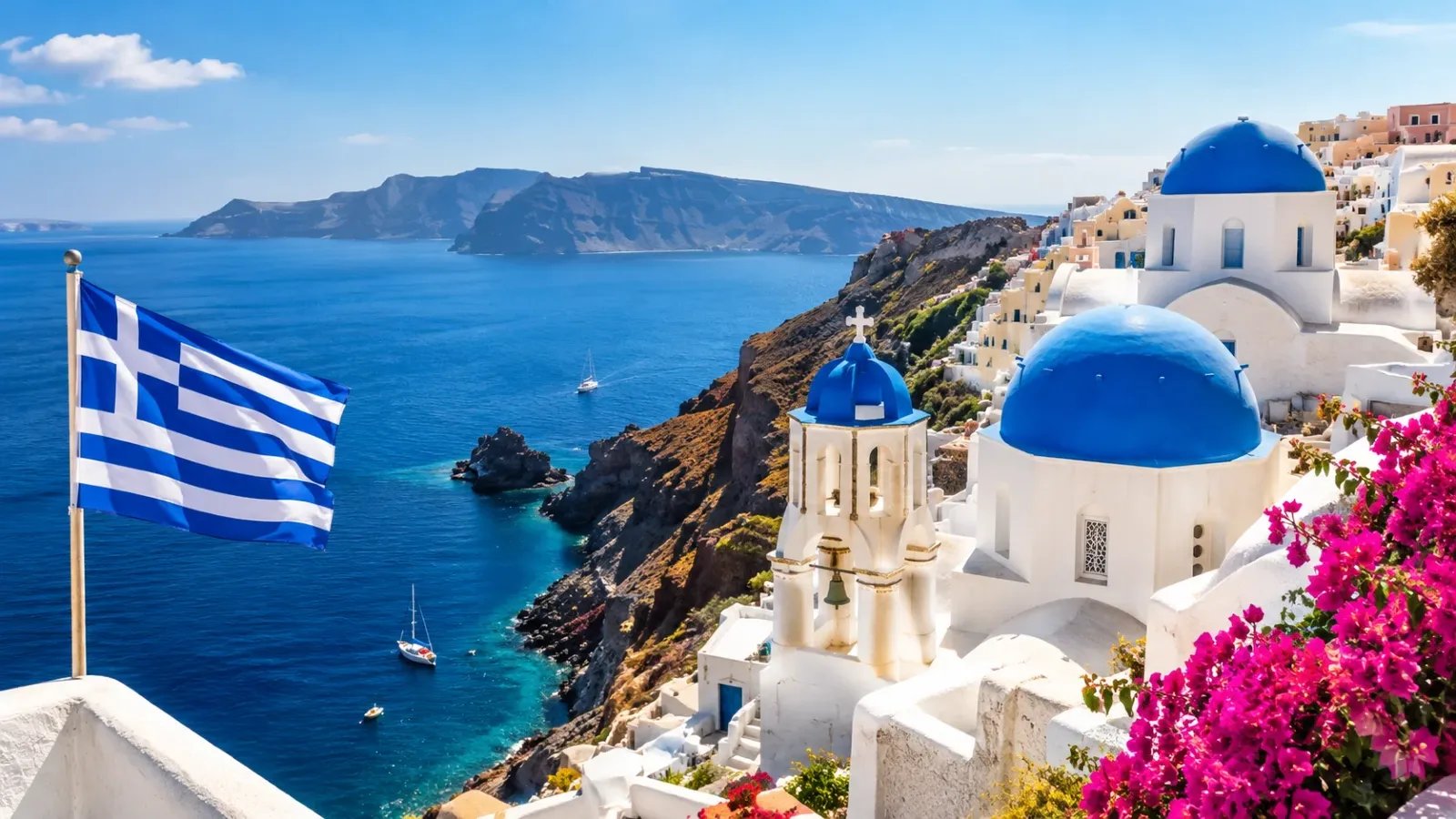
Greece offers ancient temples, thousands of islands, and landscapes that inspired myths of gods and heroes. More than 30 million visitors a year come to see the birthplace of democracy and the Olympic Games. Discover 15 fascinating facts about the Mediterranean country.
1. More than 30 million visitors come to Greece each year.
Greece welcomed around 36 million international visitors in 2024, a large number for a country of about 10 million people. Tourism is one of the pillars of its economy. Athens, Santorini, Mykonos, Crete, and Rhodes are among the most popular destinations.
2. Greece has thousands of islands.
The country has more than 6,000 islands and islets, of which only about 227 are inhabited. Its coastline, at around 13,700 kilometers, is one of the longest in the world. The islands are grouped into clusters such as the Cyclades, the Dodecanese, and the Ionian Islands.
3. The Parthenon was built in the 5th century BCE.
The Parthenon, the temple of the goddess Athena on the Athenian Acropolis, was built between 447 and 432 BCE during the age of Pericles. It was later used as a church, a mosque, and a gunpowder store, and was badly damaged by an explosion in 1687. The Acropolis is a UNESCO World Heritage Site.
4. Democracy was born in Athens.
Around 508 to 507 BCE, the Athenian leader Cleisthenes introduced reforms that gave citizens a direct role in government, and the system became known as democracy, meaning "rule by the people." Only free adult male citizens could take part, so women, slaves, and foreigners were excluded.
5. The Olympic Games began in Olympia.
According to tradition, the first Olympic Games took place in Olympia in 776 BCE, as a festival honoring Zeus. They were held every four years for more than a thousand years. The modern Olympics were revived in Athens in 1896, and the Olympic flame is still lit at Olympia.
6. Delphi was the center of the ancient world.
Delphi, on the slopes of Mount Parnassus, was home to the oracle of Apollo, where a priestess called the Pythia gave answers to questions from kings and ordinary people. The ancient Greeks believed it was the navel of the world, marked by a stone called the omphalos.
7. Knossos was the center of the Minoan civilization.
The palace of Knossos on Crete was the center of the Minoan civilization, which flourished in the Bronze Age. It was excavated by the British archaeologist Arthur Evans starting in 1900. The palace's complex layout is often linked to the myth of the Labyrinth and the Minotaur.
8. Santorini was shaped by a huge volcanic eruption.
A massive eruption of the volcano on Thera, today's Santorini, around 1600 BCE, one of the largest in human history, created the island's crescent shape and its flooded caldera. The ruins of the Bronze Age town of Akrotiri were preserved under volcanic ash.
9. Meteora's monasteries sit on rock pillars.
The monasteries of Meteora in central Greece were built from the 14th century on top of towering sandstone pillars, partly to keep monks safe from raiders. Six monasteries are still active. Originally, access was by ropes, nets, and ladders. Meteora has been a UNESCO World Heritage Site since 1988.
10. Mount Olympus is the highest mountain in Greece.
Mount Olympus rises to 2,917 meters, near the Aegean coast. In Greek mythology it was the home of the twelve gods. It was declared Greece's first national park in 1938, and hikers climb to its summit, Mytikas, each summer.
11. Women are banned from Mount Athos.
Mount Athos, in northern Greece, is a self-governing monastic community with 20 monasteries and a history of about a thousand years. Women are not allowed to enter, and men need a special permit. The peninsula is a UNESCO World Heritage Site.
12. Greek is one of the oldest written languages in Europe.
The earliest known Greek writing, Linear B tablets from Mycenaean palaces, dates back to around 1450 BCE, giving the language more than 3,400 years of recorded history. The alphabet used today developed from the one adapted from the Phoenicians around the 8th century BCE.
13. Feta cheese has a protected name.
Feta, a brined cheese made from sheep's milk, or a mix of sheep's and goat's milk, has had protected designation of origin status in the European Union since 2002, meaning that only cheese made in certain regions of Greece can be sold as feta in the EU. Greeks eat a lot of it, usually in salads and pies.
14. The Corinth Canal cuts through a rock ridge.
The Corinth Canal, opened in 1893, links the Gulf of Corinth with the Aegean Sea. It is about 6.4 kilometers long and just 21 meters wide, with steep limestone walls. It is too narrow for modern large ships but is used by tourist boats and small vessels.
15. The marathon is linked to a Greek legend.
The Battle of Marathon took place in 490 BCE, when the Athenians defeated a Persian invasion force. A later legend says a messenger ran from Marathon to Athens to announce the victory. Historians doubt the story, but it inspired the marathon race at the first modern Olympics in Athens in 1896.
Sources & References
This AI-assisted post was rigorously curated and fact-checked for accuracy by:
 Martin Roháček
How fun was this article? 🤔
Tap a star to rate it
🧠 Quiz: How closely were you paying attention?
10 questions — all answers are in the article above!
Enjoyed these facts? There's more! 💌
Fresh fun facts in your inbox. No spam, ever.