
The Ancient Salt Capital: 15 Fascinating Facts About Hallstatt
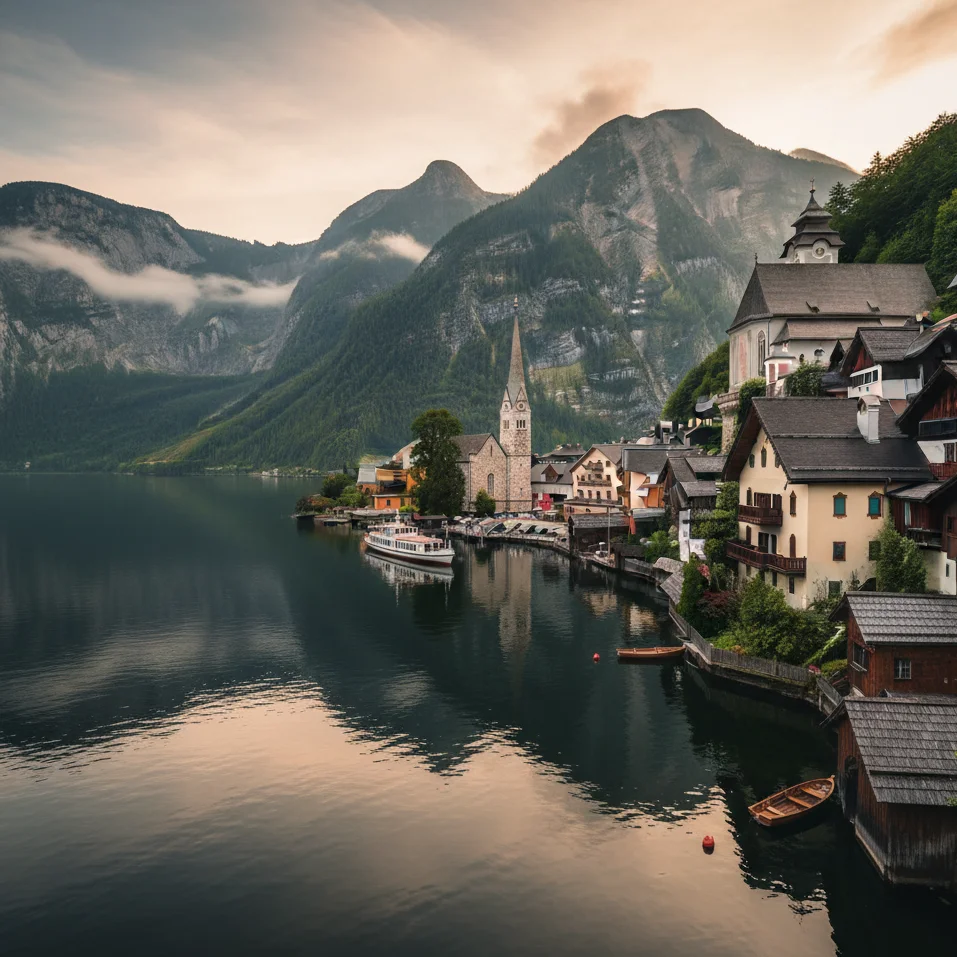
Nestled between the dramatic Dachstein Alps and the dark waters of the Hallstätter See, Hallstatt is far more than just Austria's most photogenic village. Beneath its fairy-tale wooden chalets lies over 7,000 years of continuous human history, centered on the world's oldest operating salt mine. Hallstatt was so influential in antiquity that it gave its name to an entire prehistoric era—the early Iron Age Hallstatt Culture. From hand-painted skulls and salt mummies to a full-scale replica in China, this tiny town holds a monumental place in world history.
1. World's Oldest Salt Mine
Tucked into the Salzkammergut region of the Austrian Alps, Hallstatt is home to the oldest actively worked salt mine in the world. Prehistoric inhabitants began extracting salt here over 7,000 years ago during the Neolithic period, long before the invention of written records. Salt was essential not only for human health but also as a vital preservative for meat during long alpine winters. Miners initially extracted surface deposits before carving extensive underground tunnels deep into the mountain. Today, the Salzwelten Hallstatt mine remains operational while offering guided tours through thousands of years of human engineering.
2. Namesake of an Entire Prehistoric Epoch
Hallstatt is one of the few small villages in the world to lend its name to a major archaeological era: the Hallstatt Culture. Spanning roughly 1200 BCE to 450 BCE, this late Bronze Age and early Iron Age civilization represents the earliest proto-Celtic culture in Central Europe. Archaeological findings in the valley demonstrated the rapid technological leap from bronze tools to forged iron weaponry. The distinct art, trade networks, and social structures identified here became the baseline for defining early Iron Age societies across Europe. As a result, historians treat Hallstatt as the foundational cradle of European Celtic civilization.
3. Hand-Painted Skulls of the Beinhaus
Due to the severe spatial limitations of Hallstatt’s cliffside cemetery, local residents developed a remarkable funerary tradition inside St. Michael’s Chapel. Beginning in the 12th century, graves were periodically reopened after 10 to 15 years to make room for new burials. The excavated bones were cleaned, bleached in the sun, and stored in the village charnel house, known as the Beinhaus. Relatives painted decorative floral motifs, ivy, and family names directly onto the skulls to honor their ancestors. Today, the Beinhaus contains over 600 painted skulls, creating one of the most unusual artistic ancestral records in Europe.
4. China Built a Full-Scale Copy of the Village
Hallstatt’s picturesque charm inspired a secretive multi-million dollar architectural project in Guangdong Province, China. In 2012, China Minmetals State Corporation completed a full-scale replica of Hallstatt’s town square, parish church, and wooden houses in the city of Huizhou. Chinese architects secretly photographed and measured Hallstatt's buildings for years before local Austrian officials discovered the project. Although initially controversial, the real village eventually embraced the replica, which fueled a massive wave of Asian tourism to Austria. Today, Hallstatt holds the unique distinction of existing simultaneously in the Alps and in subtropical southern China.
5. Exceptional Organic Preservation
The high concentration of salt within the Hallstatt mines created an extraordinary environment for natural preservation. Unlike most archaeological sites where organic materials decay, the mountain preserved leather shoes, woven textiles, rope, and wooden backpacks from thousands of years ago. These artifacts have provided historians with unprecedented insights into the daily wear and technology of Bronze Age workers. Scientists were even able to analyze preserved food remnants to reconstruct the nutritional diet of prehistoric miners. This natural pickling process has turned the mine shafts into a pristine time capsule of ancient daily life.
6. Home to Europe's Oldest Wooden Staircase
Deep within the ancient salt mine, archaeologists in 2003 discovered a remarkably intact wooden staircase used by prehistoric miners. Tree-ring dating, or dendrochronology, revealed that the timber used to construct the stairs was felled in 1344 BCE. Spanning nearly 26 feet in length, the sturdy structure was designed to haul heavy loads of salt out of steep underground chambers. Because salt prevented wood-rotting fungi from colonizing the timber, the staircase remained perfectly preserved for over 3,300 years. It was carefully extracted and is now displayed in a climate-controlled laboratory at the Natural History Museum in Vienna.
7. Ancient Salt Created Immense Wealth
In the ancient world, salt was so valuable that it earned the nickname "white gold," generating immense regional wealth for Hallstatt's residents. Because salt was a rare trade commodity, the local elite traded with distant civilizations across the Mediterranean and Northern Europe. Excavations have uncovered high-status grave goods including Baltic amber, glass beads from Italy, and intricate ivory carvings from Africa. These luxury items prove that prehistoric Hallstatt was not an isolated alpine village, but a major economic center at the heart of vast international trade routes. The economic power of salt allowed the local population to thrive for centuries.
8. The Rediscovery by Johann Georg Ramsauer
Modern understanding of the Hallstatt culture is largely credited to Johann Georg Ramsauer, a 19th-century mine manager. Between 1846 and 1863, Ramsauer meticulously excavated more than 1,000 prehistoric graves in the high valley above the town. He carefully documented every artifact, body orientation, and grave placement in detailed watercolor illustrations before modern photography existed. His disciplined methodology set early standards for scientific archaeology and uncovered over 1,500 burials in total. Ramsauer’s astonishing collection of iron swords, bronze vessels, and ornate jewelry brought Hallstatt to international scientific prominence.
9. The Mysterious "Man in Salt"
In April 1734, three local miners working underground uncovered a fully preserved human body encased in a block of rock salt. Known as the "Man in Salt," the miner had been crushed in an ancient shaft collapse, and his body, clothing, and tools were perfectly preserved by the salt. Historical records indicate that superstitious locals treated the preserved corpse with religious reverence before burying it in the churchyard. Unfortunately, without modern conservation techniques, the body quickly decomposed once exposed to the air. Scholars today believe the miner likely lived during the Iron Age, making him one of the earliest recorded mummy discoveries in Europe.
10. World's Oldest Industrial Pipeline
Hallstatt is the starting point of the Soleleitung, recognized as the world’s oldest functioning industrial pipeline. Constructed in 1595 under the direction of Emperor Rudolf II, the pipeline was engineered to transport liquid salt brine from Hallstatt to Ebensee. The original system consisted of over 13,000 hollowed-out spruce trees connected end-to-end over a distance of 40 kilometers. Brine was piped along steep alpine cliffs because wood fuel for salt boiling had become scarce around Hallstatt itself. Remarkably, a modern version of this historic pipeline still transports brine along the very same route today.
11. Inaccessible by Road Until the Late 19th Century
For most of its history, Hallstatt was geographically isolated from the rest of Austria due to the sheer mountains surrounding Lake Hallstatt. Prior to 1890, the village could only be accessed by boat across the lake or via treacherous mountain paths. Local residents built their houses perched on steep rock ledges, often accessible only by ladders or narrow wooden walkways. Heavy goods, livestock, and salt shipments were routinely transported on specialized flat-bottomed wooden boats called Plätten. The construction of the first road along the lakeside in 1890 finally connected Hallstatt directly to neighboring towns.
12. UNESCO World Heritage Recognition
In 1997, UNESCO designated Hallstatt alongside the surrounding Dachstein and Salzkammergut region as a World Heritage Site. The landscape was chosen due to its extraordinary combination of breathtaking natural beauty and 7,000 years of continuous economic activity. UNESCO noted that the region exemplifies a harmonious relationship between human industry and a high-alpine natural environment. The designation protects both the historic village architecture and the surrounding archaeological zones from unsanctioned modern development. Today, it stands as a globally protected icon of European cultural inheritance.
13. Battling the Challenge of Over-Tourism
Despite having fewer than 800 permanent residents, Hallstatt became one of the most heavily visited places on Earth relative to its size. Driven by rumors that the village inspired the kingdom of Arendelle in Disney’s movie Frozen, pre-pandemic tourist visits topped one million annually. The overwhelming influx of day-trippers led local authorities to introduce strict limits on tour buses and photo-seekers. In 2023, local residents famously erected wooden barriers at popular vantage points to discourage crowd congestion and preserve their privacy. Hallstatt has since become a central case study in sustainable tourism management.
14. Submerged Secrets of Lake Hallstatt
Lake Hallstatt, known locally as the Hallstätter See, holds a treasure trove of archaeological secrets hidden beneath its deep waters. Underwater excavations have revealed sunken wooden transport vessels, prehistoric dock pilings, and lost salt mining equipment dating back centuries. The cold, oxygen-poor deep waters of the lake have provided ideal conditions for preserving ancient wood and organic materials. Divers and marine archaeologists continue to survey the lake bed to reconstruct the historic water routes used by salt traders. These submerged discoveries offer a fresh perspective on how the lake served as the village’s primary lifeline.
15. The Transition to the La Tène Culture
Around 450 BCE, the dominant Hallstatt culture gradually gave way to the La Tène culture, marking a major evolution in Celtic civilization. This historical transition reflected shifts in trade routes, social structures, and artistic styles across Central Europe. While Hallstatt art featured rigid geometric patterns and heavy bronze work, La Tène art introduced fluid, curvilinear designs inspired by Mediterranean contacts. As political power shifted westward toward modern France and Switzerland, salt extraction at Hallstatt continued, though its dominance as a regional capital faded. Nevertheless, the foundation laid during the Hallstatt era set the stage for Celtic influence across the entire continent.
Sources & References
This AI-assisted post was rigorously curated and fact-checked for accuracy by:
 Martin Roháček
How fun was this article? 🤔
Tap a star to rate it
🧠 Quiz: How closely were you paying attention?
10 questions — all answers are in the article above!
Enjoyed these facts? There's more! 💌
Fresh fun facts in your inbox. No spam, ever.