The City of Angels: 15 Fascinating Facts About Los Angeles
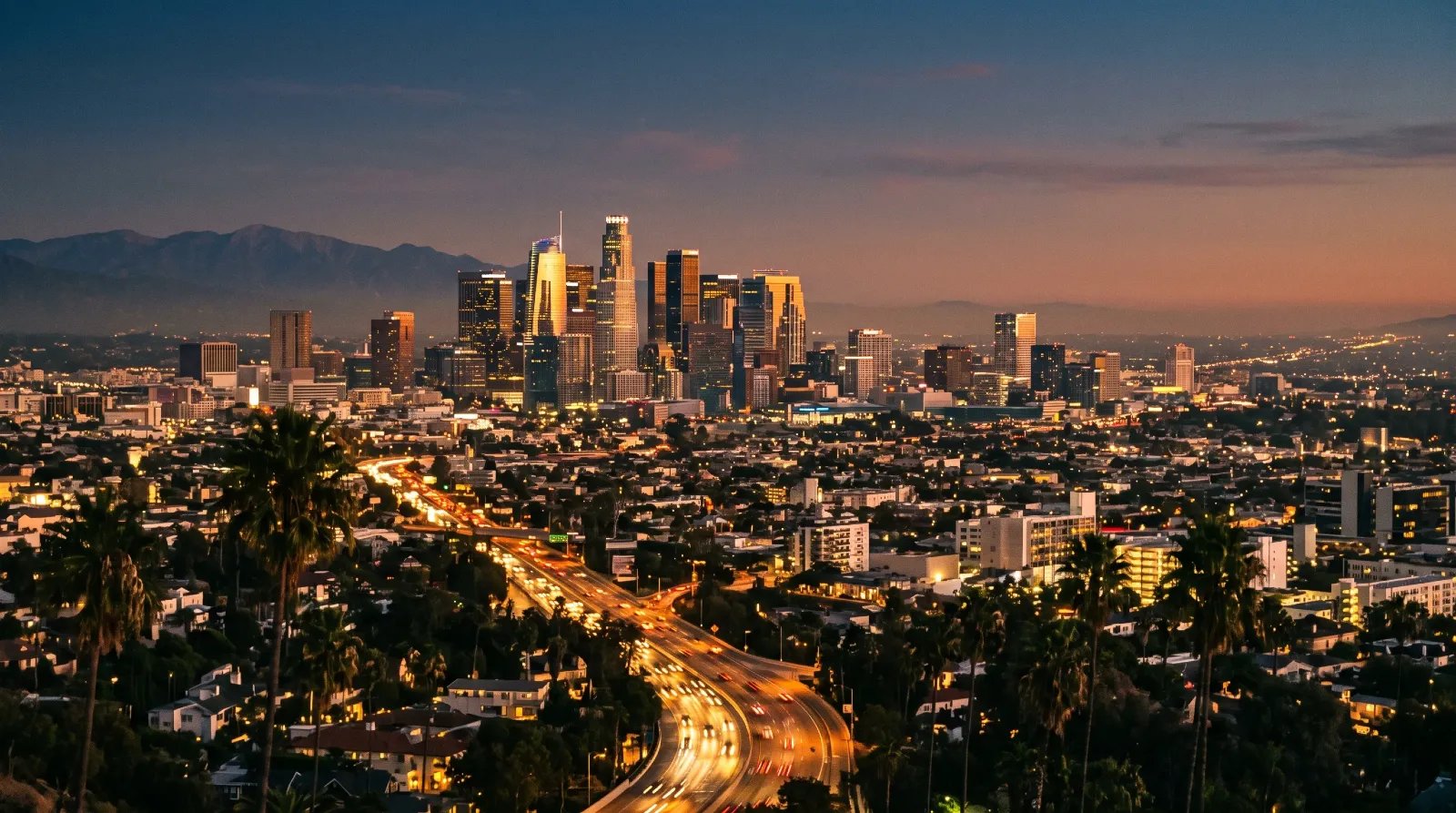
Los Angeles is famous for movie stars, palm trees and traffic, but the city hides a much stranger story. It has Ice Age fossils bubbling up in the middle of town, a river encased in concrete, a reservoir covered in 96 million black balls and a mountain lion that became a celebrity. Here is the Los Angeles most visitors never see.
1. Los Angeles was founded by 44 settlers of mixed heritage.
On 4 September 1781, a group of 44 settlers known as "Los Pobladores" founded a small farming town they called El Pueblo de Nuestra Señora la Reina de los Ángeles, "The Town of Our Lady the Queen of the Angels". Around two-thirds of these founding settlers had mixed African, Indigenous and European ancestry. The exact original name of the settlement is still disputed, and some sources give a much longer version that also mentions the Porciúncula River.
2. The Hollywood Sign was originally an advertisement for houses.
The famous sign was put up in 1923 and originally read "HOLLYWOODLAND". It advertised a new housing development in the hills and was only meant to stand for about a year and a half. The sign became so iconic that it was kept, and in 1949 the last four letters were removed so that it represented the whole district. Each letter of the current sign is about 14 metres (45 feet) tall.
3. Ice Age animals are still being dug up in the middle of the city.
The La Brea Tar Pits, located beside a busy boulevard in central Los Angeles, have trapped animals in sticky natural asphalt for tens of thousands of years. Scientists have recovered millions of fossils there, including sabre-toothed cats, dire wolves, mammoths and giant ground sloths. Excavations are still ongoing, and visitors can watch palaeontologists at work. Fittingly, the name "La Brea Tar Pits" literally means "the tar tar pits".
4. The Los Angeles River runs through a concrete channel.
After a series of devastating floods, especially the great flood of 1938, the US Army Corps of Engineers straightened the Los Angeles River and lined around 82 kilometres (51 miles) of it with concrete. For much of the year, it looks more like a giant drainage ditch than a river. Its dry riverbed has become a favourite filming location, appearing in films such as "Grease" and "Terminator 2: Judgment Day".
5. One of its reservoirs is covered in 96 million black plastic balls.
In 2015, the Los Angeles Department of Water and Power released 96 million black plastic "shade balls" onto the Los Angeles Reservoir. The balls shield the water from sunlight, which helps prevent the formation of harmful chemicals and the growth of algae. They also reduce evaporation, saving hundreds of millions of litres of water a year during droughts.
6. A mountain lion became one of the city's biggest celebrities.
A male mountain lion known as P-22 somehow crossed two of the busiest freeways in America, the 405 and the 101, to reach Griffith Park in the middle of Los Angeles. He lived there for about a decade and was famously photographed in front of the Hollywood Sign. When he was captured in poor health and put down in 2022, thousands of people attended a memorial for him. His story helped inspire the construction of a huge wildlife crossing over the 101 Freeway.
 American Cities and Landmarks
From sinking mega-cities and secret subterranean vaults to monumental feats of engineering that tamed the desert, discover the hidden histories and bizarre quirks behind America's most iconic landmarks and urban centers.
See All Facts
American Cities and Landmarks
From sinking mega-cities and secret subterranean vaults to monumental feats of engineering that tamed the desert, discover the hidden histories and bizarre quirks behind America's most iconic landmarks and urban centers.
See All Facts
7. The man who gave the city Griffith Park shot his wife.
Griffith J. Griffith, a wealthy mining businessman, donated more than 3,000 acres of land to Los Angeles in 1896 to create the park that bears his name. In 1903, during a drunken, paranoid rage, he shot his wife in a hotel room. She survived but lost an eye, and Griffith served two years in prison. He later left money to the city for the construction of the Griffith Observatory, which opened in 1935.
8. In the 1920s, Los Angeles was a huge oil town.
Oil was discovered in the city in 1892, and by 1923 the Los Angeles area had helped make California the largest oil producer in the United States, accounting for about a quarter of the world's petroleum output. Hundreds of wells sprang up in backyards and city streets. Today, some working oil wells are still hidden in the region behind tall walls or disguised as buildings.
9. By 1921, most of the world's films were made in Los Angeles.
Hollywood was a separate town until it merged with Los Angeles in 1910. Film companies were drawn by the sunny weather, varied landscapes and cheap land. By 1921, more than 80 percent of the world's film industry was concentrated in Los Angeles, and the city has remained the capital of American cinema ever since.
10. The city once had one of the largest streetcar networks in the world.
Today, Los Angeles is famous for its traffic jams, but in the early 20th century it was served by the Pacific Electric Railway and its famous "Red Cars". At its peak, the system had more than 1,600 kilometres (1,000 miles) of track linking the city with its suburbs and the beaches. As cars and freeways took over, the network was gradually shut down, and the last Red Car line closed in 1961.
11. Los Angeles turned the Olympics into a moneymaker.
Los Angeles hosted the Summer Olympics in 1932 and 1984 and will host them for a third time in 2028. The 1984 Games were organised almost entirely with private funding, using existing venues and corporate sponsorship. They made a profit of more than 200 million dollars, which changed how future host cities approached the Olympics.
12. One man spent 33 years building the Watts Towers by hand.
Between 1921 and 1954, Italian immigrant Simon Rodia built 17 interconnected towers in his backyard in the Watts neighbourhood, using steel rods, mortar and found objects such as broken glass, pottery and seashells. He worked alone, without machinery or scaffolding, and the tallest tower reaches almost 30 metres (99 feet). Today, the Watts Towers are a National Historic Landmark.
13. Los Angeles has its own Venice, complete with canals.
In 1905, tobacco millionaire Abbot Kinney opened "Venice of America", a seaside resort with canals, gondolas and Italian-style buildings. Most of the canals were later filled in to make room for roads. A small network of the original canals survives, lined with houses and footbridges, and is listed on the National Register of Historic Places.
14. Los Angeles once claimed to have invented the fortune cookie.
Both Los Angeles and San Francisco claim to be the birthplace of the fortune cookie. In Los Angeles, the honour is often credited to David Jung, founder of the Hong Kong Noodle Company, around 1918. In 1983, a mock trial held by San Francisco's Court of Historical Review ruled in favour of San Francisco, a verdict that Los Angeles has never accepted. Historians believe the cookies probably have Japanese origins.
15. Los Angeles County has more people than most US states.
Los Angeles County is home to almost 10 million people, making it the most populous county in the United States. That is more than the population of about 40 of the 50 US states. The wider Greater Los Angeles region has more than 18 million residents.
Sources & References
This AI-assisted post was rigorously curated and fact-checked for accuracy by:
 Martin Roháček
How fun was this article? 🤔
Tap a star to rate it
🧠 Quiz: How closely were you paying attention?
10 questions — all answers are in the article above!
Enjoyed these facts? There's more! 💌
Fresh fun facts in your inbox. No spam, ever.