The Irrepressible Innovator: 15 Fascinating Facts About Louis Armstrong
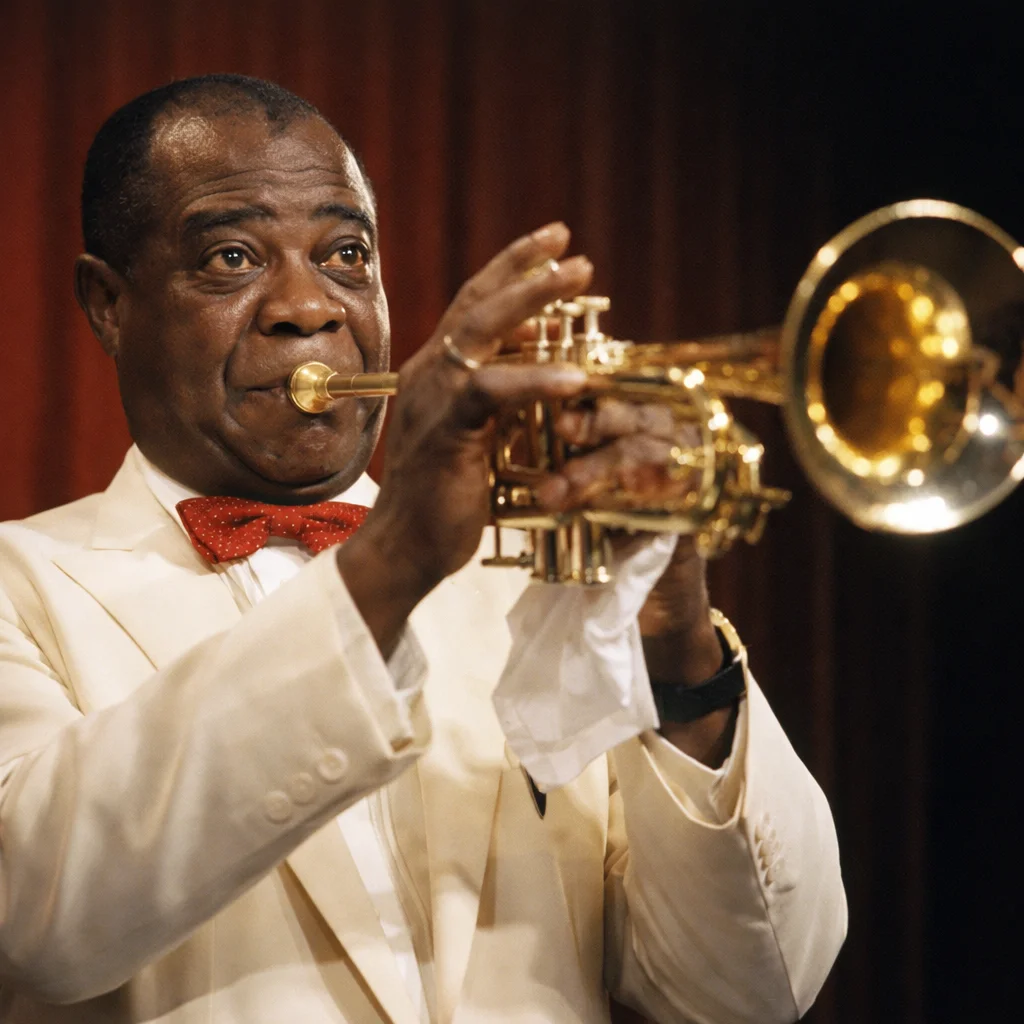
Louis Armstrong remains one of the most influential figures in American music, revolutionizing jazz with his daring trumpet virtuosity and gravelly vocal style. Beyond his historic musical achievements, Armstrong led an extraordinary life marked by shocking adventures, eccentric personal habits, and courageous civil rights activism. From unwittingly using Vice President Richard Nixon to smuggle contraband to dethroning The Beatles on the pop charts, his legacy extends far beyond the stage. Here are 15 fascinating facts about the icon known worldwide as Satchmo.
1. A New Year's Eve Arrest Launched His Musical Career
On New Year’s Eve in 1912, an 11-year-old Louis Armstrong fired his stepfather’s starter pistol into the air to celebrate in New Orleans. Police arrested the young boy on the spot and sent him to the Colored Waif’s Home for Boys. While institutionalization was a harsh punishment, it unexpectedly provided Armstrong with structure and access to formal musical instruction. Under the guidance of music director Peter Davis, Armstrong learned to play the bugle and cornet, quickly becoming the leader of the home's brass band. That fateful night with a blank pistol turned out to be the catalyst that rescued him from severe poverty and launched his legendary journey in the history of jazz.
2. He Wore a Star of David for His Entire Life
Growing up impoverished in New Orleans, young Armstrong found work doing odd jobs for the Karnofskys, a family of Jewish immigrants from Lithuania. The Karnofskys welcomed him into their home, fed him home-cooked meals, and treated him like family during a time of rampant racial segregation. Recognizing his natural passion for music, they even advanced him five dollars so he could purchase his very first cornet from a pawn shop. In deep gratitude for their kindness and early support, Armstrong wore a Star of David pendant around his neck every day for the rest of his life. He later wrote a heartfelt essay detailing how much the family’s generosity had shaped his worldview.
3. Richard Nixon Unwittingly Smuggled Armstrong's Marijuana
In 1958, Vice President Richard Nixon unwittingly acted as a drug mule for the international jazz ambassador. Armstrong was returning from a State Department-sponsored tour of Asia and arrived at Idlewild Airport in New York carrying three pounds of marijuana in his luggage. Customs officials steered the famous musician toward a detailed security search, but Nixon happened to spot him and offered to carry his heavy bags. Unaware of the contents, Nixon bypassed the customs line, declaring that the iconic entertainer did not need to be searched. When Armstrong was later informed about what had transpired, he simply laughed at how the future president had unknowingly helped him dodge federal charges.
4. He Ended The Beatles' Historic Winning Streak
In May 1964, the world was in the firm grip of Beatlemania, with the British band holding the top spot on the Billboard charts for fourteen consecutive weeks. Louis Armstrong single-handedly snapped their unbroken streak with his hit record "Hello, Dolly!" recorded for the Broadway show of the same name. At 62 years old, Armstrong became the oldest artist in history to achieve a number-one song on the Billboard Hot 100 chart at that time. The monumental achievement proved that his charismatic vocal style could compete directly with the era's biggest pop superstars. It remains one of the most remarkable chart upsets in American music history.
5. An Infamous Passion for Laxatives and Health Regimens
Armstrong possessed a lifelong obsession with personal hygiene and bowel health, frequently advocating the use of strong laxatives to everyone he met. His favorite remedy was an herbal laxative called Swiss Kriss, which he consumed daily and distributed enthusiastically to friends, fellow musicians, and international dignitaries. He was known to print customized greeting cards featuring a photo of himself sitting on a toilet with his motto, "Leave It All Behind Ya." He even handed out packets of Swiss Kriss to members of the British Royal Family during a tour of the United Kingdom. Armstrong firmly believed that regular cleansing was the secret to maintaining his incredible energy levels on tour.
6. He Fabricated a Patriotic Birthday for Decades
For almost his entire lifetime, Armstrong maintained that he was born on the Fourth of July in 1900. The patriotic date added a poetic mythos to his rise as an iconic American artist born at the turn of the century. However, music historians and archivists discovered his actual baptismal certificate nearly three decades after his death. The official record revealed that he was actually born on August 4, 1901, in a rough neighborhood of New Orleans known as "The Battlefield." Armstrong had lied about his age early in life to secure employment, and he simply kept up the harmless deception for the rest of his career.
7. A Relentless Touring Schedule of 300 Shows a Year
Few musicians in history have maintained a work ethic as demanding as Louis Armstrong's grueling tour schedule. For several decades, he played roughly 300 concert dates per year, traveling across continents with barely a day of rest between shows. He earned a reputation as the hardest-working man in show business, spending most of his adult life living out of hotel rooms and tour buses. Even after suffering a major heart attack in 1959, he refused to retire or slow down his performance calendar significantly. This relentless commitment to live music allowed millions of fans worldwide to experience his genius in person.
8. A British Reporter Coined His Famous Nickname "Satchmo"
As a boy in New Orleans, Armstrong was teased by peers for having a wide mouth and large teeth, earning nicknames like "Satchelmouth" and "Gutter mouth." In 1932, during a high-profile tour of London, an English music journalist named Percy Brooks greeted the trumpet player with a shortened version of the nickname. Brooks accidentally condensed the phrase into "Satchmo" while trying to pronounce it. Armstrong loved the punchy sound of the moniker and immediately adopted it for his public persona. The nickname stuck for the rest of his life, becoming universally recognized around the globe.
9. He Performed Gruesome DIY Lip Surgery with a Razor Blade
Playing the trumpet with intense high pressure for hours each night inflicted immense physical damage on Armstrong’s mouth. Over time, his upper lip developed thick, hardened scar tissue and calluses that severely interfered with his ability to vibrate his lips properly. To solve the problem, Armstrong took matters into his own hands by using a razor blade to shave off the calluses himself. This painful self-administered procedure often left his mouth bleeding heavily, forcing him to apply homemade salves between sets. His aggressive playing style eventually led to severe permanent scarring, known today in dentistry and medicine as "Satchmo's syndrome."
10. He Devoted His Life to Caring for His Adopted Son
When Armstrong was in his late teens, his cousin Flora passed away, leaving behind a young son named Clarence. The boy had suffered a severe head injury at age three after falling from a porch, leaving him with permanent developmental disabilities. Armstrong immediately adopted Clarence, took full parental responsibility for him, and looked after his physical and financial needs for life. Even after becoming a world-famous celebrity, Armstrong ensured Clarence had a comfortable home, personalized care, and a generous allowance. This lifelong commitment demonstrated Armstrong's deep sense of loyalty and compassion toward his family.
11. He Stood Up to the U.S. Government During the Little Rock Crisis
In 1957, during the desegregation crisis at Central High School in Little Rock, Arkansas, Armstrong publicly condemned President Dwight D. Eisenhower's cautious response. Outraged by images of Black students being blocked by federal troops and angry mobs, he openly declared that the government could "go to hell" for its hypocrisy. In protest, Armstrong canceled a high-profile State Department-sponsored tour of the Soviet Union, refusing to represent a country that denied rights to its Black citizens during the height of the civil rights movement. His sharp public criticism shocked the political establishment and inspired other prominent artists to use their platforms for advocacy. His bold stance ultimately helped pressure the White House into sending federal troops to enforce integration.
12. He Was a Prolific and Unfiltered Typewriter Correspondent
Wherever Armstrong traveled across the globe, he brought along a heavy portable typewriter, box loads of stationery, and a reel-to-reel tape recorder. He typed thousands of candid, stream-of-consciousness letters to friends, fellow musicians, fans, and world leaders. His writing style was famously unique, filled with bold underlines, idiosyncratic punctuation, phonetic spelling, and humorous commentary. He often decorated his letters with hand-made paper collages created from newspaper clippings and personal photos. Today, these vibrant letters offer historians an unprecedented, intimate glimpse into his daily thoughts and artistic philosophy.
13. "What a Wonderful World" Was Initially a Flop in the United States
Although "What a Wonderful World" is now considered Armstrong's signature song, it faced immediate hostility from his record label upon its release in 1967. Larry Newton, the president of ABC Records, hated the slow ballad and refused to promote it or release it properly in the United States. As a result, the single sold fewer than 1,000 copies domestically when first issued. However, the song became a massive international sensation, topping the charts in the United Kingdom and across Europe. It finally gained massive popularity in America two decades later after being featured in the 1987 film Good Morning, Vietnam.
14. A Catastrophic Lip Injury Transformed His Musical Style
By 1935, relentless touring and extreme high-note trumpet playing caused Armstrong's lip tissue to split severely, threatening to end his career. The injury forced him to take nearly a full year off from performing so his embouchure could heal naturally. During this forced hiatus, he reevaluated his approach to performance and restructured his musical repertoire. When he returned to the stage, he placed much greater emphasis on his unique, gravelly vocal phrasing and scat singing rather than relying solely on soaring trumpet solos. This pivot transformed him from a technical virtuoso into a legendary all-around entertainer.
15. He Insisted on Performing Until His Final Days in Queens
Despite experiencing serious heart and kidney problems in his late sixties, Armstrong refused to abandon the stage. In March 1971, against explicit orders from his personal physician, he completed a two-week engagement at the Empire Room of the Waldorf-Astoria in New York City. Shortly after, he requested that his band assemble for rehearsals, eager to resume touring for his fans. On July 6, 1971, just one month shy of his 70th birthday, Armstrong passed away peacefully in his sleep at his home in Corona, Queens. His home has since been designated a National Historic Landmark and operates as a vibrant museum dedicated to his legacy.
Sources & References
This AI-assisted post was rigorously curated and fact-checked for accuracy by:
 Martin Roháček
How fun was this article? 🤔
Tap a star to rate it
🧠 Quiz: How closely were you paying attention?
10 questions — all answers are in the article above!
Enjoyed these facts? There's more! 💌
Fresh fun facts in your inbox. No spam, ever.