The Vibrant Heavyweights: 15 Fascinating Facts About Mandrills
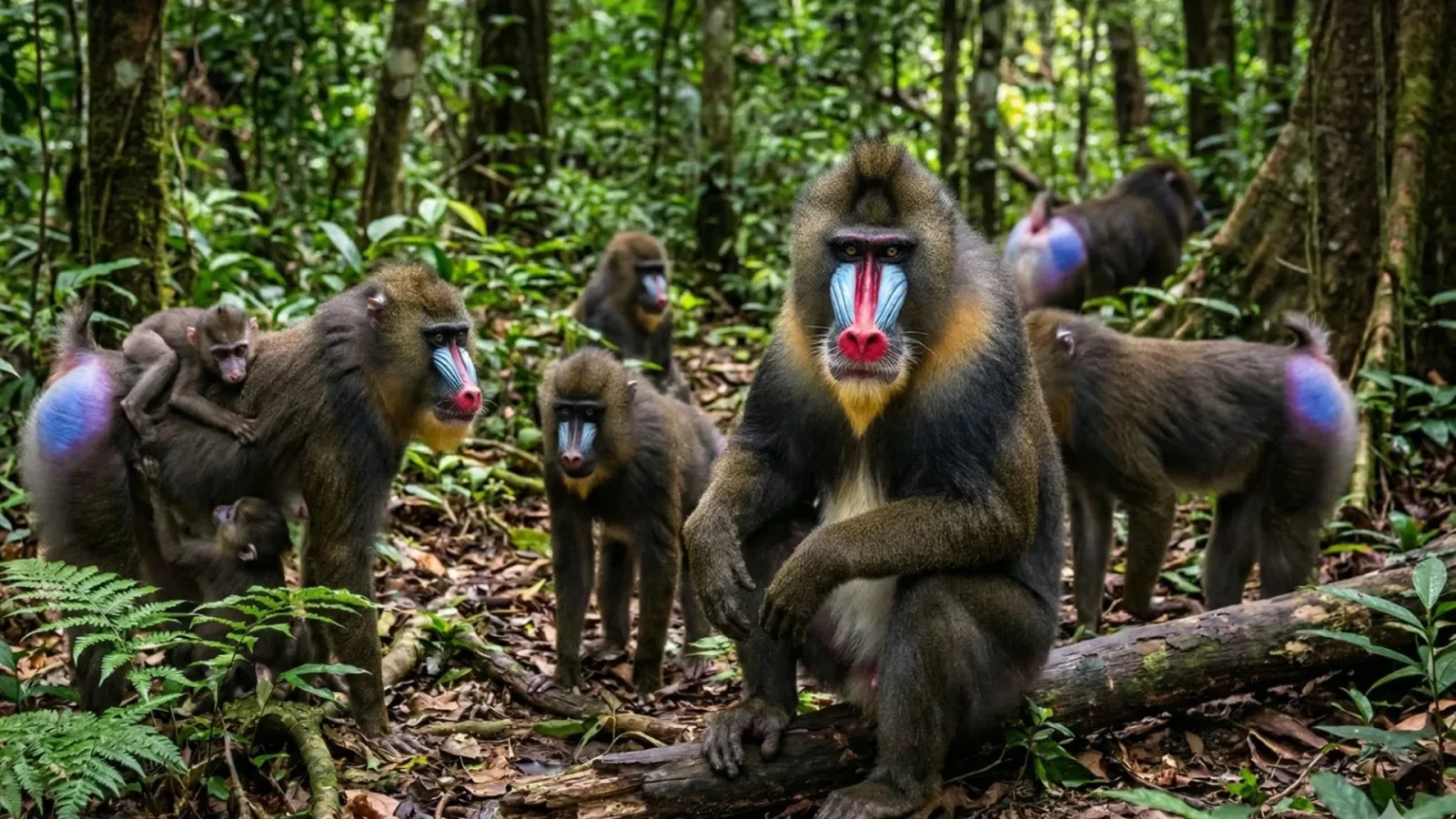
Deep within the dense rainforests of Central Africa lives the world's largest monkey, a striking primate defined by its vibrant coat, razor-sharp fangs, and colorful facial ridges. Mandrills are famed for their extraordinary social structures, roaming the forest floor in massive supergroups called hordes that can number in the hundreds or even thousands. Far from being simple canopy-dwellers, these heavyweights possess built-in mouth pouches for snacking, lion-sized canine teeth, and complex chemical communication systems. Here are 15 fascinating facts about one of the most visually stunning and misunderstood animals in the primate kingdom.
1. They Are the World's Largest Species of Monkey
Mandrills (Mandrillus sphinx) hold the official record as the heaviest monkey species on Earth. While they are often confused with baboons due to their similar body shape, mandrills are distinct rainforest inhabitants of Central Africa. Fully grown adult males routinely weigh between 50 and 70 pounds, with exceptionally large specimens exceeding 110 pounds. Females are significantly smaller, typically weighing less than half as much as their male counterparts. This massive size makes male mandrills formidable terrestrial foragers capable of fending off many forest predators.
2. Disney's Rafiki Introduced a Major Myth
One of the most famous mandrills in pop culture is Rafiki from Disney's The Lion King, but his portrayal mixes two entirely different primate species. Throughout the film and its adaptations, Rafiki is explicitly referred to as a baboon by characters and creators alike. However, his distinct red nose, vibrant blue facial ridges, and white beard are classic mandrill features rather than baboon traits. To confuse matters further, Rafiki sports a long tail typical of certain baboons, whereas real mandrills have short, stubby tails measuring only two to four inches long.
3. Males Possess Fangs as Long as a Lion's
Despite feeding heavily on fruit and vegetation, adult male mandrills pack one of the most fearsome sets of jaws in the animal kingdom. Their canine teeth can measure up to 2.5 inches (6.3 centimeters) in length, which is comparable to the fangs of a full-grown African lion. These formidable teeth are primarily used for display, defense against predators like leopards, and intra-species dominance battles. When threatened or challenged, a male mandrill will yawn deeply or flash his teeth to intimidate rivals without engaging in physical combat.
4. They Have Built-In Pouches inside Their Mouths
Like hamsters and certain rodents, mandrills possess specialized internal cheek pouches that extend down the sides of their throats. These muscular pockets allow them to store substantial amounts of food while actively foraging on the exposed forest floor. By stuffing their cheeks full of fallen fruits, seeds, and nuts, mandrills can quickly gather meal supplies and retreat to safe, concealed branches to eat at their leisure. This evolutionary adaptation reduces the amount of time they spend vulnerable to ground predators while chewing their food.
5. Facial Colors Act as a Living Status Bar
The brilliant red and blue pigmentation on a male mandrill's face and rear ends is not just decorative; it is a direct reflection of social rank and physical health. The vibrant blues are produced not by pigment cells, but by microscopic collagen fibers in the skin that structural refract light, while the intense red comes from dense networks of surface blood vessels. Alpha males exhibit the most intense, glowing colors because higher testosterone levels drive blood flow and skin vascularization. Females actively prefer males with the brightest coloration, which serves as a reliable visual indicator of genetic fitness.
6. Their Colors Can Flush and Change with Emotion
Because the vivid red portions of a mandrill's skin rely on surface blood flow, their appearance changes dynamically based on emotional state. When an adult male becomes agitated, sexually aroused, or excited during social interactions, increased heart rates cause his red facial stripe and rump to flush and brighten dramatically. Conversely, if a male loses his dominant rank within the group, his testosterone levels plunge, causing his vibrant colors to fade noticeably over time. This dynamic signaling system allows other group members to gauge a male's mood and social standing instantly.
 African Wildlife
Venture beyond the safari stereotypes and discover the astonishing biological adaptations, fierce rivalries, and complex societies of Africa's most iconic wildlife. From venom-proof mustelids to deep-rumbling giants, explore the hidden lives of the continent's most remarkable survivors.
See All Facts
African Wildlife
Venture beyond the safari stereotypes and discover the astonishing biological adaptations, fierce rivalries, and complex societies of Africa's most iconic wildlife. From venom-proof mustelids to deep-rumbling giants, explore the hidden lives of the continent's most remarkable survivors.
See All Facts
7. They Form Massive Social Groups Called Hordes
While many primates live in modest family troops of a few dozen individuals, mandrills form vast, fluid multi-male and multi-female aggregations known as hordes. These massive gatherings are primarily led by a core coalition of females and their offspring, with dominant males joining intermittently during the breeding season. Hordes travel through the equatorial rainforests of Gabon, Cameroon, and the Republic of the Congo, working together to locate patchy food sources and guard against shared threats. The sheer size of a horde provides incredible safety in numbers within dense jungle environments.
8. The Largest Recorded Horde Numbered Over 1,300
In Lopé National Park, Gabon, wildlife researchers documented a single mandrill horde containing more than 1,300 individuals traveling together. This extraordinary gathering is widely considered the largest non-human primate aggregation ever scientifically recorded in the wild. Maintaining cohesion among over a thousand fast-moving primates requires incredible spatial coordination and vocal communication through the dense understory. Scientists believe these super-hordes temporarily merge during seasons of fruit abundance to maximize foraging efficiency across vast home ranges.
9. Baring Their Teeth is Actually a Peaceful Greeting
To human eyes, a mandrill showing off its enormous set of teeth looks like a terrifying threat display, but context is everything in primate communication. When a mandrill bares its teeth in a wide, silent grin while shaking its head slightly, it is actually exhibiting a peaceful greeting known as a "silent bared-teeth face." This gesture communicates non-aggression and reassurance between troop members, reassuring companions that no violence is intended. True threat displays, by contrast, involve violent ground-slapping, intense staring, and deep vocal grunts.
10. They Are Opportunistic Omnivores with a Huge Menu
Although fruits, seeds, leaves, and fungi make up the vast majority of their daily diet, mandrills are versatile omnivores capable of hunting small animals. They routinely flip over logs and rocks to feast on earthworms, spiders, scorpions, and ants. On occasion, powerful male mandrills have been observed catching and consuming larger prey, including frogs, lizards, tortoises, birds, and even small forest antelopes like duikers. This flexible diet helps mandrills survive in changing forest conditions where seasonal fruit availability fluctuates wildly.
11. Rapid Head-Shaking is an Invitation to Play
Communication among young mandrills relies on a distinct vocabulary of physical play signals. When a young or subadult mandrill wants to engage in a friendly wrestling or chasing match with a peer, it will rapidly shake its head side-to-side while maintaining eye contact. This energetic head-shake serves as a clear play invitation, indicating that any subsequent biting or pouncing is strictly recreational. Play behavior plays a critical role in juvenile mandrill development, helping young monkeys build social bonds and physical coordination necessary for adult survival.
12. Males and Females Exhibit Extreme Differences in Appearance
Mandrills display one of the most extreme cases of sexual dimorphism among all living mammals. Adult males can weigh up to three times more than adult females and feature wide facial ridges with brilliant, saturated red and blue pigments. Females, by comparison, possess muted, dull olive-brown coats and far less prominent facial coloration, which helps them remain camouflaged while raising infants. Males also develop thick, golden mane-like beards and broad shoulders, giving them an imposing physique designed to secure dominance and impress potential mates.
13. They Spend Most Days Walking the Forest Floor
Unlike smaller, canopy-dwelling monkeys that spend their lives swinging through branches, mandrills are primarily terrestrial animals. They spend the vast majority of their daylight hours walking quadrupedally along the dark rainforest floor, digging through leaf litter in search of fallen seeds, roots, and insects. Their physical structure, featuring strong limbs and flat-footed strides, is perfectly adapted for ground locomotion. However, to stay safe from nocturnal predators such as leopards, the entire horde climbs high into the canopy each evening to sleep in the safety of strong tree branches.
14. They Communicate via Chest Gland Scent Signals
In addition to vocalizations and vibrant visual cues, mandrills rely heavily on chemical communication to stay in touch across thick jungle vegetation. Both male and female mandrills possess a specialized, hairless scent gland located in the middle of their chest. They frequently rub their chests against tree trunks and branches, leaving behind a persistent waxy secretion packed with individual chemical markers. These scent posts allow horde members to track group movements, identify individual identities, and establish territorial boundaries without making a sound.
15. Habitat Loss and Hunting Threaten Their Survival
The International Union for Conservation of Nature (IUCN) currently classifies the mandrill as a Vulnerable species facing an uncertain future. The primary threat to wild populations is severe habitat fragmentation caused by commercial logging, agriculture, and infrastructure development across Central Africa. Additionally, mandrills are heavily targeted by commercial bushmeat hunters due to their large body size and tendency to travel in loud, traceable hordes. Conservation organizations are actively working with local governments to protect critical rainforest corridors and enforce anti-poaching regulations.
Sources & References
This AI-assisted post was rigorously curated and fact-checked for accuracy by:
 Martin Roháček
How fun was this article? 🤔
Tap a star to rate it
🧠 Quiz: How closely were you paying attention?
10 questions — all answers are in the article above!
Enjoyed these facts? There's more! 💌
Fresh fun facts in your inbox. No spam, ever.