The Indomitable Author: 15 Fascinating Facts About Miguel de Cervantes
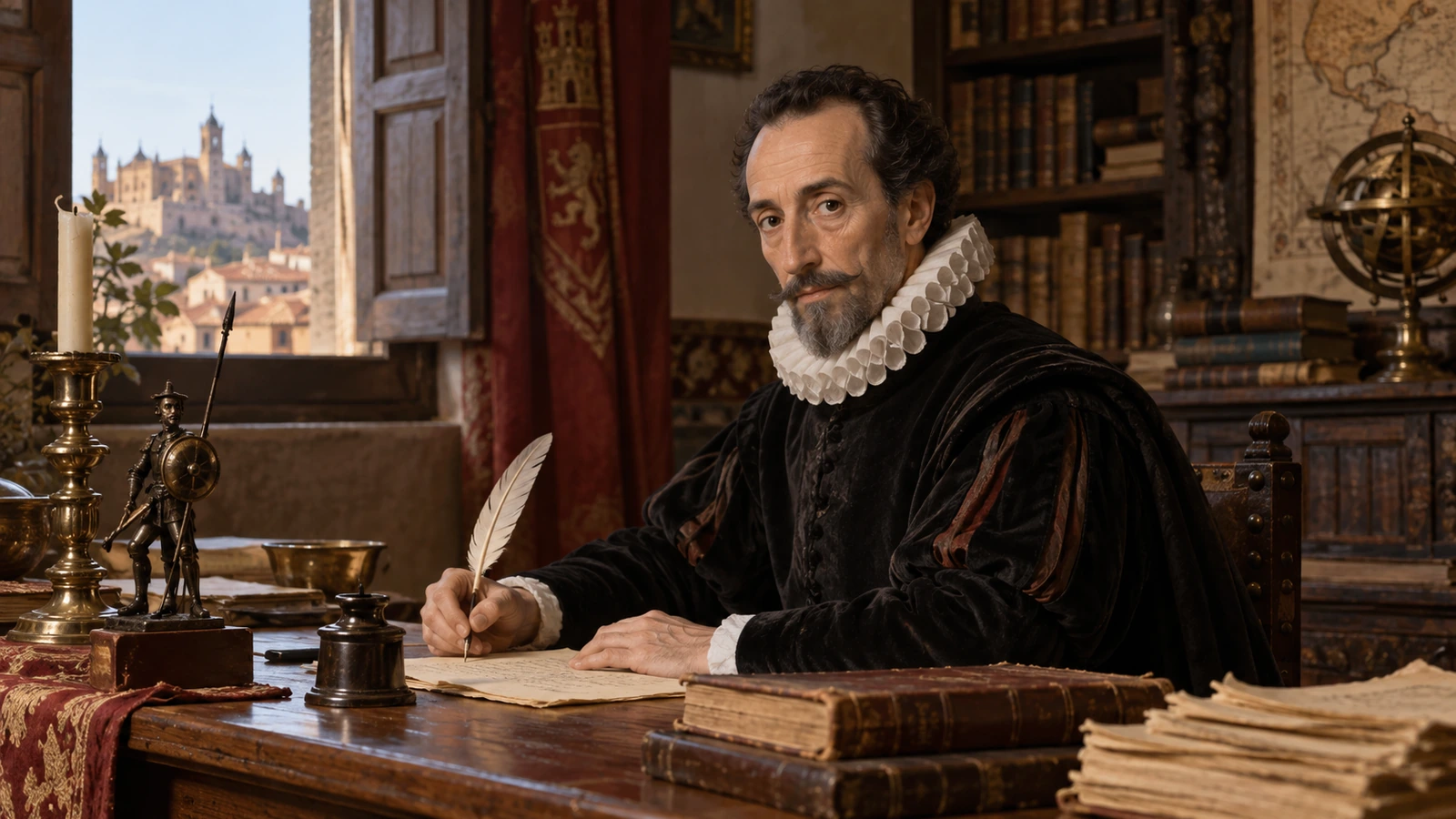
Miguel de Cervantes lived a life far more dramatic and adventurous than any fiction he ever wrote. From fighting in bloody naval warfare and surviving five years of pirate captivity in Algiers to spending time in prison where he conceived his literary masterpiece, the creator of Don Quixote endured endless hardship. Although widely celebrated today as the father of the modern novel, he died in relative poverty without realizing the enduring global legacy his pen would leave behind. Here are 15 fascinating facts about Spain's most iconic author and the wild history behind his legendary life.
1. He Lost the Use of His Left Hand at the Battle of Lepanto
In 1571, Miguel de Cervantes fought onboard the warship Marquesa during the Battle of Lepanto against the Ottoman Empire. Despite suffering from a severe fever, he steadfastly refused to stay below deck and insisted on fighting in the front lines. During the fierce naval engagement, he was struck by musket fire twice in the chest and once in the left arm. The severe bone damage permanently paralyzed his left hand for the rest of his life. Far from hiding his injury, he proudly embraced the moniker "El Manco de Lepanto" ("The One-Handed Man of Lepanto"), regarding his wounds as honorable badges of military sacrifice.
2. Letters of Recommendation Secretly Prolonged His Captivity
While returning home to Spain by sea in 1575, Cervantes' galley was ambushed by Ottoman Barbary pirates off the Catalan coast. Upon searching his personal belongings, his captors discovered glowing letters of recommendation written by top military commanders, including Don John of Austria. The pirates mistakenly assumed that a soldier carrying such prestigious commendations must be a high-ranking, wealthy nobleman. As a result, they set his ransom at an extraordinarily high figure that his working-class family could not afford. This tragic misunderstanding prolonged his enslavement in the slave pens of Algiers for five agonizing years.
3. He Orchestrated Four Daring Slave Escapes from Algiers
Cervantes was far from a passive captive during his long enslavement in North Africa. Demonstrating incredible resilience and leadership, he organized four separate, highly sophisticated escape attempts with his fellow Christian captives. His ambitious plans included hiding in coastal caves, trekking across North Africa toward Spanish strongholds, and coordinating rescue ships from Spain. Every attempt failed due to betrayal or bad luck, yet Cervantes consistently took full personal responsibility under brutal interrogation. The Ottoman governor of Algiers repeatedly spared his life, knowing that a living, high-value captive might still yield a fortune in ransom.
4. The Catholic Church Excommunicated Him Three Separate Times
After returning to Spain, Cervantes struggled to make a living and accepted a position as a royal commissary tax collector. His primary duty involved requisitioning grain, olive oil, and wheat to supply the massive Spanish Armada. To fulfill his strict government quotas, he forcibly confiscated large supplies of grain belonging to the powerful Catholic Church. Deeply offended by his actions, local church authorities formally excommunicated him on three separate occasions. Managing these heated legal disputes with ecclesiastical courts caused persistent turmoil during his civil service career.
5. He Began Writing Don Quixote Inside a Jail Cell
Cervantes' administrative career as a tax collector eventually led to severe legal trouble and imprisonment. While collecting tax revenues in Andalusia, he deposited government funds into a Seville bank that went bankrupt shortly afterward, leaving him unable to account for the missing money. Spanish authorities arrested him on charges of financial irregularities and locked him in the Royal Prison of Seville. Rather than succumbing to despair in the overcrowded dungeon, he transformed his prison experience into literary inspiration. In the prologue to Don Quixote, he explicitly suggests that his masterwork was born in a prison where "every discomfort has its seat."
6. The Myth of Shakespeare and Cervantes Dying on the Same Day
A popular literary myth claims that Miguel de Cervantes and William Shakespeare died on the exact same date: April 23, 1616. While parish records show both authors passed away on dates recorded as April 23 of that year, they did not die on the same solar day. Catholic Spain had already transitioned to the modern Gregorian calendar in 1582, whereas Protestant England still operated under the archaic Julian calendar, which lagged ten days behind. Consequently, Cervantes died on April 22 and was buried on April 23, while Shakespeare passed away ten days later on May 3 by modern calendar standards.
7. He Was Secretly Employed as a Royal Spy in North Africa
Following his ransom from captivity, King Philip II capitalized on Cervantes' detailed knowledge of Mediterranean politics and the Arabic language. In 1581, the Spanish crown employed Cervantes as a covert intelligence agent and sent him on a spy mission to Mostaganem in modern-day Algeria. His objective was to inspect military fortifications, gauge political unrest, and gather intelligence regarding Ottoman troop movements. Though he executed the secret reconnaissance mission successfully, the crown paid him a trivial stipend, leaving him financially insecure upon returning to Spain.
8. He Applied to Relocate to the Americas but Was Rejected
Eager to escape his mounting financial debts and career frustration in Europe, Cervantes sought a fresh start across the Atlantic Ocean. He submitted a formal application to the Council of the Indies requesting a bureaucratic post in the Spanish colonies of the Americas. He specifically petitioned for positions such as an accountant in Cartagena or a magistrate in the silver-mining district of La Paz. Had his petition been granted, world literary history would have taken a vastly different path. However, in May 1590, the colonial council flatly rejected his request, instructing him to seek employment closer to home.
9. An Anonymous Imposter Wrote a Fake Sequel to Don Quixote
When Don Quixote was published in 1605, it became an immediate publishing phenomenon, but Cervantes took his time writing a sequel. In 1614, a rival author writing under the pseudonym Alonso Fernández de Avellaneda published an unauthorized, fake continuation of the novel. The imposter's book openly mocked Cervantes' advanced age, physical disability, and poverty while butchering his characters. Outraged by the literary theft, Cervantes rapidly finished his authentic second volume in 1615. Within his true continuation, Cervantes famously broke the narrative wall by having Don Quixote encounter the fake book and fiercely denounce its fraudulent author.
10. He Was a Failed Playwright Who Lost Out to Lope de Vega
Before gaining fame as a prose writer, Cervantes spent years desperately attempting to establish himself as a successful theatrical playwright. During the Golden Age of Spanish theater, writing hit stage plays was by far the most lucrative path for an author. Cervantes wrote dozens of comedies and tragedies, but theatre directors found his cerebral, dialogue-heavy style outdated. Audiences instead flocked to the fast-paced, sensational dramas written by his celebrated rival, Lope de Vega. Recognizing that he could not compete on stage, Cervantes abandoned theatre and directed his narrative genius toward the novel.
11. He Sold the Rights to Don Quixote for a Flat Fee and Died Poor
Despite the phenomenal success of Don Quixote across Europe, Cervantes never achieved financial security from his masterpiece. In early seventeenth-century Spain, author copyright laws and royal rights did not grant writers ongoing sales royalties. Instead, Cervantes sold the full publishing rights of Part I outright to Madrid book publisher Francisco de Robles for a single flat fee. Unauthorized pirate editions quickly multiplied across France, Italy, and England, generating huge profits for foreign printers while leaving Cervantes penniless. As a result of this standard arrangement, the author lived in near poverty until his death in 1616.
12. He Invented the Modern Archetype for the Narrative Double Act
By pairing the idealistic Don Quixote with his sensible squire Sancho Panza, Cervantes established a foundational archetype for modern narrative storytelling. Prior to his novel, literary works featured hero-centric narratives with little psychological contrast between companions. Cervantes created a dynamic dialogue between an eccentric knight who sees giants in windmills and a realistic peasant who sees only wooden structures. Their ongoing debates, mutual affection, and philosophical growth established the classic "buddy double act" dynamic. Modern fiction, television drama, and "buddy cop" movies continue to rely heavily on the storytelling blueprint Cervantes pioneered over four centuries ago.
13. "Tilting at Windmills" Was Coined Directly from His Masterpiece
The widespread English idiom "tilting at windmills" originates directly from the iconic eighth chapter of Don Quixote. In the scene, the delusional knight charges full speed at giant windmills on his horse, believing them to be malevolent giants, only for his lance to shatter on the rotating blades. The phrase quickly evolved into a popular metaphor for attacking imaginary foes or engaging in foolish, unwinnable battles. Furthermore, the novel gave rise to the English adjective "quixotic," which describes someone foolishly impractical in the pursuit of idealistic goals.
14. Don Quixote Is Universally Recognized as the First Modern Novel
Literary scholars and critics universally acknowledge Don Quixote as the world's first modern novel. Before its release, European prose fiction was dominated by formulaic chivalric romances, pastoral poems, and moral allegories featuring static characters. Cervantes shattered these traditions by introducing psychological depth, realistic dialogue, subtle irony, and dynamic character arcs where protagonists evolve over time. By weaving social realism together with comedy and tragedy, he permanently transformed global literature, directly shaping the works of future literary titans such as Charles Dickens, Gustave Flaubert, and Fyodor Dostoevsky.
15. His Grave Was Lost for Nearly 400 Years Until 2015
When Cervantes died in Madrid in April 1616, he was laid to rest at the Convent of the Barefoot Trinitarians, the religious order that had helped buy his freedom from slavery. Subsequent expansion and rebuilding of the convent complex obscured his exact grave location, leaving his remains lost for nearly 400 years. In 2015, a team of forensic anthropologists and archaeologists launched a high-tech search using ground-penetrating radar. They successfully uncovered a crypt beneath the convent floor containing bone fragments marked by severe injuries, including a shattered left arm and chest trauma, confirming his identity after centuries of uncertainty.
Sources & References
This AI-assisted post was rigorously curated and fact-checked for accuracy by:
 Martin Roháček
How fun was this article? 🤔
Tap a star to rate it
🧠 Quiz: How closely were you paying attention?
10 questions — all answers are in the article above!
Enjoyed these facts? There's more! 💌
Fresh fun facts in your inbox. No spam, ever.