The Iron Chancellor: 15 Fascinating Facts About Otto von Bismarck
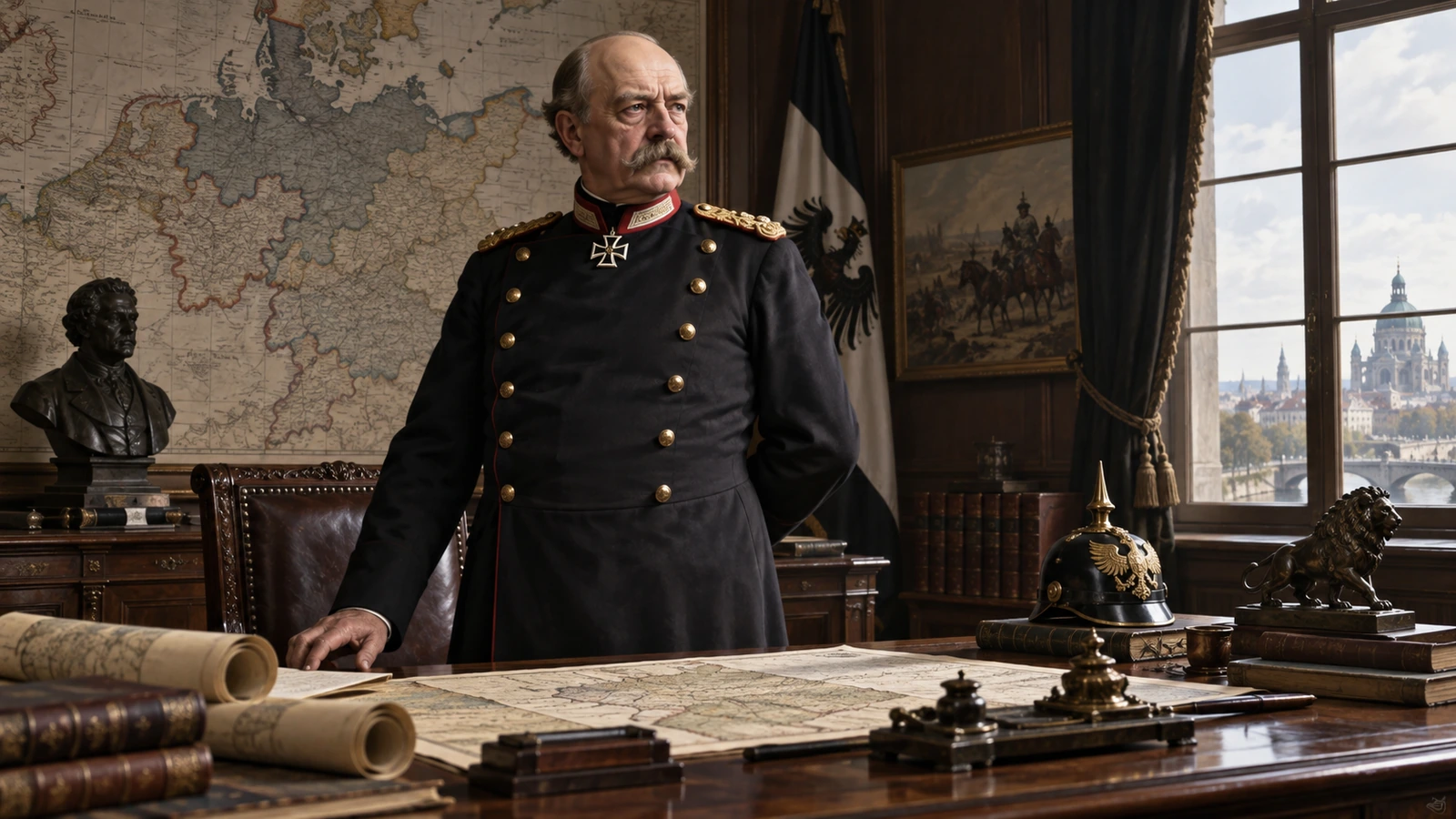
Otto von Bismarck remains one of the most influential and complex statesmen in modern European history. As the brilliant architect of German unification, he forged a mighty empire through shrewd realpolitik before spending decades preserving continental peace. From introducing the world's first modern welfare state to accurately predicting the outbreak of World War I, the 'Iron Chancellor' was a master of political pragmatism. Discover 15 fascinating facts about the life, legacy, and eccentricities of Otto von Bismarck.
1. The "Mad Junker" Was a Youthful Party Animal and Duelist
In his student days at the University of Göttingen, young Otto von Bismarck was known far and wide as the Toll Junker (Mad Junker). He drank staggering quantities of beer, kept a massive pet mastiff in his dorm room, and engaged in 27 duels with broadswords, leaving him with a lifelong facial scar. Decades later in 1865, as Prime Minister of Prussia, Bismarck challenged political rival Rudolf Virchow to a duel over military spending. Popular legend claims Virchow offered a choice between pistols or two sausages, one infected with deadly trichinosis parasites, prompting the chancellor to call off the duel. Whether the sausage story is true or embellished, Bismarck's violent temper was legendary throughout Europe.
2. He Manipulated a Single Telegram to Trigger the Franco-Prussian War
Bismarck knew that unifying the fractured German states required a common external threat to rally around. In July 1870, he received a draft dispatch from King Wilhelm I detailing a sensitive conversation with the French ambassador at the resort town of Bad Ems. Bismarck systematically edited the text, shortening it to make both the King and the ambassador sound deliberately rude and insulting to each other. He then released the edited "Ems Dispatch" to the press on Bastille Day, triggering massive public outrage in France. Manipulated into anger, Emperor Napoleon III declared war on Prussia, precisely as Bismarck had calculated, paving the way for German unification.
3. He Created the World's First Modern Welfare State to Defeat Socialism
Despite being a staunch conservative aristocrat, Bismarck introduced groundbreaking social welfare legislation that transformed 19th-century domestic policy. During the 1880s, he established compulsory health insurance in 1883, accident insurance in 1884, and old-age and disability pensions in 1889. His motivation was pragmatic rather than purely humanitarian: he sought to undercut the rapidly growing Socialist movement by proving the monarchy cared for workers. By providing state-sponsored safety nets, Bismarck successfully pacified the working class while preserving autocratic royal power. This system became the blueprint for modern welfare states across the world.
4. His Great Dane Once Attacked a Russian Diplomat Mid-Negotiation
Bismarck had a lifelong affection for Great Danes, keeping a continuous line of giant hounds known collectively as the Reichshunde ("Imperial Dogs"). His most famous canine companion was Tyras, a massive dog that accompanied the Chancellor directly into official diplomatic summits. During the high-stakes Congress of Berlin in 1878, Tyras mistook the frantic hand gestures of Russian diplomat Prince Alexander Gorchakov for a physical attack on Bismarck. The giant hound leaped onto the diplomat, pinning him to the floor and tearing his trousers in front of European dignitaries. Bismarck managed to pull the dog off, later joking that Tyras was simply defending German interests.
5. He Masterminded German Unification Without Ever Becoming Emperor
Through three short, strategic wars against Denmark, Austria, and France, Bismarck successfully merged 39 independent German states into a unified Empire in 1871. Despite being the primary architect of this historic triumph, Bismarck never claimed the crown for himself, serving instead as Imperial Chancellor under Kaiser Wilhelm I. He ensured that ultimate sovereign authority remained with the Prussian Hohenzollern monarchy while he exercised near-total administrative control. Bismarck skillfully navigated domestic politics, keeping potential rivals divided and ensuring his own position as the indispensable manager of the empire. His authority was unprecedented for a non-royal leader in modern European history.
6. He Constantly Wore a Military Uniform Despite Barely Serving in the Army
In almost every official portrait and photograph, Bismarck appears in a gleaming metal helmet and the heavy uniform of a Prussian Cuirassier officer. However, the "Iron Chancellor" was not a military veteran in any traditional sense, having fulfilled only short mandatory duty in the reserves. He chose to wear full military dress in public to blend seamlessly into the militaristic Prussian court where civilian bureaucrats were often dismissed. Cladding himself in armor projected an aura of unyielding strength that intimidated domestic opponents and foreign ambassadors alike. In reality, he far preferred loose civilian suits and soft felt hats when working behind closed doors.
7. Queen Victoria Deeply Distrusted Him as "a Very Dangerous Man"
Bismarck's ruthless political tactics and aggressive realpolitik earned him the profound distrust of foreign royal families, particularly in Great Britain. Queen Victoria met the German Chancellor on several occasions and was deeply unnerved by his cynical, power-hungry approach to statecraft. In her private correspondence, Victoria famously referred to Bismarck as "a very dangerous man" who lacked basic moral principles. She deeply feared his growing influence over her daughter, Victoria, who was married to German Crown Prince Frederick. The British monarch spent years trying to counter Bismarck's anti-liberal influence within the German imperial family.
8. He Suffered from Severe Depression, Hypochondria, and Binge Eating
Behind his formidable public image as a man of iron, Bismarck endured terrible physical and psychological suffering throughout his life. He was plagued by severe bouts of clinical depression, insomnia, rage-filled anxiety, and intense hypochondria that repeatedly drove him from public duties. Bismarck attempted to self-medicate his emotional distress through extreme overeating and heavy drinking, often consuming huge platters of caviar, game, and champagne in a single sitting. His health deteriorated so drastically that by his late sixties he was dangerously overweight and crippled by neuralgic pain. He was only saved from physical breakdown when a young physician, Dr. Ernst Schweninger, forced him onto a strict diet.
9. A Deep Religious Conversion Transformed His Political Philosophy
In his youth, Bismarck was a cynical skeptic who scoffed at traditional Christian morality and expressed contempt for religious piety. That changed radically in his early thirties when he met and married Johanna von Puttkamer, a devout Lutheran noblewoman. Following a profound religious conversion experience, Bismarck came to view himself as an instrument chosen directly by God to preserve order in Germany. He began sprinkling biblical quotes throughout his parliamentary speeches, using divine authority to justify his policies. This deep religious conviction convinced him that compromising with liberal or socialist opponents was a sin against Providence.
10. His Foreign Policy Shifted to Preserving Peace After Unification
After using calculated wars to forge the German Empire, Bismarck radically shifted his foreign policy strategy toward maintaining European peace. Recognizing that Germany was geographically vulnerable, surrounded by potential rivals, he declared the new empire a "sated power" with no desire for further land. He designed the intricate "Bismarckian System," a web of secret defensive alliances intended to isolate France and prevent a two-front war. Bismarck spent two decades acting as Europe's "honest broker," balancing powers and defusing international crises before they could escalate into major wars. His delicate diplomatic architecture successfully kept peace across continental Europe until his removal.
11. He Was Forced Out of Power by an Ambitious Young Kaiser
Bismarck's 28-year reign over German politics came to a bitter end in 1890 following the ascension of 29-year-old Kaiser Wilhelm II. The young emperor was determined to rule Germany personally and deeply resented Bismarck's overwhelming political dominance and foreign policy caution. The two clashed fiercely over labor policy, relations with Russia, and cabinet authority, leading Wilhelm II to demand the Chancellor's resignation. Bismarck was forced out of office on March 18, 1890, an event famously depicted in British satire as "Dropping the Pilot." Retired to his estate, an embittered Bismarck spent his final years writing sharp critiques of the young Emperor.
12. He Accurately Predicted the Spark and Timing of World War I
From his retirement, Bismarck watched Kaiser Wilhelm II dismantle his complex alliance system with growing horror and dread. Bismarck issued several remarkably accurate warnings about the catastrophe looming over Europe if imperial policies continued unchecked. He famously predicted that "one day the great European War will come out of some damn foolish thing in the Balkans," anticipating the 1914 assassination in Sarajevo. Even more astonishingly, he predicted that the German Empire would collapse roughly twenty years after his death. Bismarck died in July 1898, and the Empire fell in November 1918, fulfilling his prophecy almost to the month.
13. He Launched "Kulturkampf," an Unsuccessful War Against Catholicism
During the 1870s, Bismarck launched an intense domestic campaign known as the Kulturkampf ("culture struggle") aimed at reducing the power of the Catholic Church. Fearing that German Catholics were more loyal to the Pope in Rome than to the newly established German Empire, he passed laws restricting religious education and civil rights. Bishops were imprisoned, religious orders were banned, and church property was confiscated across Prussia. However, the policy backfired completely by uniting Catholics behind the Center Party, which grew into a formidable political force. Recognizing his defeat, Bismarck eventually dismantled most of the anti-Catholic legislation to secure Catholic political support.
14. His Name Was Adopted for Foods, Warships, and an American Capital
Bismarck's global fame left an indelible mark on geography, military history, and even gastronomy across the world. In 1873, developers in Dakota Territory renamed their settlement Bismarck to attract German railway investors, making it the capital of North Dakota. In culinary culture, a popular style of pickled herring was named Bismarckhering after the Chancellor praised it, while North Americans know a jelly-filled pastry as a Bismarck donut. Decades after his death, Nazi Germany named its flagship battleship Bismarck in his honor, and an island archipelago in the Pacific Ocean still bears his name today.
15. Germany Erected Its Tallest Non-Royal Monument in His Honor
Following Bismarck's death in 1898, an extraordinary wave of public veneration swept across Germany, resulting in the construction of hundreds of monuments. Over 240 "Bismarck Towers" were constructed throughout the German world, serving as nationalistic beacons lit during patriotic celebrations. The largest and most impressive monument stands high above the Elbe River in Hamburg, depicting Bismarck as a medieval Roland knight leaning on a broadsword. Towering over 34 meters (112 feet) high, it remains the tallest memorial ever erected to a non-royal individual in German history. It stands as a testament to the colossal shadow Bismarck cast over his nation.
Sources & References
This AI-assisted post was rigorously curated and fact-checked for accuracy by:
 Martin Roháček
How fun was this article? 🤔
Tap a star to rate it
🧠 Quiz: How closely were you paying attention?
10 questions — all answers are in the article above!
Enjoyed these facts? There's more! 💌
Fresh fun facts in your inbox. No spam, ever.