The Enigmatic Metropolis: 15 Fascinating Facts About Paris
From subterranean lake networks and secret decoy cities to paradoxical traffic laws and psychological conditions, Paris holds endless surprises beyond its world-famous monuments. Behind the majestic facades of the City of Light lies a complex urban tapestry shaped by centuries of engineering feats, emergency relocations, and rich cultural lore. Discover the most extraordinary hidden truths that define France's iconic capital.
1. France Built a Secret Fake Paris During World War I
During the First World War, French military strategists devised an extraordinary secret project to protect the capital from devastating German bombing raids. Engineers constructed a massive decoy replica of Paris just a few miles north of the real city, complete with translucent canvas buildings, painted roofs, and fake train tracks. To make the illusion convincing from high altitude at night, they installed an elaborate electrical lighting scheme that mimicked the glow of active streetlights and operational railway stations. The decoy was designed to fool German pilots and Zeppelin navigators into dropping their payload over uninhabited farmland instead of the metropolis. Although the war ended before the decoy city was fully completed, it remains one of the most remarkable instances of aerial deception in military history.
2. "Paris Syndrome" Causes Extreme Psychological Distress in Overwhelmed Tourists
Every year, a surprising number of visitors suffer from a recognized psychological phenomenon known specifically as Paris Syndrome. Most commonly documented among Japanese tourists, this transient mental disorder manifests as severe dizziness, hallucinations, acute anxiety, and intense delusions. Experts attribute the condition to extreme culture shock combined with the psychological collapse of hyper-romanticized expectations when faced with a gritty, fast-paced modern city. The contrast between idealized depictions of Paris in popular media and the practical reality of packed subway cars and stern service workers can prove surprisingly traumatic. The Japanese Embassy in Paris even maintains a 24-hour helpline and occasional emergency repatriation services for citizens affected by the acute condition.
3. The Famous Catacombs Were Born From a Horrific 18th-Century Public Health Crisis
Beneath the charming boulevards of Paris lies a sprawling ossuary containing the skeletal remains of over six million human beings. The subterranean cemetery was not created for romantic mystery, but out of a desperate eighteenth-century sanitation emergency. By 1780, central burial sites like the Holy Innocents' Cemetery had become so wildly overcrowded that heavy spring rains caused retaining walls to burst, spilling decaying corpses into adjacent residential basements. To prevent devastating outbreaks of disease, the city government ordered the immediate transfer of millions of remains into the abandoned limestone quarries running under the capital. Workers spent nearly two decades quietly moving bone fragments by night, stacking them into the meticulously organized underground galleries visible today.
4. The Entire City of Paris Does Not Have a Single Stop Sign
Navigating the chaotic intersections of Paris requires drivers to adhere to a unique traffic dynamic that lacks traditional stop signs entirely. For decades, the city possessed only a handful of stop signs, but in 2016, municipal authorities officially removed the very last one. Instead of relying on red octagonal signs to control traffic flow, Parisian roads operate under a strict right-of-way law known as "priorité à droite." This legal rule dictates that drivers must yield to any incoming vehicle approaching from their right side at an unregulated intersection. While this system keeps urban traffic moving continuously, it requires constant vigilance and quick reflexes from local motorists and unsuspecting visitors alike.
5. A Real Underground Lake Lies Beneath the Palais Garnier Opera House
Deep below the ornate stage and gold-leaf ceilings of the Palais Garnier opera house rests a massive, flooded subterranean vault. When architect Charles Garnier began digging the building foundation in 1861, he encountered extremely high groundwater levels that threatened to collapse the structure. To solve the engineering nightmare, Garnier constructed an enormous double-walled concrete reservoir designed to contain the water pressure and stabilize the foundation. This dark, artificial lake remains completely operational today and is regularly used by local firefighters for specialized underwater training exercises. The mysterious watery realm famously served as the direct inspiration for author Gaston Leroux when he created the lair for his iconic novel, The Phantom of the Opera.
6. Thermal Expansion Causes the Eiffel Tower to Shrink and Grow Seasonally
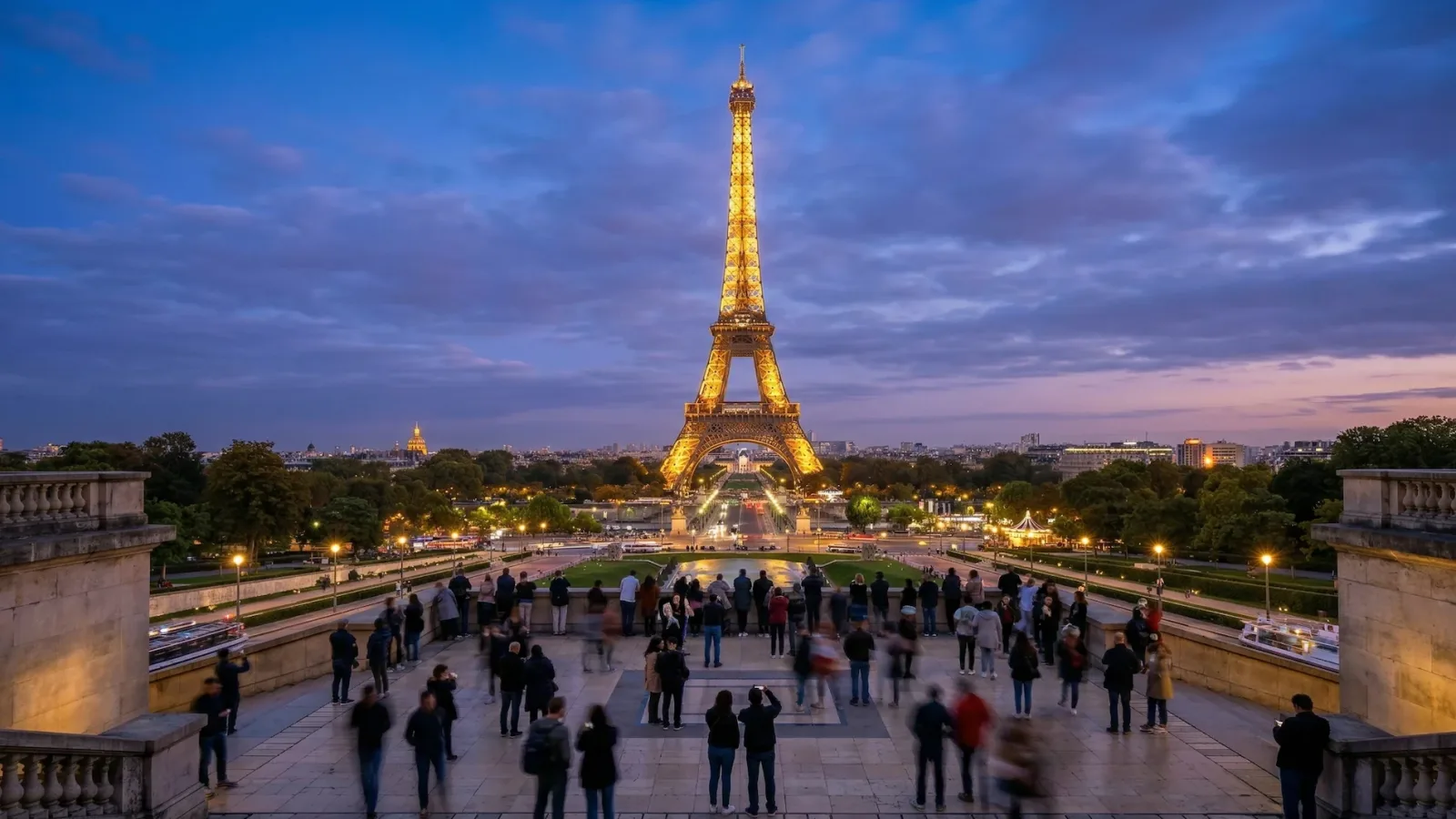
The world's most famous iron monument is not completely rigid, changing its physical dimensions based on local atmospheric temperatures. Built from thousands of forged wrought-iron components, the Eiffel Tower experiences dramatic thermal expansion when exposed to direct summer heat. During peak summer months, the metallic structure expands enough to increase the tower's overall height by up to fifteen centimeters. Additionally, because the side facing the sun expands faster than the shaded side, the summit actually tilts away from the sun by several inches. In winter, cold weather causes the metal to contract back to its baseline height, making the monument a living barometer of seasonal shifts.
7. The Oldest Standing Bridge in Paris Is Paradoxically Named the "New Bridge"
Stretching across the River Seine to connect the Île de la Cité, the Pont Neuf holds the historic distinction of being the oldest standing bridge in Paris. Completed in 1607 under King Henry IV, its name translates directly from French as the "New Bridge." The moniker was originally chosen because the stone structure incorporated revolutionary modern architectural features, including wide paved sidewalks and missing houses. Unlike traditional medieval bridges that were tightly packed with multi-story timber buildings, the Pont Neuf was designed purely for unhindered pedestrian and carriage transit. Today, the ancient stone arches stand as a permanent monument to early modern civil engineering, despite carrying a name that suggests recent construction.
8. Paris Houses Multiple Official Replicas of the Statue of Liberty
While millions of travelers associate the iconic Statue of Liberty exclusively with New York Harbor, Paris contains several authentic versions of its own. The giant copper monument standing in the United States was originally built in France as a gift celebrating American independence. In 1889, the American expatriate community in Paris returned the gesture by presenting the city with a smaller bronze scale replica. This prominent statue sits on the Île aux Cygnes in the Seine, carefully oriented so that Lady Liberty looks directly across the Atlantic toward her larger counterpart. Additional official replicas can be discovered throughout the city, including inside the Musée d'Orsay and the Jardin du Luxembourg.
9. Viewing Every Artwork in the Louvre Would Take Over Three Months
As the largest art museum on Earth, the Louvre Palace contains an overwhelming collection of human cultural heritage. The expansive galleries house over thirty-five thousand individual artworks on display at any given time, drawn from a total collection exceeding three hundred thousand items. If an energetic visitor spent exactly thirty seconds examining every single exhibited work without taking a single break to eat, drink, or sleep, the tour would require more than one hundred consecutive days to complete. The museum's physical footprint covers nearly seventy-three thousand square meters of exhibition space across former royal palace halls. Navigating the vast hallways requires miles of walking, making a comprehensive single-day visit mathematically impossible.
10. An Ancient Roman Amphitheater Is Hidden in the Heart of the Latin Quarter
Long before medieval kings ruled France, Paris was a bustling Roman provincial city named Lutetia. Hidden among the quiet residential streets of the Latin Quarter lies the Arènes de Lutèce, a remarkably preserved stone amphitheater dating back to the first century AD. In ancient times, this massive outdoor arena could accommodate over fifteen thousand spectators for gladiatorial combat, wild beast hunts, and theatrical performances. The site was buried for centuries and nearly destroyed during nineteenth-century urban construction before prominent citizens, including author Victor Hugo, campaigned to preserve it. Today, local residents casually gather on the ancient stone terracing to play boules or enjoy quiet afternoon picnics.
11. France Executed a Criminal by Guillotine in the Same Year "Star Wars" Was Released
The guillotine is strongly associated with the public executions and political chaos of the French Revolution in the late eighteenth century. However, the deadly device remained the official legal method of capital punishment in France well into the modern era. The final legal execution by guillotine took place at Baumettes Prison in Marseille on September 10, 1977, when convicted murderer Hamida Djandoubi was put to death. Coincidentally, this historic event occurred in the exact same year that George Lucas released the original Star Wars film in movie theaters worldwide. France officially abolished capital punishment four years later in 1981, retiring the guillotine after nearly two centuries of use.
12. An Underground Network of Abandoned "Ghost Stations" Lies Beneath the Metro
Beneath the bustling metropolis sits a mysterious network of abandoned subway platforms known locally as stations fantômes. Many of these underground transit hubs were closed down in 1939 at the outbreak of World War II when staff were mobilized for war service and were never reopened. Other stations, such as Haxo and Porte Molitor, were completely constructed during subway expansions but never connected to public passenger routes. Today, these eerie, frozen-in-time spaces serve specialized civic and economic roles for the transit authority. For instance, the closed station at Porte des Lilas is frequently rented out as a film set for major international motion pictures requiring authentic subway backdrop scenery.
13. Paris Operated a Mass Pneumatic Tube Mail System Until the 1980s
Long before digital messaging and instant email revolutionized global communication, Paris relied on an ingenious high-speed postal technology called the "pneu." Established in 1866, this subterranean postal network consisted of over four hundred kilometers of pressurized brass pipes running alongside the city sewer lines. Bank records, urgent letters, and official documents were packed into small metal canisters and fired through the tubes using compressed air at speeds reaching thirty miles per hour. The system allowed Parisians to send mail across the capital and receive a reply in just a few hours. This remarkable pneumatic network remained in continuous daily operation for over a century before finally being decommissioned in 1984.
14. The Official City Motto Honors Ancient River Merchants Who Survived Stormy Seas
Despite being located inland far from the ocean coast, the identity of Paris has been inextricably linked to maritime trade for thousands of years. The city's official Latin motto, Fluctuat nec mergitur, translates to "She is tossed by the waves, but does not sink." This historic phrase originates from the powerful medieval guild of river merchants, known as the Nautes Lutetiae, who controlled trade along the Seine River and helped build the city's early economy. The motto reflects resilience in the face of adversity, political upheaval, and natural disasters throughout Parisian history. Following modern tragedies, the heroic phrase has frequently resurfaced on public murals and banners across the capital as a symbol of unity.
15. The City's Iconic Green Drinking Fountains Were Designed to Combat Alcoholism
Scattered across public squares throughout Paris are dozens of elegant, dark-green cast-iron drinking fountains known as Wallace Fountains. Following the devastating Franco-Prussian War and the Siege of Paris in 1871, much of the city's clean water infrastructure was completely destroyed. Clean drinking water became extremely scarce and prohibitively expensive, forcing impoverished citizens to drink cheap wine and spirits instead, which sparked a public health crisis. Moved by the humanitarian disaster, wealthy British philanthropist Sir Richard Wallace personally funded the design and installation of dozens of free public fountains decorated with four sculpted caryatids representing kindness, simplicity, charity, and sobriety. These artistic fountains continue to supply clean, free drinking water to thirsty locals and travelers today.
Sources & References
This AI-assisted post was rigorously curated and fact-checked for accuracy by:
 Martin Roháček
How fun was this article? 🤔
Tap a star to rate it
🧠 Quiz: How closely were you paying attention?
10 questions — all answers are in the article above!
Enjoyed these facts? There's more! 💌
Fresh fun facts in your inbox. No spam, ever.