The Broad Philosopher: 15 Fascinating Facts About Plato
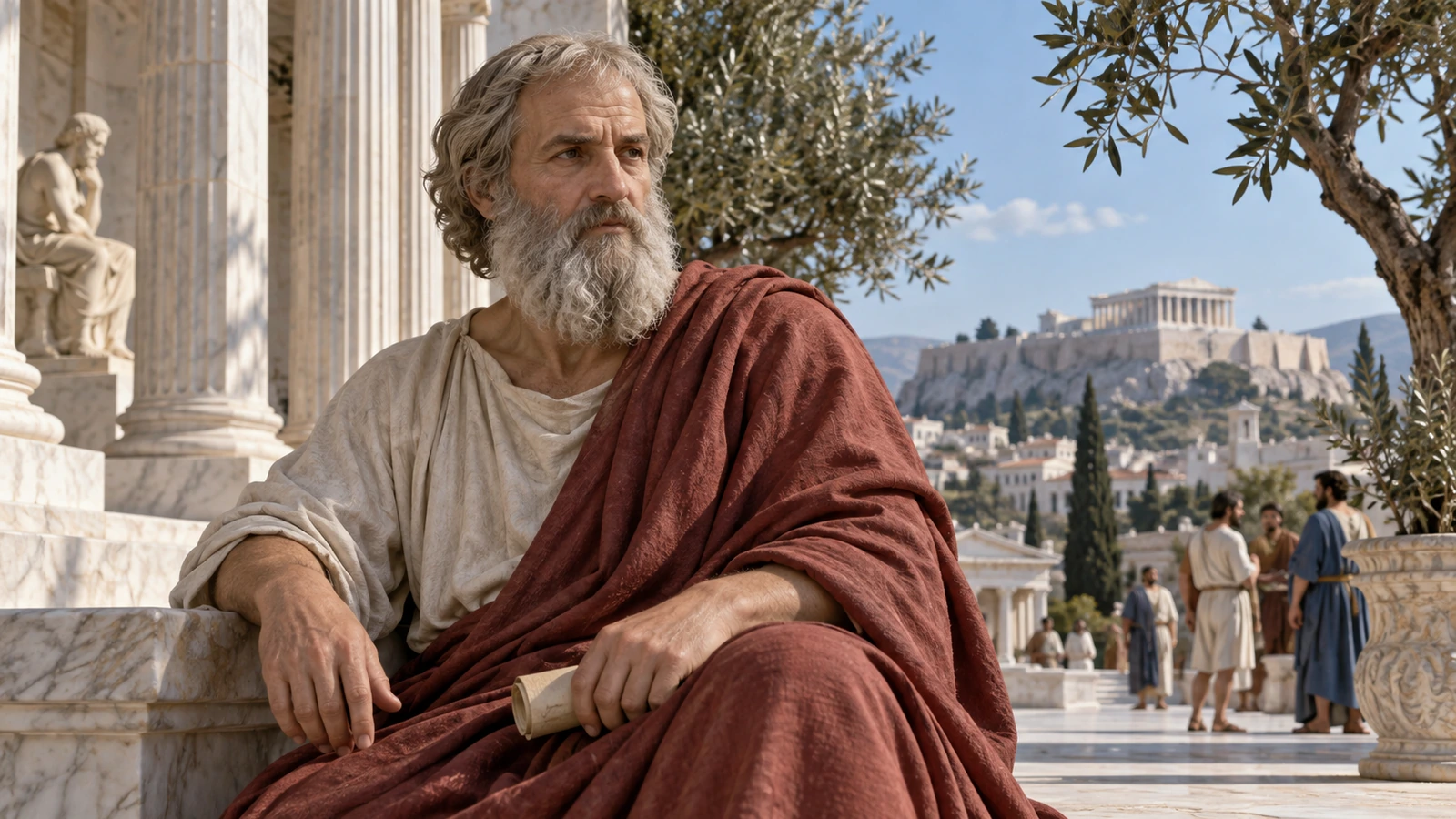
Plato stands as one of the most influential figures in Western civilization, shaping over two millennia of philosophy, science, and political thought. Beyond his famous dialogues and theories on reality, the ancient Greek thinker lived a surprisingly dramatic life filled with athletic feats, pirate kidnapping, and fierce rivalries. From his origins as a competitive wrestler to his complex views on memory and governance, his legacy holds countless unexpected turns. Discover the fascinating history and lesser-known truths about the thinker who laid the foundations of Western thought.
1. His Real Name Was Likely Aristocles
The man known worldwide as Plato was almost certainly born with the name Aristocles, named after his grandfather according to ancient Greek tradition. The moniker Plato was actually a nickname bestowed upon him during his youth. Most ancient historians attribute this title to his wrestling coach, Ariston of Argos, who noted his impressive physical stature. Derived from the Greek word platus, meaning wide or broad, the nickname referenced his broad shoulders and expansive chest. Over time, the moniker completely eclipsed his birth name, becoming the name by which history would forever remember him.
2. He Was Once Kidnapped by Pirates and Sold Into Slavery
Plato's intellectual pursuits occasionally placed him in severe real-world danger, including an incident that led to his enslavement. After traveling to Sicily and falling out of favor with Dionysius I, the ruler of Syracuse, Plato attempted to return home aboard a ship. Dionysius secretly arranged with a Spartan captain to seize the philosopher during the voyage. Plato was subsequently taken to the island of Aegina, where he was put on display in a public slave market. Fortunately, an admirer named Anniceris recognized the famous thinker, purchased his freedom for twenty minas, and sent him back to Athens safely.
3. He Founded the First University in the Western World
Around 387 BCE, Plato established a formal school of higher learning outside the city walls of Athens. Situated in a sacred grove of olive trees previously dedicated to the legendary hero Academus, the institution took the name of its location: the Academy. Scholars gathered there to study advanced mathematics, astronomy, rhetoric, and dialectic philosophy in an informal, communal setting. Unlike modern schools, it charged no tuition fees, relying instead on voluntary contributions and endowments from wealthy patrons. The Academy operated continuously for nearly nine hundred years until it was shuttered by the Byzantine Emperor Justinian in 529 CE.
4. The Execution of Socrates Made Him a Lifelong Opponent of Democracy
Plato was raised in Athenian political nobility, but his trajectory changed dramatically when the democratic government executed his beloved mentor, Socrates, in 399 BCE. Socrates was sentenced to death by hemlock after being found guilty by a popular jury of corrupting the youth and impiety. This tragic event shattered Plato's faith in democratic governance, which he viewed as unstable rule by an easily manipulated mob. In his masterwork, the Republic, he argued that pure democracy inevitably decays into tyranny. Instead, he proposed that ideal states should be governed strictly by highly trained, wise Philosopher Kings.
5. He Invented the Story of Atlantis as a Moral Allegory
The enduring legend of the lost underwater continent of Atlantis originates entirely within two of Plato's late philosophical dialogues, Timaeus and Critias. Rather than recording actual history, Plato invented the fictional empire of Atlantis as a narrative device to illustrate a point about imperial hubris. In his story, ancient Athens successfully repelled a massive invasion by the technologically advanced island power because Athens possessed ideal moral governance. The gods subsequently submerged Atlantis beneath the ocean in a single day and night of disaster to punish its arrogance. Tragically for history, later readers took his fictional allegory literally, sparking centuries of fruitless searching.
6. Diogenes the Cynic Humiliated Him with a Plucked Chicken
Plato was known for engaging in rigorous logical definitions, but one particular attempt opened him up to legendary satire. During a lecture at the Academy, Plato famously defined a human being as a featherless biped, which earned wide praise from his students. Upon hearing this, Diogenes the Cynic plucked all the feathers off a live rooster and brought it directly into Plato's classroom. Diogenes thrust the naked bird forward and declared, 'Behold! I have brought you a man!' Thoroughly embarrassed by the stunt, Plato was forced to update his official definition by adding the condition: 'with broad, flat nails.'
 Philosophers Through the Ages
From wrestling rings and pirate kidnappings to sword duels and secret brotherhoods, the greatest thinkers in history led lives as dramatic as their ideas. Explore the surprising human stories behind the brilliant minds who shaped Western and Eastern philosophy.
See All Facts
Philosophers Through the Ages
From wrestling rings and pirate kidnappings to sword duels and secret brotherhoods, the greatest thinkers in history led lives as dramatic as their ideas. Explore the surprising human stories behind the brilliant minds who shaped Western and Eastern philosophy.
See All Facts
7. He Proposed Banning Poets and Dramatists from His Ideal City
Despite being a highly gifted writer who utilized vivid imagery and narrative flair, Plato harbored a deep distrust of traditional poetry and theater. In the Republic, he advocated for the expulsion of poets, tragic playwrights, and actors from his ideal utopian state. He believed that mimetic art appealed directly to irrational emotions rather than logical reason, corrupting the moral fabric of citizens. Furthermore, he argued that poets like Homer lied about the gods, depicting them as flawed and vengeful, which set a terrible moral example for youth. Only hymns to the gods and praises of famous men were to be permitted under strict state censorship.
8. His Attempt to Turn a Sicilian Tyrant into a Philosopher King Failed Miserably
Plato did not merely theorize about politics; he attempted to put his ideal political theories into actual practice with disastrous results. Following the death of Dionysius I of Syracuse, Plato was invited by Dion to tutor the young new ruler, Dionysius II. Plato hoped to mold the young dictator into a true philosopher king who would rule with wisdom and restraint. However, Dionysius II proved untalented, paranoid, and easily distracted by court luxury, suspecting Plato and Dion of plotting against him. The tyrant banished Dion and effectively placed Plato under house arrest, forcing the philosopher to flee for his life once again.
9. He Almost Completely Erased Himself as a Speaker in His Own Writings
Across more than thirty surviving philosophical dialogues, Plato almost never speaks directly in his own voice. Instead, he crafts dramatic conversations between historical Athenian figures, using his teacher Socrates as the primary vehicle to deliver complex arguments. Throughout his vast body of work, Plato mentions his own name only twice in passing: once in the Apology as a quiet attendee at Socrates' trial, and once in the Phaedo where it is noted that he was ill on the day Socrates died. By removing himself as an active speaker, Plato maintained an enigmatic distance that leaves scholars debating his personal views to this day.
10. His Concept of 'Platonic Love' Was Not What Modern People Think
In modern conversation, 'platonic love' refers strictly to a non-romantic, non-sexual friendship between two people. However, Plato's original formulation of the concept in his dialogue, the Symposium, was vastly more complex and spiritually ambitious. Through the character of Diotima, Plato describes a ladder of love that begins with physical attraction to a beautiful body. Over time, the ideal lover ascends past physical desires to appreciate spiritual beauty, noble souls, scientific truth, and ultimately, absolute divine Beauty itself. True Platonic love was not the absence of passion, but the redirection of sexual energy toward intellectual and spiritual enlightenment.
11. He Believed Souls Choose Their Own Reincarnation Before Rebirth
Plato held firm beliefs in the immortality of the human soul and argued that reincarnation was a central feature of existence. At the conclusion of the Republic, he presents the Myth of Er, a story about a soldier who dies in battle but revives twelve days later to describe the afterlife. Er explains that deceased souls undergo judgment before being brought to a meadow where they pick their next earthly life from a vast array of options, including animals, tyrants, or common citizens. After making their choice, the souls drink from the River Lethe (Forgetfulness) to erase their memories before being reborn into the mortal world.
12. His 'Allegory of the Cave' Eerily Anticipated Modern Cinema
In Book VII of the Republic, Plato introduced one of philosophy's most famous metaphors: the Allegory of the Cave. He envisioned human beings chained inside a dark subterranean cave, facing a blank wall, unable to turn their heads. Behind them, a fire burns, while handlers carry cutouts of animals and objects along a parapet, casting flickering shadows onto the wall in front of the prisoners. The prisoners mistake these projected shadows for absolute reality. Strikingly, Plato's ancient thought experiment described the precise physical setup and psychological illusion of sitting in a modern movie theater or consuming digital screen media thousands of years early.
13. Nearly His Entire Body of Written Work Survived Intact
Unlike many ancient Greek authors whose works survive only in fragments or lost references, Plato's complete written legacy survived almost entirely intact. Scholars possess thirty-five distinct dialogues alongside a collection of thirteen personal letters attributed to him. This extraordinary preservation occurred because his writings were continuously copied and studied by Byzantine scribes, Islamic scholars during the Golden Age, and medieval European monastic orders. The Academy's continuous operation for centuries also helped establish authoritative copies of his texts early on. As a result, modern readers can engage with his philosophy almost exactly as he wrote it in antiquity.
14. He Argued That the Invention of Writing Would Destroy Human Memory
In his dialogue Phaedrus, Plato voiced a deeply skeptical view regarding a revolutionary technology of his era: the written word. Through a myth involving the Egyptian god Theuth and King Thamus, Plato argued that relying on written texts weakens the human brain because people stop exercising their memory. He claimed that writing creates a false impression of wisdom, as readers gain access to information without true internal understanding or oral instruction. Irony abounds in this argument, as modern society only knows of Plato's fierce critique of the written word precisely because he chose to write it down.
15. Legends Claim He Died Peacefully at a Wedding Feast
Plato lived an exceptionally long life for the ancient world, passing away in Athens around 348 BCE at the age of eighty-one. Accounts of his final hours vary among ancient biographers, but several persistent traditions surround his death. One popular account written by Philodemus claims that Plato died quietly in his bed while listening to a young Thracian girl play a melody on the flute. Another widely cited legend states that the elderly philosopher passed away peacefully in his sleep while attending the wedding celebration of a young friend, surrounded by music, laughter, and light conversation.
Sources & References
This AI-assisted post was rigorously curated and fact-checked for accuracy by:
 Martin Roháček
How fun was this article? 🤔
Tap a star to rate it
🧠 Quiz: How closely were you paying attention?
10 questions — all answers are in the article above!
Enjoyed these facts? There's more! 💌
Fresh fun facts in your inbox. No spam, ever.