
The Enigmatic Corvid: 15 Fascinating Facts About Ravens
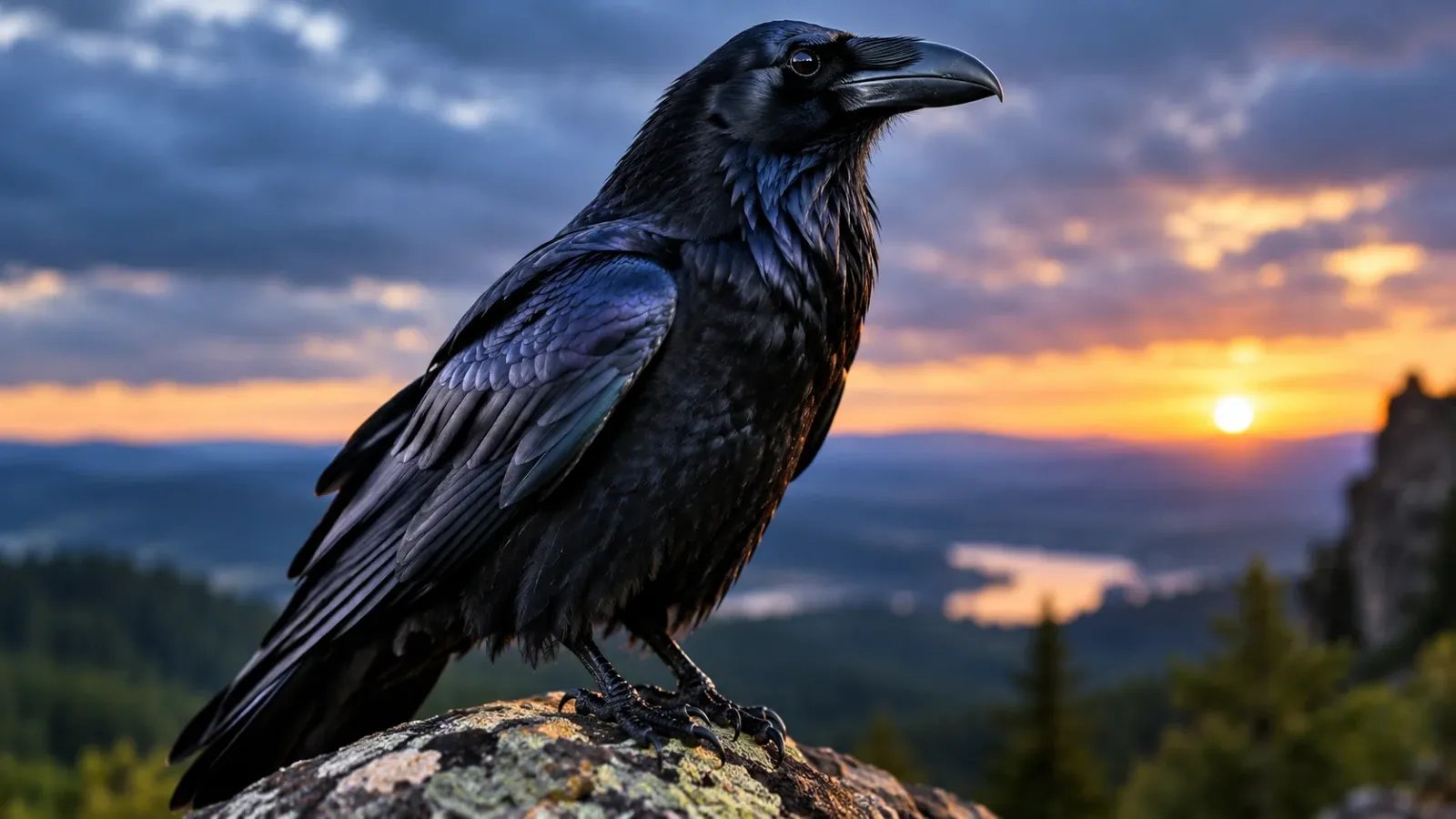
Often dismissed as mere spooky omens of death, ravens possess some of the animal kingdom's most brilliant minds. Far from simple scavengers, these complex thinkers are capable of empathy, deception, and planning for the future. Look beyond their dark pop-culture reputation to discover the incredible science and history of a bird that rivals great apes in cognitive power.
1. Ravens can plan for events that will happen days in the future, a cognitive ability once thought completely unique to humans and great apes.
Research has shown that ravens will select and store tools they do not currently need but will require later to access food. They can ignore immediate, smaller rewards in favor of holding onto a tool that will yield a larger reward the following day, demonstrating self-control and future planning capabilities that challenge traditional understanding of animal cognition.
2. Young ravens create and play with their own toys, displaying a level of playfulness rarely observed outside of mammalian species.
Juvenile ravens are known for their curiosity and have been observed breaking off twigs to play catch with one another while in mid-air. They also slide down snow-covered roofs on their backs or bellies purely for entertainment, a behavior that proves their actions are not solely driven by survival instincts but also by an intrinsic desire for stimulation and fun.
3. These birds utilize highly sophisticated, deceptive tactics to protect their hidden food caches from potential thieves.
When a raven realizes another bird is watching it bury food, it will frequently construct a fake cache. The bird will go through the motions of burying a treat, digging a hole, and covering it up, all while secretly keeping the actual food hidden in its throat pouch to bury elsewhere once the onlooker has left.
4. Ravens use complex non-vocal gestures, like pointing with their beaks, to direct the attention of their peers to specific objects.
While pointing is a foundational developmental milestone in human children, very few animals communicate this way. Ravens will hold up an item like a twig or moss in their beak to capture the attention of a potential mate, functioning exactly like a human pointing a finger. This demonstrates a deep level of intentional communication and social awareness.
5. They possess an extraordinary memory for human faces and will hold grudges against specific individuals who have wronged them.
If a researcher or ordinary person behaves aggressively toward a raven, the bird will memorize their facial features and scold them upon future encounters, even years later. Furthermore, they will socially share this information, turning their flock against the offending human, proving their memories are both long-lasting and communicable.
6. Ravens form strategic alliances with wolves in the wild to secure food that they cannot hunt or open on their own.
Biologists have documented ravens leading wolf packs to the carcasses of large prey, such as elk or moose, which the birds cannot penetrate with their own beaks. Once the wolves tear the carcass open and finish their meal, the ravens swoop in to feast on the exposed remains, establishing a mutually beneficial relationship across species lines.
 Birds of the World
From record-breaking aerial plunge-divers to massive flightless icons, the avian world is a marvel of evolutionary engineering. Discover the extraordinary intellects, specialized survival skills, and hidden superpowers of the planet's most fascinating birds.
See All Facts
Birds of the World
From record-breaking aerial plunge-divers to massive flightless icons, the avian world is a marvel of evolutionary engineering. Discover the extraordinary intellects, specialized survival skills, and hidden superpowers of the planet's most fascinating birds.
See All Facts
7. Contrary to the myth that they are strictly scavengers, ravens are highly capable, cooperative apex predators that hunt in teams.
While they will readily eat carrion, ravens often work together to take down live prey much larger than themselves. One bird might distract a mother sheep or seal, while another swoops in to target the newborn. Their cooperative hunting strategies require precise timing, communication, and a shared understanding of tactical roles.
8. Ravens possess the ability to mimic human speech and environmental noises with greater clarity than many celebrated parrots.
In captivity, ravens can be taught to say words and short phrases, reproducing the tonal qualities of human voices remarkably well. In the wild, they incorporate environmental sounds into their vocabulary, mimicking everything from the calls of other bird species to the sounds of wolf howls, car alarms, and construction equipment to deceive or communicate.
9. They exhibit profound empathetic behaviors, actively consoling their friends after a fight or stressful encounter.
In the complex social hierarchies of raven flocks, conflicts are common. Researchers have noted that when a raven loses a dispute, a bystander bird that shares a close bond with the loser will approach and preen them or touch beaks. This bystander affiliation reduces the stressed bird's anxiety, pointing to an emotional intelligence previously thought exclusive to humans and certain primates.
10. The collective noun for a group of ravens is an unkindness or a conspiracy, a linguistic quirk born from Victorian-era superstitions.
English terminology is full of poetic group names, and the raven's dark folklore heavily influenced its designation. Because they were often seen feasting on battlefields and were heavily associated with omens of death, nineteenth-century writers popularized these sinister terms. In scientific reality, however, raven flocks are highly cooperative and deeply social, contradicting their ominous labels.
11. Ravens engage in a process called anting, where they intentionally rub crushed insects into their feathers as a form of chemical hygiene.
To combat parasites, mites, and fungal infections, ravens will capture ants and crush them over their plumage. The ants secrete formic acid as a defense mechanism, which acts as a powerful, natural insecticide and fungicide. This behavior showcases a remarkable understanding of utilizing the chemical properties of other organisms for self-medication.
12. They are incredibly adaptable to harsh environments, thriving in the freezing Arctic tundra by modifying their metabolic rates.
The common raven has one of the largest geographic distributions of any bird, surviving from scorching deserts to ice-covered northern extremes. In freezing temperatures, they puff up their dense, dark feathers to absorb solar radiation and trap heat, and they can slow their metabolic processes at night to conserve energy, allowing them to survive winters that would kill most other avian species.
13. Juvenile ravens form rebellious, roaming teenage gangs to overthrow the territorial dominance of older, established mated pairs.
Young ravens leave their parents but do not immediately settle down. Instead, they form large, nomadic flocks of adolescents. When they find a lucrative food source guarded by a territorial adult pair, the younger birds will overwhelm the adults through sheer numbers, utilizing collective power to subvert the traditional social hierarchy until they are old enough to establish their own territories.
14. A raven's brain is heavily biased toward the nidopallium, an area packed with neurons that processes complex cognitive tasks.
While a raven's brain is small in absolute terms, it is massive relative to its body size. More importantly, it possesses an incredibly high density of neurons in the forebrain area that is similar to the human cortex. This dense neural packing allows for ultra-fast communication between brain cells, giving them the processing power to solve puzzles, understand water displacement, and recognize patterns.
15. The iconic ravens of the Tower of London are traditionally considered the protectors of the British Crown, though their presence there is a relatively modern invention.
Legend states that if the ravens ever leave the Tower, the kingdom will fall, leading many to believe this is an ancient medieval tradition. However, historical records suggest the ravens were likely introduced as a romanticized tourist attraction during the Victorian era. Today, the Tower's Ravenmaster carefully trims their flight feathers to ensure the prophecy of their departure never comes true.
Sources & References
This AI-assisted post was rigorously curated and fact-checked for accuracy by:
 Martin Roháček
How fun was this article? 🤔
Tap a star to rate it
🧠 Quiz: How closely were you paying attention?
10 questions — all answers are in the article above!
Enjoyed these facts? There's more! 💌
Fresh fun facts in your inbox. No spam, ever.