The Original Panda: 15 Fascinating Facts About Red Pandas
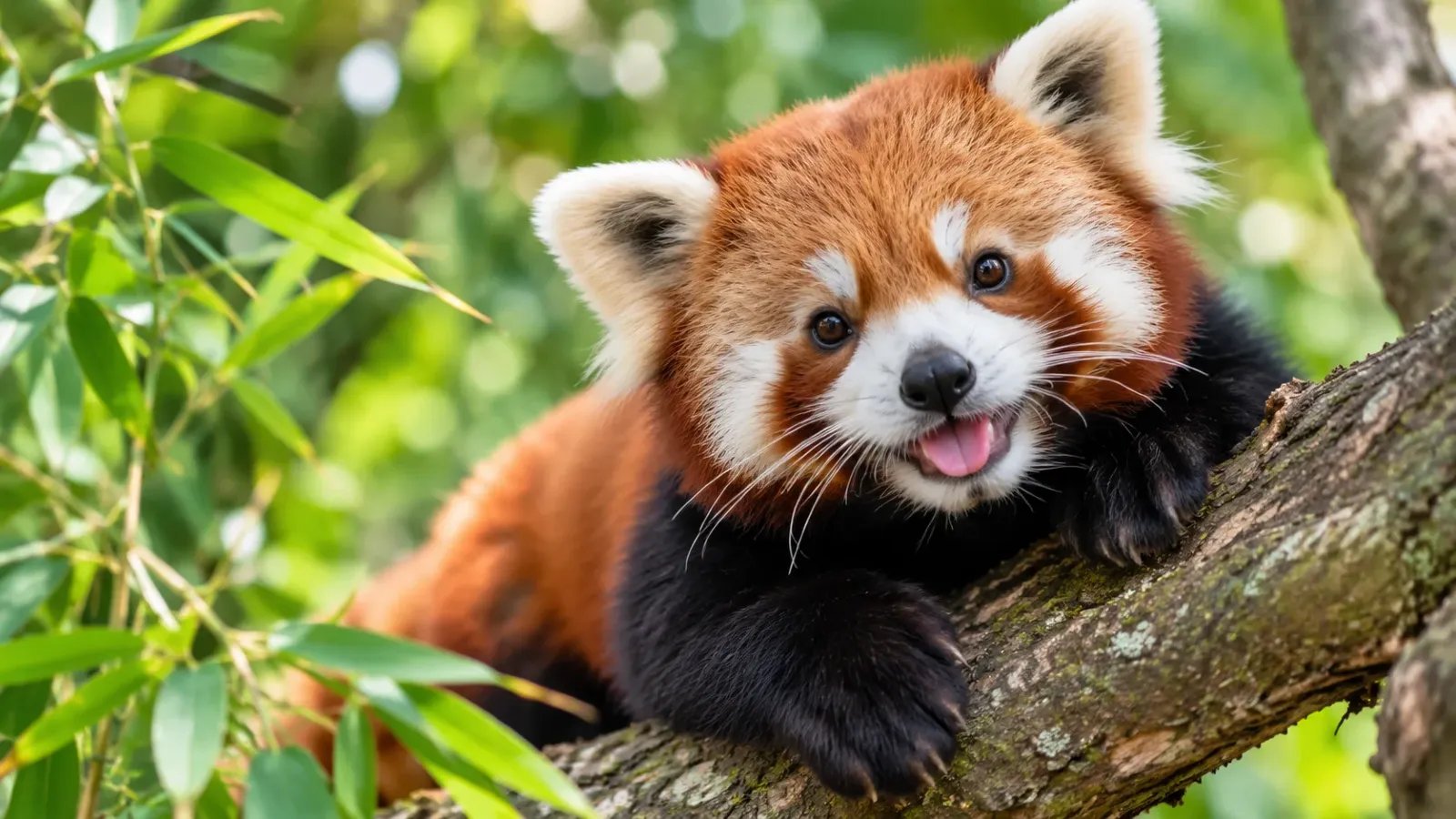
Red pandas look like a cross between a cat, a fox and a teddy bear, and they are not closely related to giant pandas at all. They had the name "panda" first, they gave their nickname to a famous web browser, and they climb down trees head-first. Here is what makes these shy, rust-coloured tree dwellers so unusual.
1. Red pandas were called pandas first.
The red panda was scientifically described in 1825 by the French zoologist Frédéric Cuvier, more than four decades before Western scientists described the giant panda. For many years, the word "panda" referred only to this small, rusty-red animal. When the black-and-white bear became famous, it borrowed the name, and the original panda gained the adjective "red".
2. They are not closely related to giant pandas.
Despite sharing a name and a love of bamboo, red pandas and giant pandas are only distant relatives. The giant panda is a bear, while the red panda is the only living member of its own family, the Ailuridae. Genetic studies place it closer to raccoons, weasels and skunks. Its family line stretches back around 20 million years, and fossil relatives have been found in Europe and North America.
3. Both pandas have a "false thumb", but for different reasons.
Red pandas and giant pandas each have an elongated wrist bone that works like an extra thumb for gripping. Because the two species are not closely related, this is a classic example of similar features evolving separately. Fossils suggest the red panda's ancestors may first have used their false thumb for climbing, and only later for holding bamboo.
4. They live on a diet that barely feeds them.
Bamboo makes up most of a red panda's diet, even though it is a carnivore by ancestry and has a simple gut that is poorly suited to digesting plants. Red pandas can extract nutrients from only about a third of what they eat, so they must spend many hours a day feeding. They pick the most tender leaves and shoots and occasionally add fruit, eggs, insects or small animals.
5. They climb down trees head-first.
Red pandas spend much of their lives in trees and are superb climbers. They can rotate their ankles so that their hind feet grip the trunk while they descend head-first, a skill few mammals have. Their curved, semi-retractable claws and fur-covered soles give them extra grip on icy branches.
6. Their colour is camouflage, not a fashion statement.
A bright red animal might seem easy to spot, but red pandas live in Himalayan and Chinese forests where tree trunks and branches are covered in reddish-brown moss and lichen. Seen from below, their rusty fur blends in remarkably well. Their dark belly and legs also help them disappear into shadows when viewed from the ground.
7. Their tail doubles as a blanket.
A red panda's bushy, ringed tail can be almost as long as its body. It helps the animal balance in the treetops, and on cold nights the red panda curls up tightly and wraps the tail around itself like a scarf. In hot weather, it does the opposite, sprawling along a branch with its legs dangling to cool down.
8. The Firefox web browser is named after them.
"Firefox" is one of the red panda's nicknames, and the popular web browser takes its name from the animal. Despite the logo's fox-like appearance, the developers chose the name with the red panda in mind. The animal has also inspired characters in films such as "Kung Fu Panda", whose wise teacher Master Shifu is a red panda, and Pixar's "Turning Red".
9. There are two distinct kinds of red panda.
Scientists recognise two populations: the Himalayan red panda and the Chinese red panda. Their lineages split around 250,000 years ago. The Chinese form is generally larger and darker, with a redder face and more distinct tail rings. Some researchers argue they should be treated as two separate species.
10. They can taste artificial sweeteners.
Most animals cannot detect the artificial sweetener aspartame, but a 2009 study found that red pandas not only noticed it but seemed to prefer it. They were the first animals outside the primates known to taste it. Scientists are still not sure why a mostly bamboo-eating animal would have evolved this ability.
11. They mostly keep to themselves.
Adult red pandas are solitary and territorial, coming together mainly during the breeding season. They mark their territories with urine and with scent from glands on their feet and under their tail. When threatened, they stand up on their hind legs and spread their front paws to look bigger.
12. One escaped red panda became an internet celebrity.
In 2013, a young male red panda named Rusty slipped out of his enclosure at the Smithsonian's National Zoo in Washington, D.C. His disappearance became national news, and people shared photos of him on social media. He was found within a day in a nearby neighbourhood after a local resident spotted him in a tree.
13. Babies stay hidden in a nest for months.
Red pandas usually give birth to one or two cubs in a hollow tree or rock crevice lined with leaves and moss. The cubs are born blind and stay in the nest for about three months before venturing out. Their mother moves them between several nests to keep them safe from predators.
14. Only about 10,000 remain in the wild.
Red pandas have been listed as Endangered by the IUCN since 2008, and the wild population is estimated at around 10,000 animals. They live in mountain forests in Nepal, India, Bhutan, Myanmar and China, where deforestation, poaching and the loss of bamboo threaten their survival. Their habitat is also becoming increasingly fragmented, isolating small groups from one another.
15. They have their own international day.
Every year in September, conservation groups celebrate International Red Panda Day to raise awareness of the species. In Nepal, community programmes train local people as "forest guardians" who monitor red pandas and their habitat. Zoos around the world also run breeding programmes to support the wild population.
Sources & References
This AI-assisted post was rigorously curated and fact-checked for accuracy by:
 Martin Roháček
How fun was this article? 🤔
Tap a star to rate it
🧠 Quiz: How closely were you paying attention?
10 questions — all answers are in the article above!
Enjoyed these facts? There's more! 💌
Fresh fun facts in your inbox. No spam, ever.