The Infinite Mirror: 15 Fascinating Facts About Salar de Uyuni
Spanning over 10,000 square kilometers high in the Bolivian Andes, Salar de Uyuni is the world's largest salt flat and one of the most mesmerizing landscapes on Earth. From turning into a giant mirror during the rainy season to holding vast reserves of lithium and ancient cactus-covered islands, this high-altitude desert defies imagination. It serves as both a critical calibration site for NASA satellites and a surreal backdrop for Hollywood blockbusters. Discover the fascinating geology, ancient legends, and unique ecosystem of this extraordinary South American wonder.
1. It Formed From the Evaporation of Prehistoric Lakes
Thousands of years ago, the region now known as Salar de Uyuni was covered by a series of massive prehistoric lakes, most notably Lake Minchin. As the ancient climate shifted and the water slowly evaporated under the intense high-altitude sun, it left behind a thick salt crust spanning over 10,000 square kilometers. Beneath this hard outer shell lies a vast subterranean reservoir of mineral-rich brine. The remaining salt sheet is so extensive that it forms the largest continuous salt flat on Earth, located 3,656 meters above sea level in southwestern Bolivia. Today, this ancient geological transformation provides geologists with a unique window into South America's prehistoric hydrologic history.
2. The Rainy Season Turns It Into the World's Largest Mirror
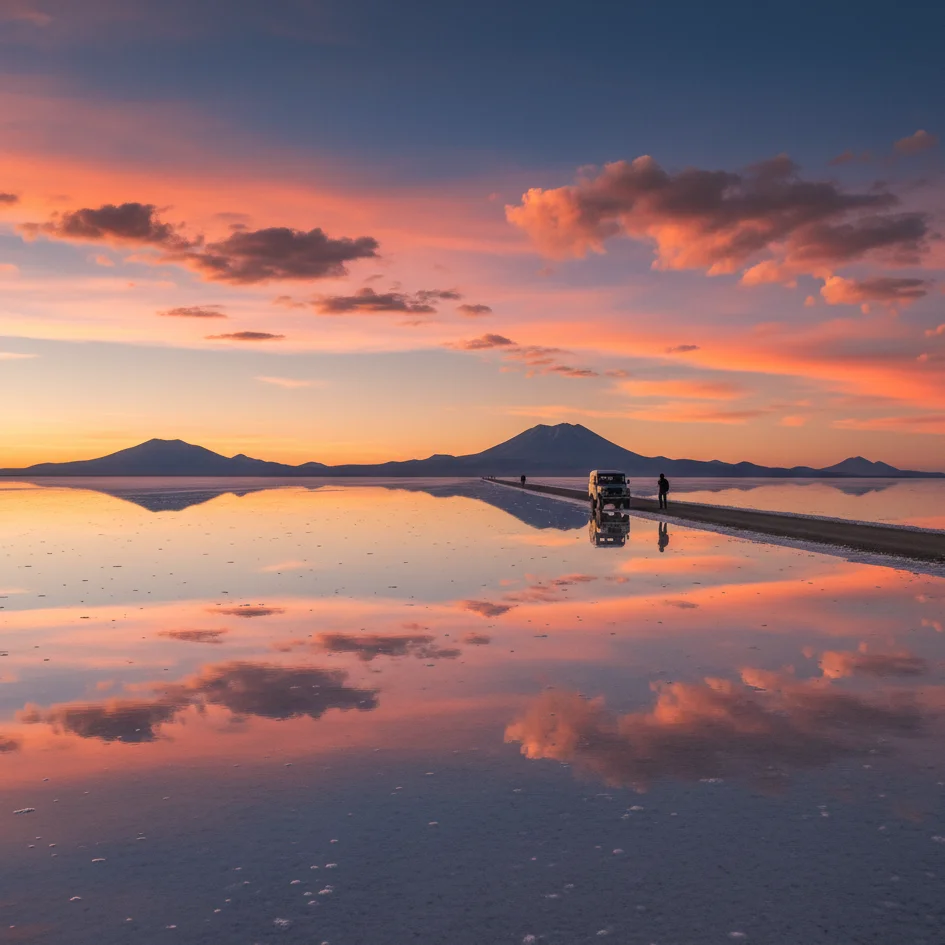
During the rainy season, which typically runs from December to April, nearby lakes overflow and blanket the salt flats in a thin layer of standing water. Because the terrain is astonishingly flat, this shallow water does not drain away immediately, transforming the landscape into a mirror over 100 kilometers wide. The surface reflects the sky so perfectly that the horizon line seems to vanish entirely, creating the illusion of walking on clouds. Photographers and travelers flock to the region during these months to capture images where heaven and earth merge into a seamless reflection. Standing on the waterlogged crust offers the disorienting feeling of floating in an endless, two-dimensional blue expanse.
3. NASA Uses the Landscape to Calibrate Satellites
Earth-observing satellites require precise calibration to measure global sea levels and land elevations accurately. NASA scientists frequently target Salar de Uyuni because its vast, perfectly level surface offers an unmatched baseline for altimetry calibration. Unlike ocean surfaces, which constantly shift with tides and waves, the salt flat remains immobile, offering an unusually high radar and laser reflection. The area's high altitude, clear atmosphere, and dry climate further minimize signal distortion during satellite passes. Consequently, space agencies around the globe rely on this remote Bolivian landscape to fine-tune instruments orbiting hundreds of kilometers above Earth.
4. It Houses the World's Largest Reserves of Lithium
Hidden beneath the bright white crust of Salar de Uyuni lies one of the planet's greatest concentrated treasure troves of natural resources. Geologists estimate that the subterranean brine holds between 20 to 50 percent of the world's total known lithium reserves. As global demand for lithium-ion batteries surges to power electric vehicles and renewable energy storage, Bolivia's salt flats have become strategically vital. Extracting the mineral involves pumping up the lithium-rich brine and evaporating it in massive outdoor solar basins. Balancing the economic windfall of lithium extraction with the delicate ecology and cultural heritage of the flats remains a critical challenge for the nation.
5. Coral Islands Covered in Giant Cacti Rise From the Salt
Rising dramatically from the middle of the blinding salt crust is Isla Incahuasi, the rocky top of an ancient submerged volcano. The island's terrain consists largely of petrified coral reefs and volcanic rock, proving that the entire area was once submerged underwater. Today, Incahuasi is famous for harboring thousands of giant Trichocereus pasacana cacti, some of which stand over 10 meters tall. Because these slow-growing cacti expand by only about one centimeter per year, many of the towering specimens are well over a thousand years old. Wandering through this surreal cactus forest offers visitors an astounding contrast between green plant life and the endless white horizon.
6. Drying Salt Naturally Forms Raised Geometric Hexagons
When the shallow water dries up during the dry season, the salt surface cracks into stunning geometric formations. As brine evaporates, salt crystals crystallize and push against each other, forcing the ground into raised hexagonal patterns that look like a giant honeycomb. These naturally occurring hexagons stretch endlessly across the landscape, giving the impression of a meticulously paved marble floor. The size and sharpness of each hexagon vary depending on ambient moisture, wind speed, and evaporation rates. This natural geometric order is one of the most photographed textures on the flats, captivating artists and scientists alike.
7. It Holds an Estimated 10 Billion Tonnes of Salt
Salar de Uyuni is estimated to contain roughly 10 billion tonnes of salt, distributed across several distinct layers beneath the surface. The topmost salt crust varies in thickness from a few centimeters to over ten meters depending on the specific location within the basin. Despite containing such astronomical quantities of sodium chloride, local miners harvest only around 25,000 tonnes annually. This moderate extraction rate ensures that the overall landscape remains virtually untouched by heavy industrial salt mining. The sheer volume of salt present could theoretically supply human consumption needs for centuries to come.
8. An Eerie Train Graveyard Ruts on Its Outskirts
Just a few kilometers outside the city of Uyuni lies the Cementerio de Trenes, an eerie graveyard of decaying steam trains. In the late 19th century, British engineers built a railway network intended to transport minerals from local mines to Pacific ports. When the mining boom collapsed in the 1940s due to depleted resources and technical challenges, scores of locomotives were abandoned on the tracks. Over decades, harsh high-altitude winds and salty air rusted the iron bodies, turning them into hollow, skeletal sculptures. Today, tourists explore the graffiti-covered train cars, which stand as a stark historical monument to Bolivia's industrial past.
9. Rare Andean Flamingos Gather There to Feed and Nest
Despite the harsh salinity and scarce vegetation, Salar de Uyuni and its adjacent mineral lagoons serve as a crucial sanctuary for wildlife. Every November, thousands of South American flamingos gather in the area to feed and raise their young. Three distinct species—the Chilean flamingo, the rare Andean flamingo, and the delicate James's flamingo—coexist in this high-altitude ecosystem. The birds thrive on red micro-algae and tiny brine shrimp growing in shallow, mineral-dense lagoons like Laguna Colorada. The striking contrast between pink flamingo flocks and the stark white salt crust creates one of South America's most breathtaking natural spectacles.
10. Hotels Are Constructed Entirely Out of Salt Blocks
To accommodate the influx of global travelers, local architects developed a truly original solution using the abundant natural materials around them. Several hotels, such as the famous Palacio de Sal, are constructed almost entirely from compressed salt blocks cut directly from the flats. Inside these extraordinary structures, walls, beds, tables, and even sculptures are crafted from raw salt. To maintain structural integrity during rainy seasons, the hotel roofs are frequently reinforced and repaired with fresh salt mixtures. Hotel management famously posts signs asking guests not to lick the interior walls, preserving both hygiene and the building's infrastructure.
11. Hollywood Uses the Flats for Sci-Fi Film Sets
Salar de Uyuni's surreal visual aesthetic has long made it a favorite location for filmmakers seeking unearthly, futuristic landscapes. Most notably, the salt flats served as the filming location for the mineral planet Crait in Star Wars: The Last Jedi. Directors favored the site because kicking up the salt exposed the stark contrast between the bright white surface and the red dust beneath. The flats have also featured in visually ambitious films such as The Fall and various international travel documentaries. Its endless horizon and featureless terrain allow directors to create cinematic worlds that appear completely disconnected from Earth.
12. The Lack of Landmarks Causes Optical Illusions
Because Salar de Uyuni offers an entirely flat surface with no visual landmarks, human depth perception breaks down dramatically. Without trees, buildings, or mountains in the immediate foreground, the brain struggles to calculate distance and relative size. Travelers regularly use this optical anomaly to take hilarious forced-perspective photographs where objects appear far larger or smaller than reality. Common photo stunts include posing people inside toy dinosaur jaws or walking on top of tiny water bottles. Capturing these playful visual tricks has become a cherished tradition for nearly every traveler visiting the salt flats.
13. Indigenous Artisans Harvest Salt Using Ancient Techniques
In nearby villages like Colchani, local indigenous communities continue to harvest salt using centuries-old manual techniques. Workers use picks and shovels to scrape the top layer of salt into small, conical piles known as colpa. These conical mounds sit exposed to the sun for several days, allowing moisture to evaporate before the salt is gathered and transported. At local processing facilities, the harvested salt is dried over fires, iodized for health safety, and packaged for domestic use. Supporting these traditional family cooperatives helps local communities benefit directly from sustainable tourism and salt production.
14. The Climate Is High-Altitude and Extremely Harsh
Salar de Uyuni rests at an impressive elevation of 3,656 meters (11,995 feet) above sea level in the high Andes plateau. Due to the high altitude and thin atmosphere, solar radiation is extremely intense, requiring visitors to use strong sun protection. Temperatures can plummet dramatically from warm daytimes to sub-zero night conditions, especially during the dry winter months. Wind speeds across the unobstructed plain can reach high velocities, whipping up salt dust and cooling the air rapidly. Traveling across this extreme landscape requires careful preparation to combat altitude sickness, sunburn, and severe cold.
15. Indigenous Mythology Attributes the Flats to a Goddess's Tears
Long before modern geology explained the formation of the salt flats, the indigenous Aymara people held a poignant myth about its origin. According to local legend, the giant mountains surrounding the plateau were once living gods capable of walking and speaking. Tunupa, a female mountain goddess, gave birth to a child, but the child was stolen away by rival male mountains. Heartbroken, Tunupa wept continuously while nursing her absent child, spilling a mixture of tears and breast milk across the desolate plain. The dried mixture of her sacred tears and milk supposedly formed the vast white crust of Salar de Uyuni, which remains sacred to the Aymara to this day.
Sources & References
This AI-assisted post was rigorously curated and fact-checked for accuracy by:
 Martin Roháček
How fun was this article? 🤔
Tap a star to rate it
🧠 Quiz: How closely were you paying attention?
10 questions — all answers are in the article above!
Enjoyed these facts? There's more! 💌
Fresh fun facts in your inbox. No spam, ever.