The Defiant Grand Slam: 15 Fascinating Facts About the US Open
Far from being just a loud finale to the tennis calendar, the US Open is the sport's most rebellious pioneer. Forget the myth that it's merely a glitzy spectacle; this tournament bravely introduced equal pay, tiebreakers, and nighttime play to the world. Read on to discover the obscure historical shifts and complex architectural quirks that truly define America's tennis jewel.
1. The US Open is the only Grand Slam tournament in history to have been contested on three entirely different playing surfaces.
While Wimbledon is forever bound to grass and the French Open to red clay, the US Open has a far more adaptive history. The tournament was originally played on natural grass from its inception in 1881 until 1974. Seeking a more durable surface, organizers switched to Har-Tru, a specialized green clay, from 1975 to 1977. Finally, in 1978, the tournament moved to Flushing Meadows and adopted the DecoTurf hard courts that remain its signature surface today, permanently altering the style of play required to win in New York.
2. Jimmy Connors holds the bizarre and unbeatable record of winning the tournament's singles championship on all three of its historical court surfaces.
Because of the rapid succession of surface changes in the 1970s, American tennis legend Jimmy Connors achieved a statistical anomaly that will almost certainly never be replicated. He won the grass-court championship in 1974, conquered the green clay in 1976, and then triumphed on the newly installed hard courts in 1978. This unprecedented feat permanently cemented his reputation as one of the most versatile athletes in the history of racket sports.
3. The tournament was originally completely closed to the public and hosted at an elite Rhode Island casino.
Despite its modern reputation as a raucous, populist sporting spectacle, the US Open began as a highly exclusive, aristocratic gathering. Known originally as the US National Championship, the inaugural 1881 event was held at the private Newport Casino in Rhode Island, and entry was strictly limited to clubs affiliated with the United States National Lawn Tennis Association. It wasn't until 1915 that organizers controversially relocated the event to New York to increase ticket revenue and make the sport accessible to the wider public.
4. In 1973, the US Open became the very first Grand Slam to grant completely equal prize money to both male and female competitors.
Decades before Wimbledon or the French Open embraced financial parity, the US Open was forced into progress by the fierce advocacy of Billie Jean King. After winning the 1972 tournament and receiving significantly less money than the men's champion, Ilie Nastase, King threatened a massive player boycott. She rallied a deodorant sponsor, Ban, to make up the financial shortfall, effectively forcing the organizers to mandate equal pay the following year and permanently altering the economic landscape of women's sports.
5. Nighttime tennis broadcasting was essentially born at the US Open when the tournament first implemented artificial floodlights in 1975.
Tennis was historically a strictly daytime affair, dictated by the position of the sun and the lack of reliable outdoor lighting. The US Open shattered this tradition by installing towering floodlights at the Forest Hills stadium to cater to working-class New Yorkers and capture lucrative prime-time television audiences. This innovation not only solved severe scheduling bottlenecks but also birthed the electrifying, rowdy evening atmosphere that now defines the New York tournament.
6. The tournament pioneered the tiebreaker system in 1970 to prevent marathon sets from completely destroying television broadcasting schedules.
Before 1970, tennis sets had to be won by a two-game margin, frequently resulting in exhausting, endless matches that wreaked havoc on live television programming. The US Open was the first major tournament to boldly implement a sudden-death tiebreaker at the end of a tied set. Initially testing a controversial nine-point format, they eventually adopted the standardized twelve-point system, fundamentally changing the psychological pacing of the sport by forcing players into high-stakes, decisive points.
7. The signature vibrant blue color of the courts was scientifically selected in 2005 strictly for the benefit of television audiences.
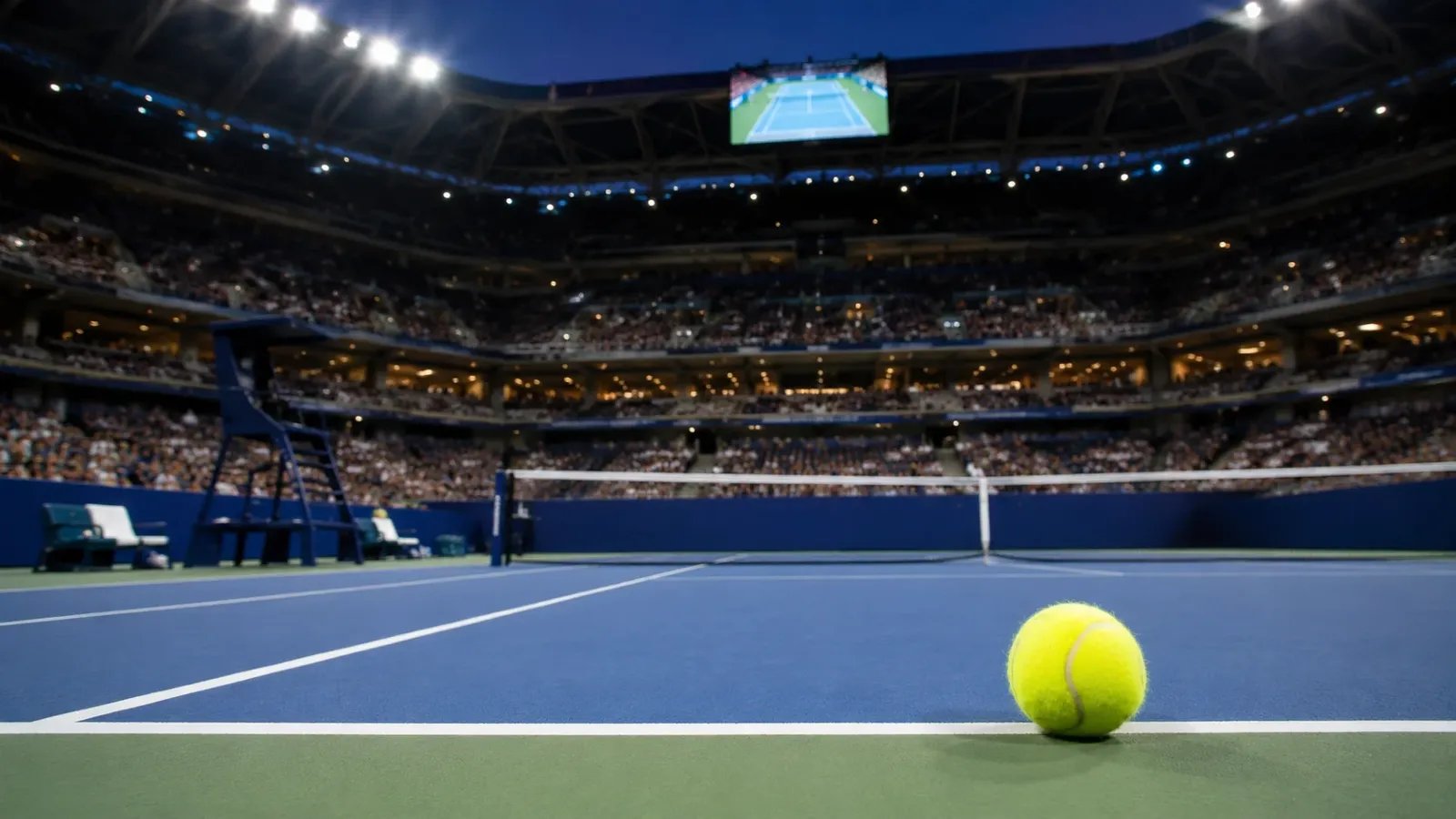
For over a century, tennis hard courts were universally painted a standard shade of forest green. However, as television broadcasting transitioned to high-definition, USTA researchers realized that the optic yellow tennis ball blended too easily into the green background. They engineered and trademarked a highly specific shade called "US Open Blue" for the inner court, leaving the outer perimeter green. This high-contrast color scheme drastically improved the viewing experience by making the ball's trajectory instantly trackable for home audiences.
8. Arthur Ashe Stadium is incredibly massive, seating nearly eight thousand more spectators than the central courts of Wimbledon or the French Open.
With an official capacity of over 23,000, Arthur Ashe Stadium is the largest tennis venue in the world by a staggering margin. The sheer scale of the arena creates a unique microclimate inside the stadium bowl, where unpredictable wind vortexes swirl chaotically down to the court level. This aerodynamic quirk famously frustrates precision players, forcing competitors to rely heavily on power and improvisation rather than delicate shot placement.
9. The engineering marvel of the stadium's retractable roof requires an intricate system of motorized bogies to move two million pounds of steel in exactly seven minutes.
When the USTA finally decided to add a roof to Arthur Ashe Stadium in 2016 to prevent rain delays, they faced a severe architectural crisis: the swampy, ash-dump soil of Flushing Meadows could not support the immense extra weight. Engineers devised a brilliant workaround by building a completely separate, freestanding superstructure around the existing stadium. This colossal umbrella rests on its own independent pillars, allowing massive mechanized panels to glide silently into place during sudden downpours.
10. The US Open was the first major tennis event to fully implement the Hawk-Eye electronic line-calling system following a disastrous string of bad calls.
The push to remove human error from critical boundary judgments was catalyzed by a notorious 2004 quarterfinal match between Serena Williams and Jennifer Capriati. The chair umpire made several blatant, visually obvious errors against Williams, which were immediately broadcast globally on television replays. Humiliated by the controversy, the USTA accelerated the adoption of automated, multi-camera tracking technology, officially debuting the Hawk-Eye system in 2006 to allow players to objectively challenge line calls.
11. For decades, the tournament controversially required men and women to play with entirely distinct types of tennis balls.
While the tennis balls used at the US Open looked identical on television, they were fundamentally different in construction. The men's balls featured heavy, extra-duty felt designed to slow down the pace of play and withstand the abrasive friction of the hard courts. Conversely, the women's balls utilized regular-duty felt, which traveled faster through the air. Organizers claimed this reduced arm strain for female players, though it sparked intense debate about speed and control before finally being standardized for both draws.
12. The official cocktail of the tournament, the Honey Deuce, generates more revenue in two weeks than the total prize money awarded to the singles champions.
Introduced in 2007 in partnership with Grey Goose, this seemingly simple concoction of vodka, lemonade, and raspberry liqueur has become an astonishing economic juggernaut. Its defining feature is a skewer of three frozen honeydew melon spheres designed to visually mimic tiny tennis balls. Selling hundreds of thousands of units annually at a premium price point, the cocktail produces tens of millions of dollars in beverage sales, making it one of the most successful localized food and beverage phenomena in sports history.
13. The facility hosting the tournament was the very first major American sports complex to be officially named in honor of a woman.
In 2006, the sprawling campus in Flushing Meadows was rededicated as the USTA Billie Jean King National Tennis Center. While stadiums are frequently named after corporate sponsors or male athletes, this monumental renaming recognized King's relentless, career-long advocacy for gender equality and the professionalization of women's sports. It remains a historic milestone in sports architecture and public memorialization.
14. A specialized, on-site weather center was implemented after extreme meteorological anomalies forced the men's final to be postponed for five consecutive years.
Between 2008 and 2012, an unprecedented streak of intense late-summer rains and coastal hurricanes repeatedly washed out the tournament's final weekend, consistently forcing the men's championship match to be pushed from Sunday to Monday. In response to this logistical nightmare, organizers hired dedicated meteorologists and built a localized weather tracking center to micro-monitor cloud patterns strictly over the precise airspace of the tennis center, fundamentally altering how the tournament operates in storm season.
15. The tournament was the first Grand Slam to introduce a visible, on-court serve clock to aggressively combat time-wasting tactics by players.
For decades, the rule requiring players to serve within a strict time limit was entirely subjective, enforced loosely and inconsistently by human umpires. In 2018, the US Open eliminated this ambiguity by installing large, digital twenty-five-second countdown clocks directly on the court walls. This innovation created a highly tense, visible psychological element to the game, as roaring fans and anxious players could physically watch the final seconds tick away before a serve.
Sources & References
This AI-assisted post was rigorously curated and fact-checked for accuracy by:
 Martin Roháček
How fun was this article? 🤔
Tap a star to rate it
🧠 Quiz: How closely were you paying attention?
10 questions — all answers are in the article above!
Enjoyed these facts? There's more! 💌
Fresh fun facts in your inbox. No spam, ever.