The Ruthless Navigator: 15 Fascinating Facts About Vasco da Gama
 By Martin Roháček
·
February 14, 2026
By Martin Roháček
·
February 14, 2026
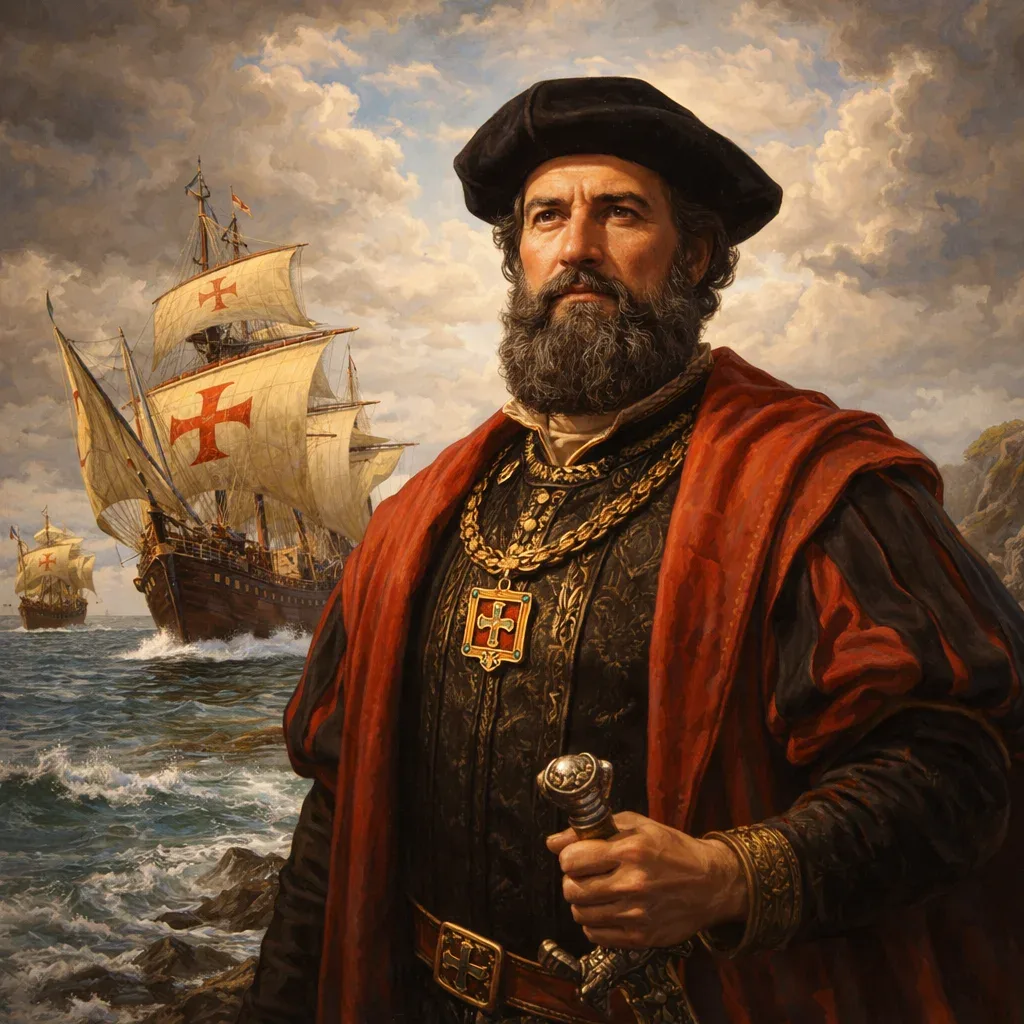
Vasco da Gama’s historic ocean voyage fundamentally altered global commerce by opening a direct maritime trade route between Europe and Asia. While often celebrated in European history as a pioneering hero of the Age of Discovery, his voyages were characterized by extreme violence, diplomatic blunders, and immense human cost. From terrifying sea monsters in epic poetry to gruesome acts of piracy and exorbitant spice profits, da Gama's legacy remains as complex as it is brutal. Here are 15 fascinating facts about the Portuguese explorer who altered the course of world history.
1. His Father Was Originally Chosen to Lead the Historic Expedition
The groundbreaking Portuguese expedition to establish a sea route to India was never meant to be commanded by Vasco da Gama. King John II of Portugal originally selected Vasco’s father, Estêvão da Gama, a seasoned nobleman and knight, to captain the ambitious voyage. However, Estêvão died unexpectedly before the fleet could launch, throwing the royal plans into disarray. King Manuel I, who succeeded King John II, subsequently transferred the prestigious command to the younger Vasco da Gama. This unexpected twist of fate thrust the young, relatively inexperienced commander into the spotlight of global exploration during the early Age of Discovery.
2. Scurvy Killed More of His Crew Than Any Battle
The journey around the southern tip of Africa was a harrowing ordeal that brought immense physical suffering to the Portuguese sailors. Because fresh fruits and vegetables were nonexistent during months spent on the open Atlantic, scurvy tore through the fleet with terrible speed. The debilitating disease caused the men’s gums to rot, teeth to fall out, and limbs to swell painfully until they could no longer work. By the time the expedition returned to Lisbon in 1499, scurvy had killed more than two-thirds of the crew, leaving only 54 survivors out of the original 170 men who had set sail. In fact, da Gama was forced to burn one of his four ships, the São Rafael, simply because he no longer had enough living sailors to crew it.
3. He Needed a Local African Pilot to Cross the Indian Ocean
Despite his nautical reputation, Vasco da Gama did not know how to navigate the complex monsoon winds of the open Indian Ocean on his own. After crawling up the eastern coast of Africa, his fleet anchored in the vibrant port city of Malindi, in modern-day Kenya. There, da Gama secured the services of a skilled local navigator—often identified in historical records as an Arab or Gujarati pilot named Kana or Ibn Majid—who understood the seasonal weather patterns. This expert guide navigated the Portuguese ships across the uncharted waters with remarkable precision, delivering them safely to Calicut in just 23 days. Without local African and Asian maritime knowledge, da Gama's maiden expedition might have ended in complete disaster.
4. His Initial Gifts Heavily Insulted the King of Calicut
When Vasco da Gama finally stepped ashore in India in May 1498, he presented royal gifts to the Zamorin, the Hindu ruler of Calicut. However, the Portuguese had grossly underestimated the wealth and sophistication of Indian ocean trade networks. Da Gama offered cheap European trinkets including copper washbasins, scarlet hats, barrels of sugar, and striped cloth, which were customary gifts for West African chieftains. The Zamorin’s courtiers laughed out loud at the paltry offerings, noting that even the poorest Muslim merchants gave far finer presents. The local ruler refused to sign a formal trade treaty, leaving da Gama humiliated and deeply bitter toward the Indian merchants.
5. He Mistook Hindu Temples for Christian Churches
Having spent centuries fighting Muslim forces in Iberia, European explorers operated under the firm belief that any non-Muslim religion in Asia must be an obscure branch of Christianity. When da Gama and his crew visited elaborate Hindu temples in Calicut, they genuinely mistook the statues of multi-armed Hindu deities for unconventional depictions of Christian saints. The Portuguese sailors fell to their knees and prayed inside these Hindu shrines for months, completely oblivious to the religious reality. Da Gama even misheard the local name for the goddess Mariamman as "Mary," writing back to Portugal that the citizens of Calicut were fellow Christians who merely practiced strange, corrupted rituals.
6. The Return Spice Profits Were Absolutely Staggering
Although his diplomatic efforts in Calicut were largely considered a failure, da Gama’s commercial cargo proved to be an astounding success. He managed to purchase a substantial shipment of black pepper, cinnamon, cloves, and precious gemstones before departing India. When the remaining ships finally returned to Portugal, the value of the spice cargo was estimated to be worth sixty times the initial cost of the entire four-ship expedition. This extraordinary profit margin overnight transformed Portugal into a dominant superpower in European maritime commerce. It also ignited a century of fierce imperial competition as European kingdoms scrambled to control the lucrative Asian spice trade.
7. He Gained Early Fame by Seizing French Ships
Long before he became a legendary transoceanic explorer, Vasco da Gama proved his military aggression in service to the Portuguese Crown. In 1492, King John II dispatched da Gama to the southern coastal region of the Algarve to conduct aggressive naval operations against French shipping. French privateers had previously intercepted and looted a Portuguese caravel returning from West Africa carrying gold, angering the monarch. Da Gama executed his mission with ruthless efficiency, rapidly capturing several French merchant vessels in retaliatory raids. His fearless tactical execution during this border conflict earned him royal favor and a reputation as a stern commander who executed orders without hesitation.
8. He Perpetrated a Horrific Act of Mass Murder Against Pilgrims
During his second expedition to India in 1502, da Gama demonstrated appalling brutality that shocked even his contemporaries. Off the coast of Madayi, he intercepted the Miri, an unarmed ship carrying over 400 Muslim pilgrims, including wealthy merchants, women, and children, returning from Mecca. Although the passengers offered all their personal wealth and treasures in exchange for their lives, da Gama ordered his men to strip the ship of its cargo. He then locked the helpless passengers below deck and set the entire vessel on fire, watching as it burned. When some passengers broke free and tried to extinguish the flames, the Portuguese bombarded the ship until it sank, killing almost everyone on board.
9. He Sent Severed Body Parts to a Local Ruler with a Ghastly Message
To enforce Portuguese commercial dominance over Calicut during his second voyage, da Gama employed extreme psychological terror. He captured dozens of unarmed local fishermen and traders who had approached his fleet to barter food and goods. Da Gama ordered his sailors to cut off the hands, ears, and noses of these innocent captives, tying the severed limbs together in a bloody bundle. He then dispatched the mutilated remains to the Zamorin of Calicut alongside a cruel note suggesting the ruler use the body parts to make a curry. This horrific display was designed to demoralize Indian resistance and establish absolute Portuguese authority through fear.
10. The Cape of Good Hope Received Its Name to Encourage Explorers
The perilous southern tip of the African continent was originally named the "Cape of Storms" by Portuguese navigator Bartolomeu Dias, who first rounded it in 1488. Dias chose the name because his fleet had been battered by violent tempests and dangerous currents for weeks. However, King John II of Portugal recognized that such an ominous name would terrify future sailors and discourage commercial investors. The monarch officially renamed the geographic landmark the Cape of Good Hope to symbolize the great optimism surrounding a direct sea route to India. This legendary passageway ultimately served as the crucial turning point for Vasco da Gama’s historic expedition nine years later.
11. He Was Granted a Prestigious Royal Title and Feudal Domain
Following the tremendous financial success of his ocean voyages, King Manuel I showered Vasco da Gama with unprecedented royal honors. The monarch granted him the lofty title of "Dom" and named him the "Admiral of the Seas of Arabia, Persia, India, and all the Orient." In addition to this prestigious naval rank, da Gama received lucrative feudal rights over his hometown of Sines, along with a massive hereditary pension. He was later created the First Count of Vidigueira in 1519, establishing his family among the highest tier of Portuguese nobility. These royal favors made the da Gama family immensely wealthy and influential for generations.
12. An Epic Poem Immortalized Him Fighting a Mythical Sea Monster
Vasco da Gama’s historic journey became the national epic of Portugal in Luís de Camões’ famous 1572 poem, Os Lusíadas (The Lusiads). In this masterpiece of Renaissance literature, da Gama is depicted as a heroic figure navigating magical oceans protected by classic pagan gods and terrifying monsters. The most famous character in the poem is Adamastor, a giant, grotesque sea monster who personifies the stormy Cape of Good Hope. Adamastor rises out of the ocean darkness to confront da Gama, threatening his fleet with destruction and foretelling the catastrophic fate of future European sailors who dare cross his domain.
13. He Died on Christmas Eve While Serving as Viceroy of India
Twenty years after his second bloody voyage, da Gama was called out of retirement by King John III to clean up Portuguese administration in Asia. In 1524, he was appointed Viceroy of India with absolute power to combat widespread corruption among colonial officials. However, shortly after arriving in the port city of Cochin, the elderly explorer contracted severe malaria. His health deteriorated rapidly, and he died on Christmas Eve, December 24, 1524, far from his homeland. Da Gama’s sudden death left the Portuguese colonial administration in disarray, but his fierce reputation remained legendary throughout the Indian Ocean realm.
14. His Final Resting Place Was Built with Spice Tax Revenues
After his death in Cochin, da Gama’s body was initially buried in St. Francis Church in India before being repatriated to Portugal in 1539. His remains were eventually reinterred inside the magnificent Jerónimos Monastery in Belém, near Lisbon, where his ornate stone sarcophagus rests today. The construction of this breathtaking UNESCO World Heritage site was directly financed by the "Vintena da Pimenta"—a five percent tax levied on all spice imports arriving from Asia. Today, da Gama's tomb stands directly opposite that of Portugal's greatest poet, Luís de Camões, linking the famous explorer permanently to the golden age of Portuguese empire.
15. An Impact Crater on the Moon Bears His Name
Vasco da Gama’s monumental legacy of exploration extends far beyond the oceans of Earth into the far reaches of space. In 1935, the International Astronomical Union officially named a prominent lunar impact crater "Vasco da Gama" in his honor. Located on the extreme western limb of the Moon's visible face, the crater spans approximately 93 kilometers in diameter and features a distinctive central peak. Sitting near the limb where it periodically rotates into view from Earth, the crater serves as a permanent celestial tribute to the ruthless navigator who first connected the East and West across open waters.
Sources & References
This AI-assisted post was rigorously curated and fact-checked for accuracy by:
Martin Roháček
How fun was this article? 🤔
Tap a star to rate it
🧠 Quiz: How closely were you paying attention?
10 questions — all answers are in the article above!
Enjoyed these facts? There's more! 💌
Fresh fun facts in your inbox. No spam, ever.