
The Unrivaled Prodigy: 15 Fascinating Facts About Wolfgang Amadeus Mozart
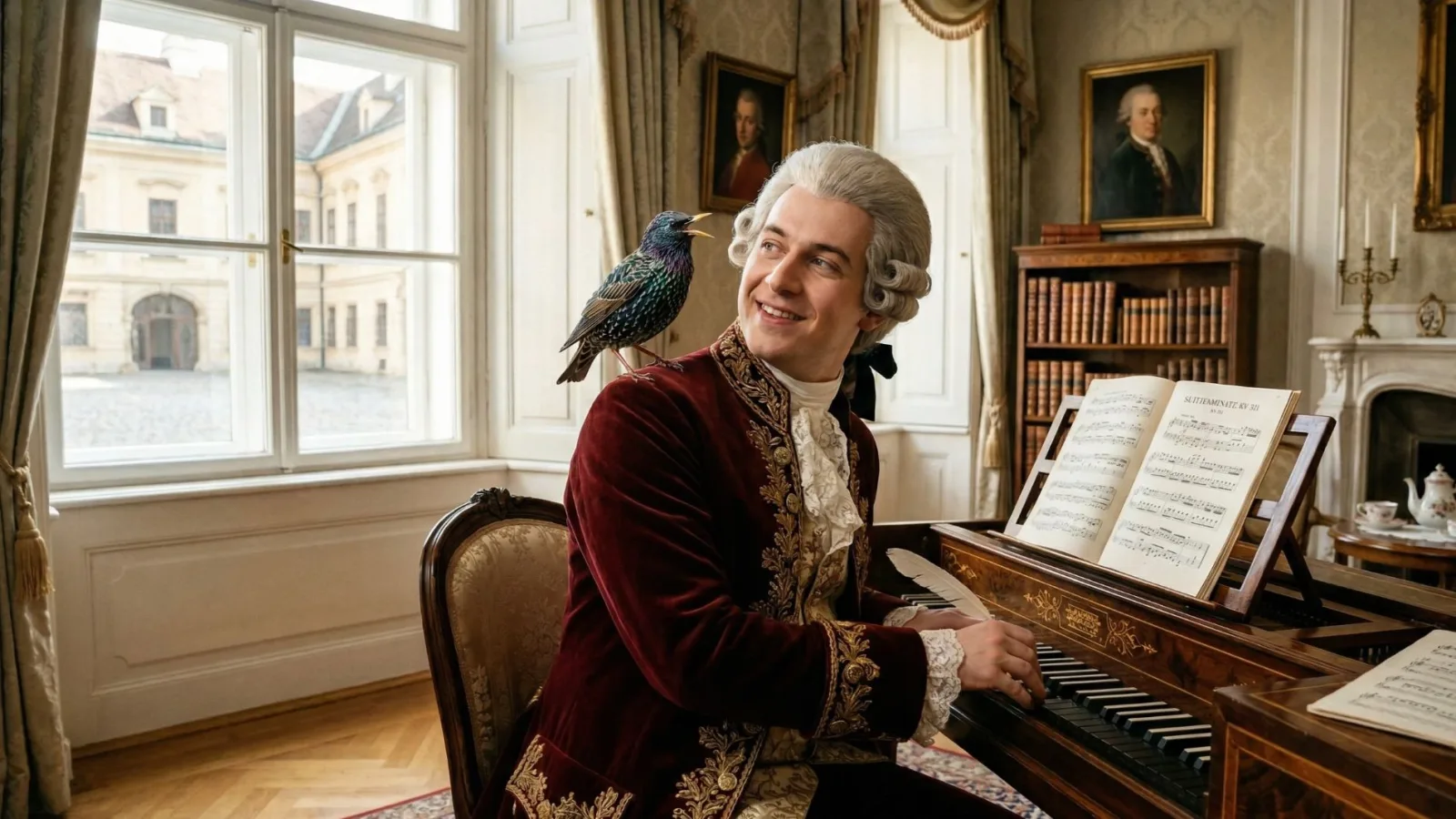
Wolfgang Amadeus Mozart remains classical music's ultimate child prodigy, but behind the powdered wig lies a life far more complex and surprising than popular legend suggests. From a daring Vatican musical heist and a beloved pet starling to wild gambling habits and a penchant for crude toilet humor, his personal history is filled with astonishing twists. Beyond his breathtaking compositions, Mozart navigated political intrigues, deadly childhood illnesses, and secretive brotherhoods. Here are 15 fascinating facts that reveal the true genius, eccentricities, and myths surrounding history's most celebrated composer.
1. He Transcribed a Secret Vatican Score After a Single Hearing
At just 14 years old, Mozart performed one of the most famous musical feats in history during a visit to the Vatican. The Papal Chapel strictly guarded Gregorio Allegri's nine-part choral masterpiece Miserere, forbidding anyone from copying or publishing the score under threat of excommunication. After listening to the complex piece performed just once during a Wednesday service, Mozart returned to his lodging and transcribed the entire composition completely from memory. He returned on Friday with the manuscript hidden in his hat to double-check a few minor notes during a second performance. Impressed by the teenager's extraordinary genius rather than offended by his defiance, Pope Clement XIV awarded him the Order of the Golden Spur.
2. He Owned a Pet Starling That Whistled His Concertos
In May 1784, Mozart was walking past a pet shop in Vienna when he heard a European starling whistling a tune that was shockingly familiar. The bird was singing a variation of the main theme from his newly composed Piano Concerto No. 17 in G Major, which had not yet been published or publicly performed. Delighted by the feathered prodigy, Mozart immediately purchased the starling for 34 kreutzers and brought it home as a companion. For three years, the bird lived in his apartment, serving as a noisy, beloved pet that Mozart even credited in his personal expense journal. When the starling died in 1787, a heartbroken Mozart organized a grand formal funeral in his garden and recited an affectionate poem he wrote for the bird.
3. High-Stakes Gambling and Billiards Drove Him into Severe Debt
Despite earning substantial income from successful opera commissions, concert subscriptions, and aristocratic patronage, Mozart suffered from chronic financial chaos throughout his adult life. A primary driver of his economic distress was an uncontrollable passion for high-stakes gambling, particularly card games and late-night billiards matches. He frequently played for exorbitant sums against wealthy Viennese nobility, rapidly losing amounts that eclipsed his annual earnings. As his debts accumulated, Mozart was forced to send desperate, pleading letters to fellow Freemasons, asking for substantial loans to stave off public embarrassment. His reckless money management meant that despite his international fame, he spent his final years under intense pressure from aggressive creditors.
4. He Was Born with a Rare Congenital Ear Deformity
Mozart was born with an unusual physical anatomical trait that modern medical science still recognizes today. Known in otolaryngology as the "Mozart ear," this rare congenital defect features an enlarged outer fold where the upper cartilage of the pinna is fused, creating an ear that lacks the typical outer rim curve. Medical historians note that this unique structural quirk was also passed down to his youngest son, Franz Xaver Wolfgang Mozart. While the condition had absolutely no negative impact on his hearing capability or musical perception, it remains one of the few distinct physical defects documented in descriptions of the composer's appearance. Today, the term is officially used in pediatric medicine to classify similar ear variations.
5. His Personal Correspondence Was Filled with Crude Toilet Humor
Behind the refined elegance of his musical masterworks lay a personal sense of humor that was notoriously childish and crudely scatological. Surviving correspondence sent to family members, particularly the intimate letters written to his cousin Maria Anna Thekla Mozart, reveals an intense fixation on toilet humor. Mozart frequently filled his letters with graphic references to bodily functions, rhyming puns about defecation, and playful, absurd insults. Far from being an isolated eccentricity, this brand of coarse vulgarity was actually a fairly common feature of middle-class Bavarian family culture during the 18th century. Nevertheless, many 19th-century biographers were so appalled by these letters that they intentionally censored them to protect the composer's pristine image.
6. He Almost Never Called Himself "Amadeus"
While the world universally knows the composer today as Wolfgang Amadeus Mozart, he almost never used the middle name "Amadeus" during his entire lifetime. He was officially baptized as Joannes Chrysostomus Wolfgangus Theophilus Mozart, with "Theophilus" being the Greek word for "beloved of God." As an adult living in multilinguistic Europe, Mozart preferred to sign his correspondence using the French equivalent, "Amadè," or the Italian version, "Amadeo." He only used the Latin form "Amadeus" in a humorous, satirical context in a handful of private letters written during his youth. The widespread adoption of "Amadeus" was largely a posthumous trend popularized by 19th-century publishers and romanticized biographies.
7. He Secretly Detested the Sound of the Flute
Mozart composed some of the most celebrated and elegant flute music in classical history, including two brilliant concertos and key passages in The Magic Flute. However, in his private correspondence, he explicitly confessed a deep-seated hatred for the instrument, complaining that he found its tone irritating and unreliable. In a 1778 letter to his father, he grumbled bitterly about having to write music for the instrument, stating that he became instantly exhausted whenever he had to compose for an instrument he could not stand. Modern musicologists believe his dislike stemmed from the technical limitations of 18th-century woodwind flutes, which were notoriously difficult to play in tune. He only accepted flute commissions when he was desperately strapped for cash and needed immediate payment from wealthy patrons.
8. Antonio Salieri Did Not Poison Him
The famous legend that Italian composer Antonio Salieri poisoned Mozart out of bitter professional jealousy is a total fabrication made famous by Peter Shaffer's play and film Amadeus. In reality, the two men were respectably competitive colleagues in the vibrant Viennese music scene, enjoying a relationship characterized by mutual professional courtesy. Salieri frequently conducted Mozart's works, and Mozart even invited Salieri to attend a performance of The Magic Flute, noting in his diary how enthusiastically Salieri applauded. Furthermore, in 1785, the two composers collaborated on a joint cantata titled Per la ricuperata salute di Ofelia, which was rediscovered in a Czech museum in 2015. The rumor of murder only surfaced decades later when an elderly, mentally ill Salieri made confused confessions shortly before his death.
9. His Grueling Childhood Tours Nearly Killed Him
Mozart's extraordinary musical talent was commercialized early by his ambitious father, Leopold, who subjected the young prodigy and his sister to brutal European tours starting when Wolfgang was just six years old. For nearly a decade, the family traveled thousands of miles across Western Europe in uncomfortable, unheated horse-drawn carriages over rough roads. These exhausting journeys exposed the frail child to harsh weather and widespread epidemic diseases, resulting in frequent, life-threatening illnesses. During a concert tour in 1767, eleven-year-old Mozart contracted a severe case of smallpox that left him bedridden for weeks and permanently pockmarked his face. These dangerous childhood travels severely strained his physical health, leaving him vulnerable to chronic illness throughout adulthood.
10. An Anonymous Messenger Secretly Commissioned His Requiem
The origin story of Mozart's final masterwork, the Requiem in D Minor, sounds like a chilling gothic ghost story, but the truth was grounded in aristocratic deception. In July 1791, a mysterious messenger dressed in gray arrived at Mozart's door to commission a funeral mass under strict conditions of secrecy. Mozart, who was suffering from declining health and severe exhaustion, became superstitiously convinced that the messenger was an omen of his own impending death. In reality, the envoy was sent by Count Franz von Walsegg, an eccentric nobleman who regularly hired famous composers to write pieces anonymously so he could copy them in his own handwriting and pass them off as his own original creations. Mozart died before completing the work, leaving his student Franz Xaver Süssmayr to finish the manuscript.
11. Freemasonry Deeply Influenced His Philosophy and Music
In December 1784, Mozart was formally admitted into the Viennese Masonic lodge Zur Wohltätigkeit ("Beneficence"), an event that profoundly shaped his life and career. Freemasonry was a major center of Enlightenment thinking in Austria, attracting influential intellectuals, scientists, and aristocrats who advocated for rationalism, humanism, and fraternity. Mozart was an exceptionally dedicated member who composed numerous works specifically for lodge rituals, including the solemn Masonic Funeral Music. His profound engagement with the order heavily influenced his final opera, The Magic Flute, which is filled with explicit Masonic symbolism, numerical patterns based on the sacred number three, and themes of moral enlightenment. Joining the brotherhood also provided him with crucial financial contacts during his frequent economic crises.
12. He Was Not Buried in a Pauper's Grave
A widespread romantic myth claims that Mozart died penniless and was tossed heartlessly into an unmarked pauper's grave because society had abandoned him. In truth, Mozart was buried according to the standard civic regulations decreed by Emperor Joseph II, who had enacted strict burial laws to improve public hygiene in Vienna. These laws required middle-class citizens to be buried in common graves containing up to six bodies, wrapped in simple linen sacks without expensive wooden coffins or elaborate individual tombstones. While his funeral was modest, it was attended by several close friends and colleagues, and the lack of a permanent monument was simply a reflection of contemporary Austrian municipal policy rather than public neglect.
13. He Maintained an Extravagant Menagerie of Pets
Despite his chronic debt and frequent letters pleading for emergency loans, Mozart maintained a surprisingly lavish lifestyle that included keeping an expensive array of animals in his Viennese apartments. Alongside his famous pet starling, his household at various times included a canary, a dog, and even a private riding horse. Purchasing and maintaining a riding horse in 18th-century Vienna was a symbol of high aristocratic status that required significant ongoing expenditure for stabling, feed, and grooming. His wife Constanze frequently expressed frustration over his impulse buys and extravagant spending habits, which continually undermined their household budget. His willingness to splurge on exotic pets and luxury transport showcased his impulsive nature and lack of financial restraint.
14. His Manuscripts Show He Composed Entire Pieces in His Head
Mozart possessed an extraordinary cognitive ability to mentally construct, arrange, and fully orchestrate complex musical compositions entirely in his mind before putting quill to parchment. While popular legend claims he never made a single mistake, examination of his manuscript scores shows that he worked out complete pieces in his head so thoroughly that his physical notation appears remarkably fluid and rapid. Unlike Ludwig van Beethoven, whose manuscripts are famously covered in violent erasures, scribbles, and heavy revisions, Mozart's scores feature long stretches of pristine notation written with astonishing speed. However, historians note that his accompanying text, lyrics, and stage directions are often sloppy and rushed, suggesting his physical hand struggled to keep pace with the overwhelming speed of his musical thoughts.
15. His Sister Nannerl Was Also a Child Prodigy
Wolfgang was not the only musical prodigy in the Mozart household; his older sister Maria Anna, nicknamed "Nannerl," was initially considered an equally brilliant keyboard virtuoso. As children, the siblings toured Europe together as co-headliners, earning equal praise from monarchs and music critics who marveled at their extraordinary harpsichord skills. However, when Nannerl turned 18 in 1769, 18th-century patriarchal social norms dictated that it was no longer respectable for an unmarried young woman to perform publicly or travel as a commercial musician. Her father forced her to remain at home in Salzburg while continuing to promote Wolfgang's career across Europe. Although Nannerl composed her own music and sent pieces to Wolfgang that he praised as beautiful, none of her original compositions have survived.
Sources & References
This AI-assisted post was rigorously curated and fact-checked for accuracy by:
 Martin Roháček
How fun was this article? 🤔
Tap a star to rate it
🧠 Quiz: How closely were you paying attention?
10 questions — all answers are in the article above!
Enjoyed these facts? There's more! 💌
Fresh fun facts in your inbox. No spam, ever.