The Surreal Pillars: 15 Fascinating Facts About Zhangjiajie National Forest Park
Nestled in China's Hunan province, Zhangjiajie National Forest Park is a fairytale realm of towering quartz sandstone pillars, swirling mountain mists, and ancient ecosystems. Famous worldwide for inspiring the iconic floating mountains in James Cameron's Avatar, this UNESCO-protected landscape combines dizzying modern engineering with deep geological heritage. From record-breaking glass bridges and outdoor elevators to rare wildlife and indigenous Tujia folklore, Zhangjiajie offers an unforgettable trip into nature's grandeur. Discover the fascinating science, rich history, and surprising secrets behind China's original national forest park.
1. China's Pioneer National Forest Park
In 1982, Zhangjiajie was officially designated as China's very first national forest park, marking a pivotal shift toward wildlife conservation in modern Chinese history. Spanning over 11,900 acres within Hunan province, the site quickly drew national attention for its otherworldly wilderness. A decade later in 1992, the park along with adjacent scenic reserves was recognized as a UNESCO World Heritage Site under the broader Wulingyuan Scenic Area. Today, it stands as one of East Asia's most celebrated eco-tourism destinations, attracting millions of international travelers each year.
2. They Are Not Karst, But Quartz Sandstone
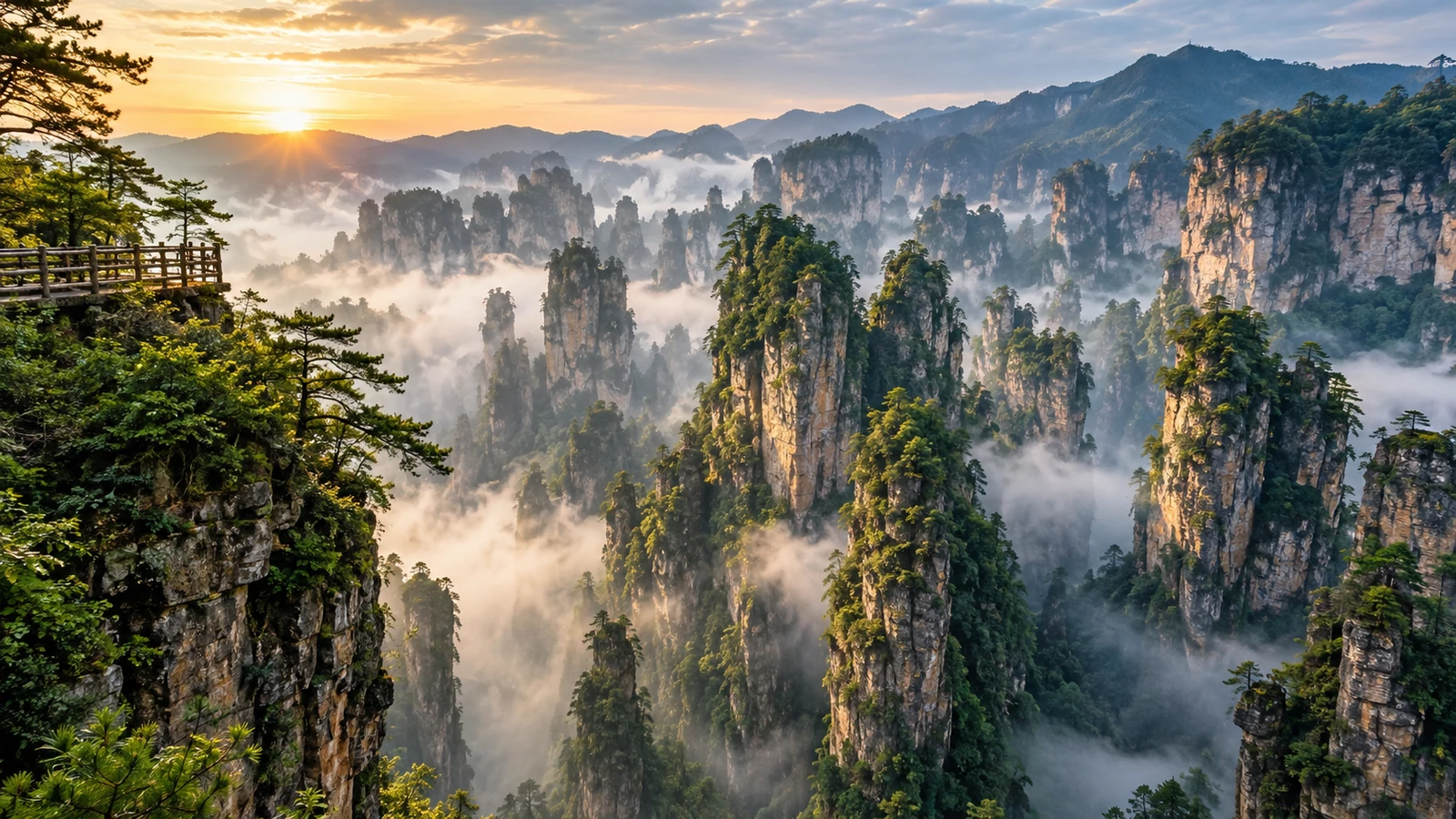
While many of South China’s iconic peaks are formed through soluble limestone dissolved by rain water—known as karst topography—Zhangjiajie's pillars are geologically distinct. The park contains over 3,000 towering quartz sandstone pillars created through millions of years of physical weathering and water erosion. Torrential rainfall, expanding tree roots, and ice wedging during winter months gradually split the soft rock layers away, leaving behind sheer quartz monoliths. This dramatic peak-forest landscape is so unique that geologists formally classified it as a custom terrain known as the Zhangjiajie Sandstone Landform.
3. The Hollywood Connection to Pandora
The park's otherworldly landscape served as the direct visual inspiration for the floating Hallelujah Mountains in James Cameron’s 2009 blockbuster film Avatar. Production designers spent weeks photographing and studying the mist-shrouded sandstone towers of Zhangjiajie to design the fictional alien world of Pandora. Following the movie's runaway global success, local officials officially renamed the 1,080-meter (3,540-foot) Southern Sky Column to Avatar Hallelujah Mountain in 2010. The cinematic connection turned the remote forest into a globally famous bucket-list destination for movie fans and nature lovers alike.
4. The World's Tallest Outdoor Elevator
Deep inside the park stands the Bailong Elevator, also known as the Hundred Dragons Elevator, a staggering engineering marvel built directly against a vertical cliff face. Ascending an incredible 326 meters (1,070 feet), it holds the official Guinness World Record as the world's tallest outdoor glass elevator. The glass-walled lift can transport up to 50 passengers per car, whisking visitors from the ravine bottom to the mountain crest in under two minutes. Before its completion in 2002, travelers faced an arduous three-hour mountain climb to access the same summit viewpoint.
5. A Terrifying Walk on Glass
Located in the adjacent Zhangjiajie Grand Canyon area, the park ecosystem features one of the world's highest and longest glass-bottomed pedestrian bridges. Suspended approximately 300 meters (984 feet) above a sheer gorge, the bridge stretches 430 meters long and 6 meters wide. Designed by Israeli architect Haim Dotan, the walkway consists of 99 panels of three-layered, heavy-duty tempered glass. To demonstrate its structural integrity before opening in 2016, officials drove a full-size passenger vehicle across it and invited volunteers to strike the panels with sledgehammers.
6. Tianzi Mountain and the Rebel King
One of the park's most iconic areas is Tianzi Mountain, which translates directly to Son of Heaven Mountain. The peak takes its name from Xiang Dakun, a historic leader of the local Tujia ethnic group who led a successful peasant revolt against Ming Dynasty tyranny during the 14th century. Xiang declared himself Tianzi, a divine royal title traditionally reserved exclusively for the ruling Emperor of China. Local folklore claims that the thousands of jagged stone spires surrounding the summit are actually Xiang's fallen army transformed into solid stone after their final battle.
7. A Haven for Living Fossils
The moisture-rich microclimates trapped within Zhangjiajie's deep valleys have allowed ancient botanical species to survive undisturbed for millions of years. Among the park's 517 species of woody plants are rare living fossils like the Chinese dove tree (Davidia involucrata) and the dawn redwood. The Chinese dove tree is famous for its large white flower bracts that resemble fluttering white dove wings when moved by gentle winds. The forest also protects ancient Chinese yews, which are heavily protected for their extreme longevity and rare medicinal compounds.
8. Sanctuary for Rare and Endangered Wildlife
Beyond its ancient flora, Zhangjiajie provides vital habitat for several critically endangered animal species. The park's mountain streams offer pristine conditions for the Chinese giant salamander, the world's largest living amphibian, which can grow up to 1.8 meters in length. Elusive apex predators like the clouded leopard and Asiatic black bear inhabit the deep forested interior, while brilliant golden pheasants nest across the upper canopy. Visitors along the lower walking paths frequently encounter native rhesus macaques roaming freely near the trees.
9. The Ethereal Sea of Clouds
Because of extreme humidity and sharp elevation changes ranging from 183 to over 1,000 meters, Zhangjiajie frequently experiences a stunning meteorological phenomenon called the Sea of Clouds. Heavy fog settles into the lower canyon basins, completely hiding the base of the rock pillars while their summits stick out above the mist. This dramatic visual effect creates the illusion that massive stone islands are hovering seamlessly in mid-air. Classical Chinese poets and traditional painters have traveled to the region for hundreds of years to capture this magical vista.
10. The First Bridge Under HeavenLocated within the Yuanjiajie scenic sector is a natural geological bridge known as the First Bridge Under Heaven. This natural sandstone arch bridges a 25-meter gap between two sky-scraping mountain cliffs, suspended an astounding 357 meters above the valley floor. It is widely regarded as one of the highest natural stone bridges on Earth produced entirely by wind and water erosion. A narrow safety path permits tourists to walk across the bridge span, where thousands of red silk ribbons and brass love locks are secured along the guardrails for good luck.
11. Golden Whip Stream's Crystal Waters
Winding along the bottom of the gorge for over 7.5 kilometers is Golden Whip Stream, one of the park's most tranquil spots. Named after the towering 380-meter Golden Whip Rock that rises above its start, the stream flows through lush greenery and steep canyon walls. The flat foot trail running parallel to the stream offers a peaceful walking path cooled by dense tree cover and rushing mountain water. Thanks to abundant foliage and flowing water, the canyon contains extremely elevated concentrations of negative air ions, making it a natural mountain air retreat.
12. Rich Indigenous Tujia Culture
Long before Zhangjiajie became a global landmark, the region was populated by indigenous minority groups, predominantly the Tujia, Miao, and Yao peoples. Tujia heritage remains central to the region's character, preserved through traditional mountain folk music and customs like the Crying Marriage ritual. Traditional architecture around the forest edge features *diaojiaolou*—wooden stilt houses built over steep mountain slopes to handle humidity and terrain. Visitors to local villages can sample traditional Tujia dishes, such as cured smoked meats and seasoned bamboo shoots.
13. Yellow Dragon Cave's Underground Realm
Beneath the vertical sandstone landscape lies Huanglong Cave (Yellow Dragon Cave), one of Asia's largest subterranean cave systems. Spanning over 13 kilometers in length, the cave features vast cavern chambers, underground rivers, and tens of thousands of illuminated stalagmites and stalactites. Its most famous rock structure, the Dragon King's Sea-Settling Needle, is a pencil-thin stalagmite standing nearly 20 meters tall. Because of its structural delicacy and immense geological value, park authorities reportedly took out a 100 million yuan insurance policy on the spire.
14. Vertical Diversity Across Microclimates
The steep, narrow canyons of Zhangjiajie create sharp vertical microclimates across brief geographic distances. Temperatures at higher peak elevations can be 8 to 10 degrees Celsius cooler than on the humid ravine floors below. Moisture trapped inside the shadows of the rock shafts generates localized cloud cover and micro-rainfall, sustaining tropical evergreen plants alongside cold-hardy trees. This extreme vertical gradient allows temperate high-altitude plants and subtropical river valley species to grow side-by-side within the same forest system.
15. The Gateway to Tianmen Mountain
While located slightly outside the core national forest park border, nearby Tianmen Mountain forms an essential chapter of the regional Zhangjiajie experience. The summit is accessed by one of the world's longest passenger cable car lines, spanning over 7.5 kilometers directly from the city center up to the mountain peak. Tianmen Mountain is world-famous for its massive natural cave opening known as Heaven's Door and the dizzying 99-Bend Road that snakes up the mountain cliff. Thrill-seekers regularly travel here to attempt extreme outdoor stunts, including wingsuit flying through the giant rock hole.
Sources & References
This AI-assisted post was rigorously curated and fact-checked for accuracy by:
 Martin Roháček
How fun was this article? 🤔
Tap a star to rate it
🧠 Quiz: How closely were you paying attention?
10 questions — all answers are in the article above!
Enjoyed these facts? There's more! 💌
Fresh fun facts in your inbox. No spam, ever.