The Unicorn of the Sea: 15 Fascinating Facts About Narwhals
Inhabiting the remote, icy waters of the Arctic Circle, narwhals are among the most enigmatic ocean creatures on Earth. Renowned for their spiraling, sword-like tusks, these medium-sized whales have captivated human imagination for centuries, inspiring medieval myths of unicorns and puzzling modern marine biologists. From extraordinary deep-diving capabilities to highly sensitive sensory teeth, narwhals possess remarkable evolutionary adaptations designed for extreme polar survival. Discover 15 fascinating facts about the sea's most mysterious whale and learn what makes them truly extraordinary.
1. The Famous Tusk Is Actually an Extraverted Left Canine Tooth
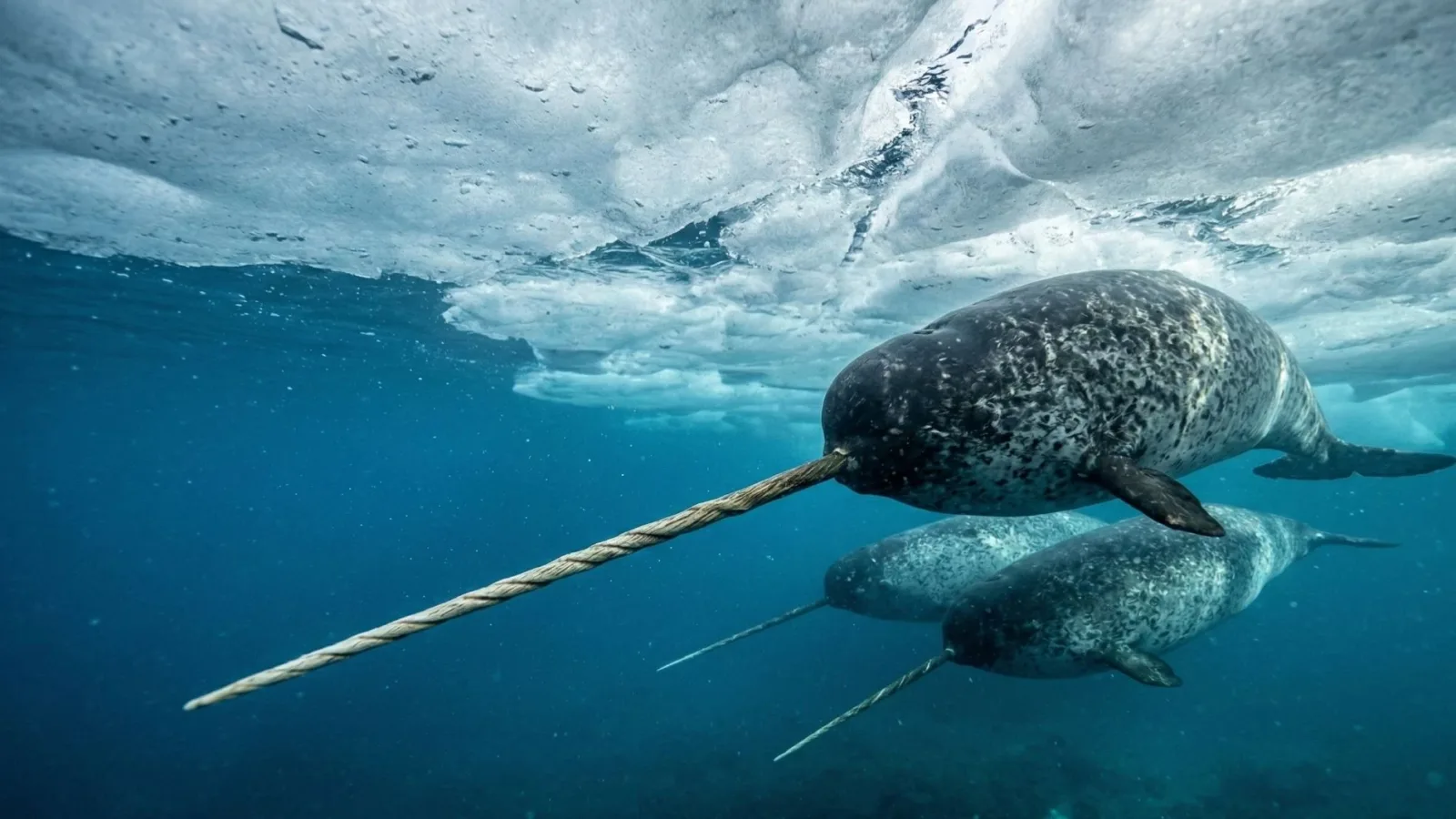
The most striking feature of the male narwhal is not a horn, but a deeply modified left canine tooth that grows directly through the upper lip. Spiral-patterned and capable of reaching up to nine feet in length, this tusk is a biological marvel unique among mammals. While most tooth development grows inward toward the jaw, the narwhal's tusk protrudes outward in a counterclockwise helical direction. Interestingly, around 15 percent of female narwhals also grow a small tusk, though it is far less prominent than the male counterpart. On exceedingly rare occasions, a male narwhal can even grow two fully formed tusks simultaneously.
2. The Tusk Is Packed With Millions of Sensory Nerve Endings
Far from being a rigid, lifeless weapon, the narwhal's tusk is actually a highly sensitive sensory organ wrapped in an unusual porous outer shell. It contains up to 10 million individual nerve endings that extend from its core to its exterior surface. This complex nervous architecture allows narwhals to detect minute changes in ocean salinity, water temperature, barometric pressure, and prey concentrations. Researchers have observed narwhals raising their tusks above the freezing surface, likely measuring atmospheric conditions to navigate their changing surroundings. Rather than physical combat, the primary purpose of the tusk appears to be environmental perception and communication.
3. Narwhal Tusks Fueled Medieval Unicorn Myths and Royal Fortunes
During the Middle Ages, Viking traders frequently harvested narwhal tusks washed ashore in the Arctic and transported them to mainland Europe. Unaware of the marine creatures living in the icy north, European royals and scholars believed these spiraled ivory shafts were the mythical horns of legendary land unicorns. The tusks were prized not only as symbols of immense power but also for their supposed magical ability to neutralize deadly poisons. Queen Elizabeth I of England famously received a decorated narwhal tusk worth thousands of pounds—an amount equivalent to the cost of an entire castle at the time.
4. Their Skin Tone Changes Dramatically Throughout Their Lives
Marine biologists can estimate a narwhal's age simply by examining the coloration pattern on its skin. Newborn calves are born with a uniform dark blue-gray hue that gradually deepens to a mottled blue-black during juvenile development. As they reach adulthood and continue to age, white patches expand across their bellies and flanks, replacing the darker pigmentation. Extremely old narwhals can turn almost entirely white, making them easily confused with their close cousins, the beluga whale. This dynamic skin transformation is thought to aid in camouflage across the evolving sea ice conditions throughout their lives.
5. They Are Champion Deep Divers Reaching Depths Exceeding One Mile
Narwhals are among the deepest-diving marine mammals in the entire ocean, frequently plunging into pitch-black depths below 5,000 feet. During these extreme foraging dives, which can last up to 25 minutes, they face crushing pressures that would instantly collapse human lungs. To endure these harsh deep-sea conditions, narwhals rely on specialized physiological adaptations, including highly flexible rib cages that compress safely without fracturing. Furthermore, their muscles are packed with high concentrations of myoglobin, an oxygen-binding protein that acts as an internal biological oxygen tank during prolonged submersions.
6. Narwhals Are Completely Toothless Inside Their Mouths
Aside from the male's prominent outward-growing tusk, narwhals have no functional teeth inside their mouths. Because they lack grinding or tearing teeth, they cannot bite or chew their food in a traditional manner. Instead, narwhals hunt by swimming close to bottom-dwelling prey—such as Greenland halibut, cod, and squid—and generating a powerful suction force. By opening their mouths rapidly, they create a vacuum that draws the unsuspicious prey directly into their throats to be swallowed whole.
 Marine and Freshwater Animals
Twenty-five animals of the sea and rivers, from the largest creature ever to exist to a seahorse dad, each linked to its full 15-fact article.
See All Facts
Marine and Freshwater Animals
Twenty-five animals of the sea and rivers, from the largest creature ever to exist to a seahorse dad, each linked to its full 15-fact article.
See All Facts
7. Their Name Originates from an Old Norse Word for Corpse
The English word "narwhal" stems from the Old Norse term nárhvalr, which literally translates to "corpse whale." Norse mariners bestowed this morbid moniker upon the cetacean because of its pale, mottled gray skin, which resembled the cold, bloated body of a drowned sailor. Additionally, during the summer months, narwhals often lie perfectly still near the water's surface for long stretches to rest, reinforcing their ghostly, lifeless appearance to ancient observers.
8. Half of Their Total Body Mass Consists of Dense Blubber
Surviving in the freezing polar waters of the Arctic requires extraordinary thermal protection, which narwhals achieve through a massive layer of subcutaneous fat. Blubber makes up nearly 50 percent of a narwhal's total body weight and can reach thicknesses of up to four inches. This dense fat layer serves a dual purpose, acting both as crucial insulation against near-freezing temperatures and as a vital energy reservoir during times of scarce food supply. Without this specialized biological suit, a narwhal would quickly succumb to hypothermia in its frigid polar environment.
9. They Live in the Frigid Arctic Circle Year-Round
Unlike many other whale species that undertake long seasonal migrations to warm tropical oceans for breeding, narwhals spend their entire lives within the chilly waters of the Arctic Circle. They are specifically adapted to life among dense, shifting pack ice across northern Canada, Greenland, and Russia. Even during harsh polar winters when ice freezes solid across vast areas, narwhals remain in their northern habitat, relying on narrow leads and breathing holes to survive.
10. They Hide Under Sea Ice to Escape Voracious Orcas
Thick, heavy sea ice acts as a protective shield for narwhals against their primary marine predator, the killer whale. Because apex predator killer whales possess tall, rigid dorsal fins, they are physically unable to navigate easily through tightly packed sea ice without injuring themselves. Narwhals cleverly retreat deep into thick ice fields where killer whales cannot follow, using small cracks in the ice to catch their breath. However, shifting ice conditions can sometimes trap narwhals in trapped pools called savssats, exposing them to polar bears and ice hunters.
11. Narwhals and Beluga Whales Are the Only Living Monodontids
Narwhals and beluga whales are the only two surviving members of the scientific family Monodontidae, a group of medium-sized arctic whales. Both species share several unique physical characteristics tailored for polar life, including the absence of a dorsal fin. Instead of a tall fin, narwhals possess a low, bumpy ridge along their spine, allowing them to swim smoothly directly underneath thick ice sheets without catching on frozen obstacles. Genetic research has shown that these two species are so closely related that they occasionally hybridize, producing rare offspring known as "narlugas."
12. They Gather in Massive Super Pods During Summer Migrations
Throughout most of the year, narwhals travel in relatively small family pods consisting of 10 to 20 closely knit individuals. However, as ice melts during the Arctic summer, these small family units gather along coastlines and ice edges to form astonishing super pods. These colossal gatherings can comprise hundreds or even thousands of narwhals migrating together in synchronized harmony. Within these massive groups, younger narwhals engage in social learning and bonding, while adult males frequently engage in soft tusk-touching behaviors known as tusking.
13. They Use Acoustic Echolocation and Clicks to Navigate Dark Waters
Operating in complete darkness deep beneath thick sea ice, narwhals rely almost entirely on sound rather than sight to navigate and hunt. They emit extremely rapid acoustic clicks—up to 1,000 clicks per second—to create detailed echolocation maps of their sub-zero environment. In addition to clicks used for navigation, narwhals produce a diverse array of squeaks, whistles, and trumpeting sounds to stay in touch with their pod. Furthermore, when narwhals gently cross tusks at the surface, they may be transmitting subtle vibrational acoustic signals directly into each other's nerve-rich teeth.
14. Their Unique Rib Cages Safely Squeeze Under Extreme Deep-Sea Pressure
Descending deep into the benthic zones of the Arctic Ocean subjects a narwhal's body to tremendous hyperbaric pressure. To prevent dangerous internal trauma and lung collapse during deep dives, narwhals possess highly flexible, compressible rib cages. As ambient water pressure increases with depth, the rib cage safely collapses inward, squeezing air out of the lungs into non-absorptive respiratory passages. This mechanism prevents nitrogen from forcing its way into the bloodstream, protecting the narwhal from decompression sickness, commonly known as the bends.
15. Climate Change Threatens Their Reliance on Sea Ice
As Arctic temperatures rise at rates significantly faster than the global average, rapid sea ice loss poses a severe threat to narwhal survival. Unpredictable ice freezing can trap pods far from open water, leading to mass mortality events when breathing holes freeze completely shut. Furthermore, shrinking ice caps allow increased commercial shipping, oil exploration, and killer whale access into historically protected narwhal habitats. Because narwhals are creatures of extreme habitat specificity, they are classified by scientists as among the most vulnerable Arctic marine mammals to climate-driven environmental changes.
Sources & References
This AI-assisted post was rigorously curated and fact-checked for accuracy by:
 Martin Roháček
How fun was this article? 🤔
Tap a star to rate it
🧠 Quiz: How closely were you paying attention?
10 questions — all answers are in the article above!
Enjoyed these facts? There's more! 💌
Fresh fun facts in your inbox. No spam, ever.